
Work by Niels Bohr 2026-10-18
NAD+ 2026-10-18
Work by Nicolay Gennadiyevich Basov Created 2026-10-18 Updated 2026-10-24
Work by Nicolaas Bloembergen 2026-10-18
Work by Nicola Cabibbo 2026-10-18
Work by Nicholas J. Williams 2026-10-18
Work by Nicholas Harvey 2026-10-18
Work by Nevill Francis Mott Created 2026-10-18 Updated 2026-10-24
Magnetic horn 2026-10-18
A magnetic horn uses a pulsed magnetic field around a high-current conductor to focus charged secondary pions and kaons of a selected sign. Their decays then create a directed neutrino beam. The field acts on the charged parents, not on the neutral neutrinos.
Decay tunnel 2026-10-18
A decay tunnel provides a low-density flight region where selected unstable particles decay before remaining charged particles are removed or absorbed. For a pion-produced neutrino beam, its length balances pion decay probability against backgrounds from longer-lived daughters.
Neptunium-239 Created 2026-10-18 Updated 2026-11-05
Neptunium-239 is a radioactive isotope with ninety-three protons and one hundred forty-six neutrons. It beta-decays to plutonium-239.
It occurs in the sequence following neutron capture by uranium-238 and beta decay of uranium-239. This is an example of transmutation changing the chemical element through a nuclear process, unlike an ordinary chemical reaction that rearranges electrons and bonds.
Rindler limit of a Schwarzschild horizon 2026-10-18
Outside a Schwarzschild metric horizon , write . To leading order the radial metric isIt has Rindler coordinates with . The proper-distance-like coordinate has null paths exponential in ; the Schwarzschild coordinate difference is exponential in .
Inside, writing instead gives , where the radial coordinate is timelike. The negative- Rindler wedge is therefore not the black-hole interior: its time coordinate retains the same causal type as in the positive- wedge. The flat radial limit does not remove the genuine curvature of the full Schwarzschild spacetime.
The physics course entries follow the Cavendish Laboratory's 2025–26 teaching list.[ref]
https://www.phy.cam.ac.uk/study/undergraduate/undergraduate-courses/. Undergraduate Courses: course list and academic-year notice
Past examination papers: Physics Teaching Information System past-paper search (University sign-in required). Specific paper years and their solution availability must be checked inside the system.
A public release includes physics papers for 2017–2019 and 2021–2022, with examiner reports and some answers. [ref]
https://www.whatdotheyknow.com/request/natural_science_tripos_physics_e. Cambridge freedom-of-information response, 20 September 2022
Work by Murray Gell-Mann 2026-10-18
Calibrated two-wire charge centroid 2026-10-18
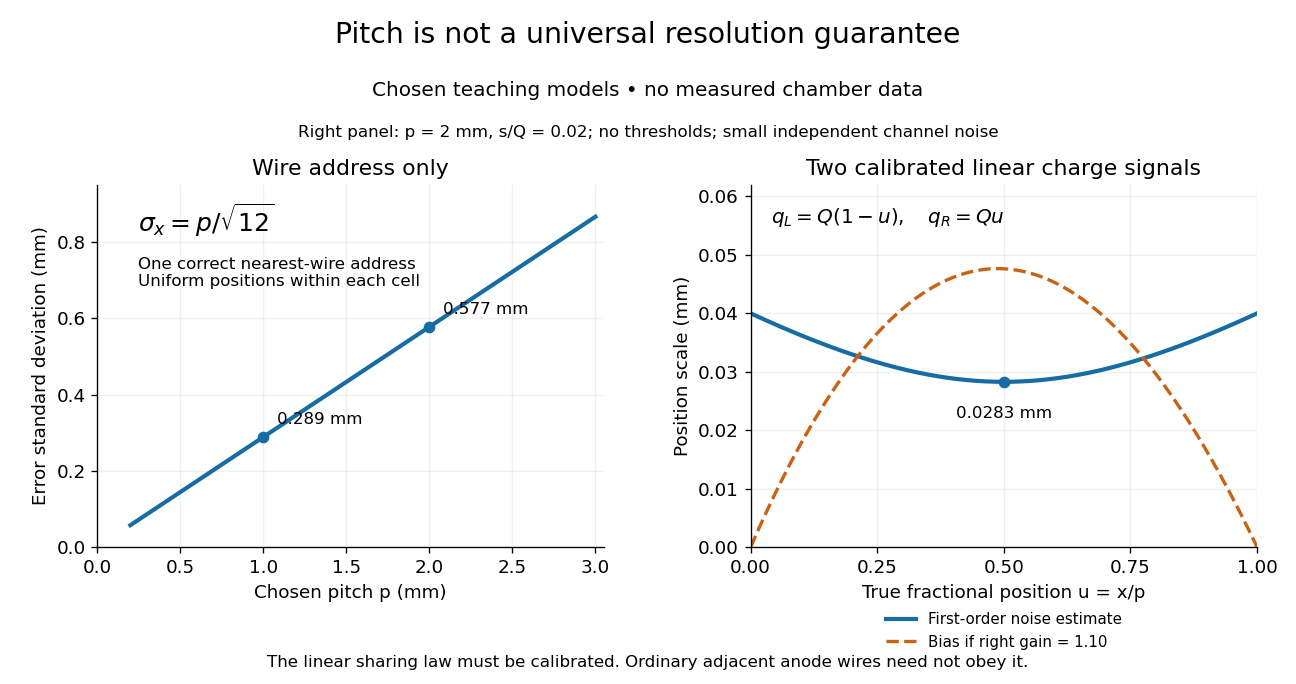
Can two readout values locate a hit between wires? Only with a specified response model. Place two readout wires at and , put , and stipulate calibrated, noiseless electric chargesThese are assumptions for a toy sensor response, not the natural response law of adjacent anode wires. Under these assumptions the centroidrecovers position exactly. The apparent gain in precision comes from adding calibrated analogue information. Taking the mean of two fired wire addresses without their electric charges would instead give the fixed midpoint .
For a chosen noise model, replace the two electric charges by and , with independent random variables of zero expected value and common standard deviation . Assume and no threshold censoring. First-order expansion of the ratio givesFor stipulated and , this approximation gives at the midpoint and at either endpoint. The endpoint values describe uncensored signed channel readouts, including small negative values after baseline subtraction. They do not assume that both channels would pass a positive threshold. A ratio with a fluctuating denominator also need not have exactly zero bias; this is a local small-noise approximation.
Three original counterexamples show why calibration and selection matter:
- If the right channel retains a relative gain , then . At , the bias is for the chosen pitch, larger than the midpoint noise estimate above.
- Suppose symmetric electronic leakage transforms the normalized right signal to . Treating as gives a position bias . A known permits inversion; destroys position information entirely. This is a stipulated crosstalk model, not a measurement.
- Requiring both noiseless channels to exceed accepts only : of uniformly distributed hits. Computing a position spread after that cut describes a selected sample. It does not establish improved spatial resolution for all incident hits.
Likewise, two equal hits at and have exactly the same total two-channel response as one hit at with twice the electric charge. A centroid can hide multiplicity even when each charge measurement is exact.
Wire-address position model 2026-10-18
Consider an original idealized track reconstruction model. Let equally spaced wires have positions and assign each event to the nearest wire, reporting . Assume exactly one correct wire address, perfect detection efficiency, exact wire positions and a uniform distribution of true positions within each cell. These assumptions explicitly exclude missed pulses, false addresses and several unresolved tracks.
Writing , the measurement error is , with uniform on . Symmetry gives zero expected value. Its variance and standard deviation follow by integration:For chosen wire pitches and this gives and respectively. These are model standard deviations, not measured chamber spatial resolutions. The largest possible absolute error in this model is , which is a different quantity.
A useful subtlety is that the formula depends on the illumination. For an unresolved pencil beam fixed at , every reconstructed position is . The repeated estimates have zero variance, but every error is . Small repeat-to-repeat spread can coexist with a biased position. The uniform-cell result therefore cannot be transferred to an arbitrary beam profile or detector selection.
The wire address supplies one transverse coordinate in this model. Combining several separated measurements supports track reconstruction; a single address does not specify a complete trajectory. If two charged particles enter the same cell during one accepted interval, an address-only record can be identical to that from one particle. No reconstruction of that record can recover the lost multiplicity without additional information.

Wire pitch 2026-10-18
Multiwire proportional chamber experiment Created 2026-10-18 Updated 2026-10-20
The original apparatus used stainless-steel wires between meshes away, flowing argon with organic vapor, negative mesh voltage and individual electronic amplifiers. A X-ray source calibrated pulse height while voltage was varied.[ref]
A coincidence circuit defined a narrow proton or pion beam. Scanning it across wires tested localization; the response edge matched the beam width, limiting the inference. Distant counts were attributed to accidental coincidences. Separate electron scans measured pulse delay versus position, comparing gas mixtures and pulse-height-dependent electronics.[ref]
Thresholds rejected small pulses, reducing detection efficiency. Wire-independence tests did not establish unlimited separation of overlapping tracks.[ref]
Multiple Coulomb scattering Created 2026-10-18 Updated 2026-11-05
Multiple Coulomb scattering is the accumulated deflection of a charged particle passing through matter, mainly through repeated Rutherford scattering by atomic nuclei. Many small deflections broaden a beam or make a reconstructed particle track wander. A roughly Gaussian distribution describes the central angular core in a useful regime, while rarer large-angle encounters produce tails.[ref]
Passage of Particles Through Matter by Donald E. Groom and Spencer Klein. §34.3, Multiple scattering through small angles: nuclear Coulomb deflections, Gaussian core and non-Gaussian tails
The angular width increases with traversed material and decreases as particle momentum increases. It is commonly parameterized using material thickness relative to the radiation length. In a particle detector, adding measurement layers can improve position sampling while also increasing Multiple Coulomb scattering; track precision therefore depends on material as well as sensor accuracy. A width projected onto one measurement plane must be distinguished from the full spatial deflection angle.
Work by Moshe Livšic Created 2026-10-18 Updated 2026-10-24
There are unlisted articles, also show them or only show them.