
Work by Patrick Maynard Stuart Blackett Created 2026-10-18 Updated 2026-10-24
Multiply connected region Created 2026-10-18 Updated 2026-10-31
A path-connected region is multiply connected when some closed path cannot contract to a point within the region. An annulus and the complement of a solid torus are examples. The accessible region in the ideal magnetic Aharonov-Bohm effect has this obstruction. Such a region is not a simply connected space.
Work by Pascual Jordan 2026-10-18
Zeeman spectrum for orbital angular momentum one Created 2026-10-18 Updated 2026-10-20
For orbital angular momentum and spin , considerThe quantum number is conserved. The stretched states with have energies . The remaining eigenvalues follow from two blocks with off-diagonal entries :The subscripts denote . For , the zero-field multiplets are at and at . Their weak-field Zeeman splitting is , with Landé g-factors and , respectively. When , the Paschen-Back effect gives approximate product states and energies . Mixing within a fixed causes an avoided crossing; different sectors can cross because the Hamiltonian does not couple them.
Neutrino flux 2026-10-18
The particle flux of neutrinos through a specified surface; an incident-energy distribution may also be specified.
Diffusion-limited cluster aggregation 2026-10-18
In diffusion-limited cluster aggregation, mobile clusters undergoing Brownian motion attach with probability close to one when they encounter another cluster. Irreversible first-contact sticking tends to trap particles in exposed outer branches, producing open aggregates. In the common three-dimensional isotropic cluster model, the mass fractal dimension is roughly . This is different from depositing individual random walkers onto one fixed cluster. Rotational motion, anisotropic attraction and bond restructuring can change the morphology.
Reaction-limited cluster aggregation Created 2026-10-18 Updated 2026-10-20
In reaction-limited cluster aggregation, encounters occur frequently compared with successful attachment: an activation or interaction barrier gives a small sticking probability. Repeated unsuccessful approaches allow clusters to sample more relative configurations before bonding, commonly producing denser aggregates than diffusion-limited cluster aggregation. Typical three-dimensional isotropic irreversible cluster models give mass fractal dimension around . This structural contrast does not require previously formed bonds to break and restructure; it can arise from unsuccessful encounters alone. [ref]
https://www.sciencedirect.com/science/article/pii/016974399180043P. Universality laws in coagulation: experimental comparison of diffusion-limited and reaction-limited aggregate dimensions
Poisson's equation Created 2026-10-18 Updated 2026-11-05
Poisson's equation is , where is the Laplace operator and a prescribed source. It generalizes the Laplace equation, recovered when . Boundary conditions are needed to determine a unique solution; Neumann boundary conditions can leave an additive constant.
For electrostatics in vacuum, the convention is . For Newtonian gravity, . The opposite signs reflect the specified force and potential conventions. A simple mathematical example is on , which solves with endpoint values zero and . On a periodic domain the source must have zero mean, by integrating the equation.
Natural parity Created 2026-10-18 Updated 2026-11-05
For a state of integer total angular momentum , natural parity means : . The other sign is called unnatural parity. The terminology is useful when a spin-zero positive-parity parent emits a spin-zero positive-parity particle: angular momentum conservation fixes relative orbital angular momentum , and parity conservation then forces natural parity for the daughter.
Work by Pablo A. Parrilo Created 2026-10-18 Updated 2026-10-24
Work by P. James Peebles Created 2026-10-18 Updated 2026-10-24
Kummer's theorem Created 2026-10-18 Updated 2026-11-05
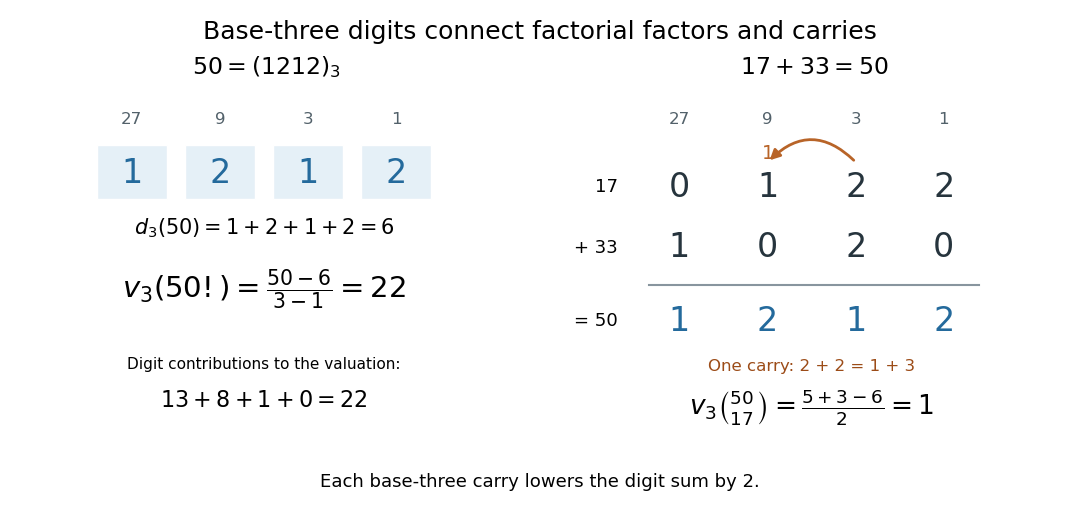
For a prime number and integers , the p-adic valuation of the binomial coefficient equals the number of arithmetic carries in the base- addition of and .[ref]
Number Theory for Mathematical Contests by David Anthony Santos. David A. Santos, Number Theory for Mathematical Contests, revision 31 October 2007, §8.3, Theorem 246, printed p. 90: carry count for a binomial coefficient
Indeed, subtract the two denominator factorial valuations in the Legendre formula:Each arithmetic carry accounts for one unit of this quotient by subadditivity of the base-p digit sum. In particular, the binomial coefficient is divisible by exactly when at least one carry occurs.For , the factorial counts giveThe matching base-p expansions are and . Their units add to two; the next column gives , sending one carry into the nines column. That column then gives , and no further carry occurs. The result is . The base-p digit sums check the same result: . Consequently is divisible by three but not by nine.

Magnetite Created 2026-10-18 Updated 2026-11-05
Magnetite is the iron oxide , commonly described as containing both iron(II) and iron(III) in an inverse-spinel structure. Its magnetic order is ferrimagnetic.
The unequal magnetic contributions of its sublattices leave a net magnetization. This makes magnetite a useful connection between oxidation-state chemistry, crystal structure, and bulk magnetism.
Respiratory uncoupling 2026-10-18
Respiratory uncoupling allows proton return to bypass ATP synthase, dissipating the electrochemical gradient. Electron transport and oxygen consumption can continue while less ATP is recovered.[ref]
Molecular Biology of the Cell, 4th edition by Bruce Alberts and others. Chapter 14, Electron-Transport Chains and Their Proton Pumps, H+ Ionophores Uncouple Electron Transport from ATP Synthesis
In the thermodynamic example under chemiosmosis, reducing both the activity ratio to one and the electric potential difference to zero removes the driving contribution. The hypothetical ATP-forming conversion then costs . Continued donor oxidation would not restore coupling unless it rebuilt a usable electrochemical gradient. This distinction makes respiratory uncoupling useful conceptually: abundant oxygen consumption can coexist with poor recovery of ATP.
Chemiosmosis Created 2026-10-18 Updated 2026-10-20
Chemiosmosis couples transmembrane ion movement down an electrochemical gradient to a chemical transformation. For mitochondrial ATP synthesis, protons return from the intermembrane space to the mitochondrial matrix through ATP synthase.[ref]
Molecular Biology of the Cell, 4th edition by Bruce Alberts and others. Chapter 14, Electron-Transport Chains and Their Proton Pumps, Summary: inward proton flow driving ATP synthesis
An original thermodynamic example separates the electrical and chemical contributions. At fixed temperature , use ideal dilute thermodynamic activities and the electric potential on each side. The molar electrochemical potential difference for inward transfer of a singly charged proton isHere is the molar gas constant, the Faraday constant, and the natural logarithm. The sign convention is destination minus origin: a negative difference makes inward transfer favourable. Both lower proton activity and a more negative electric potential inside favour inward movement.
Stipulate , , , and . These illustrative inputs give approximately and for the chemical and electrical terms, hence per transferred proton. For a hypothetical device coupling three inward protons per ATP to an ATP-formation cost of ,The sign follows by adding changes in the state function Gibbs free energy. It establishes thermodynamic feasibility for this chosen model, not its reaction rate. Three is a stipulated coupling count, not a universal ATP synthase stoichiometry; transport costs and leaks can also consume the available free energy.
Work by Owen Willans Richardson 2026-10-18
Work by Owen Chamberlain 2026-10-18
Work by Otto Stern 2026-10-18
Work by Otto Robert Frisch 2026-10-18
Work by Otto Hölder 2026-10-18
There are unlisted articles, also show them or only show them.