
Work by Mark Krein 2026-10-18
Work by Marissa Giustina 2026-10-18
Work by Mario P. Vecchi 2026-10-18
Work by Mário Norberto Baibich 2026-10-18
Work by Mario Dagenais 2026-10-18
Work by Marietta Blau 2026-10-18
Work by Marie Curie 2026-10-18
Work by Maria Goeppert Mayer 2026-10-18
Work by Marcel Bouvier 2026-10-18
Work by Marc Cheneau 2026-10-18
Work by Manuel Brando 2026-10-18
McLeod gauge 2026-10-18
A McLeod gauge infers low gas pressure by compressing a trapped gas sample into a calibrated smaller volume.
U-tube differential manometer 2026-10-18
A U-tube differential manometer contains a connected column of liquid with one gas connection above each liquid meniscus. Write for the left and right pressures, and for the meniscus heights on an upward vertical coordinate. Assume constant mass density and downward gravitational acceleration of magnitude ; neglect the gas column's mass density and differences in capillary pressure. The signed vertical length difference then givesLarger left pressure means a lower left liquid meniscus: implies . Equal pressures give equal meniscus heights.
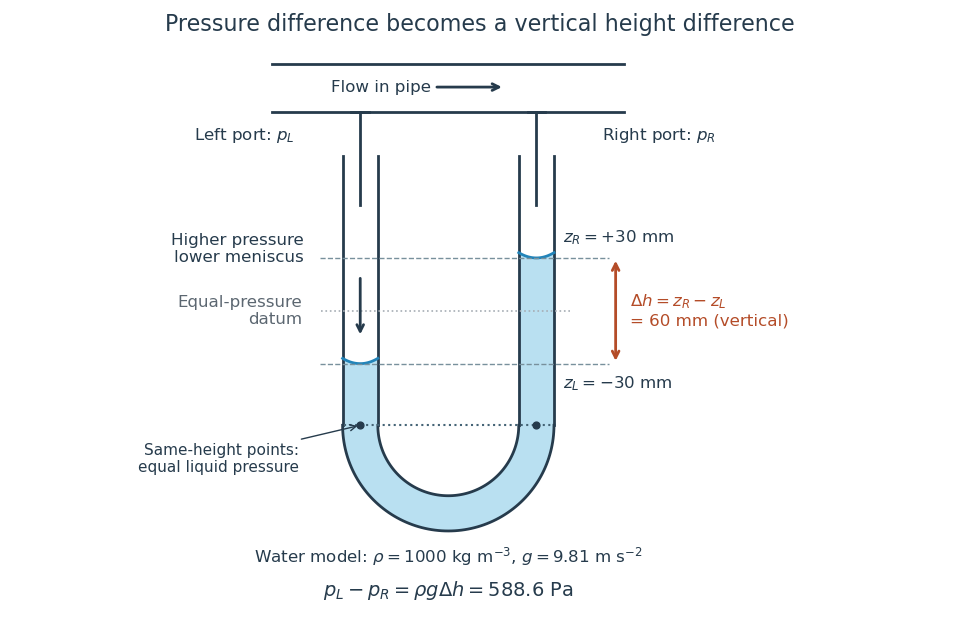

The balance follows directly from hydrostatic pressure. At a common height below both surfaces, the two points in the connected homogeneous liquid have equal pressure:Subtracting cancels the common bottom depth and leaves . The same-height rule follows from hydrostatic equilibrium, : a horizontal displacement changes no pressure, and for constant the quantity is constant throughout the connected liquid. Equal height alone is insufficient for unrelated vessels or for fluid flow with significant acceleration.
For an original constructed example, choose water of stipulated mass density , gravitational acceleration , and vertical length difference . ThenThe SI pressure unit is the pascal: the product has units . Swapping the two connections gives and reverses which liquid meniscus is lower. In equal-bore arms, volume conservation makes each surface move from its initial equal-height position; using only one surface's displacement would halve the inferred pressure. With unequal arm areas , a left fall and right rise instead obey , while the vertical length difference is still .
If the right port is open to the local atmosphere, is the left gauge pressure. Only with that reference and known atmospheric pressure can one obtain absolute pressure fromFor an explicitly stipulated atmospheric pressure of , the example gives absolute pressure. If the right port is connected to another vessel or a pressure tapping, the same reading is a differential pressure and supplies no absolute pressure without knowing that reference.[ref]
Work by Manoj Kaplinghat 2026-10-18
Work by Makoto Kobayashi 2026-10-18
Magnetic circuit 2026-10-18
A magnetic circuit approximates a narrow core and its gaps by sections carrying a common magnetic flux . With negligible leakage and approximately uniform magnetic flux density across each section, Gauss's law for magnetism gives . The magnetostatic Ampère law then gives . This requires an appropriate material relation; constant magnetic permeability is an approximation for an actual magnetic core.
Magnetic field of a rotating charged solid cylinder Created 2026-10-18 Updated 2026-11-05
An infinite solid cylinder with radius , prescribed uniform volume charge density , and angular velocity has current density . Treat a shell at radius and thickness as a solenoid carrying surface current . With no applied background magnetic field and permeability ,The same result follows from Ampère's circuital law, since inside.
Ferrimagnetism 2026-10-18
Ferrimagnetism has opposing, generally unequal ordered magnetic sublattices, with net magnetization in a collinear model. Louis Néel used it to explain magnetic oxides.[ref]
Magnetism and the local molecular field by Louis Néel. §8, pp.328–330: unequal sublattice contributions
The counting example in magnetic sublattice gives . Unequal populations also suffice: four sites carrying and two carrying give , even with identical individual magnitudes. Thus one must compare total sublattice contributions per common volume, rather than merely asking whether two atomic species carry different magnetic moments.
Both ferromagnetism and ferrimagnetism can produce a macroscopic magnet. Their internal organization differs: the latter retains opposing contributions. This makes ferrimagnetism a useful bridge between net magnetization and microscopic magnetic order: reducing one opposing contribution can increase the net sum, even though the total sum of moment magnitudes decreases.
Antiferromagnetism 2026-10-18
Antiferromagnetism is ordered compensation of magnetic moments. In the collinear two-sublattice model, : net magnetization vanishes but staggered magnetization remains. Louis Néel developed this possibility.[ref]
Magnetism and the local molecular field by Louis Néel. §5, pp.324–326: opposing ordered sublattices
For an original local energy check, perturb the antiparallel pair in exchange interaction by writing . ThenFor , a small relative rotation costs positive energy. This verifies a pair's preference; it does not prove a bulk ordering temperature. A whole crystal must satisfy many bonds simultaneously, and thermal fluctuations and quantum effects matter. The Heisenberg antiferromagnet and antiferromagnetic Ising model specify different assumptions about those collective degrees of freedom.
Why is the distinction useful? A measurement of zero magnetization cannot decide between an ordered alternating arrangement, a disordered ensemble, and oppositely magnetized magnetic domains. A spatial probe such as magnetic neutron diffraction tests the pattern directly. The manganese monoxide neutron diffraction experiment is a particularly clear example: the order adds a new periodic scattering signal even though the net magnetic moment cancels.
Exchange interaction Created 2026-10-18 Updated 2026-10-20
The exchange interaction is an effective interaction between spins originating in the quantum mechanics of electrons. Its sign convention must accompany any formula. For the illustrative classical fixed-length spin pair used here, writeWith this plus-sign convention, favors antiparallel spins: , compared with . The energy difference is . If instead the Hamiltonian is written with an overall minus sign, the same physical preference has a negative coupling. This prevents a sign convention in the Ising model from being mistaken for a disagreement about the ordering.
There are unlisted articles, also show them or only show them.