
Work by Otto Hahn Created 2026-10-18 Updated 2026-11-05
Vena contracta Created 2026-10-18 Updated 2026-11-05
The vena contracta is the narrowest jet section after an opening. Its area may be smaller than the opening area, so the jet speed and volumetric flow rate require separate comparisons with ideal flow.
Cotranslational protein translocation Created 2026-10-18 Updated 2026-10-20
Cotranslational protein translocation is passage of a growing polypeptide chain across a membrane during biological translation. SRP recognizes an exposed hydrophobic ER signal sequence. The SRP receptor enables handoff to the Sec61 complex. Biological translation can slow during delivery; the ribosome remains on the cytosol side.[ref]
Membrane Protein Insertion at the Endoplasmic Reticulum by Sichen Shao and Ramanujan S. Hegde. Shao and Hegde, Membrane Protein Insertion at the Endoplasmic Reticulum, 2011; “Cotranslational Targeting”, Figure 3
The useful engineering feature is coordination: a targeting instruction can become accessible while the rest of its cargo is still being made. Recognition, docking and crossing remain distinct operations. A defect in any one can prevent successful import even when the protein primary structure contains an appropriate signal.
This route is not universal. Many tail-anchored proteins use delivery after biological translation, and their membrane-spanning segment lies near the C-terminus. Thus protein targeting signals need not be at the N-terminus.[ref]
Membrane Protein Insertion at the Endoplasmic Reticulum by Sichen Shao and Ramanujan S. Hegde. Shao and Hegde, 2011; “Posttranslational Membrane Protein Topogenesis”, Figure 6
List of opticians 2026-10-18
Optical trap position readout 2026-10-18
A detector measures a signal, not a force. One proposed arrangement collects transmitted and scattered light onto a quadrant photodiode, using a normalized difference of opposite segments as a position-sensitive signal. A camera can supply an independent image and bead-height check. Near a chosen operating point, a voltage channel may obey , but its linear range and sensitivity must be measured at that bead size, focus and collection geometry. An arbitrary scattered-light intensity is not automatically proportional to displacement.
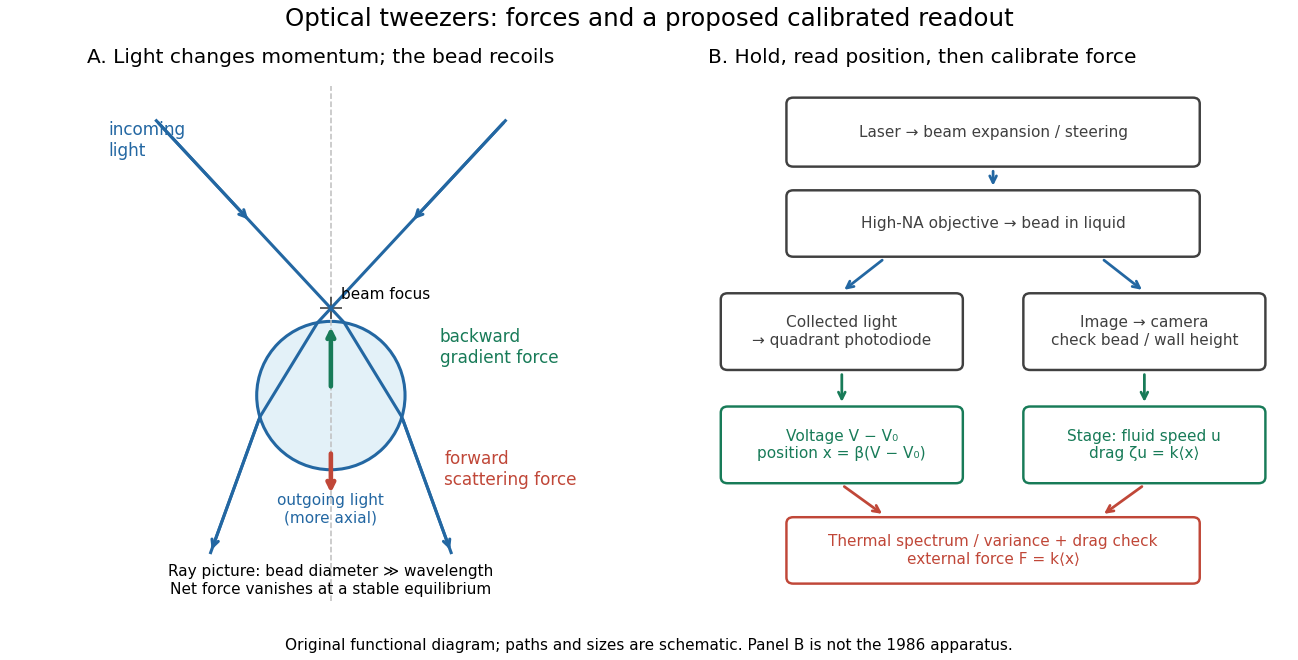

A useful proposed control sequence is to record detector offsets with illumination blocked, calibrate image scale against known stage travel, and test the detector response with independently known bead-relative motion. Moving a free trapped bead's chamber is not by itself a known bead displacement: fluid drag and trap stiffness determine the shift. Use a separate immobilized bead or an independently imaged trajectory for the position response, then check whether the response transfers to the actual trapped bead. Repeat the calibration after changing trapping power or optics.
Measure the acquisition frequency response and choose a sample rate that resolves , with sufficient signal bandwidth and control of aliasing. Compare thermal calibration of an optical trap with optical trap drag calibration, sweep small positive and negative flow speeds, inspect for multiple beads, and repeat at several wall distances. Check temperature and drift before interpreting a power-dependent stiffness: a changed fluid viscosity can change even at unchanged . These are proposed diagnostics of the model, not procedures attributed to the 1970 or 1986 papers.
Three-dimensional optical trap stability 2026-10-18
At an equilibrium , the total force vanishes. A small transverse displacement must produce a transverse restoring force; a small axial displacement must also restore the bead. Downstream of a tight focus, the backward optical gradient force can oppose the forward optical scattering force. Equality at one point is insufficient: the total axial force must decrease as the bead moves downstream through that point. The equilibrium can therefore lie downstream of the intensity maximum.
For uncoupled overdamped coordinates, with decays only when each . More generally, linearizing gives , where is the hydrodynamic mobility matrix and at equilibrium. All eigenvalues of must have negative real parts for linear asymptotic stability. For a conservative force with symmetric positive-definite mobility, a positive-definite Hessian matrix of the potential energy supplies this condition. A general optical force need not possess a global potential energy.
Increasing numerical aperture admits more strongly converging light rays and a steeper axial variation of the field. But a larger nominal numerical aperture alone does not establish trapping: illumination of the objective pupil, optical aberration, particle properties and the actual in-liquid focus also matter. A harmonic optical trap describes local confinement after this stability question has been answered; it does not predict capture from arbitrary positions or an infinite holding force.
Single-beam gradient trapping experiment 2026-10-18
In 1986, Arthur Ashkin, Joseph Martin Dziedzic, John Ernst Bjorkholm and Steven Chu used spatially filtered argon laser light, a water-immersion objective of numerical aperture , and a water-filled glass cell. An auxiliary beam loaded large glass beads; dispersed small particles entered by Brownian motion. A side microscope and scattering of light detector provided readout. Their Fig. 1 shows a bead below the focus with about . On p. 290, silica size was inferred by scattering against a latex standard; translating the cell imposed fluid drag. These observations support single-beam confinement, while inferred size depends on the scattering model.[ref]
Observation of a single-beam gradient force optical trap for dielectric particles by Arthur Ashkin and others. A. Ashkin, J. M. Dziedzic, J. E. Bjorkholm and Steven Chu, Observation of a single-beam gradient force optical trap for dielectric particles, 1986, pp. 288–290, Figs. 1–2 and final experimental paragraphs
A loading beam can help bring a bead into the capture region without supplying its subsequent confinement. Distinguish loading, holding and sensing when interpreting an apparatus drawing. The following optical trap position readout is a proposed calibration arrangement; its detector layout is not a reconstruction of this historical experiment.
Ashkin radiation-pressure trapping experiment Created 2026-10-18 Updated 2026-10-20
Arthur Ashkin's 1970 first experiment suspended transparent latex spheres in water inside a glass cell. A horizontal argon laser beam, focused to a radius, illuminated individual beads viewed through a microscope. An off-centre bead moved toward the beam axis and downstream until reaching the cell wall; blocking the beam released it into Brownian motion. Transparent particles and liquid reduced competing thermal effects. This observed sequence separates transverse attraction from downstream radiation pressure: wall-assisted confinement is not free three-dimensional confinement by one beam.[ref]
Acceleration and Trapping of Particles by Radiation Pressure by Arthur Ashkin. A. Ashkin, Acceleration and Trapping of Particles by Radiation Pressure, 1970, p. 156 and Fig. 1(a)
The beam-blocking comparison is particularly informative: persistence against a wall while illuminated and release when illumination stops test an optical cause. To infer a force from the downstream velocity, one additionally needs a linear drag model and the bead's distance from the wall; the observed motion alone does not calibrate an unrestricted harmonic optical trap.
Optical pumping versus relaxation 2026-10-18
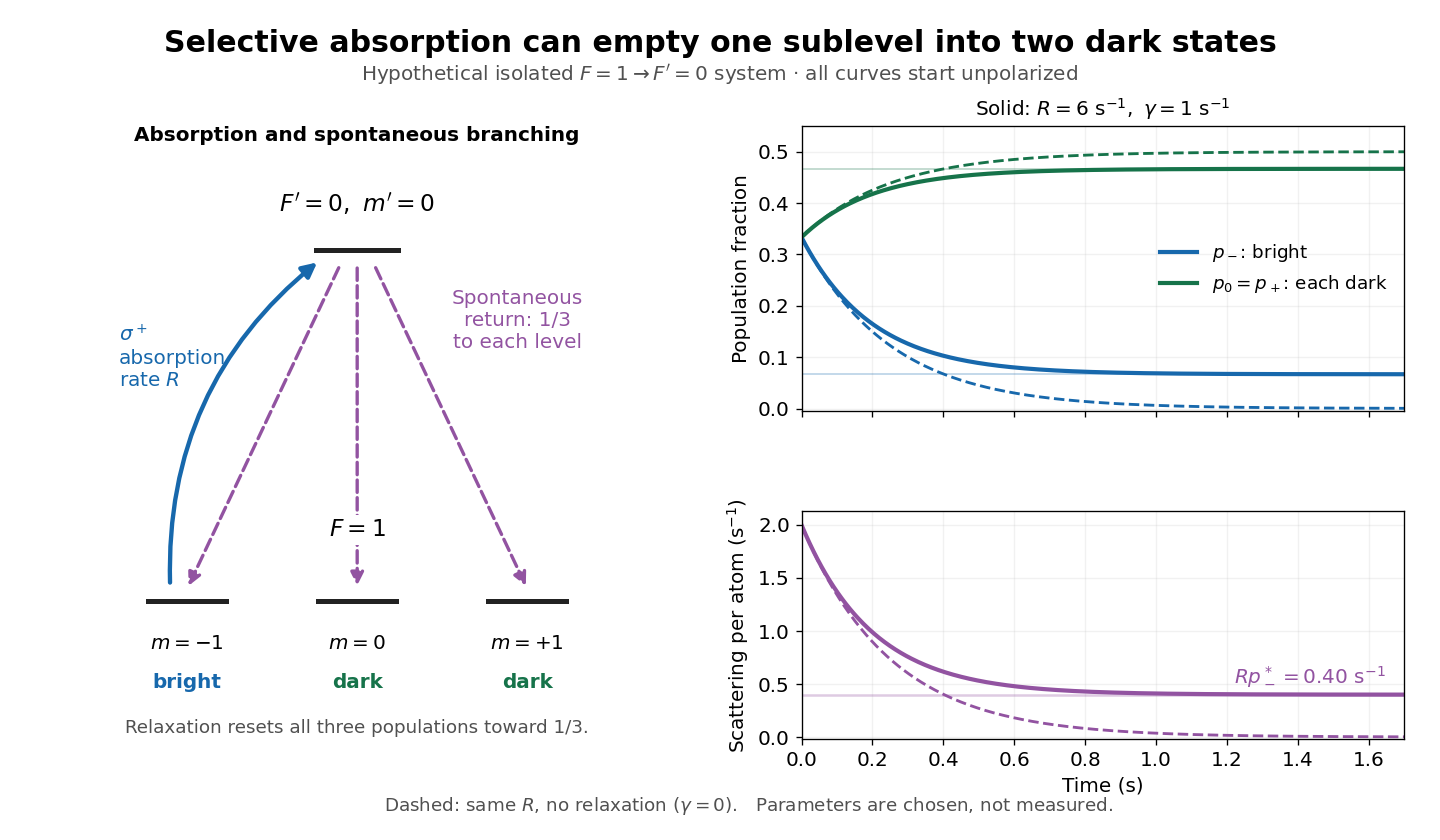
For , setting the rate equations to zero gives the unique stationary distribution of this continuous-time Markov chain:The nonzero mean magnetic quantum number represents atomic orientation. Increasing empties the bright state, but leaves two dark populations. For , relaxation alone gives . When and , every distribution with is stationary; the initial difference between the two dark populations survives. The equal dark populations below follow from the specified unpolarized initial condition.
Starting from , the solution for or isFor pure pumping, take in this formula. Its redistribution time is , longer than the mean scattering interval of a bright atom, because one third of scattering events return it to the same sublevel. For arbitrary initial populations the additional mode satisfies .
For an original numerical example choose and , with much larger than either. ThenAt , , while . If the light is then switched off, relaxation returns all three populations toward with time constant . Faster optical preparation and slower dark recovery measure different combinations of rates.
In an optically thin uniform sample of atoms, with equal collection efficiency for each decay branch, the detected fluorescence count rate is approximately . The same scattering removes pump photons, giving when depletion is small. For the chosen example the steady scattering rate is per atom, compared with the initial . Pumping lowers this signal fivefold, while increasing transmission. If rapid mixing restores nearly uniform populations, scattering rises again. Reabsorption, strong attenuation, unequal collection efficiencies or coherent RF dynamics require a more detailed model; the reset rate does not stand for an exact RF Hamiltonian.
Three-sublevel optical pumping model 2026-10-18
Consider an original hypothetical atom with a lower angular momentum multiplet , , and one opposite-parity excited level . Stipulate that all spontaneous emission returns to these three lower quantum states, with no other decay channel. This is an isolated four-state model, not the actual sodium or rubidium D-line structure. In particular, the physical rubidium cell above contains multiple hyperfine structure levels.
The electric-dipole selection rule permits here; absorption with excites only . Decay from has three equal integrated branching probabilities : rotational symmetry gives equal squared Clebsch-Gordan coefficients. The emitted photons carry the three permitted angular momentum projections; equal integrated branching does not imply equal intensity in every observation direction. Thus and are both dark. The chosen beam cannot prepare a unique pure state.
Let be the absorption rate of an atom in , and let be the excited-state spontaneous emission rate, both in inverse seconds. Assume , negligible stimulated emission, and no maintained quantum coherence between sublevels. Eliminating the short-lived excited population gives normalized lower populations to this approximation. At each scattering event the atom leaves with probability ; the remaining simply returns it there.
Model depolarizing collisions and other population relaxation by resets to the unpolarized distribution at rate . The rate equations areThis relaxation prescription assumes that Zeeman splitting is small compared with thermal energy, so the unpolarized distribution approximates thermal equilibrium. It is not an energy-independent relaxation law at arbitrarily low temperature.
Every transfer has a nonnegative rate: optical transfers and each have rate , and relaxation transfers between each distinct pair have rate . These define a continuous-time Markov chain. The three derivatives sum to zero, and at the corresponding derivative cannot be negative. Hence the model conserves population and preserves nonnegative populations. Optical cycles that return to contribute to scattering even though they cause no net population transfer.
Three-sublevel pumping, spontaneous branching and dark-state dynamics
. Original hypothetical model. Solid blue shows selective absorption; dashed purple arrows show equal spontaneous branching. Two lower states are dark to the selected beam. Curves start unpolarized and compare pure pumping with chosen . Rates and curves are stipulated examples, not historical data or a model of the full rubidium spectrum. Details.
Kastler-Brossel optical pumping experiments 2026-10-18
Alfred Kastler's 1966 lecture recalls his 1950 proposal and distinguishes the early atomic beam work from later sealed-vapour experiments. Its Fig. 5 shows subsequent sodium radio wave resonances, including multiple-photon transitions.[ref]
Optical methods for studying Hertzian resonances by Alfred Kastler. 1966 lecture, pp. 188–189, 193–194, Fig. 5; inspected authored transcription
The 1952 demonstration by Jean Brossel, Alfred Kastler and Jacques Winter used a sodium atomic beam, lamp light with circular polarization and fluorescence readout. Jean Brossel was a central experimental contributor; Alfred Kastler received the 1966 Nobel Prize in Physics alone.[ref]
Jean Brossel by Laboratoire Kastler Brossel. Direction du laboratoire, 1952 sodium-beam demonstration and Brossel's experimental role
[ref]The lecture also describes a experiment: a pumping beam with circular polarization prepares the vapour, while a perpendicular probe converts transverse magnetic dipole moment Larmor precession into modulated absorption at a photodetector. Interrupting pump and RF together exposes decaying free Larmor precession. Its envelope measures transverse relaxation under that model; it is distinct from the sodium atomic beam fluorescence signal.[ref]
Optical methods for studying Hertzian resonances by Alfred Kastler. pp. 196–199, Figs. 9–12: crossed-beam detection and interruption experiment
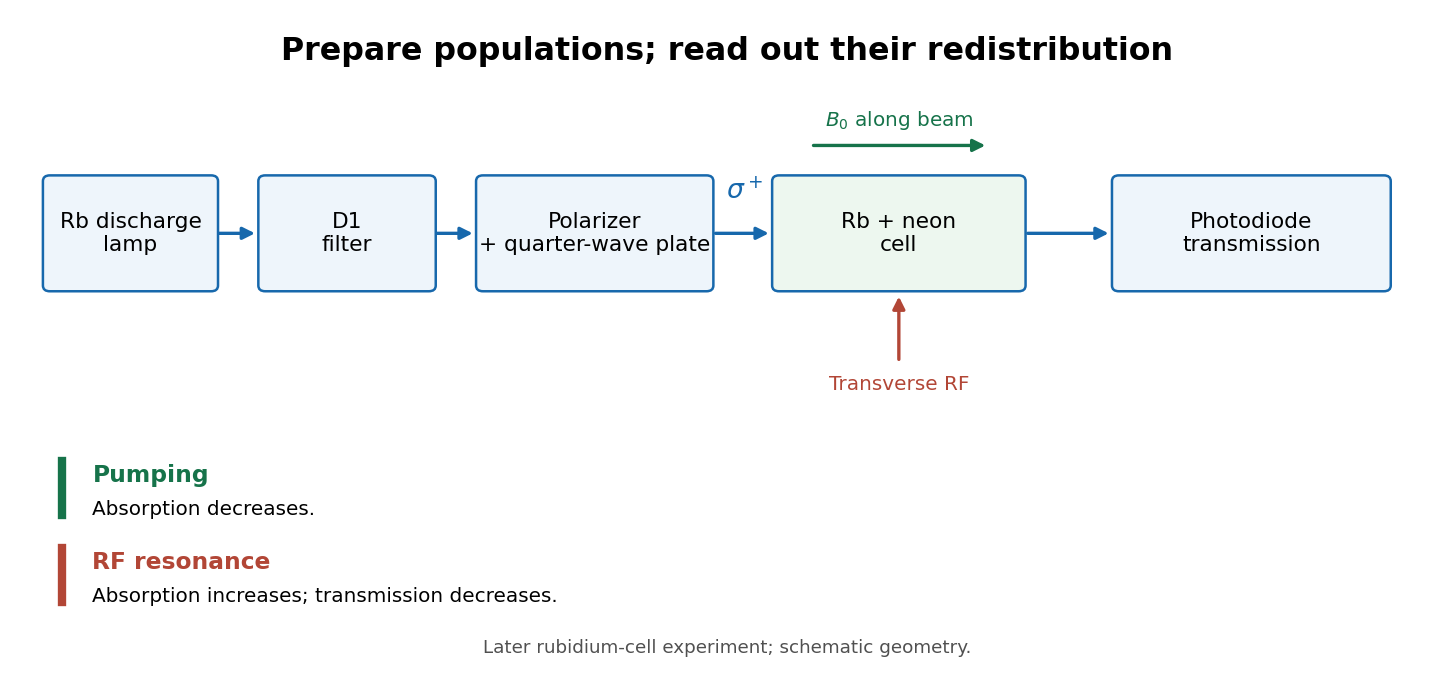
MIT's later rubidium experiment pumps natural / with a discharge lamp filtered to D1 (, near ). A polarizer and quarter-wave plate precede a heated rubidium/neon cell. Helmholtz coils set a weak static magnetic field. Separate transverse RF mixing increases absorption, measured by photodiode transmission.[ref]
Vapour-cell preparation and optical transmission readout
. Original functional schematic of the later rubidium-cell apparatus. Geometry is schematic; lamp and interrogation drives are separate. Details.
Compare resonant and detuned RF with the optical beam fixed, then change the calibrated static magnetic field: a true magnetic sublevel resonance should move with its Zeeman splitting. Lamp drift, stray magnetic fields, imperfect circular polarization, optical attenuation and RF power broadening can change the observed signal. Consequently, a transmission dip alone does not determine every sublevel population. These are measurement-design considerations, not additional reported historical observations.
Optical pumping preparation and readout 2026-10-18
Circular polarization selects the sign of the absorbed photon's angular momentum along the beam. Choose that direction as and define by the absorption rule , where is the magnetic quantum number. Spontaneous emission can return an atom to a different magnetic sublevel, so absorption followed by emission is a population-transfer cycle. A sublevel that the chosen beam cannot excite is dark to that beam. Darkness is relative to the selected transition and electromagnetic polarization, rather than a claim that the atom cannot interact with any light.
A static magnetic field along defines a stable axis and gives Zeeman splitting. A transverse oscillating magnetic field can redistribute magnetic sublevel populations when its frequency matches an allowed splitting. With the appropriate optical transition, that redistribution restores photon absorption: transmitted intensity decreases, or collected fluorescence increases. These are alternative readouts whose detailed sensitivity depends on the transition, viewing direction and electromagnetic polarization.
Photographic plate 2026-10-18
Optical isolator 2026-10-18
An optical isolator transmits light preferentially in one direction. An ideal Faraday effect device combines a rotator with polarizers at and : forward light passes, while backward light acquires another rotation and reaches the entrance polarizer at . See Faraday rotation on a round trip.
Stray light 2026-10-18
Stray light reaches a photodetector by an unintended path or from outside the intended wavelength band. It can bias spectrophotometry by adding received radiant power.
Optical chopper 2026-10-18
An optical chopper periodically interrupts a beam of light, for example with a rotating slotted wheel. Its timing can provide a reference for a lock-in amplifier measuring the modulated photodiode signal.
Refractometer Created 2026-10-18 Updated 2026-11-05
A refractometer measures refractive index through the way a sample redirects or reflects light. Some instruments measure the deviation through an optical prism; others locate the critical angle for total internal reflection at an interface with a prism of known refractive index.
In the latter geometry, for prism index greater than sample index , the critical-angle relation is . Locating the transition between transmitted and totally reflected directions therefore determines . Reference liquids check the angular calibration, while controlled temperature and wavelength make comparisons reproducible. Inferring composition from refractive index additionally requires a sample-specific calibration.
Goniometer Created 2026-10-18 Updated 2026-11-05
A goniometer measures angles by comparing the orientations of a sample, beam or viewing arm. An optical implementation can rotate a specimen and detector about a common center, measuring the directions of reflected, refracted or diffracted light.
For a prism experiment, a collimated input and a viewing telescope determine the angle through which the beam is deviated as the prism rotates. For a reflection experiment, the incident and viewing directions define the scattering geometry. Accurate centering matters: an off-center sample can move out of the measured beam as the arm rotates, changing signal strength for reasons unrelated to angular response.
Optical filter 2026-10-18
An optical filter selectively transmits light according to properties such as wavelength or polarization of waves.
Camera lucida 2026-10-18
There are unlisted articles, also show them or only show them.