
Naruhito Iwasa Created 2026-10-18 Updated 2026-11-05
Naruhito Iwasa coauthored experiments on p-type semiconductor behavior in gallium nitride. Contrasting annealing in nitrogen and ammonia linked changes in electrical resistivity to hydrogen; the authors proposed neutral complexes of hydrogen and acceptor impurities as a mechanism reducing mobile electron holes.[ref]
Hole Compensation Mechanism of P-Type GaN Films by Shuji Nakamura and others. pp. 1258–1266, author list, abstract and experimental comparison of annealing atmospheres: hydrogen-related hole compensation; indexed primary PDF text.
Masayuki Senoh Created 2026-10-18 Updated 2026-11-05
Masayuki Senoh coauthored work on blue light-emitting diodes using an indium gallium nitride/aluminium gallium nitride double heterostructure. The devices emitted near nm and reached external quantum efficiency at mA electric current.[ref]
Candela-class high-brightness InGaN⁄AlGaN double-heterostructure blue-light-emitting diodes by Shuji Nakamura and others. Applied Physics Letters 64 (1994), pp. 1687–1689: author list, abstract and emission/output measurements; primary article reproduced in the USPTO record.
P. Gould Created 2026-10-18 Updated 2026-11-05
An atomic-physics researcher whose joint work demonstrated resolved sideband cooling of a bound ion to near the lowest available motional energy. Resolving individual vibrational sidebands lets light selectively remove excitation, extending laser cooling from a broad temperature reduction to preparation of a particular quantum state.[ref]
Resolved-Sideband Raman Cooling of a Bound Atom to the 3D Zero-Point Energy by Christopher Monroe and others. pp. 4011–4014: Raman sidebands and motional-state preparation
B. E. King Created 2026-10-18 Updated 2026-11-05
A researcher whose team used resolved sideband cooling to prepare the motion of a single trapped ion. The experiment measured a high probability of occupying the three-dimensional motional ground state, providing controlled starting conditions for operations that couple internal atomic states to vibration.[ref]
Resolved-Sideband Raman Cooling of a Bound Atom to the 3D Zero-Point Energy by Christopher Monroe and others. Abstract and pp. 4011–4014: three-dimensional cooling and quantum-logic motivation
D. M. Meekhof Created 2026-10-18 Updated 2026-11-05
An experimental researcher whose joint work cooled a trapped beryllium ion close to its three-dimensional motional ground state. Resolved sideband cooling uses transitions that remove vibrational quanta. Preparing this low-excitation motion makes later control of internal and motional quantum states more reliable.[ref]
Resolved-Sideband Raman Cooling of a Bound Atom to the 3D Zero-Point Energy by Christopher Monroe and others. pp. 4011–4014: stimulated Raman sidebands and ground-state populations
Robert Sanders 2026-10-18
Woodruff T. Sullivan III 2026-10-18
Interviewer.
Claude Delhaye 2026-10-18
G. Binasch Created 2026-10-18 Updated 2026-11-05
Coauthored measurements of iron/chromium/iron layers showing increased electrical resistivity for antiparallel layer magnetizations. The effect exceeded ordinary anisotropic magnetoresistance and strengthened with additional iron layers. [ref]
Enhanced magnetoresistance in layered magnetic structures with antiferromagnetic interlayer exchange by G. Binasch and others. Page 4828: authors and abstract; layered-resistance comparison.
Institutional source issuer.
University of Chicago Library 2026-10-18
Institutional source issuer.
Institutional source issuer.
Robert S. Windeler Created 2026-10-18 Updated 2026-11-05
A researcher in fiber optics whose joint work contributed to the 2000 demonstration of stabilized carrier-envelope phase in an ultrafast laser. The experiment linked the pulse waveform with the absolute frequencies of an optical frequency comb, providing a direct connection between an optical measurement and a microwave frequency reference.[ref]
Carrier-Envelope Phase Control of Femtosecond Mode-Locked Lasers and Direct Optical Frequency Synthesis by David J. Jones and others. Author list and abstract: carrier-envelope control, cross-correlation verification and microwave clock reference
Andrew Stentz Created 2026-10-18 Updated 2026-11-05
A researcher in ultrafast optics whose Rochester experiment used an erbium-based laser to send short soliton pulses through a long optical fiber. A fiber with decreasing dispersion preserved the pulses better than conventional fiber in the reported comparison, demonstrating how propagation can be engineered to retain information-bearing pulse shape.[ref]
Optical Fiber Keeps Ultrafast Light Pulses Intact. 1994 institutional report: Stentz’s laser, forty-kilometer fiber test and comparison with ordinary fiber
He later coauthored the 2000 carrier-envelope phase stabilization experiment.[ref] Jinendra K. Ranka Created 2026-10-18 Updated 2026-11-05
A researcher in optical physics whose team helped connect ultrafast lasers with precision frequency measurement. Their 2000 experiment stabilized the carrier-envelope phase of pulses from a mode-locked laser, controlling the absolute positions of the resulting optical frequency comb. This allowed optical frequencies to be measured against a stable microwave clock.[ref]
Carrier-Envelope Phase Control of Femtosecond Mode-Locked Lasers and Direct Optical Frequency Synthesis by David J. Jones and others. Abstract: carrier-envelope stabilization and microwave-referenced absolute optical measurements
H1 Collaboration 2026-10-18
Lois Yoksoulian 2026-10-18
Lev P. Pitaevskii Created 2026-10-18 Updated 2026-11-05
A theoretical physicist whose work helped describe interacting Bose-Einstein condensates. The Gross–Pitaevskii equation treats the condensate through a collective wavefunction, allowing interactions and spatial variation to be studied together. His early work on quantum vortices connected this description with circulating superfluid flow. Later predictions and collaborations addressed condensate excitations and forces between atoms and material surfaces.[ref]
Scientific memorial of Lev P. Pitaevskii at the University of Trento. Research summary and Eric Cornell’s tribute: equation, vortex motivation, collective excitations and atom-surface force experiment
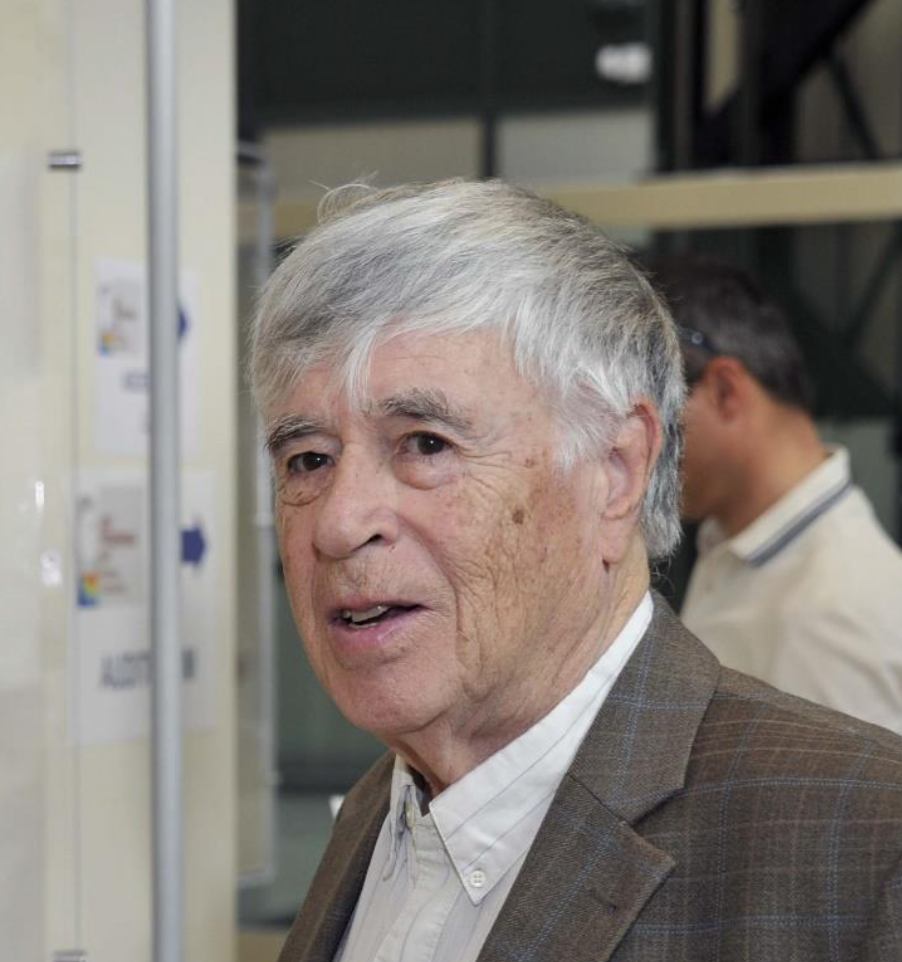
Portrait of Lev P. Pitaevskii
. Source. Andrey A. Varlamov Created 2026-10-18 Updated 2026-11-05
A theoretical physicist whose research investigates superconducting fluctuations. Even outside the region of stable superconductivity, short-lived pairing correlations can alter electrical conductivity and magnetization. His fluctuation calculations connect those observable changes with temperature and magnetic field, making transport measurements a probe of developing superconducting correlations rather than only of an established superconducting state.[ref]
Fluctuoscopy of Superconductors by Andrey A. Varlamov. Abstract, pp. 1–2: fluctuation observables above the upper-critical-field boundary
Michael R. Norman Created 2026-10-18 Updated 2026-11-05
A physicist whose work addresses high-temperature superconductivity and the pseudogap. His 2005 perspective with colleagues examines why a depletion of low-energy electronic states can appear above the temperature where superconductivity begins. Determining whether this behavior assists pairing, competes with it, or signals a distinct phase is essential to interpreting the normal state from which superconductivity develops. The article presents these alternatives as unresolved physical questions.[ref]
The pseudogap: friend or foe of high Tc? by Michael R. Norman and others. Abstract and introduction: pseudogap above the transition, uncertain microscopic origin and relationship to superconductivity
There are unlisted articles, also show them or only show them.