
Past exam of the mathematics course of the University of Cambridge 2005 iii Paper 85 6 Solution 2026-10-14
The Bernstein inequality for Weyl algebra modules requires characteristic zero: for a nonzero finitely generated left or right module over ,Equivalently, its Bernstein growth dimension of a Weyl algebra module is at least . Without the characteristic-zero hypothesis this is false, as the module in part (c) has dimension zero in the growth sense. The proof below works over any characteristic-zero field, not just an algebraically closed one.
For a left module, choose a nonzero finite-dimensional generating subspace and put , where is the Bernstein filtration. Ordered monomials giveMultiplication defines the linear action mapWe prove this map injective by induction on , which is the essential faithful finite-step action of a Weyl algebra argument. For , an element is a scalar, and a scalar killing is zero. Suppose kills . For any generator and , both and vanish because and . Thus kills , so induction gives for every generator. By the explicit commutator formulas in part (a), commuting with all forces all positive exponents of to vanish, and commuting with all forces all positive exponents to vanish. Characteristic zero is used to cancel the nonzero integer exponents. Hence is scalar and, because it kills , is zero. This proves injectivity.
Taking dimensions yieldsThe left side is asymptotic to . Consequently for all sufficiently large and some . Taking logarithms and the limsup in the definition of Gelfand–Kirillov dimension of a module proves the claimed lower bound. For a good Bernstein filtration, the associated graded module is finite over ; its cumulative Hilbert function is eventually polynomial, and the same comparison says its degree is at least .
For right modules, use the opposite ring isomorphism sending to and to . It respects the Bernstein filtration, so the identical estimate applies. The bound is sharp: the polynomial module , generated by , has equal to the polynomials of degree at most , of dimension . Its Gelfand–Kirillov dimension of a module is exactly .
Past exam of the mathematics course of the University of Cambridge 2005 iii Paper 85 5 Solution 2026-10-14
In a commutative ring, if , then the principal ideal satisfies . Thus a semiprime ring has no nonzero nilpotent elements. Conversely, if for an ideal , then every satisfies ; absence of nonzero nilpotent elements forces . Hence commutative semiprimeness is exactly reducedness.
For a prime ideal , let . Every ideal of is the extension of its contraction : if , multiply by the unit to get , so . If is Noetherian, write ; their images generate . This proves that is Noetherian.
The extended ideal is proper. Indeed would imply for some , and then , contradicting primeness and . A fraction with numerator outside is invertible, with inverse . A fraction with numerator in lies in the proper ideal and cannot be invertible. Thus the nonunits are precisely , making it the unique maximal ideal. ThereforeTo prove reducedness is detected by prime localizations, let be a nilpotent element of . Its image in every is zero because these localizations are semiprime, hence reduced. If , its annihilator is a proper ideal; choose a maximal ideal containing it. The zero criterion for localization says in only if for some , which would put in , a contradiction. Hence , and is semiprime. This argument does not need Noetherianity.
Primeness is not detected in the same way. Take . Its two prime ideals are and , and its corresponding localizations are both isomorphic to the field . To see these are all the prime ideals, the orthogonal idempotents have product zero, so a prime ideal contains one of them and is then the kernel of the other projection. Both localizations are prime rings, but is not prime: and .
Past exam of the mathematics course of the University of Cambridge 2005 iii Paper 85 4 Solution 2026-10-14
Let , where is an indeterminate, and form the right Artinian triangular ring that is not left NoetherianMultiplication uses the natural – bimodule structure on the upper-right entry. With the two diagonal idempotents , the right regular module is . The off-diagonal submodule of is one-dimensional over the bottom-right field , hence simple. Its quotient is one-dimensional over the top-left field , hence simple. Also is a simple right module over . Thus has a composition series of length three, and in particular is right Artinian.
On the left, multiplication of an off-diagonal matrix givesEvery -subspace therefore yields a left ideal of off-diagonal matrices with entries in . The subspaces are strictly increasing because is transcendental. Their associated left ideals violate the ascending chain condition. Hence is not left Noetherian, even though it is right Artinian and right Noetherian.
Past exam of the mathematics course of the University of Cambridge 2005 iii Paper 85 3 Solution 2026-10-14
A right Ore localization at is a unital homomorphism such that every , , is a unit, every element of is , andEquivalently, the usual fraction construction has this zero criterion and is universal among homomorphisms that invert . Injectivity is required only when the denominators are regular elements of a ring. If , every homomorphism inverting has zero target; this is the degenerate zero-ring localization. For a nonzero localization we require .
- For and , there are and with ; this is the right Ore condition.
- If with , there is with ; this is right reversibility.
For necessity, write the element as . Multiplying by on the left and on the right gives . The zero criterion supplies with . Hence , the right Ore condition in , not merely an equality of images in . Also makes because is invertible, and the zero criterion gives . This proves both necessities.
The sufficiency is the Ore theorem for denominator sets. Concretely, right fractions can be represented by ; a common-denominator equality has and for suitable . The two conditions make the induced fraction equivalence transitive and make addition and multiplication well defined; the zero fraction is exactly the kernel displayed above. The requested direction of the theorem was necessity, for which the complete argument has just been given.
For a right Noetherian domain, any two nonzero principal right ideals intersect. To see this without using the desired localization, suppose with . The sumis direct: reduce a finite relation modulo to get its first summand zero, then cancel in the noncommutative domain and repeat. Every summand is nonzero, so the finite partial sums form a strictly ascending chain of right ideals, contradicting the ascending chain condition. A nonzero intersection thus provides , with . This is the right Ore condition for . Reversibility is automatic in a noncommutative domain, and the zero criterion makes the map injective. The localization is a division ring, since a nonzero has inverse .
The Goldie theorem states that a semiprime ring has a semisimple Artinian classical right ring of quotients if and only if it has finite right uniform dimension and satisfies the ascending chain condition on right annihilators. A right Noetherian ring satisfies the annihilator condition because right annihilators are right ideals. Its right regular module has finite uniform dimension: an infinite direct sum of nonzero submodules would give a strictly ascending chain of finite partial sums. A prime ring is semiprime, so the theorem applies to a prime right Noetherian ring .
To obtain a single matrix-ring factor, not just a finite product, prove that its quotient is prime. A nonzero two-sided ideal contains a nonzero fraction and hence the nonzero element . The same holds for any other nonzero ideal . Since is prime, , so . Thus is prime. The Artin–Wedderburn theorem gives a finite product of matrix rings over division rings; primeness excludes two different nonzero factors with zero product. This proves the prime classical quotient of a prime right Goldie ring:For the requested counterexample to Noetherianity, take . It is a commutative integral domain and has its field of fractions as its classical right ring of quotients. But is a strictly ascending ideal chain: evaluation at shows is not in the preceding ideal. Therefore existence of a classical quotient does not imply right Noetherianity.
Past exam of the mathematics course of the University of Cambridge 2005 iii Paper 85 2 Solution 2026-10-14
The variable is central. To prove the leading-coefficient proof for a central polynomial extension, let be any right ideal of and setZero leading coefficients are allowed. Addition and right multiplication by constants show that is a right ideal. Multiplication by gives . Since is a right Noetherian ring, this chain stabilizes, say at , and each for has finitely many generators . Choose of degree at most lifting these coefficients.
These finitely many polynomial lifts generate on the right. Indeed, for of degree , let . Write its leading coefficient as . Thenbelongs to and has degree less than , because when . Induction on degree reduces to a right linear combination of the chosen lifts. This proves finite generation of every right ideal, and henceCentrality matters: it is what permits the displayed leading-coefficient cancellation without twisting the coefficients.
Past exam of the mathematics course of the University of Cambridge 2005 iii Paper 82 2 Solution 2026-10-14
Take a stable isotropic elastic material with mass density and Lamé parameters , where and . Its elastic stiffness tensor isThe P wave is longitudinal and the S wave transverse. The wavefront-transport alternative and all three steps of the Love wave alternative are given below.
Past exam of the mathematics course of the University of Cambridge 2005 iii Paper 79 3 Solution 2026-10-14
The square-root reaction problem with nested boundary layers has a small positive plateau , an left-end layer, and two distinct scales on the right. The broad right layer has width ; its inner edge needs a thinner transition to the plateau. A single right-end scale cannot describe both matches.
Here is a uniformly matched leading solution. Let solveusing the increasing branch below . DefineThen . For the right-hand branch, define by ; it tends to as . These formulas follow from the first integral of a square-root reaction layer and are expanded in solution and solution.
For sufficiently small , let . Then , so the right profile meets the prescribed order-one endpoint. The composite asymptotic expansion isThe subtraction removes the common plateau counted twice. Its boundary residuals are exponentially small: the right profile has almost reached at , and the left profile has almost reached at . In each active layer the opposite profile is exponentially close to its plateau, so the composite reproduces that layer's governing equation and the shared outer solution to the retained order.
The right transition location satisfies . Outside its thin transition, the broad right layer iswhere the bracket is positive; it matches through the thin layer to , rather than continuing as a fourth power on the wrong side. The dominant balances and the end-region matches are detailed below.
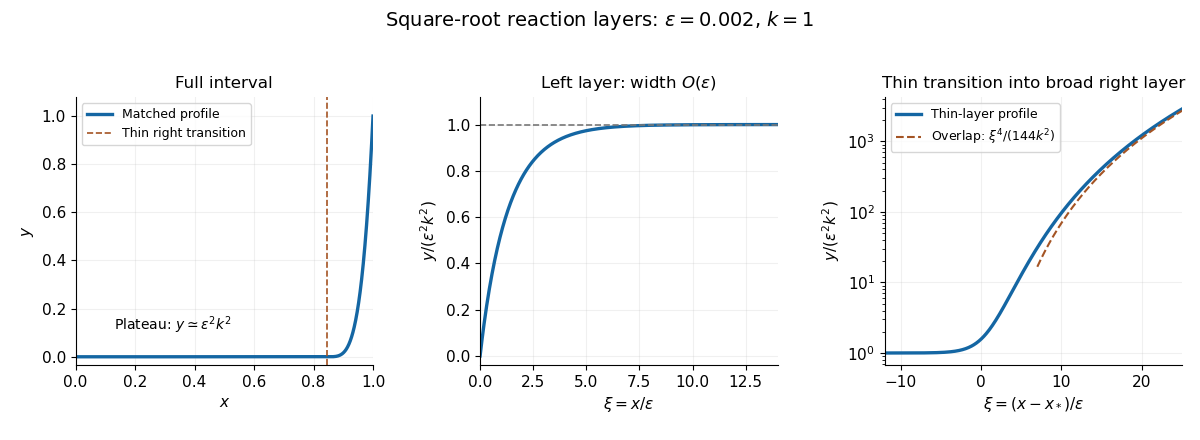
The left layer, small plateau and two right-hand scales of the square-root reaction problem
. Details. 
Past exam of the mathematics course of the University of Cambridge 2005 iii Paper 79 2 Solution 2026-10-14
First take . Set in the tail integral. This puts it in the endpoint form needed for Watson's lemma:The binomial coefficients are , where is the rising factorial. Integrating each endpoint term givesAlso, scaling the complete positive-ray integral gives . HenceThe endpoint term is exponentially small on this positive ray but must be retained for continuation to other sectors.
For complex , use so . Put and . The complete steepest descent contours from the cubic saddle are the rays , whose integrals are . Deform the finite contour onto one of these rays followed by the endpoint contour. The cubic exponential integral Stokes sectors giveFor , take below , between and , between and , and above . The corresponding algebraic coefficients are . A negative-real provides a useful sign check: is real and positive, so its two lateral algebraic coefficients must be complex conjugates.
The subdominant algebraic term switches across the Stokes linesThere is negative real and the endpoint exponential is dominant. The intervening anti-Stokes lines are , where and the exponential changes from growth to decay. The naming convention here distinguishes switching from equal exponential magnitude.
To resolve the jump near , optimally truncate the endpoint series at with , where . Let denote that truncated endpoint contribution. The Borel remainder for a cubic exponential integral derived in solution, together with the Gaussian pole transition for a large gamma parameter in solution, givesThis estimate is on the transition scale after optimal truncation. The error-function smoothing of a Stokes multiplier has width . Before the line and the coefficient is ; after it and the coefficient is , agreeing with the sector expansions. On the line the leading coefficient is their average. The original is an entire function; only its asymptotic decomposition has these sector-dependent coefficients.
Past exam of the mathematics course of the University of Cambridge 2005 iii Paper 77 3 Solution 2026-10-14
In this continuation measures eccentricity, not the viscosity ratio used in Question 2. Take with fixed. For the nearly occluding sphere in a cylindrical tube, the narrow gap has thickness and axial length , obtained by balancing and . In the sphere frame the tangential velocity scale is . The lubrication approximation then gives the gap scalesThe large local pressure excursion is distinct from the eventual net pressure jump. Away from the sphere the velocity varies across a radius , so the far Hagen-Poiseuille flow hasThese scales also show why the gap pressure can be much larger than its shear stress while the leading net jump can be smaller than that pressure.
Use , so is the moving tube wall and is the locally stationary sphere. The no-slip boundary conditions are , . Integrating , with pressure independent of to leading order, gives the Couette-Poiseuille flow in a thin gapDifferentiate at both surfaces and eliminate using this moving-boundary lubrication flux:The coordinate reversal means at the tube wall.
At leading order is independent of in each angular strip, though it may depend on . Both boundaries are stationary as shapes in the sphere frame and impermeable, so the integrated continuity equation is . The pressure changes along over but along the circumference over . Thus circumferential velocity is only , and its flux is . Circumferential flux divergence is smaller than the possible leading axial divergence by a factor . Consequently to the order needed. This is not an assumption of equal flux at different angular positions.
For fixed define the lubrication resistance integrals for a nearly occluding sphereIn particular, , and . The local pressure relation givesA putative generic value makes this jump . However, the integrated wall shear in part (ii) is only , so the force-free global balance permits a common net pressure jump only of order . The outer flow has circumferentially uniform pressures on both sides. Therefore the pressure jump must cancel in every angular strip, not merely after angular averaging. The pressure recovery condition in lubrication flow determinesThis explains how the leading-order part of the global force balance selects the local flux.
The total sphere-frame volume flux is nowTransforming back to the laboratory adds , so to this order. For physical pressure, Hagen-Poiseuille flow gives . ThusThe printed positive expression is the pressure-drop gradient in the direction of the laboratory flow; the Poiseuille hint omits the minus sign when is read as the derivative of physical pressure. With the specified wall velocity , the laboratory flow is positive and its physical pressure gradient is negative.
Next insert the leading flux into the wall shear stress:Let be the localized extra pressure drop, after subtracting the regular far Poiseuille gradient. Contributions outside the neck are only and are smaller than the jump. Since , part (ii) gives . Hence the leading pressure drop isFor example, the concentric limit is . The integral grows as the minimum gap shrinks; the fixed- qualification prevents treating a further near-contact limit as uniformly covered.
On the sphere the leading shear stress is , soPositive and negative tangential stresses cancel within each angular strip. Thus the leading tangential resultant, and its leading torque contribution, vanish: negligible rotation is consistent with the torque-free condition. The shear is not zero pointwise, and the pressure forces are not zero. Pressure on a sphere cannot produce a torque about its centre because its normal is radial; its force contributions and the matched far pressure jump remain essential to the force-free transport of a nearly occluding sphere.
There are unlisted articles, also show them or only show them.