
Past exam of the mathematics course of the University of Cambridge 2007 ib Paper 1 14D Solution 2026-10-14
Use the Fourier transform conventionDecay alone does not guarantee existence of the ordinary integrals, so impose the usual integrability and regularity assumptions. One sufficient version of the Fourier inversion theorem is that and are integrable and is continuous, in which case the inversion integral recovers . Under the standard piecewise-smooth Dirichlet assumptions, inversion instead gives the midpoint of the two one-sided limits at a jump, with a suitable improper integral interpretation.
For integrable , define . The convolution theorem statesTo prove it, absolute integrability permits Fubini's theorem. Set in the inner integral:The absolute double integral is , justifying the interchange. The computations below assume and use the source PDF's factor in the final integral, omitted in the converted TeX.
Past exam of the mathematics course of the University of Cambridge 2007 ib Paper 1 12A Solution 2026-10-14
The product topology on has as a basis the rectangles , where is open in and is open in . Equivalently, it is the coarsest topology making both coordinate projections continuous.
To show that the product of two Hausdorff spaces is Hausdorff, take distinct points and . If , choose disjoint open neighborhoods in ; the rectangles and separate the product points. If the first coordinates agree, the second coordinates differ, and the same argument uses disjoint open neighborhoods in . Thus every pair of distinct product points has disjoint open neighborhoods.
The three implications below prove the requested equivalence without assuming metrizability.
Past exam of the mathematics course of the University of Cambridge 2007 ia Paper 3 7D Solution 2026-10-14
Allow an eigenvector to have complex entries, since real matrices can initially have complex eigenvalues. Write for its conjugate transpose. Reality of gives ; symmetry then gives . Thus is a Hermitian matrix. The scalar equals its complex conjugate, because . If , thensince . This proves that all eigenvalues are real. The equality is precisely where reality was used; a complex symmetric matrix need not be Hermitian, as illustrates.
If and , then , but also . Consequently . Distinct eigenvalues force . For real eigenvectors this is ordinary Euclidean orthogonality. These arguments establish real symmetric spectral orthogonality without assuming a diagonalization in advance.
A real orthogonal matrix satisfies , equivalently . If is symmetric,so orthogonal similarity preserves symmetry. An arbitrary real invertible change of basis need not do so. For example,The final matrix is not symmetric. Orthogonal similarity preserves real symmetry; general similarity does not.
Past exam of the mathematics course of the University of Cambridge 2007 ia Paper 3 6D Solution 2026-10-14
A subgroup is a normal subgroup of if for every , equivalently if for every . In the symmetric group , the subgroup is normal: conjugation relabels a three-cycle as a three-cycle, so preserves this set. By contrast, is not normal because conjugating by gives outside the subgroup.
If is normal, define a product on its left cosets by . To check that this quotient group operation is well-defined, take different representatives and , with . Their product isNormality puts the last two factors in , so its coset is exactly . Associativity follows from that in , the identity coset is , and the inverse of is . Thus all the group axioms hold, and the projection is a group homomorphism.
Past exam of the mathematics course of the University of Cambridge 2007 ia Paper 3 11A Solution 2026-10-14
For a real-valued function on a bounded regular region, apply the divergence theorem to . The product rule yields . The prescribed zero boundary values and Laplace equation therefore implyThe continuous nonnegative integrand must vanish everywhere. Hence is constant on each connected component, and its boundary value makes each constant zero. This proves zero-boundary harmonic uniqueness. If complex-valued functions are allowed, apply the same argument separately to their real and imaginary parts. If solve the same Poisson equation and Dirichlet boundary data, their difference is harmonic with zero boundary value, so is zero. Thus there is at most one solution. An exterior unbounded region would require an additional condition at infinity; the preceding bounded-domain proof does not assert uniqueness without one.
For the radial calculation use Cartesian coordinates with . The chain rule gives andDifferentiate again and sum the three coordinates:This derives the radial Laplacian directly in Cartesian coordinates. For , set , so . Integrating twice gives , and consequentlyIf the solution must extend boundedly through the origin, . The remaining polynomial is smooth there.
Past exam of the mathematics course of the University of Cambridge 2007 ia Paper 1 7C Solution 2026-10-14
For the Cauchy-Schwarz inequality, take and use positivity of the inner product:Multiplication by provesEquality holds exactly when . Positive definiteness of the inner product makes this equivalent to . Conversely, substitution of a scalar multiple gives equality. Thus equality holds precisely for linearly dependent nonzero vectors.
Past exam of the mathematics course of the University of Cambridge 2007 ia Paper 1 12D Solution 2026-10-14
For a bounded function, a partition of an interval is . Put and . Its lower Darboux sum and upper Darboux sum areThe lower Darboux integral is and the upper Darboux integral is . Riemann integrability means that these two real numbers coincide, and their common value is the Riemann integral.
Equivalently, the Riemann integrability criterion says that for every some partition satisfies . To see equivalence, all lower sums are at most all upper sums: refine any two partitions to their common refinement and use Darboux sum refinement monotonicity. Thus a small gap forces the difference of the two integrals below . Conversely, if both integrals equal , choose a lower sum above and an upper sum below ; their common refinement has gap below .
This also agrees with the tagged Riemann sum definition: there is such that every tagged sum on a partition of sufficiently small mesh is within any prescribed tolerance of . Each tagged sum lies between the two Darboux sums. From a partition with small gap, an arbitrary small-mesh partition differs from its refinement at only the cells crossing the finitely many original division points; boundedness makes their total contribution tend to zero. Conversely, on a fine partition tags approximating each cell supremum or infimum force both Darboux sums close to the same tagged-sum limit.
Now suppose is continuous on . It is bounded by the result of Question 11. It is also uniformly continuous: otherwise there are with but . The Bolzano-Weierstrass theorem gives a convergent subsequence of ; the corresponding have the same limit, contradicting continuity. Given , this uniform continuity gives such that points less than apart have function values less than apart. A partition of mesh below then satisfiesHence every continuous function on the interval is Riemann integrable, with the required proof supplied by its oscillation estimates.
Past exam of the mathematics course of the University of Cambridge 2007 ia Paper 1 10E Solution 2026-10-14
The mean value theorem states that a real-valued function continuous on and differentiable on , with , has a point such thatFor the proof, subtract the secant line and put . Then . If is identically zero, every interior point works. Otherwise it has a positive maximum or a negative minimum. The extreme value theorem supplies that extremum, and its nonzero value makes its location interior. At an interior differentiable extremum, the difference quotients on the two sides have opposite weak signs, so their common limit is zero. Hence , proving the formula. This also gives the Rolle theorem argument rather than merely citing it.
Past exam of the mathematics course of the University of Cambridge 2006 iii Paper 83 3 Solution 2026-10-14
Model the post-eruption flow as an axisymmetric, shallow, hydrostatic, turbulently mixed layer on a horizontal bed. Neglect entrainment, erosion, heat exchange, rotation and large-scale viscous drag. Particles are dilute, with density , uniform-in-depth particle volume fraction and constant downward settling speed relative to the carrier gas. Deposited particles are not resuspended. Their volume is small enough that settling does not significantly change the bulk carrier volume. Let be ambient air density and carrier-gas density at its local temperature, and use a leading Boussinesq approximation for the mixture motion. DefineThe hot gas reduces the density excess; the ground-hugging current model requires . If density contrasts are too large for Boussinesq dynamics, density-weighted balances would be needed instead. The equations below are a stated shallow-layer model, not a description of the initial explosive vent jet.
For layer height and radial depth-averaged speed , the appropriate shallow-water balances areThe hydrostatic force gives the nonconservative momentum equation . In particular a spatially varying particle fraction must not be treated as constant reduced gravity when differentiating pressure. With no heat exchange or entrainment, a carrier-temperature anomaly is advected:At this order is proportional to . At the bed the carrier has no normal penetration and particles have absorbing deposition flux ; at the top the pressure equals ambient pressure. Axis regularity requires and smooth scalar fields, with no further source after the initial pulse. The initial height, particle inventory and temperature anomaly specify the released volume and ash content. Outside the front , the current layer is absent. At a resolved advancing head, use the material-front condition and the gravity-current front condition , where is an order-one front Froude number and refer to the fluid feeding the head. The front closure replaces unresolved head dynamics; simply prescribing both a zero-depth mathematical edge and a finite-depth box-head speed would be inconsistent.
To obtain a gravity-current box model, assume horizontal as well as vertical mixing, uniform in a disk of radius , and a negligible-volume head whose feeding depth is the box depth. The conserved bulk volume givesA bulk velocity satisfies interior continuity for this box. Rather than impose a uniform pressure on the full shallow-water equations and thereby lose the head force, replace their momentum dynamics by the front closure. Total suspended particle volume is , so bed deposition givesThese ordinary differential equations, together with initial , are the axisymmetric settling box model. The maintained negative thermal term may eventually cancel particle buoyancy and cause lift-off; beyond this horizontal gravity-current model does not apply.
For the requested particle-only calculation set and define the initial reduced gravity . The equations reduce toEliminating time gives . Integrating from the release state yieldsThus the monodisperse circular ash runout has limiting radiusThe maximum outward distance beyond the initial release edge is . When the vent scale is negligible, set in this late-time source idealization. The resulting radius scales as ; it is not obtained by conserving reduced gravity after particles settle out.
To determine the time, put , and . The concentration relation becomes , and the front equation reduces toConsequentlyThe furthest reach is a limiting radius, approached asymptotically rather than attained at a finite stopping time. As the residual particle concentration vanishes, the front slows exponentially. A finite observational threshold for remaining ash would give a finite practical stopping time, but no such threshold is part of these balances.
The local ash deposit density is most naturally its mass per horizontal area, . Once the front has arrived at , its local deposition flux is . For , define ; the arrival time is zero inside the initial footprint and otherwise . Sincewe can integrate the flux exactly. Using gives the circular ash deposit profileIt is constant under the initial disk, then decreases to zero at the limiting edge. Particle solid volume per area is ; deposit thickness is if a bulk deposit density including voids is supplied. The problem does not determine that packing density.
For a negligible initial radius this simplifies toIts integral confirms that the complete initial ash inventory is deposited. The finite- formula gives the same budget including its central flat portion.
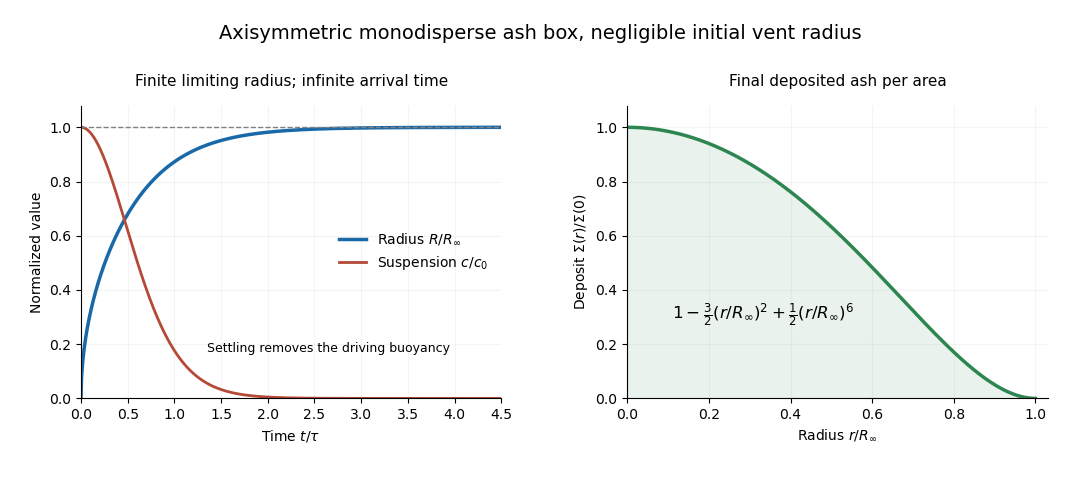
Monodisperse axisymmetric ash box: asymptotic runout and decreasing radial deposit density
. Details. 
The diagram uses the negligible-vent-radius idealization and time normalized by . It illustrates both the asymptotic approach to and the smoothly vanishing outer deposit. All these predictions depend on the mixing and constant-Froude head closure; they do not claim to resolve the initial blast or the ultimate inertia-dominated motion of almost particle-free gas.
Past exam of the mathematics course of the University of Cambridge 2006 iii Paper 78 4 Solution 2026-10-14
Let the tangential velocity scale be , gap scale and along-gap length . The tangential Stokes equation balances with , while wall shear is . ThereforeThis is lubrication pressure dominates shear stress; pressure force projections may nevertheless be small in a particular direction or may give no torque on a spherical surface.
Write the signed centre displacement along the downward axis as . A point on the inner sphere has distance from the outer centre. The leading normal gap to radius is consequentlyThe local-curvature corrections are smaller by . This approximation also follows by solving the outer-sphere intersection along the ray from the inner centre and expanding its positive root.
Past exam of the mathematics course of the University of Cambridge 2006 iii Paper 78 1 Solution 2026-10-14
Use the Newtonian fluid stress tensor , where . The Stokes equations for a point force on the fluid are and . Put . Away from the origin, a harmonic vector potential proportional to in the Unscaled Papkovich–Neuber representation gives the rotationally covariant decaying solution. Specifically, take and . Differentiation yieldsThis satisfies the homogeneous Stokes equations for . Its stress isTo verify the point-force normalization, on a sphere the traction is . Since , its surface integral is . Thus integrating momentum balance over the small ball gives exactly the applied force , fixing the normalization of the Stokeslet. Its radial velocity is , soThere is no net volume or mass source at the singularity. The kernels have the parity and .
For two Stokes flows with the same viscosity and body forces , the Lorentz reciprocal theorem including body forces isIndeed, apply the divergence theorem to . The cross-gradient terms cancel: incompressibility removes each pressure contraction and the remaining terms are both . The two stress divergences give the body-force terms shown.
Choose flow 1 to be the desired body-force-free field and flow 2 to be a Stokeslet with arbitrary force vector at . For , the body-force term is . Rearrange the reciprocal identity and use the parity of ; equality for every givesFor outside the volume there is no point force in , so the same two integrals sum to zero. To obtain the smooth boundary value, exclude a small hemisphere about , use continuity of to replace it by on that hemisphere, and take the radius to zero. A full small sphere contributes ; a hemisphere contributes half of it. Equivalently, the local solid-angle factor is . The result is the boundary integral representation of Stokes flow with right side on a smooth boundary, and with the double layer interpreted by its boundary principal value. A nonsmooth corner would have a different solid-angle coefficient.
Past exam of the mathematics course of the University of Cambridge 2006 iii Paper 67 5 Solution 2026-10-14
This addresses the general interpolation bound in part (I); the subsequent (a)–(c) address the cubic case in part (II). Write the interpolant in the B-spline basis asThe stipulated uniquely defined spline interpolation operator presupposes invertibility of the B-spline collocation matrix. For the standard increasing distinct sites, the conditions give it by the Schoenberg–Whitney theorem. Thus .
Use the standard partition-normalized B-splines of the question: they are nonnegative and satisfy the subpartition of unity for B-splines, . This also holds outside the basic knot interval; one may extend the knots and regard the finite family as a subfamily of a full partition of unity. The recurrence proof of the full partition is given in Question 6(c). Repeated knots retain the same nonnegativity and subpartition properties, with zero-denominator recurrence terms interpreted as zero or by knot limits. ConsequentlySampling has norm at most one, , and soHere the induced matrix norm is the maximum absolute row sum. The label -normalized means the usual partition normalization, not rescaling each spline to have maximum value one. Such a rescaling would invalidate the specific coefficient bound and the cardinal values used below.
Past exam of the mathematics course of the University of Cambridge 2006 iii Paper 67 2 Solution 2026-10-14
For a continuous -periodic function, define the Fourier coefficients and Fourier partial sum byThe Fejér sum is the arithmetic average of the first Fourier partial sums:Thus has degree at most , whereas has degree at most . These indexing conventions matter in the identity in (b). Throughout, is a positive integer; when , any term is interpreted as zero without introducing .
For later estimates, the Fejér kernel in the PDF's normalization isThe apparent singularities are removable. The squared modulus makes nonnegative, and integrating its finite exponential expansion leaves only the diagonal terms, so . In particular Fejér summation is a uniform-norm contraction:
There are unlisted articles, also show them or only show them.