
Past exam of the mathematics course of the University of Cambridge 2006 iii Paper 64 5 Solution 2026-10-14
The two unheaded requests are addressed here; the individual group-cover calculations are in the scoped parts below. A quaternion has norm . Thus the unit quaternions form exactly the sphere , with quaternion multiplication giving its smooth group structure. The explicit identification with the special unitary group isThe matrices representing satisfy the quaternion multiplication relations. The displayed matrix obeys and ; conversely every matrix has that form with . Hence is the manifold of unit quaternions, and its group is .
For the exterior-square double cover of SO(3,3), fix a basis and volume element . Define the symmetric bilinear form on the six-dimensional exterior square byIt is symmetric because two-forms commute under the wedge product. PutThen and . The Gram matrix is : the vectors have norm , while have norm . Therefore the quadratic form has signature .
For ,Thus preserves . The special linear group is connected: polar decomposition of an invertible real matrix writes with and positive definite of determinant one, and both factors can be joined to the identity. The image consequently lies in .
If , then for every pair, so preserves every two-plane. A line is an intersection of two such planes, hence every line is preserved. A linear map preserving every line is scalar: apply it to basis vectors and then to their pairwise sums. Thus , and forces . The kernel is exactly . It is discrete, so the derivative of is injective. Both Lie algebras have dimension , making the image open; an open subgroup of a connected group is the whole group. HenceThe identity-component restriction is essential. The same principle of an explicit form-preserving representation, kernel calculation and dimension argument supplies the five remaining covers.
Past exam of the mathematics course of the University of Cambridge 2006 iii Paper 6 6 Solution 2026-10-14
For the unheaded representation request, retain the question's standing unital hypothesis. Let be the character space of an algebra of , with its weak-star or Gelfand topology. The standard commutative Banach-algebra results allowed here give a nonempty compact Hausdorff character space and . In particular, character compactness follows from the Banach-Alaoglu theorem: the equations and define a weak-star closed subset of the dual unit ball.
The Gelfand transform is the unital homomorphismEvery element of the commutative C-star algebra is normal. Part i and the character spectrum formula therefore giveThus is an isometry, hence injective, and its range is closed because is complete. Part ii gives . The range contains constants and separates points of , since two distinct characters differ on some element of . The complex Stone-Weierstrass theorem states that a unital, conjugation-closed subalgebra of separating points of a compact Hausdorff space is uniformly dense. Its application here, together with closedness of the range, yieldsThis proves the Commutative Gelfand--Naimark theorem from the preceding parts and the stated approximation theorem.
The word “every” in the printed deduction must be read under the initial unital hypothesis. If nonunital commutative C-star algebras are included, the compact-space statement is false: the nonzero algebra has no multiplicative identity, whereas for nonempty compact does. The general nonunital version is on a locally compact Hausdorff space, with vanishing at infinity. This qualification preserves the proved unital result.
For the final real spectrum criterion for a normal C-star element, the ambient algebra may be noncommutative. Let be the norm-closed unital subalgebra generated by and . Normality makes these two generators commute. The involution preserves their polynomial algebra and is continuous, so is a commutative C-star subalgebra.
We first show that has the same spectrum in as in , without assuming spectral permanence. Put . A compact subset of the real axis has connected complement: upper and lower half-plane paths join around either end of a bounded interval containing it, and each omitted real point can be joined locally to the upper half-plane. DefineThis set is nonempty because the Neumann series puts the inverse in for . It is relatively open: from an inverse in , the local inverse formulastays in for small . It is relatively closed by continuity of the ambient resolvent and norm-closedness of . Connectedness gives . Conversely an inverse in is an inverse in , soThis is the connected-resolvent case of spectrum in a closed unital subalgebra.
Apply the just-proved commutative C-star representation to . For every character of , lies in this real spectrum. Part ii makes . The Gelfand transform of is injective by its isometry, soFor a nonunital ambient C-star algebra, perform the same argument in its standard C-star unitization, using the usual unitization spectrum.
Past exam of the mathematics course of the University of Cambridge 2006 iii Paper 54 2 Solution 2026-10-14
Use , and , where are the Pauli matrices. The translation and Lorentz generators obey the Poincare algebraOne can derive the additional relations by realizing the supercharges as differential operators on superspace. With left Grassmann derivatives and , takeUsing , the two mixed derivative-coordinate terms each give . The remaining terms cancel by Grassmann anticommutation. Equal-chirality terms cancel in the same way. HenceAll coefficients are independent of , so direct differentiation gives . This also shows that supercharges commute with translations and preserve the four-momentum of a state.
For the Lorentz generators, define the left-handed spinor matricesThe identity gives their Lorentz commutation relations. Acting on the spinor superspace coordinates and their dual derivatives then gives, in a column-component convention,Here dotted index values are identified with the conjugate undotted values, and . The second formula also follows directly by taking the adjoint of the first, using Hermitian . For example, , so and for . This explicit component convention avoids reversing signs by mixing state matrices with operator-component matrices. Covariance of the mixed anticommutator follows by applying these matrices to .
These are the minimal Super-Poincaré algebra relations. In the ordinary particle algebra a possible scalar term in would be proportional to , but an anticommutator is symmetric in its two labels; with only one supersymmetry such a central term vanishes. Extended algebras can instead use an antisymmetric internal index tensor. Tensor charges associated with extended objects are not part of this minimal particle algebra.
For a positive-energy massless supermultiplet, choose with , so andPositivity of the Hilbert-space norm implies that both and annihilate every state: their squared norms sum to zero. SetFor momentum along the positive third axis, helicity is . The Lorentz commutators give and . Choose a highest-helicity Clifford vacuum with . Its partner has unit norm if the first state does and has helicity . No further state is generated because . ThereforeThe two states have opposite fermion parity. A CPT completion of a supermultiplet adds helicities and conjugate internal charges when necessary. Taking produces a complex scalar and a Weyl spinor after CPT completion; taking produces the massless vector multiplet. This construction assumes ordinary finite-helicity particle representations, rather than continuous-spin representations.
Past exam of the mathematics course of the University of Cambridge 2006 iii Paper 51 1 Solution 2026-10-14
The mean-field approximation replaces each site's fluctuating surroundings by a self-consistent average. On a cubic lattice each spin has coordination number of a lattice , even though summing only over positive basis directions counts each bond once. Write and drop products of deviations. Each Ising bond becomes , so the approximate statistical Hamiltonian isThe constant corrects counting each bond twice. The resulting independent-spin partition function is , where . The one-spin probabilities giveEquating this average with the assumed givesHere is assumed; a ferromagnetic order parameter is not the appropriate choice for an antiferromagnetic coupling. Put . For , at any , so only is possible. For , the function has positive slope at zero, is strictly concave on and is negative at . It therefore has exactly one positive zero and a spin-reversed negative zero. Expanding at the bifurcation givesThe transition is continuous, with order-parameter critical exponent . Stability can also be checked from the Bragg-Williams free energy of the Ising model per Ising spin:Its derivative is , giving the same self-consistency equation. Near zero,The quartic coefficient is positive at , the stable minima approach zero continuously, and the minimized free energy has no first-derivative jump. Thus mean-field approximation predicts a second-order transition at . This is the mean-field Ising critical bifurcation.
For short-range interactions, large dimension gives many neighbours and suppresses the relative fluctuations of their average. More quantitatively, Gaussian field theory fluctuations averaged over a correlation volume have variance of order , while the squared ordinary mean-field order parameter is of order . Their ratio is proportional to . The Ginzburg criterion therefore makes neglect of critical fluctuations asymptotically consistent above four dimensions, inconsistent below four, and marginal at four, where logarithms occur. Large dimension is a route to validity; sufficiently long-range or infinite-range interactions can also produce mean-field behaviour. In low-dimensional short-range systems even the existence and location of a transition can differ from this approximation.
Past exam of the mathematics course of the University of Cambridge 2006 iii Paper 50 2 Solution 2026-10-14
The anti-Hermitian operators represent the compact real form; its complexification also contains the Hermitian and the raising operators and lowering operators , with . Define the roots in the two-dimensional Cartan plane byEach has squared length one. For each , setThe displayed commutators give and . Thus these are the three root SU(2) subalgebras of SU(3).
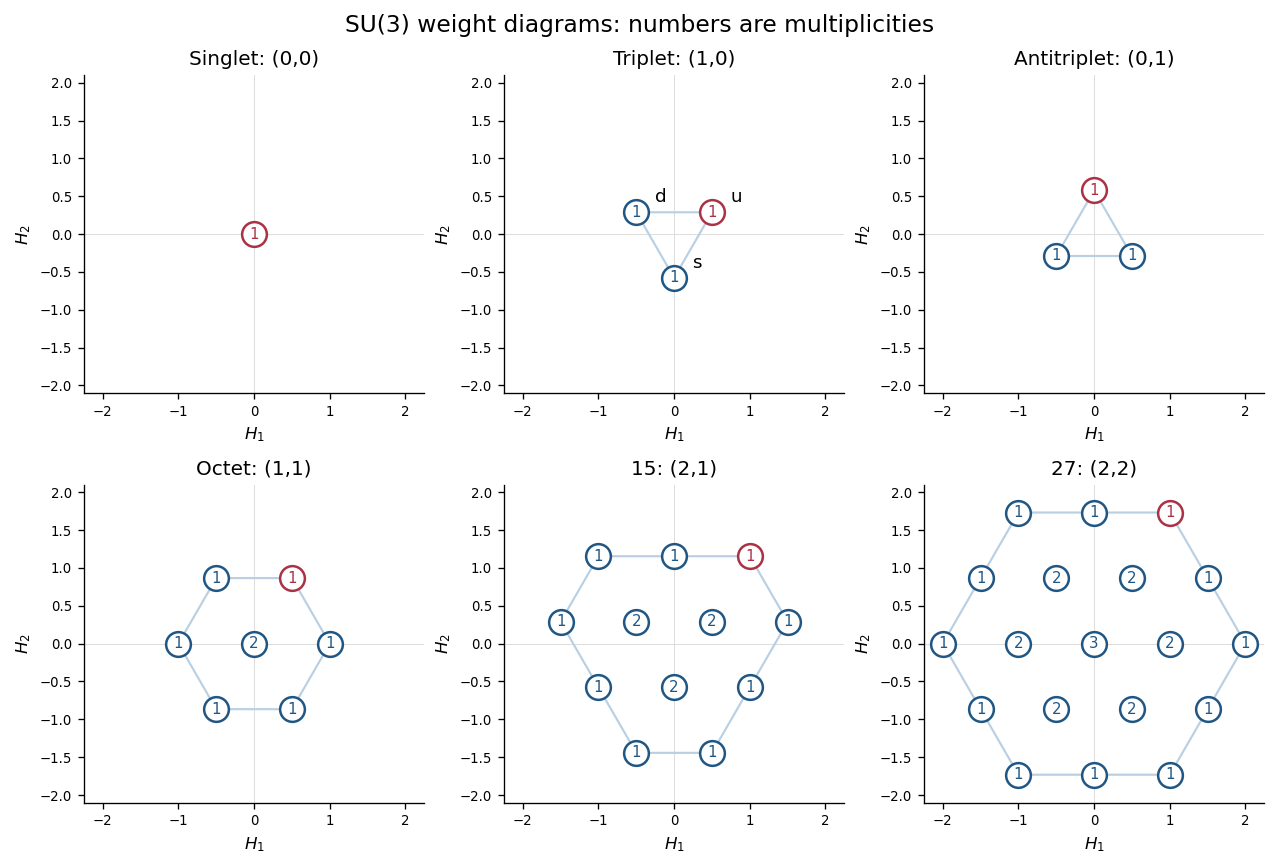
The commuting Hermitian operators can be simultaneously diagonalized. A weight of a representation is a pair for whichwhere labels independent states of that representation weight. The weight multiplicity is the dimension of this simultaneous eigenspace. Commuting past a ladder operator proveswith zero image allowed when the raised or lowered representation weight is absent.
Choose as positive simple roots. A highest-weight vector is a nonzero simultaneous eigenvector annihilated by ; the third condition follows from the first two and their commutator. In an irreducible representation, its highest weight has multiplicity one and repeated lowering generates the representation. The three root SU(2) subalgebras of SU(3) give nonnegative integer Dynkin labelsEquivalently, with and ,These are the SU(3) highest-weight coordinates in the normalization used here.
The Weyl group is generated by the reflections . The SU(2) Lie algebra root-string symmetry makes these reflections preserve both representation weights and their weight multiplicities. They generate the symmetries of an equilateral triangle: rotations through and three reflections. The outer polygon is the convex hull of the Weyl group orbit of . When it is a hexagon with alternating side lengths in root-step units; when exactly one is zero it is a triangle; when both vanish it is a point. The representation conjugate to has labels and negative representation weights. For , this gives an additional inversion symmetry and a regular hexagon with rotations. A general unequal-sided hexagon need not have that extra symmetry.
The shell multiplicities in an SU(3) weight diagram can be stated precisely. Let be the convex hull of the Weyl group orbit of . For in the root lattice coset ,representation weights outside this coset or outside the outer polygon are absent. This states that boundary representation weights have multiplicity one, each inward shell adds one, and the innermost triangular region has constant multiplicity . When the innermost region is a single point. All representation weights of a triangular diagram have multiplicity one. Counting the diagram gives . The examples below display both triangular orientations, a regular hexagon, an unequal-sided hexagon, a central multiplicity three, and the trivial diagram.

Past exam of the mathematics course of the University of Cambridge 2006 iii Paper 47 2 Solution 2026-10-14
For a weakly stationary process with mean , the autocovariance function is , independent of . The positive definiteness of these covariances gives a unique finite positive spectral measure of a stationary time series on the frequency circle. Its cumulative function is the time-series spectral distribution , with total mass , andUse one representative of the identified endpoints and when specifying atoms. For a real-valued process the measure is symmetric, so the imaginary part integrates to zero. If it has a time-series spectral density, thenThe second identity is pointwise for an absolutely summable covariance sequence, as will apply to part (a). Existence of a density alone does not guarantee ordinary pointwise convergence of its Fourier series; in general the reconstruction can be interpreted by its Cesàro means in . This fixes the frequency normalization for all three calculations below.
Past exam of the mathematics course of the University of Cambridge 2006 iii Paper 44 5 Solution Created 2026-10-14 Updated 2026-10-20
Use the usual semiparametric Cox proportional-hazards model with observed covariates :The covariates are implicit in the question's regression fit, even though the displayed data notation only lists exit times and event indicators. Assume entry at a common origin, time-constant covariates, distinct observed times and independent censoring. Write and . Conditional on a single event at in its risk set, the chance that individual supplies it isThe baseline hazard cancels. Consequently estimate by maximizing Cox partial likelihoodFor example, the score and information of Cox partial likelihood follow by differentiation. Define , and . ThenWhen a finite identifiable maximum exists, iterate until convergence. The observed Fisher information also gives the usual asymptotic coefficient uncertainty. Censored subjects enter the relevant risk sets, even though they supply no numerator event factor.
After fitting , estimate the cumulative hazard of the reference subject by the Breslow estimatorIts jump at an event is the observed event count divided by the total fitted hazard multiplier at risk. The estimate is an integrated baseline hazard, with hazard represented by a measure placing these jumps at observed event times. If a smooth ordinary hazard function is wanted, smooth these increments with a chosen kernel and bandwidth; differentiating the step function as an ordinary function would incorrectly give zero away from the jumps. The fitted individual cumulative hazard is over that individual's follow-up. The invariances below concern this Cox partial likelihood fit and this Breslow estimator; they need not hold for a fully parametric proportional-hazards fit or an arbitrarily smoothed hazard estimator.
Past exam of the mathematics course of the University of Cambridge 2006 iii Paper 42 1 Solution 2026-10-14
The empirical distribution function gives each observation mass :The Glivenko-Cantelli theorem asserts the uniform, almost sure convergenceNo continuity of the distribution function is required. Here is a proof that also handles its jumps. Let be independent uniform random variables on , and write , where . The generalized inverse property gives , so, if is the empirical distribution function of the , then .
For a fixed positive integer , the strong law of large numbers applied at each of the finitely many grid points shows that almost surely. If , monotonicity sandwiches between its endpoint values, whenceTake the probability-one intersection of these events over all . On that event the limit superior is at most for every , hence is zero. Therefore . The coupled sequence has the same joint law as any independent sample from , which proves the asserted almost sure conclusion for the original sample.
For , the sample quantile iswhere denotes the th order statistic, with repeated observations retained. Suppose the population median is unique and is continuously differentiable in a neighbourhood of , with probability density function . ThenTo see the variance directly, fix and count observations below . This count has a binomial distribution with success probability . The event that the sample median is below this point is that the count is at least . The central limit theorem for this binomial triangular array gives a limiting probability , exactly the displayed normal distribution. Centering is necessary for stating the limiting distribution; subtracting the deterministic population median has no effect on the asymptotic variance requested in the comparisons.
Past exam of the mathematics course of the University of Cambridge 2006 iii Paper 41 5 Solution 2026-10-14
Let denote the observed data, the unobserved data and the model parameters. The expectation-maximization algorithm works with the complete-data log-likelihood . Given , its E-step computeswhere the conditional expectation uses the old parameter, while remains the argument to maximize. Its M-step chooses maximizing this function over the parameter space. EM likelihood monotonicity ensures that an M-step increasing cannot decrease the observed-data log-likelihood. It does not guarantee a global maximum, so convergence and any parameter constraints must still be checked.
Past exam of the mathematics course of the University of Cambridge 2006 iii Paper 3 5 Solution 2026-10-14
Let . The subgroup correspondence for a surjective group homomorphism sends a subgroup to and a subgroup containing to . Inverse images are subgroups containing , and images are subgroups. Surjectivity gives . Conversely, if and , choose with . Then , so . Thus . These two assignments are inverse bijections.
For , the map of left coset setsis well defined and onto. If , then , so and . Hence it is injective, provingNo normality of is required; these are coset sets, not necessarily quotient groups.
The abelianization is , where the commutator subgroup is generated by the commutators . Conjugating a commutator gives another commutator, so this subgroup is normal. In the quotient all commutators are trivial, and therefore the quotient is abelian. If and is abelian, every commutator lies in , so . Henceis well defined and satisfies , where is the natural map. It is uniquely determined because is onto. This is the universal factorization property of abelianization.
Now write for the unique index- subgroup of . Since conjugation preserves index, as shown in part (ii), for every . Thus every is normal. For each prime the quotient has order and is cyclic, so there is a surjection . Being an abelian quotient, it factors through .
The abelianization is finitely generated because is. By the Fundamental theorem of finitely generated abelian groups,where is finite. If , choose a prime . The finite group could not surject onto the order- group , contradicting the preceding surjections. Hence , and projection from a free coordinate supplies
Every subgroup of finite index in has an inverse image of the same index in , so there cannot be two different subgroups of any given finite index in . If , reduction modulo a prime in the first and second free coordinates gives two distinct surjective maps to with different kernels: the first basis vector lies in one kernel but not the other. Both kernels have index , a contradiction. Therefore .
If , choose a prime dividing its order. The decomposition of a finite abelian group into cyclic factors gives a surjection . In , the mapshave distinct index- kernels, again distinguished by . This is another contradiction, so . We have proved uniqueness of finite-index subgroups forces infinite cyclic abelianization:
A residually finite group is one in which every nonidentity element has nonidentity image under some homomorphism to a finite group. Equivalently, the intersection of all finite-index normal subgroups is trivial: a finite separating map has such a kernel, and conversely quotienting by such a normal subgroup gives a finite separating map.
Choose the surjection . For each positive integer , the subgroup has index and hence equals . Its kernel is therefore contained in every finite-index subgroup. Indeed,If is residually finite, this intersection is trivial. Thus and is an isomorphism. The residually finite group with one subgroup of each finite index is infinite cyclic conclusion isResidual finiteness is used exactly to eliminate the commutator subgroup that all finite quotients would otherwise fail to detect.
Past exam of the mathematics course of the University of Cambridge 2006 iii Paper 24 4 Solution 2026-10-14
For an adjunction , with unit and counit , call the adjunction idempotent when the multiplicationof its induced monad is invertible. We show that this idempotent adjunction condition is equivalent to invertibility of , the comultiplication of the induced comonad.
For an idempotent monad , the unit laws implyIf is a monad algebra, naturality of the unit and its algebra unit law giveThus is an isomorphism. Apply this to the canonical algebra : its unit law is a triangle identity for an adjunction. It follows that , and therefore , is invertible for every . Hence is invertible.
Apply the same argument to the dual adjunction . It gives the converse. Idempotence is self-dual: the induced monad is idempotent exactly when the induced comonad is idempotent. In particular, idempotence requires the unit to be invertible on every object in the image of the right adjoint.
Past exam of the mathematics course of the University of Cambridge 2006 iii Paper 2 6 Solution 2026-10-14
Fix a finite-dimensional nonnegative filtration of a ring giving its almost commutative algebra structure, and choose a good filtration of a module on . When is a standard graded algebra, the Hilbert-Serre theorem makes the cumulative Hilbert function eventually a polynomial. For , define the dimension of a filtered module and multiplicity of a filtered module byUse and . With positive weighted generators instead of a standard grading, the cumulative Hilbert function is eventually a quasipolynomial with a common positive leading coefficient across residue classes. Equivalently, , and the definitions are and . The common leading coefficient follows from monotonicity: interlacing consecutive residue classes forces their leading coefficients to agree. For a standard grading, multiplicity is a positive integer, since an integer-valued polynomial has an integral expansion in the binomial polynomials; weighted normalization can instead give a positive rational number.
Two good filtrations of a module for this fixed algebra filtration bound each other after fixed index shifts. The corresponding Hilbert functions therefore satisfy for fixed . Comparing their leading growth shows that the degree and leading coefficient agree. Thus and are independent of the module filtration; the fixed algebra filtration is part of the multiplicity convention.
For a submodule , use its subspace filtration and the quotient filtration on . These are good because is Noetherian. The short exact sequence of filtered pieces givesNonzero leading coefficients are positive, soIf , those leading coefficients add andThis is dimension and multiplicity in a filtered exact sequence.
For the Weyl algebra in characteristic zero, Bernstein inequality for Weyl algebra modules asserts for every nonzero finitely generated module . Write its generators as , with and all other generator commutators zero. The ordered monomials give the Bernstein filtrationTake a finite-dimensional generating subspace of and put .
To prove faithful finite-step action of a Weyl algebra, consider and choose a nonzero coefficient of a monomial of maximal total degree . Applying to givesIndeed, these commutators differentiate the ordered coefficients: lower-degree monomials vanish, and another degree- monomial can survive only if all its exponents dominate , which forces equality. This is scalar extraction by iterated Weyl commutators.
Expanding these iterated commutators writes with . If annihilated , every summand would annihilate , contrary to . Therefore the action map is injective:Taking dimensions and comparing polynomial degrees giveswhich proves Bernstein inequality for Weyl algebra modules. The polynomial representation has dimension , so the bound is sharp.
The associated graded ring of the Weyl algebra is a polynomial ring, so ascending filtered-graded transfer of Noetherianity makes a left Noetherian ring. Thus every submodule of a finitely generated module is finitely generated. If , every nonzero subquotient has dimension at most by the exact-sequence formula, and at least by Bernstein inequality for Weyl algebra modules. Every such subquotient therefore has dimension and positive integral multiplicity.
In a strictly descending chain , each nonzero quotient consumes at least one unit of multiplicity, by dimension and multiplicity in a filtered exact sequence. Hence there are at most strict steps. This proves the descending chain condition, so is Artinian. In fact this holonomic Weyl algebra module has module length at most , as in multiplicity bounds the length of a holonomic Weyl module.
Past exam of the mathematics course of the University of Cambridge 2006 iii Paper 2 5 Solution 2026-10-14
The prime radical of a noncommutative ring is , with ranging over all prime ideals of a noncommutative ring. Here primeness means that for two-sided ideals , implies or . A minimal prime over an ideal is a prime ideal containing with no strictly smaller prime ideal containing .
The ascending chain condition on left ideals also applies to two-sided ideals. We first prove by Noetherian induction that every proper contains a finite product of prime ideals, each containing . If there were counterexamples, choose a maximal one. It is not prime, so there are strictly larger two-sided ideals with . Neither is a counterexample; products of prime ideals contained in and in then concatenate to a product contained in , a contradiction.
Write . Every prime ideal over contains at least one , by primeness. The inclusion-minimal members of the finite list are therefore precisely the minimal primes over an ideal : any smaller prime over would contain a member of that same list. Consequently there are finitely many. Replacing each factor by a minimal prime contained in it giveswith each minimal over . Repeated factors may be necessary; in the sole minimal prime requires its th power to reach zero.
Apply this to . Since for every ,Thus the prime radical is a nilpotent ideal, as in finite minimal primes and nilpotent prime radical.
Now assume is commutative. A prime ideal is an associated prime of a module when for some . Every nonzero module over has an associated prime: the ascending chain condition gives a maximal annihilator of a nonzero element, and maximal annihilator of a module element is prime.
Since the given is a Noetherian module, repeatedly choosing such a cyclic submodule in the next quotient yields a finite prime filtrationThe process terminates by the ascending chain condition. In a short exact sequence , one has . Indeed, if and , the image of in still has annihilator . Otherwise choose ; then , and primeness gives . As , induction along the prime filtration provesIn particular there are only finitely many associated primes of a module.
Finally let be a minimal prime ideal of . Its localization at a prime ideal has exactly one prime, its maximal ideal . The preceding nilpotence result makes this maximal ideal nilpotent. Choose annihilated by , for example a nonzero element in its last nonzero power, or if . Since elements outside the maximal ideal are units, .
Write . The element is nonzero and also has annihilator . Generate by . For each , choose with , and put . Then remains nonzero after localization, while . If , localization forces , and hence . Therefore . This proves that minimal primes are associated primes.
Past exam of the mathematics course of the University of Cambridge 2006 iii Paper 2 4 Solution 2026-10-14
A filtration of a ring is an exhaustive increasing family of additive subgroups , indexed by the integers, with and . A compatible filtration of a module on a right module satisfies . The associated graded module has components , and its action by the associated graded ring isChanging either representative changes the product only by an element of , so the action is well-defined.
The subspace filtration on is . The quotient filtration is . Inclusion induces an injective map , and the quotient induces a surjective map to . If maps to zero in its degree- quotient, write with and . Then , so the kernel is exactly the image of . We have the short exact sequencewhich is exactness of associated graded modules for induced filtrations.
For the negative case, for . Completeness means that is an isomorphism; in particular the filtration of a ring is separated. If and , then . The geometric seriesconverges in the complete negative filtration and is a two-sided inverse of , by the finite geometric identity and continuity of multiplication. The unit criterion for the Jacobson radical now gives
Let be any right ideal. The associated graded module for its subspace filtration is a homogeneous ideal on the right in . If is a right Noetherian ring, choose homogeneous generators that lift to , with degrees .
For , cancel its degree- symbol by a sum with . The remainder belongs to . Repeat the cancellation in each succeeding degree. After steps,For every , the coefficient series converges to some by completeness. Passing to the limit gives . Thus these finitely many generate the actual right ideal ; no assumption that is closed is needed. Since every right ideal is finitely generated, is right Noetherian, by complete negative filtered-graded transfer of Noetherianity.
Past exam of the mathematics course of the University of Cambridge 2006 iii Paper 17 2 Solution 2026-10-14
The affine module sheaf construction makes the remaining statements explicit. For and an -module , defineon the basis of principal open subsets. Restrictions are the natural localization maps. Equivalently, a section on an arbitrary open set is a family which near each point is represented by a single fraction , with nonvanishing throughout that neighbourhood. This locally representable family construction gives a sheaf; the usual localization gluing verifies its quasi-coherence. Its stalk is andThis last identification is precisely the standard module-localization gluing on the affine basis, not an assertion that arbitrary sheaves are determined by their global sections.
Now write , and . Let , for -modules , and let for a -module . The affine versions of the three constructions areHere denotes restriction of scalars along , whereas the last associated sheaf lives on . To verify the tensor-product assertion, localize at every prime: both stalks are . For the direct image, , andThese equalities identify the sheaves on a basis and respect restrictions. For the pullback of a sheaf of modules, its stalk at is , exactly the stalk of . The local tensor maps are compatible, so these stalk identifications come from an actual sheaf isomorphism. Thus all three constructions are quasi-coherent in the stated affine setting.
Finally construct the natural projection formula for sheaves map by sending a local tensor to in the pulled-back module, followed by direct image. In the affine description, the target is the sheaf associated with the -module , while corresponds to . The mapsare inverse -linear maps. Localizing them commutes with every restriction, provingNo flatness assumption on or finiteness assumption on is needed.
Past exam of the mathematics course of the University of Cambridge 2006 iii Paper 14 5 Solution 2026-10-14
The general, or asymmetric Lovász local lemma, is as follows. Let be events, with a dependency graph of events having neighbour sets . Each must be independent of the sigma-algebra generated by all the events indexed by its nonneighbours. If numbers satisfythenFor completeness, the key inductive bound is whenever . Split into neighbours of and nonneighbours . If is empty, the dependency condition gives the bound directly. Otherwise,The denominator bound follows by exposing the exclusions in one at a time and using the induction hypothesis with strictly fewer conditioning events. The same induction ensures that all conditioning events have positive probability. Finally multiply the successive conditional probabilities of avoiding to obtain the stated lower bound.
For the symmetric form, suppose each event has probability at most and the dependency graph has maximum degree . Choose . ThenThe final inequality follows from . Thus suffices for positive probability that no bad event occurs. If , the dependency condition gives joint independence and the same criterion implies , so the conclusion follows directly.
Apply this to a fair independent two-colouring of the hypergraph vertices, with the event that hypergraph edge is monochromatic. Its probability is . Events on disjoint hypergraph edges use disjoint independent variables, giving a dependency graph by joining intersecting hypergraph edges. Each hypergraph edge meets at mostother hypergraph edges; repeated counting only enlarges this upper bound. The slightly looser bound is enough for the printed condition. Indeed,The symmetric Lovász local lemma therefore gives a proper two-colouring. A hypergraph with no hypergraph edges is trivially colourable and needs no dependency calculation.
Past exam of the mathematics course of the University of Cambridge 2006 iii Paper 14 4 Solution 2026-10-14
For the unheaded degree-one continuation, write , where indicates that vertex has degree one. Withwe haveFor distinct vertices , separate the cases where their connecting edge is present or absent. If it is present, all their other incident edges must be absent. If it is absent, each vertex chooses its unique neighbour among the other vertices; those two neighbours may coincide. The respective edge constraints are independent even in that case. ThusDividing by gives the exact ratioThe first term tends to zero because has order ; the second tends to one. Consequently its variance satisfiesThe Chebyshev inequality now yields . A vertex of degree one exists with high probability, even though the limiting probability of having an isolated vertex is strictly between zero and one.
Past exam of the mathematics course of the University of Cambridge 2006 iii Paper 14 2 Solution 2026-10-14
We use the random alteration method, controlling large hypergraph independent sets and then removing the few forbidden overlaps. Fix , let tend to infinity, and independently include each three-element subset of an -vertex set as an hypergraph edge with probability . Call the resulting three-uniform hypergraph , and let .
For any prescribed -vertex set, the probability that it is a hypergraph independent set is . Hence the union bound givesbecause has order , with a positive constant depending only on .
Let count unordered pairs of distinct hypergraph edges meeting in two vertices. Each potential pair consists of its common pair and two distinct additional vertices, soThe Markov inequality implies . We may therefore fix one realization for which and no -vertex hypergraph independent set exists. For each offending hypergraph edge pair choose one vertex from its union, and let be the set of all chosen vertices. Delete , together with all incident hypergraph edges, and call the induced hypergraph . Then , so . The next two parts verify both desired properties of this same .
Past exam of the mathematics course of the University of Cambridge 2006 iii Paper 13 1 Solution 2026-10-14
For the unheaded existence request, use the probabilistic method. Choose every value independently and uniformly from . For a rectangle with and , its four entries are distinct, so independence and the zero mean of each sign give expectation zero for their product. If or , the product is identically one. The number of ordered rectangles in this union of diagonal cases isTherefore the random sign rectangle fourth moment has expectationSome sign function has at most this expectation. Applying the bound in part (a) to that same function gives the simultaneous choicesBoth constants tend to zero whenever both dimensions tend to infinity, without any assumption on their relative rates of growth.
There are unlisted articles, also show them or only show them.