
Past exam of the mathematics course of the University of Cambridge 2005 ii Paper 2 16F Solution 2026-10-14
The inductive definition of ordinal addition isfor nonzero limit ordinals . The synthetic definition is the order type of a disjoint copy of followed by a disjoint copy of , retaining the order within each block and declaring every element of the first block smaller than every element of the second.
These are equivalent by transfinite induction in the second argument. An empty second block leaves ; a successor block appends one final point; and a limit block is the increasing union of its proper initial blocks, whose order types have the indicated supremum. Thus the synthetic construction satisfies exactly the inductive recursion, which determines the operation uniquely. It is not commutative: , whereas .
Past exam of the mathematics course of the University of Cambridge 2005 ii Paper 2 14B Solution 2026-10-14
Let the three orbit points be . Up to reflection of the interval, their images are . Set and . Continuity and the intermediate value theorem imply the covering relationsWe first prove the needed interval-covering principle using the permitted pullback fact. If a cyclic list of closed intervals obeys , pull back successively from the end to obtain a closed interval with and . Since , the intermediate value theorem gives a fixed point of in : choose preimages of the two endpoints of , which give opposite weak signs of , irrespective of their order. This point realizes the cyclic itinerary.
For , use the word . It obeys the covering relations and therefore yields a point with period dividing . A point away from the shared endpoint has an unambiguous itinerary, and this word has exactly one per cycle; it cannot be a repetition of a shorter word. Its least period is consequently . If an orbit touches , it is the original three-cycle. That realizes the case itself. It cannot realize any of the other words: for not divisible by three it is not fixed by , and for a multiple of three larger than three it visits more than once, contradicting the itinerary. Thus the construction works for every . For , and the same fixed-point argument gives a fixed point. This proves period three implies all periods: there is an orbit of every positive least period.
For the two five-cycles forced by a three-cycle, use the two cyclic words and . Both are admissible. Their points cannot be endpoints from the three-cycle, and because five is prime and the words use both intervals, each has least period five. Their itineraries have respectively one and two visits to the interior of ; cyclically shifting the starting point cannot change this count. Hence they give at least two distinct period-five orbits.
Past exam of the mathematics course of the University of Cambridge 2005 ii Paper 1 36E Solution 2026-10-14
For steady unidirectional pressure-driven channel flow, write . The axial momentum equation and no-slip boundary condition areNear an ideal wedge, the constant forcing has an particular solution by scaling. Substitution gives , with . For , the symmetric particular solution isThis corner expansion of pressure-driven sector flow is a particular solution, not necessarily the dominant corner term; a homogeneous corner mode can be larger, as the requested cases below show.
Separation of the symmetric harmonic correction with zero values on the straight walls gives modes , whereRegularity at the vertex excludes negative powers. Orthogonality on has norm . To cancel the particular solution on , use its cosine coefficientsThe integral follows by product-to-sum and . ThusThe arc data are satisfied by the cosine expansion, and the Poisson equation by construction. At the omitted thresholds , a mode has , so the pure ansatz is resonant. The corresponding finite-limit term in the full sector solution is ; the other modes remain regular. This explains rather than hides the division by .
Past exam of the mathematics course of the University of Cambridge 2005 ib Paper 4 4A Solution 2026-10-14
For a closed piecewise continuously differentiable path avoiding , the winding number isBreak the parameter interval at the finitely many derivative discontinuities when evaluating this integral. Translating the curve gives , which will also be used below.
Past exam of the mathematics course of the University of Cambridge 2005 ib Paper 3 3B Solution 2026-10-14
A function is a differentiable function at if there is a linear map withThe map is its derivative; equivalently for fixed constants. Since every such linear map is bounded, . This proves differentiability implies continuity, not merely continuity along each coordinate axis.
Past exam of the mathematics course of the University of Cambridge 2005 ib Paper 1 5E Solution 2026-10-14
For a two-dimensional incompressible flow , the continuity equation is . Locally, or globally on a simply connected fluid region, this permits a streamfunction withIndeed, the one-form is closed by incompressibility and hence is locally the differential of . Conversely these expressions automatically give zero divergence by equality of mixed derivatives.
A streamline at a fixed time is tangent to the instantaneous velocity field. Along it,Thus streamlines are connected curves on which the streamfunction is constant; wherever , the level curves have exactly the required tangent direction. At a stagnation point, the tangent is degenerate and distinct branches of a level set need not form a single streamline. For unsteady flow this argument fixes time: it does not identify streamlines with particle pathlines.
Past exam of the mathematics course of the University of Cambridge 2005 ia Paper 1 5C Solution 2026-10-14
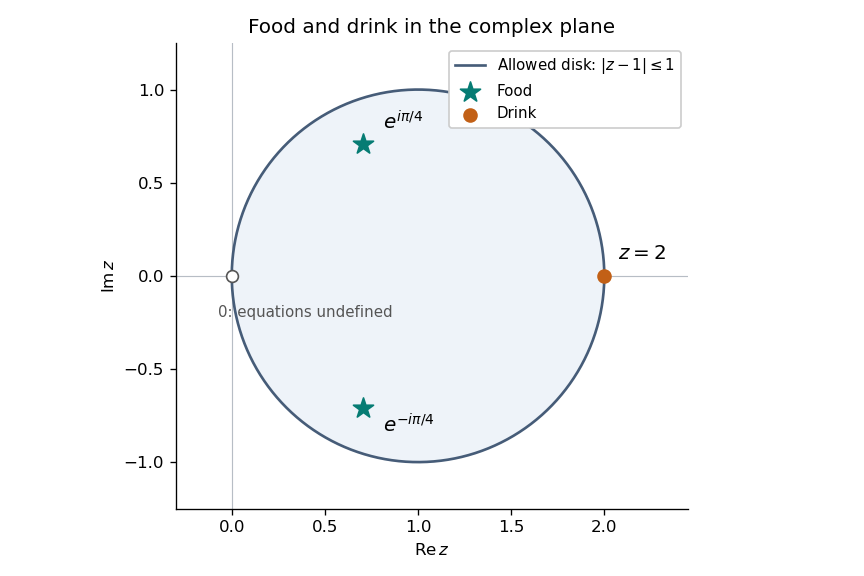
For the unheaded continuation, set in the food equation. The two square roots are , so exponentiating givesBoth values have and hence lie strictly inside the disk. Both also have the indicated principal logarithms. Allowing the multivalued complex logarithm produces no additional points: the only permitted values of are still the two square roots already used.
For drink, the PDF squares only the denominator. Put . Its numerator is and its unsquared denominator is , which is nonzero unless . Multiplying the equation by this denominator squared and equating the real part and imaginary part yieldsthat is and . If , the real equation gives or , and zero is excluded. If , then , but the real equation would require , impossible for real . ThusIt lies on the allowed disk boundary, and direct substitution gives . The denominator-only square matters: squaring the entire quotient would define a different locus.

Past exam of the mathematics course of the University of Cambridge 2005 ia Paper 1 1C Solution 2026-10-14
For the unheaded continuation, write the vector triple product asThe Levi-Civita symbol contraction is . One way to check its sign is to fix distinct : the only nonzero term has the remaining index, and the pairs contribute respectively. When , both sides vanish. Contracting with the vectors now gives both requested notations:If and are orthogonal, then . With the specified , the perpendicularity of the cross product gives . ThereforeThe same answer covers the degenerate case in which one of these two vectors is zero.
Past exam of the mathematics course of the University of Cambridge 2004 iii Paper 73 4 Solution 2026-10-14
Let be the eddy momentum flux, the eddy density flux, and . The PDF's hydrostatic equation is ; the converted TeX mistakenly replaces the pressure derivative by a density derivative. With , defineThe residual mean circulation is nondivergent because . Substituting in the original mean momentum and density equations gives the transformed Eulerian mean equationswith the unchanged geostrophic and hydrostatic balances. Here the Eliassen–Palm flux components areThe eddy buoyancy flux has been absorbed into the residual transport, while both types of wave forcing enter the momentum equation through the Eliassen–Palm flux divergence.
For geostrophic disturbances, the Taylor identity for quasi-geostrophic flux givesFor example, zonal averaging removes and converts the remaining horizontal and vertical terms in into derivatives of and , giving precisely the displayed fluxes.
Locally, for a basic flow with nonzero meridional PV gradient , the quasi-geostrophic wave pseudomomentum is . Multiplying the linear perturbation PV equation by giveswhere is a PV source or sink. In a locally uniform conservative Rossby wave packet, . Thus the flux tracks group velocity rather than the generally different phase velocity, with a signed wave activity if .
The non-acceleration theorem for quasi-geostrophic waves states that statistically steady conservative waves, with no wave-activity sources, sinks or independent boundary forcing, produce no balanced mean acceleration. Their flux divergence vanishes. In the present stable, impermeable mean-flow problem the homogeneous residual-circulation equation then has the zero solution, so and . The Eulerian mean flow can still circulate because its eddy-induced correction need not vanish. Dissipation, absorption at a critical layer, time-dependent wave activity or boundary forcing produces a nonzero flux divergence and invalidates the non-acceleration conclusion.
Past exam of the mathematics course of the University of Cambridge 2004 iii Paper 72 4 Solution 2026-10-14
For antiplane shear, the infinitesimal displacement is . The isotropic linear elasticity constitutive law gives and , together with the symmetric entries . All other stress tensor components vanish. Static force balance without body force becomes , so satisfies the Laplace equation.
Locally choose a harmonic conjugate by and . Compatibility follows from the Laplace equation. These are the Cauchy-Riemann equations for , and henceThus the complex stress potential for antiplane shear supplies both stresses and, by integration, the displacement. A global potential must have the displacement periods appropriate to the cracked body; these periods also help fix homogeneous solutions.
For the additional crack-induced field, set and . Only loads the prospective faces, since is tangential to their normal. Denote upper and lower boundary values by . The imposed cancellation of face tractions is . The traction data and geometry are invariant under the displacement reflection . For the induced correction with no independently added loading, uniqueness up to a rigid translation allows the odd displacement choice. Then is even, is odd, and on the real axis. Therefore the Hilbert problem for an antiplane crack isThe second condition expresses continuation through uncracked material. There is real and the additional vanishes. This scalar Riemann-Hilbert problem is supplemented by at most inverse-square-root stress singularities at the crack tips and the usual correction with no additional remote resultant or imposed dislocation. Without a far-field or period normalization, the face conditions alone permit homogeneous terms. The formulas below select this normalized induced field and explicitly identify the excluded terms.
Past exam of the mathematics course of the University of Cambridge 2004 iii Paper 72 3 Solution 2026-10-14
Work in the fixed reference domain , and write . For the unconstrained hyperelastic material considered here, the material-first nominal stress is . The increment of the deformation gradient and the incremental elastic moduli areAll coefficients are evaluated at the base deformation. The Hessian symmetry is ; minor interchange symmetry is unnecessary. Linearizing the momentum equation givesThe reference mass density and reference outward unit normal vector are fixed, so the incremental boundary conditions areIn particular, no variation of a current surface normal belongs in this material-coordinate traction condition. If a material constraint were imposed, one would additionally linearize its constraint reaction in hyperelastic stress and its admissibility equation; the present moduli formula is the unconstrained one.
Past exam of the mathematics course of the University of Cambridge 2004 iii Paper 50 3 Solution 2026-10-14
For the unheaded extended-algebra request, fix the central-charge normalization explicitly:The central charges are scalar numbers on an irreducible massive representation. A unitary skew-diagonalization of an antisymmetric matrix puts into two-by-two blocks and, for odd , a leftover zero entry. Since this change of supercharge basis is unitary, it preserves the mixed anticommutator. Go to the rest frame .
For one block set and , with . Direct use of the algebra givesWrite and form the combinations suggested by the hint:ThenEach diagonal anticommutator has nonnegative expectation because it is the sum of squared norms of an operator and its adjoint. Therefore for every block, provingIf the algebra is instead written with without the factor two, the same proof gives . This is the normalization used by some definitions of the BPS bound in supersymmetry; the physical bound is unchanged by the naming of the central charge.
A massive BPS state saturates at least one block bound. At saturation , so both and annihilate every state in its multiplet. The two complex inactive oscillators are four preserved real supersymmetries per saturated block. If blocks saturate, the preserved fraction is and only complex fermionic oscillators remain active. For a spin- Clifford vacuum,compared with for a long massive multiplet. Thus BPS states have an exact mass-charge relation, preserve part of the supersymmetry, and belong to shortened representations. A physical CPT-invariant spectrum may additionally require the conjugate-charge multiplet. The short representation protects the saturated mass relation while it exists; it does not prohibit a decay at a threshold where central-charge phases align and the sum of daughter masses equals the bound.
There are unlisted articles, also show them or only show them.