
Upper hemicontinuity Created 2026-10-14 Updated 2026-11-05
A set-valued mapping is upper hemicontinuous at when every open set containing also contains for all in some neighborhood of . Empty values are permitted. For a single-valued map this is the usual neighborhood definition of continuity.
If is compact and the graph of a set-valued mapping is closed, upper hemicontinuity follows without a sequential-countability assumption. For each , the point is outside the closed graph, so there is a product neighborhood disjoint from it. Finitely many cover the compact set . Intersect their : every nearby value is then contained in .
Countable union 2026-10-14
Finite union Created 2026-10-14 Updated 2026-10-25
A finite union is a union of finitely many sets. The indexing set is finite; its member sets need not be finite sets. The union of an empty indexed family is the empty set.
Countable intersection 2026-10-14
The countable intersection of a sequence of sets contains exactly the elements belonging to every set. De Morgan's laws identify its relative complement with the union of their complements.
Disjoint sets 2026-10-14
Finite intersection 2026-10-14
A finite intersection is an intersection of finitely many sets. The indexing set is finite, regardless of the size of the intersected sets. For an empty indexed family of subsets of a specified ambient set , the convention is that the intersection equals .
Finite additivity of a set function Created 2026-10-14 Updated 2026-11-05
A real-valued set function on an algebra of sets is finitely additive whenfor disjoint members of the algebra. Taking both sets empty gives , and induction extends the identity to every finite disjoint union.
On the full power set of a finite set , every subset is a disjoint union of singletons, soThus arbitrary signed weights on the points describe exactly these finitely additive set functions. Summing the pointwise indicator function identity for the inclusion-exclusion principle against those weights gives the corresponding identity for .
The full-power-set qualification matters: on the smaller algebra , the value does not specify or , because the singletons are outside the domain. One must not apply the singleton formula to undefined values.
First come first served 2026-10-14
A queue serves customers in arrival order. For multiple classes, retaining this order generally requires an ordered multiclass single-server queue state, rather than only a vector of class counts.
Processor sharing 2026-10-14
A nonempty server divides its capacity equally among all customers present. With class- exponential service parameter , population , and total population , the class departure rate is . The resulting class-count process is a continuous-time Markov chain.
Symmetric service discipline 2026-10-14
In an ordered queue, let be the fraction of service capacity assigned to position when customers are present. A symmetric discipline inserts an arrival into position with probability . The same position rule for service and insertion makes transitions satisfy detailed balance for the word weights . It accommodates class-dependent exponential service rates; processor sharing is an example.
First Rankin-Cohen bracket 2026-10-14
For modular forms of weights , respectively, the displayed combination cancels the anomaly in derivative transformation of a weak modular form and is a weight- cusp form. Equivalently, for weights in the order , a conventional first bracket is ; its negative is equally modular. Differentiation kills each constant Fourier coefficient, proving cusp vanishing.
Polynomial-logarithmic series convergence 2026-10-14
For , the positive series converges precisely when , or and . For use comparison with a convergent p-series; for , the bound gives a lower comparison with a divergent p-series. At , the integral test for convergence and reduce the question to . In contrast, diverges for every finite , since eventually and diverges.
Factorial series 2026-10-14
A factorial series with digits is an absolutely convergent series of real numbers between zero and one. The telescoping series identityshows that its largest possible tail after place is . Multiplying this tail by gives a number between zero and one, a useful arithmetic constraint on rational numbers.
Summation method 2026-10-14
A rule for assigning a value to some series through a specified limiting operation. It must say which series belong to its domain; different rules can have different domains. A regular summation method agrees with ordinary summation for every convergent series.
Divergent series Created 2026-10-14 Updated 2026-10-18
A series whose partial sums do not have a finite limit of a sequence. They may grow without bound or oscillate. Some divergent series belong to the domain of a summation method, such as Cesàro summation.
Bitstream 2026-10-14
Cluster-set matching of bounded sequences 2026-10-14
Two bounded real sequences with the same set of subsequential limits admit permutations that match their terms with differences tending to zero. Alternate between taking the least unused index of the first sequence and of the second. Match its value to an unused term of the other sequence near a nearest common cluster point, with additional error at most at stage . Every cluster-point neighbourhood contains infinitely many available terms. The actively chosen indices tend to infinity, whose distance to the common cluster set tends to zero by boundedness. By step , both lists have included every index up to .
Thue–Morse sequence Created 2026-10-14 Updated 2026-10-20
Here is the sum of the binary digits of the nonnegative integer . The sign version is . Concatenating binary digits gives for . It supplies cancellation controlled by binary blocks rather than multiplicative factorization.
Recurrence relation 2026-10-14
A recurrence relation specifies members of a sequence in terms of previous members, together with enough initial values to determine the sequence. A three-term recurrence for orthogonal polynomials relates consecutive orders. For example, the physicists' Hermite polynomials satisfy , starting from and .
Limit inferior and limit superior 2026-10-14
The limit inferior and limit superior retain the lower and upper long-run behaviour of a real sequence, even when it has no ordinary limit of a sequence. For each tail of a sequence beginning at , defineDiscarding more initial terms raises or preserves the infimum and lowers or preserves the supremum. Hence is nondecreasing and is nonincreasing. Their limits exist in the extended real number line:For a bounded sequence, both values are finite and . These bounds use the entire infinite tail of a sequence, rather than the last few observed terms. [ref]
https://ocw.mit.edu/courses/18-100a-real-analysis-fall-2020/mit18_100af20_lec92.pdf. MIT 18.100A, Lecture 9, Definition 3 and Theorem 4: tail bounds and monotonicity
.Take the original example , beginning . The subsequence at even integers decreases toward one, while the subsequence at odd integers increases toward minus one. If is the first even integer at least and is the first odd integer at least , thenThus and . The finite initial extreme disappears from later lower bounds; neither long-run value is attained by any term of this example.
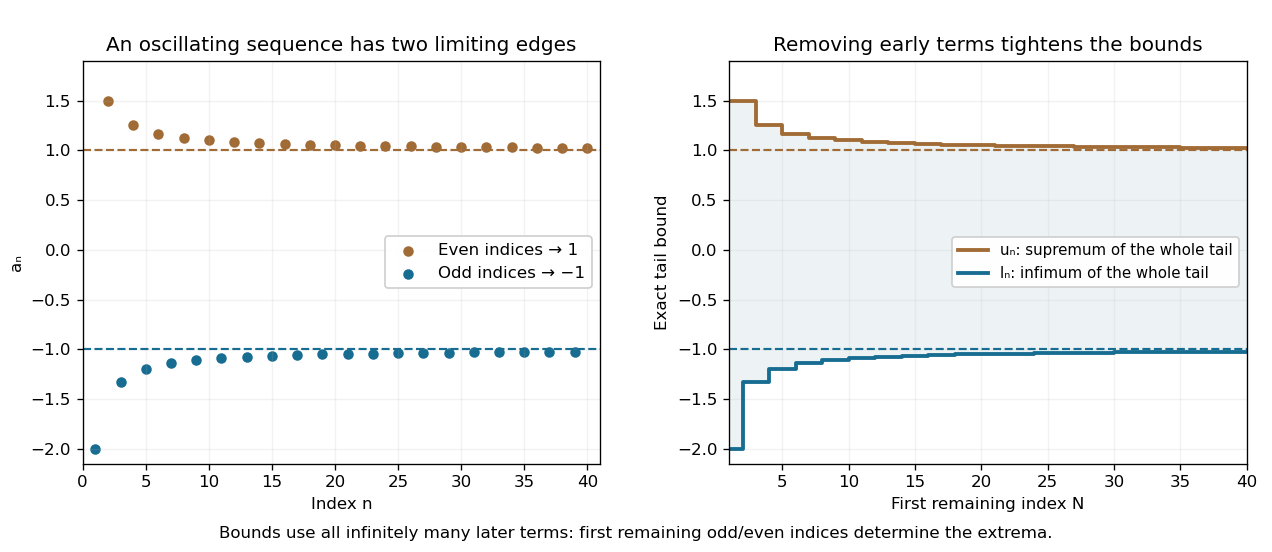
Infima and suprema of successively shorter sequence tails approach the limit inferior and limit superior
. The original sequence alternates beyond both limiting levels. The exact bounds are determined by the first remaining odd and even indices, producing monotone stair-step envelopes. Although only a finite portion is drawn, these formulas describe every infinite tail. Details.
For a bounded sequence, the limit inferior is the smallest subsequential limit and the limit superior is the largest subsequential limit; both are reached by suitable convergent subsequences. Every other subsequential limit lies between them. In the example there are only two subsequential limits, and : a convergent subsequence cannot retain infinitely many terms of both parities, because those two branches stay separated. The whole interval between the two bounds need not consist of subsequential limits. [ref]
2.3 Limit superior, limit inferior, and Bolzano–Weierstrass. Lebl, Basic Analysis I, §2.3: extreme subsequential limits
.A finite ordinary limit of a sequence exists exactly when the limit inferior and limit superior agree at the same finite value . The bounds and the squeeze theorem prove the sufficient direction. For a bounded sequence, its tail diameter of a sequence is , so the limiting gap is zero exactly when the Cauchy sequence condition holds. In the example the gap approaches two, not zero. The same framework allows infinite bounds: has both values , whereas has limit inferior and limit superior . Equality at infinity describes escape rather than convergence to a real value. [ref]
2.3 Limit superior, limit inferior, and Bolzano–Weierstrass. Lebl, Basic Analysis I, §2.3: equality of finite bounds and extended limits
. There are unlisted articles, also show them or only show them.