
Smooth vector Created 2026-10-14 Updated 2026-11-05
A smooth vector in any abstract group representation of a locally profinite group has an open stabilizer, equivalently is fixed by some compact-open subgroup. Smooth vectors form an invariant linear subspace: use intersections for addition and conjugation for translation. A smooth representation is one in which every vector has this property.
Transversality of a map to a submanifold 2026-10-14
A smooth map is transverse to an embedded submanifold whenThis is a sum of vector subspaces, not necessarily a direct sum. Equivalently the composition of with the quotient to is surjective. In a slice chart for an embedded submanifold of codimension , the normal coordinate functions composed with have surjective derivative on their common zero set. If the preimage is empty the condition holds vacuously.
A continuous map from a smooth manifold to can be approximated by a smooth map with any prescribed positive continuous pointwise error bound. In coordinate charts, smoothing by local convolution and then combining with a smooth partition of unity gives the approximation. On a compact subset of an open chart domain, a smooth cutoff allows the resulting straight-line homotopy to be supported in that domain. This permits the Sard theorem to be used after approximation; the original continuous map can be space-filling and need not omit a point.
C1 metric on a smooth mapping space 2026-10-14
For smooth maps from a compact manifold with a fixed Riemannian metric to Euclidean space, the displayed metric measures uniform convergence of maps and their first derivatives. For a manifold embedded in Euclidean space use its induced metric. Different fixed metrics give equivalent topologies on a compact domain.
Stability of compact smooth embeddings 2026-10-14
A smooth embedding of a compact manifold remains an embedding under sufficiently small C1 metric on a smooth mapping space perturbations. A positive uniform lower bound on its differential preserves immersion. Finite coordinate neighborhoods give uniform local injectivity for nearby maps, and compactness separates the remaining pairs of points. A uniform second-derivative bound gives an explicit local Taylor estimate, although it is not necessary for the C1 openness statement.
Choose finitely many coordinate charts on a compact manifold and smooth functions supported in them, positive on a cover. Extend the displayed chart products by zero. A positive first coordinate and its matching chart coordinates separate points, while their derivatives detect every nonzero tangent vector. Thus the map is an injective immersion; compactness makes it a smooth embedding. Extra zero coordinates make its codimension positive if required.
Function spectrum 2026-10-14
Capillary height-difference correlation 2026-10-14
For a tension-dominated membrane with internal dimension , the massless Gaussian height covariance has spectrum . Removing the uniform translation mode leaves the height difference well-defined. Its variance grows linearly with distance for , logarithmically for , and approaches a cutoff-dependent constant for . A microscopic cutoff is necessary when the short-distance integral diverges. This distinguishes rough positional order from a failure of the local small-slope approximation.
Slip line Created 2026-10-14 Updated 2026-11-05
A slip line is a characteristic curve of a yielded plane-strain plastic equilibrium system. The two orthogonal families carry stress and velocity compatibility relations. Their directions need not agree with principal stress directions.
Stress characteristics for an anisotropic yield curve Created 2026-10-14 Updated 2026-11-05
Parameterize a fixed yield surface by stress-space arc length with and . For mean normal stress , force balance gives , where . Its eigenvectors along angles and have eigenvalues and , proving the displayed slip line invariants.
Geiringer velocity relations Created 2026-10-14 Updated 2026-11-05
For an associated flow rule in the reduced plane-strain yield coordinates, the rate-of-strain tensor has zero extension along both slip line directions. Write velocity as , with the local orthonormal axes turning through angle . Differentiating along an curve gives longitudinal extension ; along a curve it gives . Setting these extensions to zero proves the relations for the corresponding anisotropic yield surface parameterization.
Hencky stress relations Created 2026-10-14 Updated 2026-11-05
In plane strain perfect plasticity with , and , equilibrium givesThe slip line tangent directions and are eigenvectors with eigenvalues . Taking directional derivatives proves the two Hencky stress relations. These sign choices must be changed consistently if the shear-stress convention changes.
Uniform-pressure evolution of a slender viscous bubble Created 2026-10-14 Updated 2026-11-05
A periodic slender bubble with and negligible internal pressure variation has exterior radial velocity and pressure . Its conserved mean cross-sectional area gives . Comparing the constant and sinusoidal terms gives the displayed equations. The long-wave growth rate about radius is , and . Small internal viscosity eventually produces appreciable axial pressure gradients near a neck, so this uniform-pressure reduction cannot persist to pinch-off at fixed positive viscosity ratio.
Lubrication equation for a bubble with viscous exterior Created 2026-10-14 Updated 2026-11-05
Internal Hagen-Poiseuille flow of viscosity has axial volume flux when the interfacial axial speed is negligible to leading order. Conservation of mass gives . Combining with the exterior radial normal-stress balance gives the displayed implicit evolution equation. The radial viscous normal stress and capillary pressure both matter in its local pinch-off similarity.
Hecke-normalized rational slash operator Created 2026-10-14 Updated 2026-11-05
For a rational matrix of positive determinant, this slash normalization differs from the determinant-normalized slash operator by . Both are right actions, by the automorphy factor identity. For a positive scalar , the displayed action of is multiplication by . On determinant-one matrices it agrees with the ordinary slash operator for modular forms. This normalization makes a good-prime Hecke operator a plain sum over its double-coset representatives.
Double-coset operator on modular forms Created 2026-10-14 Updated 2026-11-05
Decompose for finite-index congruence subgroups . The sum is independent of representative choices because is invariant under . Right multiplication by permutes these right cosets, so the sum is invariant under . Each summand is holomorphic in the half-plane; cusp holomorphy under rational slash operators proves holomorphy at every new cusp. The same reasoning preserves vanishing at cusps. With the Hecke-normalized rational slash operator, no extra scalar is needed in the defining sum.
Skorokhod reflection map on the half-line Created 2026-10-14 Updated 2026-11-05
For a continuous driving path with , the running supremum supplies the minimal nondecreasing regulator keeping the path nonnegative. It increases only at a new negative running minimum, where the reflected path is zero. Any regulator satisfying the Skorokhod problem constraints must coincide with it. On a finite time interval, , so the map is continuous and transfers a functional central limit theorem to reflected workloads.
Skew Laurent polynomial ring Created 2026-10-14 Updated 2026-11-05
Adjoining an inverse of to the skew polynomial ring of an automorphism allows finite sums , with . Every element can be moved into the polynomial subring by multiplying by a sufficiently large power of . Consequently, for a right ideal of this ring, is generated by its intersection with the polynomial subring: if lies there, then . This proves transfer of right Noetherianity from the polynomial subring, and multiplication on the left proves the left-handed version.
Fluid limit of the SIRS Markov chain Created 2026-10-14 Updated 2026-11-05
For convergent initial proportions, the scaled SIRS Markov chain converges uniformly in probability on each fixed finite interval to the solution of these equations. The Poisson time-change representation of a Markov chain writes it as its integrated drift plus centered Poisson errors. Bounded rates, Poisson concentration and the Gronwall inequality control the error. This finite-time limit does not by itself justify an approximation over time intervals growing with the population size.
SIR infection peak 2026-10-14
If and , the infectious compartment initially grows. The SIR model equations give its unique later maximum whenBefore this SIR infection peak, ; afterward it is negative because the susceptible compartment keeps shrinking. Substituting into the SIR first integral givesFor the stipulated initial value problem,Thus about of the modelled population belongs to the infectious compartment simultaneously at the SIR infection peak. This is a peak of the infectious compartment, not of incidence, whose flow is . If , the maximum is already at the start and the interior SIR infection peak formula does not apply.
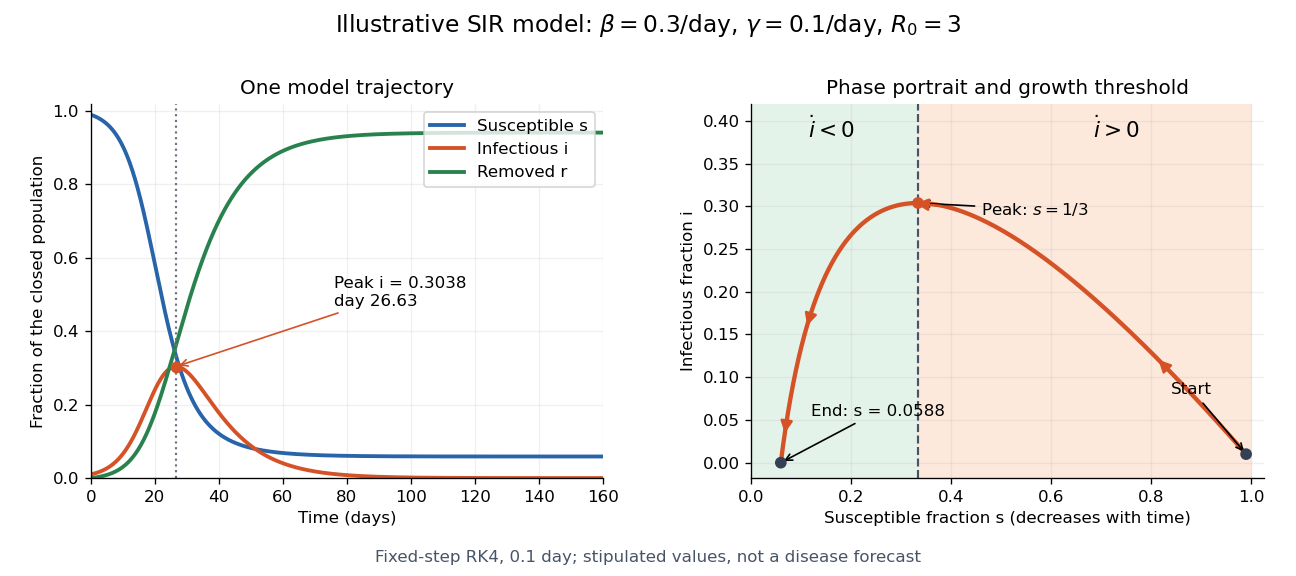

The numerical solution of a differential equation puts the SIR infection peak at about day with , agreeing with the SIR first integral to within . The accompanying generator checks nonnegative fractions and conservation of population without clipping or rescaling. For steps , and day, the largest differences between successive numerical trajectories at shared times are approximately and . Their ratio is , close to the factor expected when a fourth-order Runge-Kutta method's step is halved.
There are unlisted articles, also show them or only show them.