
In a countable language, an ultraproduct over a nonprincipal ultrafilter on realizes every countable finitely satisfiable type, including types over countably many parameters. Enumerate the type , and let be the ultrafilter-large set of coordinates where the first first-order formulas have a simultaneous witness. Put . At coordinate , choose a witness for the largest with , or an arbitrary element when there is none. For each fixed , the resulting function satisfies the first first-order formulas on . The Łoś theorem then realizes the entire type. Countability of the language and parameter set makes the enumeration possible.
Saturated elementary extension theorem 2026-10-14
For every infinite regular cardinal , every first-order structure has a -saturated elementary extension. At one stage use the compactness theorem with the elementary diagram to realize all complete types over subsets of the stage having size less than . There is a set of such types; finite subsets of the enlarged theory are satisfiable because their finitely many witnesses are independent. Iterate for stages, taking elementary unions at limits. Regularity puts any parameter set of size less than inside one stage, and its type is realized at the next one. Passing to a larger regular cardinal covers singular requested degrees of saturation as well.
Omega-saturated model 2026-10-14
Admissible values for a sandwich extension 2026-10-14
Suppose satisfies the mixed domination on a subspace , and . Apply that domination to and , split the argument as , and use superadditivity of . This proves every lower candidate in the displayed interval is at most every upper candidate. The zero-vector candidates bound the lower supremum below by and the upper infimum above by , so both endpoints are finite. Choosing any intervening value permits . For , scale the upper comparison by ; for , scale the lower comparison by . Both give the required mixed domination, proving the interval characterizes the permitted extension values.
First marked item in a random permutation Created 2026-10-14 Updated 2026-10-18
When items among are marked, inspect a uniformly random permutation until the first marked item. For its first position to be , the other marked positions must lie among the last slots. This yields the displayed law with support . It is the first-success form of sampling without replacement. For one marked item the position is uniform, while its conditional success chance after failures increases to .
Pooled sample variance 2026-10-14
For two independent normal samples of sizes with a common unknown variance, pooling their within-sample sums of squares gives the unbiased estimator . The numerator divided by the common population variance has a chi-squared distribution with degrees of freedom and is independent of both sample means. Therefore has a Student t-distribution. This exact construction requires a positive residual number of degrees of freedom and the common-variance assumption.
Empirical variance Created 2026-10-14 Updated 2026-10-25
The empirical variance is the variance of the empirical distribution, which puts probability on each observation. It uses divisor , whereas the usual sample variance uses divisor . For independent and identically distributed random variables with finite second moment, jackknife bias correction converts the empirical variance into the unbiased estimator exactly.
Two-toss sample space 2026-10-14
Model two fair independent coin tosses, recording their order. Here denotes heads and tails, andThe power set includes every question expressible as a subset of these four outcomes. The mass comes from the fairness and independence assumptions. These are exact model probabilities, rather than measured toss frequencies.
Let be the event that the first toss is heads and the event that the second toss is heads. ThenThe union means “at least one head,” while the intersection means “both heads.” Their probabilities are and . Counting the union through the inclusion-exclusion principle gives ; alternatively its complement of an event is , of probability .
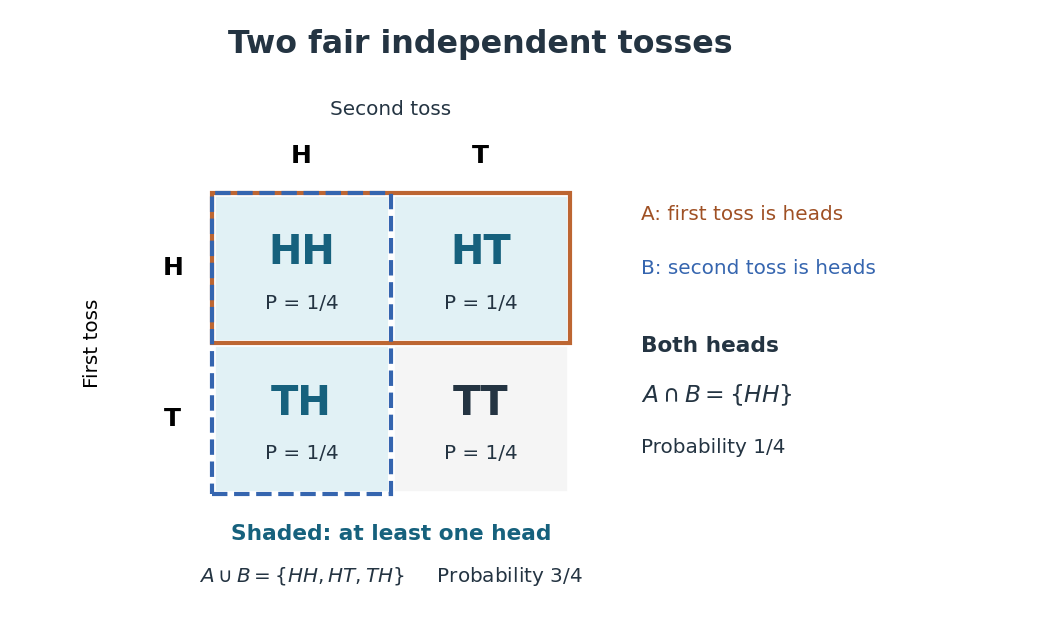
Four ordered outcomes and the event of at least one head
. Rows record the first toss and columns the second. Each cell has probability under fair independent tosses. The highlighted union includes , , and ; the overlap contains only . Details.
On the same sample space, assigning masses to would still make each toss fair: . But , so the tosses would be dependent. The event of at least one head would have probability . Changing the probability measure changes the answer even when the sample space and the single-toss probabilities stay the same.
Elementary outcome Created 2026-10-14 Updated 2026-10-25
An elementary outcome is one member of the sample space. For the ordered two-toss model, is one outcome; it contains both toss results. By contrast, “at least one head” is an event containing three outcomes. The outcome and the singleton set are different objects: when that singleton is measurable, the notation gives its probability. In the finite model below, every subset is measurable.
The word elementary refers to the chosen level of detail. An outcome can be an ordered pair, a sequence, or an entire realization of a point process. A random variable then extracts a numerical feature of that outcome; the window count of a point process is one example.
Endpoint-specific rare-event sample size 2026-10-14
A sample size calculation for a binary endpoint requires its own baseline probability, not merely the rate of a related outcome. A fatal-event probability equals the probability of the underlying event times its conditional fatality probability; knowing only that product does not identify the incidence of all events. Thus a mortality rate can size a mortality trial but cannot determine the size for all fatal and nonfatal events without further assumptions. The significance level, allocation, target statistical power and effect definition must also be specified.
Rare-event collaboration size at half power Created 2026-10-14 Updated 2026-11-05
Suppose each collaborating centre contributes independently randomized participants per arm with specified event probabilities. At 50% statistical power, the usual normal-approximation alternative quantile is zero. The required size per arm is , with for a two-sided test or for a one-sided test. Divide by the per-centre arm size and round up. Endpoints must use the same time origin and follow-up window, and cluster dependence requires an additional adjustment.
A periodic orbit entering the local flow at a fixed negative and leaving at positive has passage time . The same coefficient holds if . It is not uniform in the joint limit : if , the leading coefficient is . For entry at zero it is , while entry at a fixed positive gives bounded passage time. These distinctions matter near a saddle-node separatrix-loop bifurcation.
At a planar saddle equilibrium with , positive saddle quantity is equivalent to saddle index . The local passage followed by the regular return has leading transverse map , . Its derivative diverges as , so a nearby periodic orbit created by the saddle-loop splitting is repelling. This local mechanism agrees with the growth of the unstable periodic orbit born at a subcritical Hopf bifurcation in the quadratic Bogdanov–Takens unfolding.
First-Rytov coherent mean 2026-10-14
If the first logarithmic perturbation is a centered linear functional of a Gaussian random field, the complex Gaussian exponential moment gives the displayed mean of the first Rytov approximation . This is the mean of the truncated logarithmic model. A nonzero mean of the omitted second logarithmic perturbation can change the true field mean at order .
Coordinate Hopf algebra of quantum SL2 Created 2026-10-14 Updated 2026-11-05
The generators obey , , , , , and . Matrix multiplication gives the coproduct, and the antipode matrix is . For , its quotient with , , and is the quantum Laurent-plane algebra , proving noncommutativity. The same quotient distinguishes from its flipped coproduct.
Quantum determinant Created 2026-10-14 Updated 2026-11-05
For the two-by-two RTT construction with the standard Yang-Baxter R-matrix, the displayed determinant commutes with the matrix generators and satisfies and . Imposing gives the coordinate Hopf algebra of quantum SL2; adjoining its inverse instead gives the quantum general-linear coordinate algebra.
FRT bialgebra Created 2026-10-14 Updated 2026-11-05
Given an invertible braiding on , the universal bialgebra coacting on for which is a comodule map is generated by the matrix coefficients . Its comultiplication is . Colinearity gives quadratic relations. Writing turns the relation into the familiar RTT construction with the appropriate ordered tensor factors. A Yang-Baxter R-matrix supplies a scalar coquasitriangular structure.
For a deterministic path in the Cameron-Martin space of Wiener measure, the law of is equivalent to the law of enhanced Brownian motion. The Cameron-Martin theorem gives equivalence for the underlying Brownian paths; the canonical enhancement of the translated path is exactly the rough-path translation, including its mixed area terms. Continuity of this translation transfers small-ball positivity at the identity to every control signature.
Rouché localization of polynomial roots 2026-10-14
Let have distinct roots. Choose a disc around with radius smaller than every separation from . On its boundary, . If a holomorphic perturbation satisfies the displayed inequality, Rouché's theorem shows that has exactly one root in that disc, counted with multiplicity. Discs confined to specified half-planes or quadrants give direct geometric root-location proofs without needing a global root-continuation argument.
For an indicator function of a subset of with subset density , a large Fourier coefficient of gives a density increment on an arithmetic progression. The Dirichlet approximation theorem supplies a step on which the detected linear phase changes slowly. Split its residue classes into progressions of lengths comparable to . Replacing the phase by one constant on each cell preserves a fixed fraction of the Fourier correlation. Since the balanced function has total sum zero, positive discrepancies sum to half the total absolute discrepancy; one cell has the displayed increased density. One may take when is sufficiently large in terms of .
There are unlisted articles, also show them or only show them.