
In a unital Banach algebra, for the existence of gives , as verified by multiplying on either side. Interchanging proves the converse. Zero may differ: for the unilateral shift operator on , has spectrum and has spectrum .
Quasinilpotent element 2026-10-14
An element of a complex unital Banach algebra is quasinilpotent if its spectral radius is zero, equivalently its spectrum of an element is . A nilpotent element is quasinilpotent, but the converse need not hold. The Volterra convolution algebra on a finite interval gives powers which never vanish, yet have factorially decreasing norms, making the inverse series for converge for every .
Translation of the spectrum by a scalar 2026-10-14
The identity proves the formula directly from invertibility. In a nonzero complex unital Banach algebra, the nonemptiness of the Banach-algebra spectrum implies that if is a quasinilpotent element, then . Consequently every nonscalar element cannot simultaneously be quasinilpotent: adding the identity preserves nonscalarity while translating its spectrum.
For a closed unital subalgebra of a unital Banach algebra and , the smaller-algebra algebra resolvent set is relatively open and closed in the larger one. Openness follows from the Neumann series; closedness follows from continuity of inversion in and norm closedness of . Every larger-algebra resolvent component is therefore either retained whole or absorbed into the smaller-algebra Banach algebra spectrum. The unbounded component is always retained, since inverses at large modulus are norm-convergent series in .
Resolvent set of a Banach algebra element 2026-10-14
The algebra resolvent set consists of those scalars for which is invertible in the algebra. It is open by the Neumann series, and the inverse-valued map is the resolvent of an element. A closed subalgebra can have a smaller algebra resolvent set because an ambient inverse need not lie in it.
Spectrophotometry 2026-10-14
Spectrophotometry measures received light as a function of wavelength, accounting for the instrument's wavelength-dependent response.
Biot strain tensor 2026-10-14
The Biot strain tensor uses , so . Its principal values are extension ratios minus one. It is a spectral strain measure, since , and . Its reference-volume work conjugate is the symmetric Biot stress.
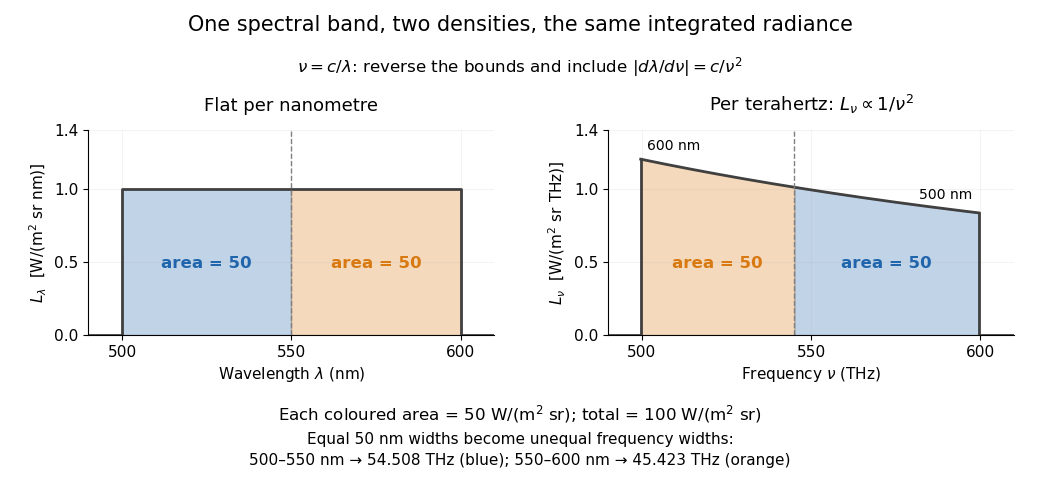
In vacuum, , where is the speed of light. Increasing wavelength decreases frequency, so the ordinary signed differentials satisfy . A spectral slice's positive contribution to radiance must be unchanged. The change of variables formula therefore gives the absolute Jacobian determinantThese formulas use per metre and per hertz. The factor has units , which converts the former density into the latter. If denotes the numerical density per nanometre in , its per-metre value is . Conversely, the per-nanometre value is times the per-metre value. Likewise, a density per terahertz is times its per-hertz value because .
For a concrete stipulated spectrum, let between and , and zero outside. This is exactly throughout the band. Using the exact International System of Units value , the corresponding frequency bounds areThe transformed spectral radiance is on this interval. At it is approximately , and at it is in the same units. These are respectively and per terahertz. Thus a flat wavelength density becomes a decreasing frequency density; relabelling the horizontal axis alone would miss both the shape and the units. [ref].
The equality of band radiances has a short exact proof:The reversed bounds and the Jacobian determinant preserve the same spectral measure. Each half-band, – and –, carries , although the corresponding frequency widths are about and .

Voigt profile Created 2026-10-14 Updated 2026-11-05
A Voigt profile is the convolution of a Gaussian distribution and a Cauchy distribution. For an absorption line, thermal Doppler broadening contributes the Gaussian core while finite excited-state lifetime contributes the Lorentzian wings. Instrumental broadening and unresolved motions must also be modeled when inferring column density and temperature.
Pressure broadening Created 2026-10-14 Updated 2026-11-05
Collisions and fluctuating neighboring-particle electric fields alter atomic energy levels and coherence times, broadening a spectral line. In a simple impact treatment the coherence-decay rate gives a Lorentzian width of order ; the precise definition of full or half width must be stated. Unlike Doppler broadening, this depends primarily on collision rates and perturber density. In stellar opacity calculations it alters line overlap and the low-opacity windows entering the Rosseland mean opacity.
Spectral zeta function 2026-10-14
For a nonnegative elliptic operator on a closed manifold, sum its positive eigenvalues with multiplicity. The defining series converges in a right half-plane. If and is the heat trace, thenSubtracting finitely many terms of the short-time heat kernel expansion gives a meromorphic continuation. Zero eigenvalues must be excluded: assigning them a nonexistent inverse power does not define the spectral zeta function.
Weyl law 2026-10-14
For the positive scalar Laplace-Beltrami operator on a closed -dimensional Riemannian manifold, the number of eigenvalues at most , counted with multiplicity, has the displayed leading asymptotic. The exponent determines the dimension and the coefficient determines the total volume of the Riemannian metric. There is an analogous result with fixed Dirichlet boundary conditions or Neumann boundary conditions on a compact smooth domain.
Wave trace 2026-10-14
For the positive Laplace-Beltrami operator on a closed manifold, the wave trace is the distribution , counting multiplicities. The series is interpreted after testing against smooth compactly supported functions, rather than as an ordinarily convergent sum. Its singularities relate the spectrum to the length spectrum of closed geodesics, through the Duistermaat-Guillemin trace formula.
Barotropic relativistic sound speed 2026-10-14
In units , an isentropic perfect fluid in general relativity has sound speed . Writing gives and . Linearized particle number conservation in a relativistic fluid and the relativistic Euler equation then yield acoustic waves with this speed. Positive is needed for ordinary acoustic stability; a causal fluid model additionally requires .
Special orthogonal sphere fibration Created 2026-10-14 Updated 2026-11-05
For an integer , the last-column map has fiber , included as . Local completion of a unit vector by the Gram-Schmidt process gives local fiber bundle charts. Consequently it has the homotopy lifting property and the long exact sequence of homotopy groups of a fibration.
All the special orthogonal groups are connected, and their second homotopy groups vanish. The rotation circle gives . Conjugation by unit quaternions gives the twofold universal cover , so and . The special orthogonal sphere fibration propagates the first two homotopy groups for . In dimension four its exact sequence has a zero map from the torsion group to , giving . For all positive groups vanish, and .
Trace height on the special orthogonal group Created 2026-10-14 Updated 2026-10-18
For positive distinct diagonal entries , the critical points of this function are diagonal sign matrices with . Criticality forces symmetric; its square is , so it commutes with the distinct-spectrum diagonal matrix and is diagonal. In the skew coordinates its Hessian is . The sign of each parenthesis is that of , giving Morse index .
Lightest supersymmetric particle 2026-10-14
The lightest supersymmetric particle is the least massive sparticle in a given spectrum. Exact R-parity makes it stable: a lighter final state cannot contain another odd particle, while a final state of ordinary particles is even. A neutral weakly interacting lightest supersymmetric particle is a possible dark matter constituent, but its cosmological abundance must be computed separately.
Neutralino Created 2026-10-14 Updated 2026-11-05
In the MSSM, electroweak symmetry breaking mixes the neutral bino, wino and two neutral higgsinos into four neutral Majorana spinor mass eigenstates, the neutralinos. A neutralino can be the lightest supersymmetric particle; with conserved R-parity it then provides a stable possible dark matter candidate.
A maximal ideal of has a common zero: otherwise finitely many have no simultaneous zero, and is invertible, a contradiction. If the common zero is , then is the kernel of evaluation at by maximality. Thus every algebra character is point evaluation. Continuous functions separate distinct points of the unit circle, and the evaluation bijection is a homeomorphism for the Gelfand topology.
There are unlisted articles, also show them or only show them.