
For an explicit linear multistep method, the highest-degree coefficient of is fixed while at least one lower coefficient grows unboundedly with negative real . If all roots stayed in the unit disk, the elementary symmetric polynomials of those roots would keep every monic coefficient bounded. This contradiction proves that no nontrivial consistent explicit method is A-stable.
Principal-root obstruction to A-stability 2026-10-14
Suppose a consistent linear multistep method has a simple principal polynomial root and its analytic logarithm satisfies near zero, with real coefficients. If , then at the real part of is positive to leading order. The same remains true after giving a small negative real part of smaller magnitude than that leading term. Thus a growing amplification factor occurs inside the left half-plane, ruling out A-stability. For an order-three method with , choose .
For nonnegative degrees with , the Padé approximant to the exponential function has no poles in the left half-plane and satisfies for . Consequently a numerical method having that stability function is A-stable. In particular, the near-diagonal choice gives the Radau IIA method stability function, while corresponds to the Gauss collocation method. The theorem concerns these exponential approximants, not arbitrary rational approximations with the same degrees.
Smooth four-manifold Created 2026-10-14 Updated 2026-11-05
A smooth four-manifold is a four-dimensional smooth manifold. Its intersection form and gauge-theoretic invariants impose strong constraints on its possible smooth and symplectic structures.
Thurston elliptization conjecture 2026-10-14
Every connected closed orientable three-manifold with finite fundamental group admits spherical geometry. With cyclic fundamental group, it is a lens space.
Prime three-manifold 2026-10-14
A closed connected orientable smooth manifold of dimension three is prime when a decomposition as a connected sum forces at least one summand to be the three-sphere. Unlike an irreducible three-manifold, it may contain a nonseparating embedded two-sphere.
Geometrizable three-manifold 2026-10-14
A closed orientable three-manifold is geometrizable if its prime summands can be split along finitely many disjoint essential tori into pieces whose interiors carry complete geometric structures modeled on the eight Thurston geometries. Prime decomposition and capping sphere boundaries precede the torus cuts; a single homogeneous geometry on the original connected sum is not required.
Three-dimensional Schoenflies theorem 2026-10-14
A smooth, piecewise-linear or locally flat embedded two-sphere in the three-sphere has two complementary components, each with closure homeomorphic to a three-ball. Equivalently a tame embedded two-sphere in bounds a ball on its compact side. Local flatness is essential; arbitrary wild sphere embeddings are excluded.
Hyperbolic three-manifold 2026-10-14
A complete hyperbolic three-manifold is a complete Riemannian manifold of dimension three with constant sectional curvature . Its universal cover is hyperbolic space and its deck group acts freely and discretely by Riemannian isometries. In the orientable case it is a torsion-free Kleinian group.
Sphere theorem for three-manifolds 2026-10-14
If an orientable three-manifold has nonzero , it contains an embedded essential two-sphere. Consequently a closed orientable irreducible three-manifold with infinite fundamental group is aspherical: its simply connected noncompact universal cover has zero second homotopy and top ordinary homology, hence is acyclic and contractible by the Hurewicz theorem and Whitehead theorem.
Loop theorem 2026-10-14
If a boundary surface inclusion has noninjective fundamental group map, there is a compression disk whose boundary represents a nontrivial element of that kernel. More generally the boundary can be required to avoid a prescribed normal subgroup if a singular disk with that property exists.
Poincaré conjecture 2026-10-14
A closed simply connected three-manifold is homeomorphic to the three-sphere. Now a theorem, this identifies every homotopy three-sphere with the standard sphere and removes homotopy-sphere ambiguities in three-dimensional connected-sum classification. Smooth structures are also unique in dimension three.
Three-ball 2026-10-14
A three-ball is a three-manifold homeomorphic to the closed unit ball in . Its boundary is a two-sphere. Attaching a three-ball to a spherical boundary component is called capping that boundary; marked endpoints may be joined by a straight arc inside the cap.
Punctured three-sphere 2026-10-14
A punctured three-sphere is with the interiors of finitely many disjoint piecewise linear balls removed. Capping its spherical boundary components with balls restores . Removing another ball or gluing two such manifolds along one spherical boundary component preserves this class.
Normal surface Created 2026-10-14 Updated 2026-11-05
Relative to a triangulation, a normal surface meets every tetrahedron in disjoint normal disks: four types of triangles cutting off vertices and three types of quadrilaterals separating opposite pairs of edges. A normal disk meets any edge at most once; its face arcs join distinct edges. Two different quadrilateral types cannot coexist in a tetrahedron.
Proof outline of Zorn's lemma 2026-10-14
Assume the axiom of choice and suppose a poset satisfying the hypothesis has no maximal element. Fix a choice function on its nonempty subsets. By transfinite recursion, choose at each ordinal stage an upper bound of the chain in a partial order already constructed, then choose a strictly larger member. Both choices are available, including the initial empty stage. This produces distinct members throughout the Hartogs ordinal of , contradicting the Hartogs theorem. Thus a maximal element exists. Conversely, apply Zorn's lemma to partial choice functions on a family of nonempty sets, ordered by extension. A chain in a partial order has the compatible union as an upper bound, and a maximal element must be defined on the whole family, since one missing value could be adjoined.
Zorn's lemma was introduced in 1935 to shorten algebra proofs using choice or the well-ordering theorem.[ref]
Zorn’s Lemma and Some Applications by Keith Conrad. Zorn’s Lemma and Some Applications, §1, p. 4, paragraph on the 1935 introduction to shorten algebraic proofs
Finite greedy basis extension and choice 2026-10-14
For an explicit basis extension in , start with , where . Its linear span is the line . Adding preserves linear independence, because is outside that line, and gives a basis. Every vector has the finite linear combinationThe vector cannot be added while preserving linear independence: it is already in the linear span. Many choices outside the line work, so maximality does not select a unique basis.
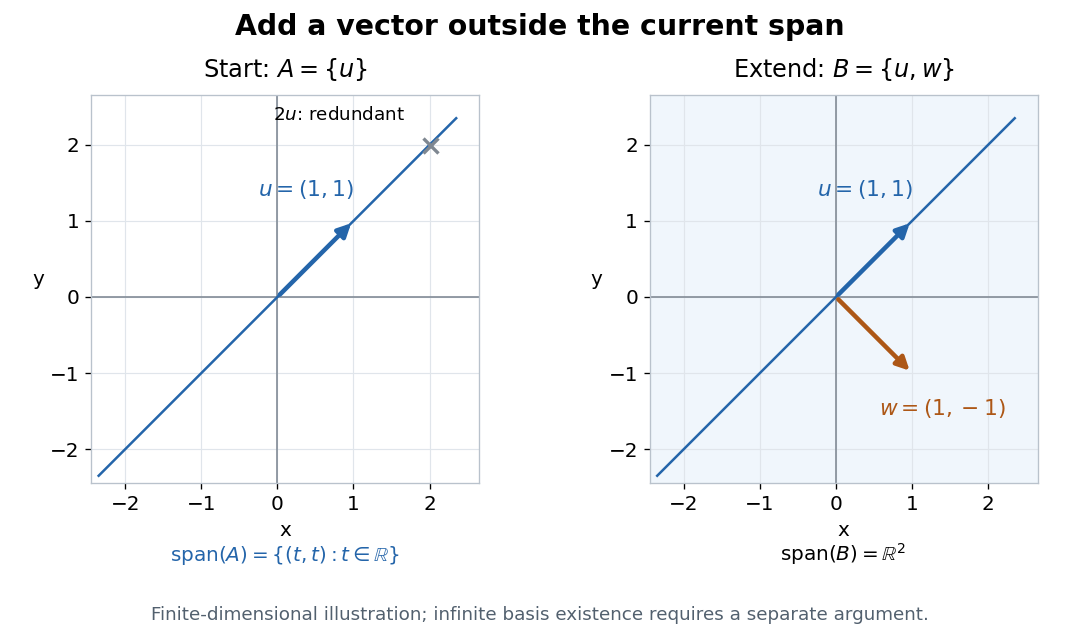

For a finite-dimensional vector space with a supplied finite spanning set, a greedy algorithm scans the list, retaining each vector precisely when it is outside the linear span of those already retained. Starting with a linearly independent , the same scan adjoins only the needed vectors. Retained vectors remain linearly independent, and every skipped vector is in the final linear span, so the result is a basis containing . Finite reasoning needs no axiom of choice.
For an arbitrary vector space, this finite stopping argument is unavailable. Accepting Zorn's lemma asserts existence of a maximal element once every chain in a partial order has an upper bound; it supplies no general computational recipe. Over ZF, Zorn's lemma, the axiom of choice and the well-ordering theorem are equivalent. Particular infinite vector spaces can still have explicit bases, such as for the vector space of univariate polynomials over a specified field; infinity alone does not force a nonconstructive argument.[ref]
How to use Zorn’s lemma by Timothy Gowers. How to use Zorn’s lemma, “Further general remarks”, immediately after Example 1 continued: equivalence with choice and well-ordering
Vector space bases from Zorn's lemma 2026-10-14
Every vector space over a field has a basis, assuming the axiom of choice. More generally, any linearly independent subset extends to a basis. This is an algebraic Hamel basis: each representation uses a finite linear combination, even when the basis is infinite.[ref]
Use the poset of linearly independent subsets containing :It is a set, being a subset of the power set of , and is nonempty because .
A short proof outline supplies both essential steps:
- For a nonempty chain in a partial order , put . Any finite linear relation in lies in one member of : among finitely many containing members, one contains the rest. Its linear independence makes every coefficient zero. Thus is an upper bound. For the empty chain in a partial order, use ; its empty union need not contain .
- Zorn's lemma gives a maximal element . If a vector lies outside its linear span, then is linearly independent: a linear relation with nonzero coefficient on would express in that linear span. This contradicts maximality, so is a spanning set and hence a basis.[ref]
Taking proves existence, including , whose basis is the empty set. The chain in a partial order need not be indexed by the natural numbers: only the finitely many members needed for a particular linear relation are compared. An arbitrary union of linearly independent sets can fail: and for a nonzero vector over the real numbers are each linearly independent, but their union is linearly dependent. The nesting of a chain in a partial order is what prevents this failure.
Zorn's lemma in a finite poset 2026-10-14
Consider the following finite set of subsets, ordered by subset containment:Every nonempty chain in a partial order has a greatest element within that chain in a partial order, hence an upper bound in . For the empty chain in a partial order, choose . Thus the hypothesis of Zorn's lemma holds. The two maximal elements are and : neither is a proper subset of another member of . There is no greatest element, because it would have to contain both, and no member of contains .
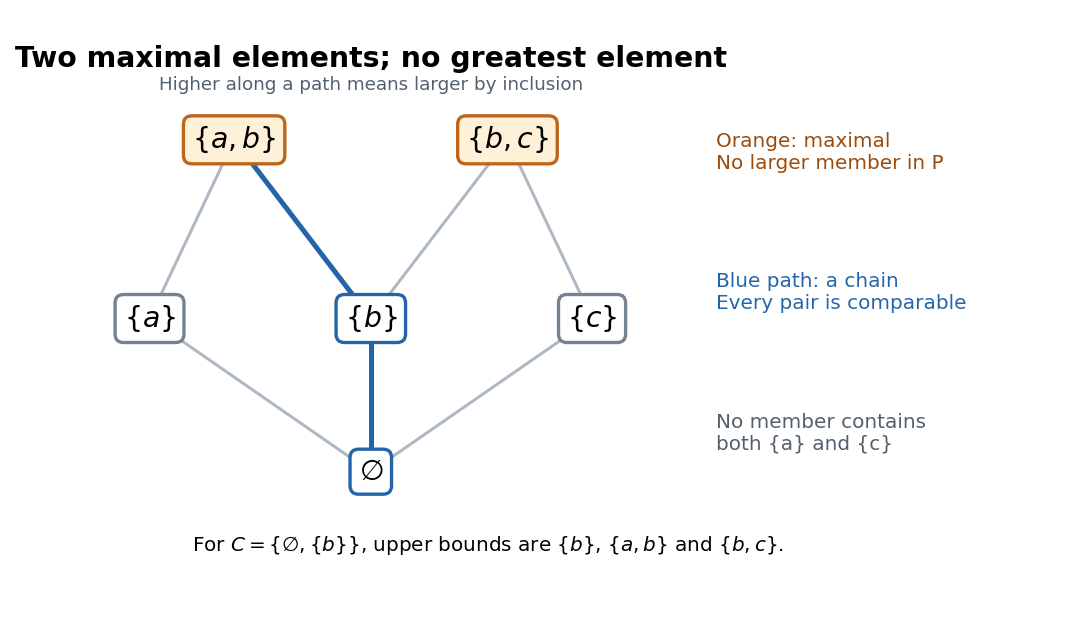
A finite inclusion poset with two maximal elements and no greatest element
. Lines show immediate upward inclusions; following upward paths gives all other strict comparisons. The blue path is a chain, and the orange nodes are the two maximal elements. Details.
For the chain in a partial order , the member is already an upper bound, although it is not a maximal element of . Both orange members are also upper bounds for . A chain in a partial order need not have a unique upper bound, and the upper bound used to check the hypothesis need not be the eventual maximal element.
The restriction to chains in a partial order matters. The subset has no upper bound in , but its two members are incomparable, so it is not a chain in a partial order. Requiring every subset of to have an upper bound would be much stronger: taking that subset to be itself would force a greatest element.
Value of a zero-sum game 2026-10-14
For a finite matrix zero-sum game, the value is the payoff that the maximizing player can guarantee and the minimizing player can prevent the payoff from exceeding, using mixed strategies. The common value of the two displayed optimizations exists by the minimax theorem. A pair of strategies can be verified directly by checking that every pure column pays the row mixture at least and every pure row earns at most against the column mixture.
There are unlisted articles, also show them or only show them.