
Delaunay variables Created 2026-10-14 Updated 2026-10-25
For a bound noncollision Kepler orbit with gravitational parameter , the canonical actions per unit mass are , and . Their angles are mean anomaly , argument of periapsis and longitude of ascending node . The Hamiltonian is , so only advances in the unperturbed problem. In the prograde spherical-action chart, , , ; the type-two canonical transformation is generated by . Retrograde spherical actions have , so the absolute value cannot be dropped globally. Circular and coplanar limits are singular angle charts, not singular orbits.
Rotating acoustic point source 2026-10-14
A point source moving at angular speed on a circle of radius has observer-direction Mach number . In the far field its retarded phase satisfies . For there is one retarded root, and a constant source strength gives . For , multiple retarded roots can occur; their contributions require and a sum over roots. Coalescing roots produce a caustic in the ideal point-source model.
Acoustic dipole Mach-number scaling 2026-10-14
For a small body of size in flow of speed , force of order varying on time produces an acoustic dipole density amplitude of the displayed order, where is the Mach number. Its sound power scales as . The corresponding compact acoustic quadrupole Mach-number scaling has density amplitude of order and power .
For a closed operator on a Banach space , a positive-time classical solution belongs to , takes values in for positive time, and has . It satisfies the differential equation and the initial condition in . Classical regularity also at time zero requires the corresponding regularity of the initial datum, in particular . For an analytic semigroup and Hölder continuous forcing, the variation-of-constants formula gives such a solution: subtracting the forcing at the current time turns the singular estimate into the integrable bound .
Absorption distance 2026-10-14
Absorption distance is a dimensionless path variable chosen so a non-evolving comoving absorber population with fixed proper cross-section has constant . It absorbs the geometrical factor in absorber incidence and comoving number density. A distribution per and one per therefore differ by .
Summable absolute-value cusp series 2026-10-14
Let the locations be distinct and bounded, and let with . The Weierstrass M-test gives locally uniform convergence of , so the uniform limit theorem makes it continuous. The reverse triangle inequality bounds each term's difference quotient by . Consequently a uniformly small tail permits passing each one-sided difference-quotient limit through the series. At every point outside the locations, ; at , the right derivative minus the left derivative is . Thus the function has precisely the prescribed cusp locations, even when they accumulate at another point where the function remains differentiable.
Absolute value at a simple zero 2026-10-14
Suppose a real function is differentiable at , with and . The derivative definition gives . The reverse triangle inequality then impliesThus has unequal one-sided derivatives, on the right and on the left. More generally, multiplication by a function continuous at with gives right and left slopes and . This elementary expansion explains how a smooth oscillation can acquire infinitely many corners under the absolute value function, even after multiplication by a factor that makes it differentiable at an accumulation point.
Asymmetric absolute-error loss 2026-10-14
Abelianization of the square symmetry group 2026-10-14
Let denote the dihedral group of group order eight acting on a square. Here the subscript specifies group order; the same group is called in the convention that counts vertices of a polygon, as in the group action example. Let be a counterclockwise quarter-turn rotation and a reflection in a diagonal. ThenProducts act rightmost first. The group commutator of the generators of a group isIt is a half-turn rotation, so forcing and to commute must identify a half-turn with .
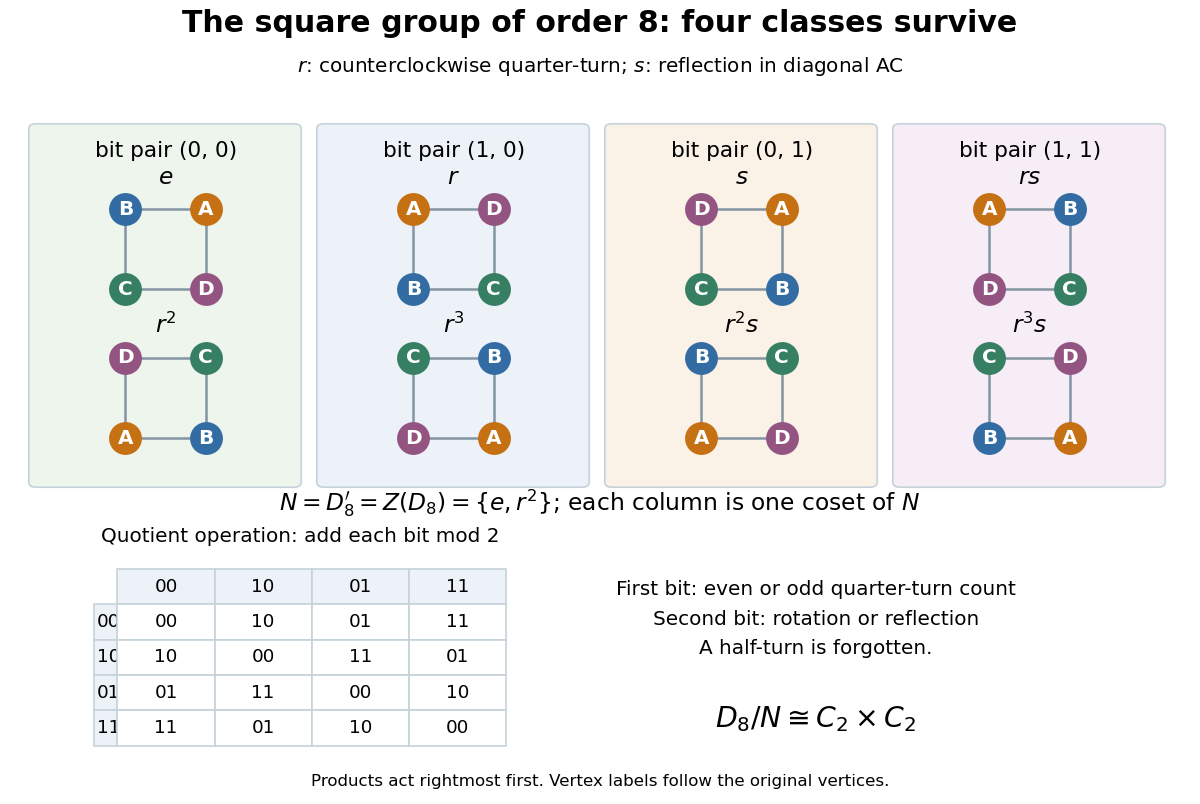

More concretely, write each element uniquely as , with and . The functionis a surjective group homomorphism. Indeed, giveswhere the exponents are reduced modulo four and two. Modulo two, and agree, so adds the two coordinates separately. Its group kernel is . Since the target is an abelian group, ; since , also . ThusThe four cosets are , , , and . Each coset forgets the difference of a half-turn. The quotient group still distinguishes rotations from reflections, and even from odd numbers of quarter-turns; the two surviving choices are independent. This is the Klein four-group, rather than the cyclic group , because each nonidentity element squares to the identity element. For the general dihedral group calculation, see Conrad, Dihedral groups I, theorem A.1; that source uses the vertex-count convention and for individual group commutators.
Uniqueness of finite-index subgroups forces infinite cyclic abelianization Created 2026-10-14 Updated 2026-11-05
If a finitely generated group has exactly one subgroup of each finite index, every such subgroup is normal. The quotients of prime order give surjections of its finitely generated abelianization onto for all primes, forcing positive free rank. A free rank of at least two gives two distinct index- subgroups. Positive finite torsion together with the free rank-one factor also gives two index- subgroups for a suitable prime. Hence .
// Target: algebra.bigb
Universal property of abelianization 2026-10-14
For every abelian group and group homomorphism , there is a unique group homomorphism such thatThis is a universal property. To see why it holds, compute , using commutativity in . Hence , and is constant on each coset of . The displayed formula is therefore well-defined and preserves multiplication. It is unique because is surjective. This is an instance of factoring a group homomorphism through a quotient group; see Conrad, Universal mapping properties, theorem 3.4.
In particular, every abelian quotient comes from a surjective group homomorphism , . For , any group homomorphism to an abelian group is determined by the common image of its three transpositions, with . Every even permutation must map to . Thus sign of a permutation captures all possible information of this kind, including maps with infinite abelian groups as their targets.
Massive p-form field Created 2026-10-14 Updated 2026-11-05
A free massive -form obeys the displayed equation, with the divergence constraint following by applying the codifferential. For and , a rest frame leaves an antisymmetric tensor on spatial directions, giving physical polarizations. The mass term removes the ordinary gauge invariance, unless a Stueckelberg mechanism restores a redundant description.
// Target: quantum-field-theory.bigb
Nielsen-Olesen vortex Created 2026-10-14 Updated 2026-11-05
An Abelian Higgs vortex has quantized magnetic flux and a Higgs field whose phase winds at spatial infinity. Its vortex number is under the convention .
Inverse-density Abelian Higgs model Created 2026-10-14 Updated 2026-11-05
This planar Abelian Higgs model replaces the usual magnetic energy by . Use and . The magnetic term is singular at a zero of the Higgs field, so the admissible class must have finite energy; formal field equations are first derived where . Its positive-flux Bogomolny equations are and . On those solutions extends regularly across zeros.
Derrick scaling of the Abelian Higgs energy 2026-10-14
In two dimensions, scale and . The magnetic field has scaling weight two, the gauge covariant derivative of the Higgs field has weight one, and the potential has weight zero. Their integrated energies therefore have the powers shown. Stationarity gives , a Derrick virial identity. This balance allows a planar Abelian Higgs vortex to have finite size even though a scalar-gradient-plus-nonnegative-potential model has no comparable magnetic term.
Broken-phase spectrum of the Abelian Higgs model Created 2026-10-14 Updated 2026-11-05
For , write and absorb into the vector field. The quadratic Lagrangian has a real scalar of mass and a vector of mass . The two scalar plus two massless-vector polarizations in the symmetric phase become one radial scalar plus three massive-vector polarizations. The removed phase supplies the longitudinal mode; local vortices retain global winding and quantized flux.
// Target: cosmology.bigb
Abelian group of prime-square order Created 2026-10-14 Updated 2026-11-05
An abelian group of order is cyclic if it has an element of order . Otherwise Lagrange's theorem makes every nonidentity element have order . Choose and . The group homomorphism from is injective: with would imply , using the inverse of modulo . Equal finite orders then make this an isomorphism.
Complex multiplicative group Created 2026-10-14 Updated 2026-10-25
The nonzero complex numbers form an abelian group under multiplication, with identity one and inverse . As a topological group it is isomorphic to by logarithmic modulus and phase. It appears naturally as a Möbius pointwise stabilizer of two points.
Abel theorem for divisors 2026-10-14
A degree-zero complex analytic divisor on a compact Riemann surface is principal exactly when its Abel-Jacobi map of a compact Riemann surface is zero. Normalize a differential of the third kind with residues equal to the coefficients of . The Riemann bilinear relations for a compact surface express its -periods as times the Abel integrals. If those integrals are in the period lattice, subtract a suitable integral multiple of the normalized holomorphic differential forms; all periods then lie in , so exponentiation gives the required meromorphic function. Conversely, the logarithmic differential of a meromorphic function has integer residues and periods in , giving a zero Abel class by the same calculation.
For competing risks, a cumulative incidence function jumps by the displayed Aalen–Johansen estimator increment. A person right-censored at exactly the event time remains in the immediately preceding risk set under the usual events-before-censoring tie convention. Censoring changes the next risk set, not the current event numerator or survival jump.
There are unlisted articles, also show them or only show them.