
Affine Galois group of a prime-radical splitting field Created 2026-10-14 Updated 2026-11-05
For distinct or equal prime numbers , the polynomial is Eisenstein at . Its splitting field over has Galois group a subgroup of , which is nontrivial because a degree- radical cannot belong to a degree- cyclotomic field. Thus the full Galois group has order . On roots indexed by , all automorphisms act as . Equality of orders identifies the group with the full affine group over a finite field.
// Target: algebra.bigb
A nonidentity involution in the affine group over a finite field , for odd prime , has linear coefficient : a translation has order , while forces . Its unique fixed point is , and its remaining orbits have size two. This orbit count computes primes in an intermediate field as double cosets for an order-two decomposition group acting on the radical roots.
// Target: number-theory.bigb
For on , integration by parts in its half-line Fourier transform gives . Its time-integrated identity relates initial data and boundary values. The spectral involution preserves . Evaluating the relation at both arguments eliminates the unknown Neumann transform from a Dirichlet problem; the residual unknown solution transform vanishes upon closing the upper contour for .
In coordinates , , the transport derivative becomes . A Heaviside step function moving at that speed becomes stationary, and its twice-integrated profile gives the displayed continuously differentiable solution of . Its second spatial derivative has a jump, so the equation holds away from the moving interface and in the distributional sense there.
Homogenization of a periodic advection-diffusion equation Created 2026-10-14 Updated 2026-10-18
At long wavelengths and on a diffusive time scale, a rapidly varying periodic advection-diffusion equation can have a constant effective diffusivity. A multiple-scale expansion solves periodic cell equations for the fast variables. The solvability condition at the next order gives the macroscopic equation. For a periodic sinusoidal shear this is the effective diffusivity of a periodic sinusoidal shear; its transverse zero-mean cell modes decay, leaving the slow conserved concentration. This use of homogenization concerns differential equations, rather than polynomial homogenization.
For an Erlang distribution of shape two and rate , the claim expected value is and its moment-generating function is for . The adjustment coefficient equation is . With , divide out the zero root to get . The smaller quadratic root lies in when ; the larger root lies beyond the finite-transform domain and must be rejected. This proves the displayed coefficient.
Fix positive claim expected value and relative safety loading in a classical risk model. Assume the random claim law has an adjustment coefficient . By Jensen inequality, . Thus . The expression on the left is strictly convex, has negative derivative at zero and tends to infinity, so its unique positive zero satisfies . If the claim size is not almost surely constant, strict Jensen inequality gives . Consequently the Lundberg inequality upper bound for deterministic claims is smaller for . Comparing these upper bounds alone does not establish an ordering of actual ultimate ruin probabilities.
For positive claims with a finite positive moment-generating function neighbourhood, use and for in the defining adjustment coefficient equation. They imply the displayed strict upper bounds, where is the positive quadratic root. Its defining polynomial is negative at zero and positive at , proving . Higher exponential-series truncations similarly yield upper bounds from more raw moments.
Adjustment coefficient for shape-one-half gamma claims Created 2026-10-14 Updated 2026-11-05
The gamma distribution of shape one half and rate has moment-generating function . With mean and positive relative safety loading , write . Dividing out the zero root after squaring the adjustment equation gives . Its unique positive root lies between zero and one, so it belongs to the transform domain and gives the display.
Adjoint functor theorem 2026-10-14
A theorem giving sufficient conditions for a functor to have an adjoint functor. The general adjoint functor theorem uses a complete category, locally small categories, preservation of categorical limits and a solution-set condition. The Special adjoint functor theorem obtains that condition from a well-powered source and a small cogenerating family. Precise hypotheses matter in both forms.
Idempotent adjunction 2026-10-14
An adjunction is idempotent when its induced monad has invertible multiplication. This is equivalent to its induced comonad having invertible comultiplication. For an idempotent monad, the two maps and agree, since both invert the multiplication. If is an algebra, naturality then gives . Thus every algebra unit is invertible. Apply this to to obtain the self-dual adjunction condition.
Boolean ultrafilter-power-set adjunction 2026-10-14
A Boolean algebra homomorphism is equivalent to a function assigning to every an ultrafilter on : test membership of in every image subset. This gives a left adjoint valued in the opposite category of sets. Its unit sends an algebra element to the set of ultrafilters containing . On an infinite power-set algebra this map is not surjective, because the subset consisting of the principal ultrafilters cannot arise this way in the presence of a nonprincipal ultrafilter.
Discrete-indiscrete adjunction 2026-10-14
Discretization and indiscretization retain underlying sets. Every function is continuous, and every function is continuous, giving the adjunction. Its induced monad and comonad are idempotent, since repeated discrete topology or indiscrete topology construction changes nothing.
Adjoint chain for the objects of a category 2026-10-14
For small categories, the object functor has left adjoint the discrete category functor and right adjoint the indiscrete category functor. Connected components, defined by zigzags of morphisms, give a left adjoint to the discrete functor. There is no further left adjoint: fails the equalizer of two functors selecting distinct objects of the indiscrete two-object category. There is no further right adjoint: the indiscrete functor fails the coproduct of two singleton sets.
A functor admitting a further left adjoint must itself be a right adjoint and preserve all existing categorical limits. A functor admitting a further right adjoint must preserve all existing colimits. Failure to preserve a single terminal object, equalizer, initial object or coproduct therefore rules out the corresponding extension. In the adjoint chain for the objects of a category, connected components fail an equalizer and the indiscrete category functor fails a binary coproduct.
Stimulated Raman adiabatic passage 2026-10-14
For a resonant three-level chain with couplings , the zero-energy dark state of a driven Hamiltonian is . Turning on the target-to-intermediate coupling first and sweeping from zero to infinity rotates this state from to . The other eigenvalues are , so controls nonadiabatic leakage. Ideally the intermediate state remains unoccupied, suppressing spontaneous-emission loss. The gap must not close while the dark state is rotating.
Adiabatic matter-string density relation 2026-10-14
For separately conserved barotropic components, an adiabatic cosmological perturbation has equal . Pressureless matter and a string component therefore have on superhorizon scales. In the supplied perfect-fluid synchronous equations, neglecting spatial gradients gives for . Both and its independent decaying-mode amplitude must vanish to select the growing adiabatic solution. At finite wavenumber, pressure gradients generate departures from this leading long-wavelength relation.
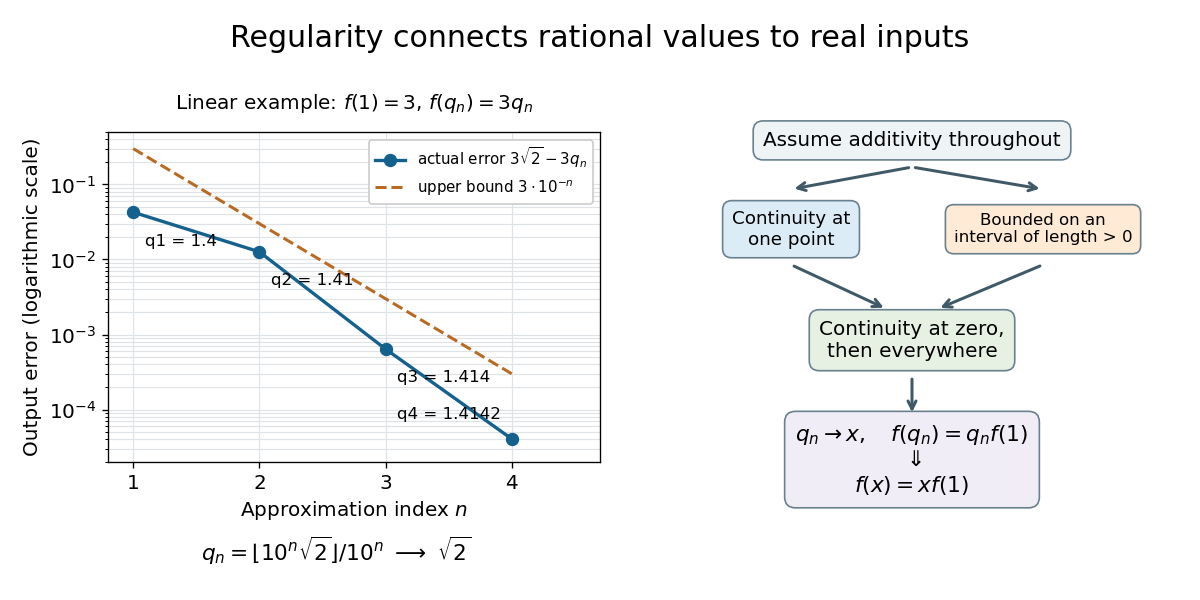
Additive function continuous at one point is linear Created 2026-10-14 Updated 2026-10-18
A real additive function that is continuous at one point is continuous everywhere and has form . Indeed , and as . Then for every . Additivity gives for every rational number; continuity and the density of the rational numbers extend this identity to every real argument.
The step from the rational numbers to the real numbers can be made explicit. Put . For an arbitrary real number , the density of the rational numbers supplies a sequence of rational numbers . Because continuity at the original point already implied continuity everywhere,This is where continuity enters: knowing all the rational values alone does not justify the first equality.
For an original numerical example, use the floor function to define the rational lower approximants . They obey . When and is continuous at one point, rational homogeneity of an additive function and the preceding argument giveThe error bound here follows from the resulting linear map, rather than from a quantitative bound on the initially assumed continuity.

For centered-space diffusion, a Fourier mode gives , with . For the roots have opposite signs, the positive root lies in , and the negative root lies in exactly when . At the unit-modulus roots are simple. Hence the root condition for a multistep method holds for every Fourier frequency exactly when . Under fixed , the unscaled one-step defect is ; dividing by the step changes its order to .
Integer-matrix vertex coordinate bound 2026-10-14
At an extreme point of , the active rows span the ambient dimension: otherwise a nonzero direction orthogonal to all active rows permits small feasible moves of both signs. Select independent active rows to form an integer matrix . Its nonzero determinant has absolute value at least one. Cramer's rule and the determinant expansion bound each coordinate by , where bounds the entries of and . The vector may be real; only the denominator matrix needs to be integer.
There are unlisted articles, also show them or only show them.