
Rock paper scissors Created 2026-10-14 Updated 2026-10-25
With choices ordered rock, scissors, paper and winner payoff , the row-player payoff matrix is . Both the row and column sums vanish. Thus the uniform mixed strategy guarantees expected payoff zero against every opposing strategy; the value of a zero-sum game is zero. A player responding to a known nonuniform mixture can instead optimize its linear expected payoff over pure responses and their ties.
Zero set Created 2026-10-14 Updated 2026-10-20
The zero set of a function is the preimage , consisting of all its zeros of a function. For a real- or complex-valued continuous function, it is a closed set, because the preimage of the closed singleton under a continuous function is closed. A nonzero holomorphic function on a connected open set has isolated zeros by the identity theorem for holomorphic functions.
Rieger-Bernays permutation model 2026-10-14
A definable class bijection of a model's universe changes membership as displayed. Images and inverse images of sets under remain sets by the Axiom schema of replacement. The new extension of is the old set . Thus the representative of any desired extension is . Extensionality follows from bijectivity; separation and replacement translate to old definable formulas; pairs, unions and power sets have explicit representatives. Infinity follows by iterating the new empty set and successor. Foundation need not survive: interchanging and makes the old empty set a Quine atom. A full such permutation of a model of choice still satisfies choice; failure of choice requires an additional symmetry restriction.
Intuitionistic Zermelo–Fraenkel set theory 2026-10-14
Full intuitionistic Zermelo–Fraenkel set theory uses intuitionistic first-order logic, extensionality, pairing, union, infinity, full separation, power set, collection and epsilon induction. Collection is stronger than replacement intuitionistically. This is distinct from predicative constructive ZF, which restricts separation and replaces full power set. The full theory supports a Boolean-valued inner universe over intuitionistic set theory, giving the relative consistency of classical ZF.
Zermelo set theory 2026-10-14
The usual set theory with extensionality, empty set, pairing, union, power set, infinity and full separation, before adjoining replacement. Modern presentations often include foundation; the convention should be specified when comparing theories. Class-theoretic variants add classes and class comprehension, rather than treating proper classes as sets.
Zenith distance 2026-10-14
Zenith distance is the angle from the zenith to a viewing direction: , where is altitude and . The astronomical horizon has , while the zenith has . This unsigned separation supplies no azimuth and is distinct from the signed north/south angular readout used under declination.
Three coordinate axes in affine three-space have coordinate ideal ; their common point has embedding dimension three. Three distinct coplanar lines meeting at one point have embedding dimension two there. An isomorphism preserves the unique point lying on all three irreducible components and preserves the algebraic cotangent space, so these two configurations are not isomorphic despite identical component incidence.
Projective tangent plane 2026-10-14
For a smooth algebraic surface defined by a homogeneous polynomial in projective space of dimension three, its tangent plane at is the displayed plane. Every projective line on the surface through lies in this plane.
Saccharomyces cerevisiae Created 2026-10-14 Updated 2026-11-05
Saccharomyces cerevisiae is a particular species of yeast, used in baking, brewing and laboratory research. During ordinary vegetative growth it reproduces by budding: a smaller daughter grows from the mother before separation. Laboratory strains can be maintained as either haploid or diploid biological cells. This makes it possible to investigate genes in a single eukaryote, then use controlled crosses and meiosis to connect a genotype to a phenotype. See Burgess, Powers and Mell, Budding Yeast Saccharomyces cerevisiae as a Model Genetic Organism (2017), pp. 1–2.
The practical value of Saccharomyces cerevisiae as a model organism is the combination of easy laboratory cultivation, accessible genetics, and cellular functions shared with other eukaryotes. A haploid strain has one set of chromosomes, so a changed allele is not accompanied by a second copy at that genetic locus. But a mutation need not produce an observable phenotype under every condition. The yeast is also a whole organism, not a miniature human: transferring a result requires evidence that the relevant function is shared in the target system. See Duina, Miller and Keeney, Budding Yeast for Budding Geneticists (2014): cultivation, genetic tools and conserved functions.
For a concrete example, Hartwell, Culotti and Reid's 1970 work followed temperature-sensitive Saccharomyces cerevisiae strains with successive microscope photographs. Failure to complete a particular part of the cell cycle helped identify required gene functions. Their distinction between when a function is required and where a cell finally stops is especially instructive: the visible endpoint need not be the time of the underlying defect. See Hartwell, Culotti and Reid, Genetic control of the cell-division cycle in yeast. I. Detection of mutants (1970): primary abstract. This is a useful way to turn an observable change in a biological cell into a question about genes and causal order.
In alcoholic fermentation, Saccharomyces cerevisiae converts sugars into ethanol and carbon dioxide. The carbon dioxide helps dough rise; the ethanol is useful in alcoholic drinks. The metabolism also supports production of ATP, a usable cellular energy carrier. This is one metabolic ability of one species, not the definition of every yeast. See Clark, Douglas and Choi, Biology 2e, 7.5: alcohol fermentation and the Burgess, Powers and Mell account above.
For glucose, the ideal net stoichiometry isOne molecule of glucose supplies six carbon chemical atoms: four end up in the two ethanol molecules and two in the two carbon dioxide molecules. The twelve hydrogen and six oxygen chemical atoms also balance. This is a net material balance across several enzyme-catalyzed steps, not a single chemical reaction step or the complete bookkeeping for cellular energy carriers. The standard pathway accounting yields a net two ATP per glucose: the initial breakdown produces the ATP, while the later conversion to ethanol regenerates a coenzyme needed to keep the breakdown going. See Clark, Douglas and Choi, Biology 2e, 7.2: net ATP accounting and the section 7.5 cited above.
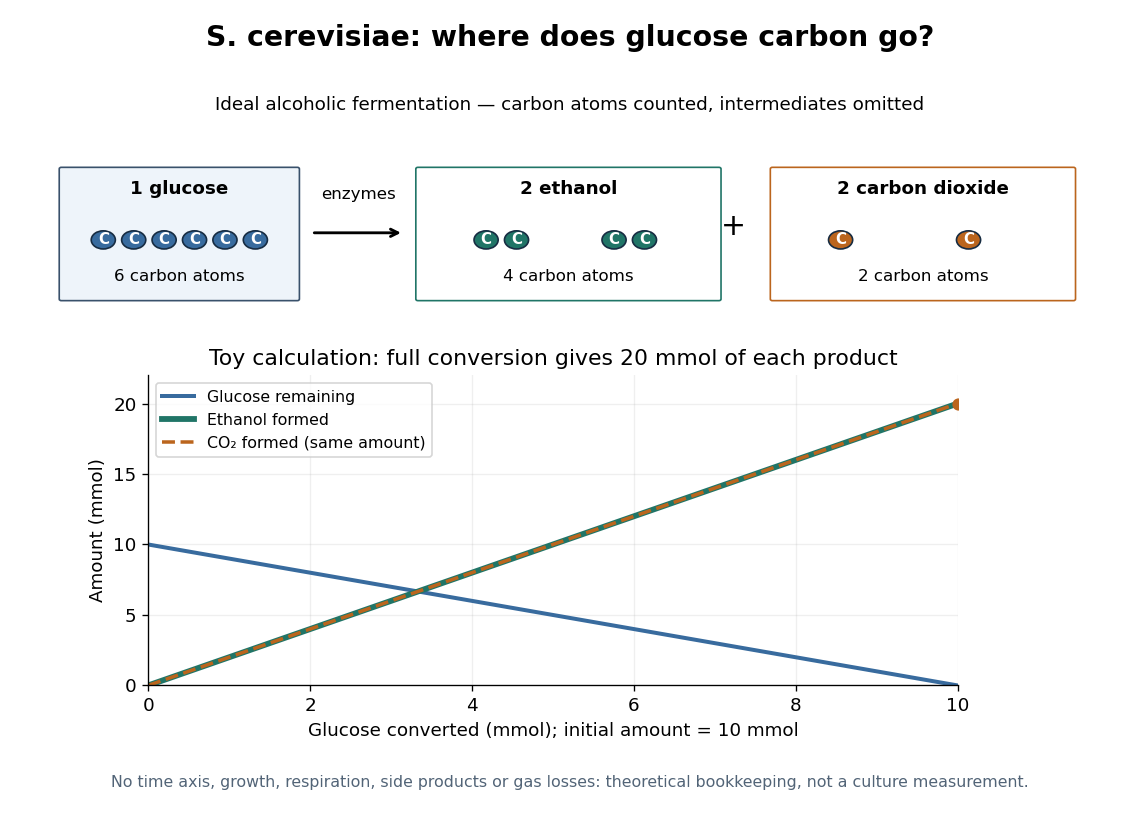

At complete conversion, this toy gives of ethanol and of carbon dioxide. The carbon balance is of carbon chemical atoms. A real culture also builds cellular material, can use other metabolic routes, and may retain dissolved carbon dioxide; the toy is a reference balance rather than a prediction of collected gas or beverage yield.
Although alcoholic fermentation does not require molecular oxygen as a reactant, the presence of molecular oxygen does not force Saccharomyces cerevisiae to stop fermenting. De Deken's 1966 experiments reported predominantly fermentative glucose use during exponential growth in air. Consequently, bubbles do not establish either absence of molecular oxygen or an exclusively fermentative metabolism. See De Deken, The Crabtree Effect: A Regulatory System in Yeast (1966): primary abstract.
Schizosaccharomyces pombe Created 2026-10-14 Updated 2026-10-20
Schizosaccharomyces pombe is a yeast species used as a model organism. It supplies the candidate genes in the yeast cross-species complementation experiment; the recipient remains Saccharomyces cerevisiae.
Villain model Created 2026-10-14 Updated 2026-10-25
A Villain model replaces the cosine Boltzmann factor of the XY model by a periodic Gaussian weight. The Poisson summation formula makes its bond weight equal to . The periodic Gaussian retains integer winding defects and permits an explicit separation into spin waves and vortices in two dimensions. Its replacement of the cosine model is an approximation; subsequent transformations within the Villain model can be exact.
Geodesic X-ray transform 2026-10-14
For a symmetric covariant two-tensor, the geodesic transform integrates its evaluation on the unit velocity along boundary-to-boundary or closed geodesics, as appropriate to the manifold. A potential symmetric 2-tensor gives a total derivative along each geodesic and therefore integrates to zero on closed geodesics; boundary data require the corresponding boundary potential to vanish.
Magnetic X-ray transform 2026-10-14
The magnetic transform integrates functions or velocity-evaluated one-forms along magnetic trajectories, rather than ordinary geodesics. For closed trajectories, every exact one-form integrates to zero. Hyperbolic dynamics can make these the entire degree-one kernel.
Thermostat X-ray transform 2026-10-14
The transform integrates a base function and a velocity-evaluated one-form along the closed trajectories of a surface thermostat. Every exact differential form of degree one integrates to zero, because . The relevant kernel theorem concerns these functions of velocity degree zero and one, rather than arbitrary functions on the unit tangent bundle.
Journal replay 2026-10-14
Reinstalling the complete new images of a committed file-system transaction after a crash. An uncommitted journal payload is ignored. Rewriting the same image has idempotence: repeating it gives the same contents, unlike performing "append four more bytes" again. If recovery itself crashes, retaining the journal until the journal checkpoint is durable allows the same recovery to restart.
The second diagram exhausts the small full-data model. A triple lists in that order; a bit is 1 exactly when the corresponding new record has persisted. Before commit, any of the subsets of journal payload records can be durable, while every final-location triple is
000. After commit, the journal triple is 111, while any of the eight final-location triples can be durable. Retirement adds one state: the live journal is gone and the final-location triple is 111. Thus there are distinct abstract crash states. Waiting for a storage flush without another record reaching persistence does not create an additional state. Retirement is modeled as an atomic change of live-log status: old payload bytes may remain physically present but are no longer part of the live journal.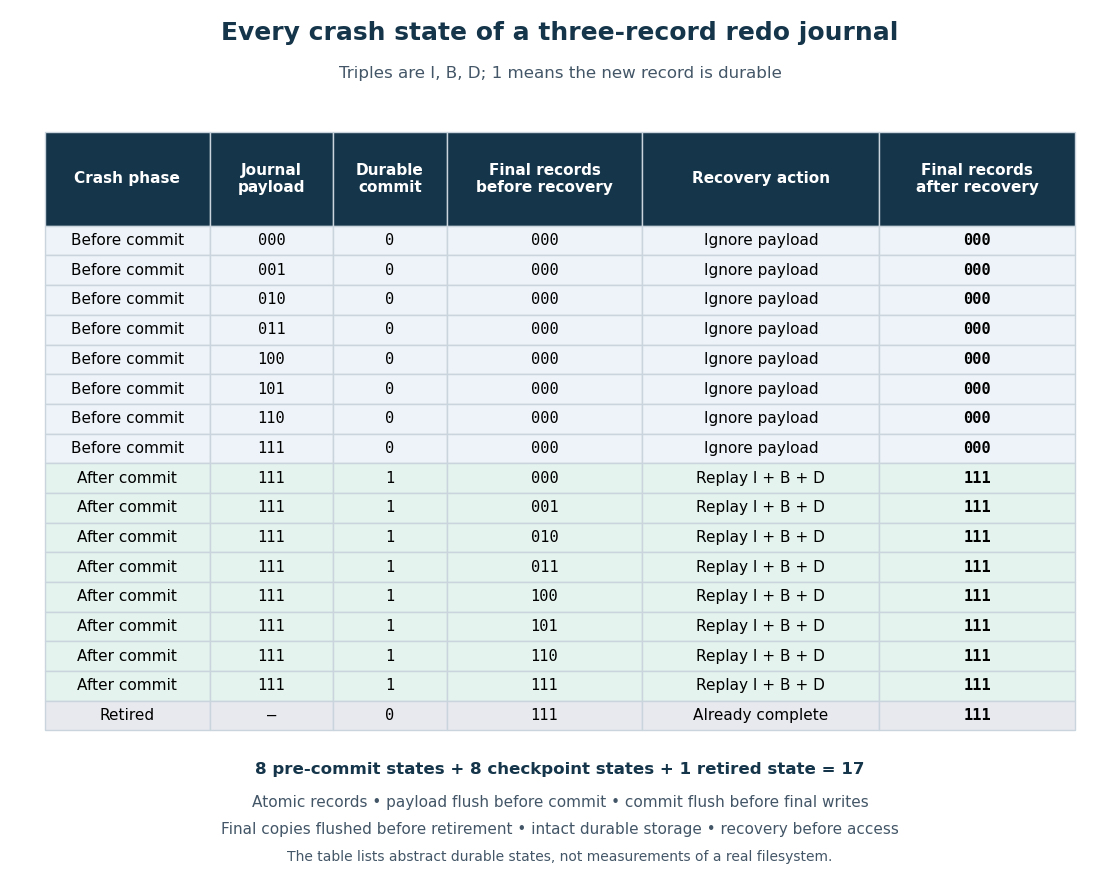
All 17 abstract crash states recover to the old or new three-record append under the stated storage flush and atomic storage write assumptions
. Details. 
The short correctness argument has three cases. Before commit, final locations are unchanged. With commit, the complete journal payload restores
111 regardless of the current final-location subset. After retirement, 111 is already durable. Each of the six partial final-location triples is repairable because its journal is retained. The enumeration is exhaustive for these records and phase rules; it excludes torn records, dishonest flush completion, media corruption, journal reuse across several file-system transactions and failures of the recovery code. It is a model check, not a measured crash test of ext4. Journal checkpoint 2026-10-14
Installing committed journal payload at final locations and making those copies durable. Safe retirement follows this completion, not merely submission of the copies. Discarding the journal while some copies remain only in a volatile memory cache can leave an unrecoverable mixture after a crash. Commit establishes a recoverable decision; a journal checkpoint permits reclamation of its journal space.
Journal commit record 2026-10-14
A marker identifying a complete committed file-system transaction. A marker alone is insufficient if its journal payload is missing or belongs to another group. The simple model prevents this through ordering and fresh record identities. Real journal formats also validate record identities and integrity: the ext4 documentation says replay discards a group lacking its commit or having mismatched integrity checks.[ref]
Journal payload 2026-10-14
The protected new contents and destination information for a file-system transaction. In the diagrams, the three complete journal payload records correspond to . Records can reach storage in any order within this phase. The journal commit record cannot become durable until all three are durable.
High-force worm-like chain elasticity Created 2026-10-14 Updated 2026-11-05
A strongly stretched inextensible worm-like chain has two small transverse tangent components. Its quadratic energy is . For a long bulk chain, the equipartition theorem assigns each Fourier mode covariance . Integrating over and summing both components gives , hence the extension deficit is half that value. With persistence length , the deficit is . It requires small slopes and negligible stretching of the backbone.
Kuhn length Created 2026-10-14 Updated 2026-11-05
The Kuhn length is the link length of an equivalent long ideal chain with the same contour length and mean squared end-to-end distance. A three-dimensional worm-like chain satisfies for , hence .
There are unlisted articles, also show them or only show them.