
Fractional-power root expansion Created 2026-10-06 Updated 2026-10-14
An algebraic root can depend on a parameter through fractional powers even when the polynomial coefficients have ordinary power series. For example, the roots of are on the scale . Dominant balance for algebraic roots identifies the exponent, and local expansion of the scaled root supplies successive coefficients.
Ricci-flat manifold Created 2026-10-06 Updated 2026-10-14
A Ricci-flat manifold has vanishing Ricci tensor. This is weaker than vanishing Riemann curvature tensor: the latter describes complete local flatness. A Kerr black hole supplies a Lorentzian manifold that is Ricci flat in its vacuum region but has nonzero Riemann curvature tensor.
Proximal operator under affine rescaling 2026-10-06
For a real Hilbert space, , and , identify with its vector by the Riesz representation theorem. Completing the square in shifts the input to . Substitute and multiply by to obtain the displayed formula, valid also for negative . If and , the answer is ; if , the objective is identically infinite and no proper proximal problem remains.
Banach-space proximal minimization 2026-10-06
On a Banach space one can define the set of minimizers of , but existence and uniqueness need additional geometry or coercivity hypotheses. The optimality condition is , with the duality mapping . The Hilbert completion-of-square shift by a dual vector does not generalize unchanged. On with and , every with is a minimizer; the vector is not one.
Radial soft thresholding 2026-10-06
Deduction theorem for propositional logic Created 2026-10-06 Updated 2026-10-07
An implication is derivable from a theory precisely when its conclusion is derivable after adjoining its antecedent. Together with classical contradiction rules, this identifies failure to prove a proposition with consistency after adjoining its negation.
Proper acceleration for one-dimensional motion Created 2026-10-06 Updated 2026-10-18
For motion on a fixed axis, the signed spatial four-acceleration in the instantaneous rest inertial frame is . Its magnitude is the scalar proper acceleration. Constant signed from rest gives and the hyperbolic motion worldline .
Projective presentation 2026-10-06
A short exact sequence presenting a module as a quotient of a projective module. The kernel need not be projective. Continuing a projective presentation gives a projective resolution.
Standard projective resolution of a quiver representation Created 2026-10-06 Updated 2026-10-14
Set , , . There is an exact sequencewhere in the source and target summands, and the augmentation is . Each is a summand of , so the two terms are projective modules. This also works for infinite-dimensional modules.
Equatorial qubit measurement Created 2026-10-06 Updated 2026-10-14
The orthonormal quantum states , , define an equatorial projective measurement. The measured observable is , with eigenvalue . Thus measures , and measures with these outcome labels. The sign convention matters when comparing different definitions of equatorial bases.
Möbius group 2026-10-06
The Möbius group is the group of all Möbius transformations of the Riemann sphere, under function composition. An invertible complex matrix represents , and nonzero scalar multiples represent the same transformation. Rescaling a representative to determinant one gives a surjective group homomorphism with kernel of a group homomorphism . Thus it is also the projective linear group and the quotient .
Productivity of arithmetic truth 2026-10-06
Multiplicative energy 2026-10-06
For finite sets of nonzero real numbers, the multiplicative energy is the number of quadruples satisfying . Swapping shows that it also counts quadruples with . Thus , where counts product representations. The Cauchy-Schwarz inequality yields .
First-order two-local Hamiltonian simulation 2026-10-06
For a sum of Hermitian two-local terms of norm below one, repeat a first-order Lie-Trotter product formula step times. The first-order unitary product-formula error bound gives total error at most for . Taking uses arbitrary two-qubit gates. At unit time and this is a sufficient bound; additional commutation structure can improve it.
Almost sure event Created 2026-10-06 Updated 2026-10-14
An almost sure event is a measurable event of probability one. Countable intersections of such events still have probability one, allowing a conclusion to hold simultaneously for countably many parameter choices. Further deterministic reasoning may then extend it to uncountably many parameters, as in Brownian Hölder regularity or nowhere monotonicity of Brownian motion. An uncountable intersection need not preserve probability one without such additional reasoning.
Lyapunov moment inequality Created 2026-10-06 Updated 2026-10-14
The Lyapunov moment inequality says that higher positive absolute moments give no smaller absolute moment sizes on a probability space. For a real random variable and ,allowing an infinite value. For the left expression is an Lp norm; below one it is a quasi-norm, so the usual triangle inequality terminology needs that distinction. The comparison uses a probability measure of total mass one; arbitrary unnormalized measure spaces need a factor depending on their total mass.
For a nonnegative count, the first moment size is its expected value, while the second is the square root of its second moment. Both ten-trial counts in second moment method have first moment size one. The independent count has second moment size , whereas the shared-outcome count has second moment size . The second moment distinguishes models with the same average because its square increases the influence of rare large counts.
More generally, for with a Bernoulli random variable of parameter ,It rises from one at toward ten as . Replacing by a parameter gives , which decreases toward zero for a fixed positive exponent when , making the rare-event and large-exponent limits different questions. For a scaled Rademacher random variable taking values and two with equal probabilities, every absolute moment size is exactly two: increasing the exponent does not distinguish signs when the absolute value is constant.
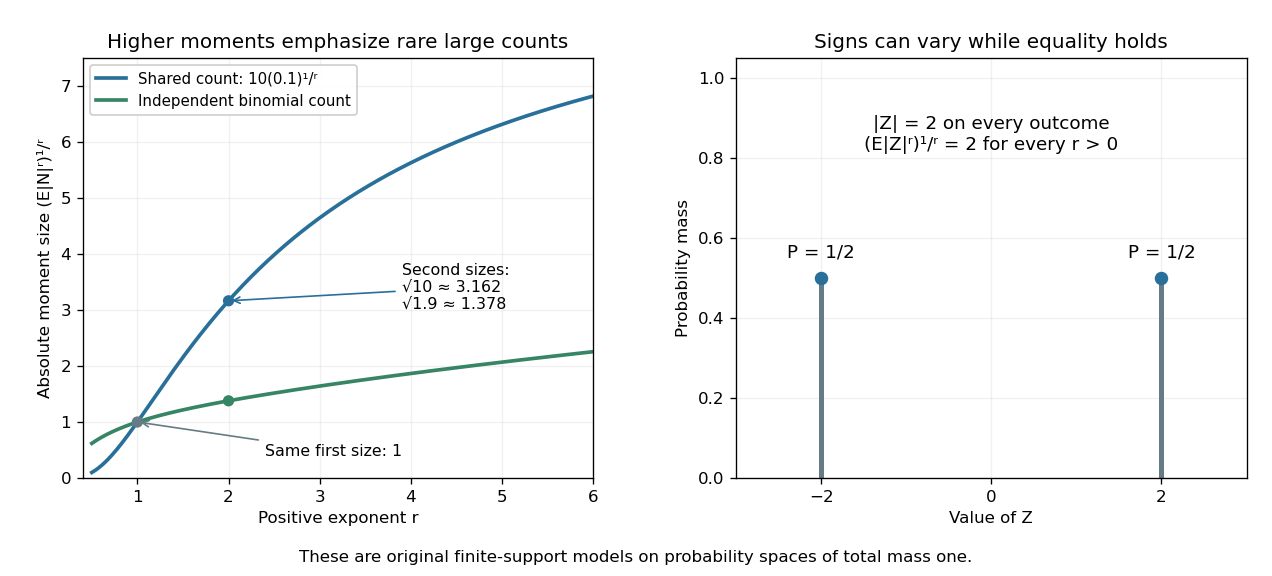
Lyapunov moment inequality reveals how higher moments emphasize large outcomes and when equality holds
. Left: the two original ten-trial models from second moment method have the same mean one, but different absolute moment sizes at exponents above one. The shared model has with . Right: equal masses at and two keep almost surely, giving equality for every pair of positive exponents. These are fully specified mathematical probability models. Details.
For finite , apply the reversed Jensen's inequality to the strictly concave function and the nonnegative random variable :Taking the positive th root proves the claim. Equality in this finite case holds exactly when is constant almost surely. If the higher moment is infinite, the upper bound is infinite and remains valid. Exponent zero is excluded from the statement; logarithmic or geometric limiting summaries require separately stated conventions, especially when can vanish.
Nonarithmetic distribution 2026-10-06
A probability distribution is nonarithmetic when it is not concentrated on for any . Every law with a probability density is nonarithmetic. This hypothesis removes lattice oscillations from the key renewal theorem.
Mixture distribution 2026-10-06
A mixture distribution first chooses a component with nonnegative mixture weights summing to one, then samples from its law . Consequently , and any finite moment-generating function is the same weighted sum of the component transforms. A component may be a Dirac measure, so a mixture may have both discrete and continuous parts.
Integrated tail distribution 2026-10-06
For a positive random variable with finite nonzero expected value , its integrated tail law has density on . The tail integral formula for moments normalizes it. For its exponential transform is , with extended-value interpretation when needed.
Kurtosis Created 2026-10-06 Updated 2026-10-14
For a real random variable with mean , finite positive variance , and finite fourth moment, kurtosis is the fourth central moment divided by the square of the variance:The standard score measures distance from the mean in standard deviations. Its fourth power gives a value ten standard deviations away a weight inside the expected value. Thus a small probability mass far from the mean can strongly affect kurtosis. It is useful for describing the contribution of extreme standard scores, but does not by itself describe the height or shape of a probability density function near its peak.[ref]
Kurtosis as Peakedness, 1905 – 2014. R.I.P. by Peter H. Westfall. §2, Terminology, definition of κ; §4, counterexamples with different peaks; §5, central and tail contributions
The normal distribution has kurtosis . A random scale can increase kurtosis even when the conditional distribution is normal. A constant random variable has zero variance, so this ratio is undefined. If the variance is finite and positive but the fourth central moment is infinite, the ratio can be written in an extended sense; it is not a finite kurtosis. If the variance itself is infinite or the mean is undefined, the displayed normalization is unavailable.
There are unlisted articles, also show them or only show them.