
Ramond zero-mode Clifford algebra 2026-10-06
The zero-mode anticommutator becomes the Euclidean Clifford algebra after . It acts within the oscillator-vacuum space. Eight transverse Gamma matrices give a minimal complex representation of dimension sixteen, split into two eight-dimensional chirality sectors.
RNS spin field 2026-10-06
A worldsheet operator that changes fermion boundary conditions to the Ramond sector and creates a target spinor state. For real matter fermions its conformal weight is . At , combining it with the appropriate superghost factor gives a dimension-one spacetime-supersymmetry current.
Attenuated Radon transform Created 2026-10-06 Updated 2026-10-14
The integral of a source over a directed line, weighted by exponential absorption between each source point and a detector. For line coordinates and a detector at the negative end, it is . The integrating factor of a transport equation derives the weight. Reversing the detector direction changes the weight for spatially varying attenuation, so the two directed measurements need not coincide. Setting recovers the Radon transform.
Radiative transfer source function Created 2026-10-06 Updated 2026-10-25
The radiative transfer source function is emission per unit extinction. If is emission per unit path length and is extinction per unit path length, and the transfer equation is . Under thermal absorption in local thermodynamic equilibrium it is the Planck function; for conservative coherent isotropic scattering it is the mean intensity.
Combining with viscous heating gives a height-independent dynamic viscosity under constant opacity. This exact limiting relation differs from an approximate vertically averaged alpha disk closure.
Kepler–harmonic radial duality 2026-10-06
Taking in a radial orbit time transformation gives and . Bound Kepler orbits with map to a confining harmonic oscillator; positive energy maps to an inverted oscillator. Full angular reconstruction halves the original orbital angle.
Kepler–isochrone radial transformation 2026-10-06
With , and , set . If , its positive-radius root is , with . The transformed Newtonian gravitational potential is an additive constant plus , the spherical isochrone model. The mass sign and branch conditions must be checked.
A transformed radial equation containing becomes a full planar central-force orbit by choosing . For and old angular velocity , this gives . Keeping the old angle generally fails to preserve the stated transformed angular momentum.
An outgoing radial null geodesic of the Vaidya metric prescribed as determines the mass along that curve by . This inverse relation comes from the radial null condition. It determines a function of advanced time wherever the prescribed curve is differentiable and has positive radius.
Kepler-harmonic epicyclic precession 2026-10-06
For , nearly circular motion has and . Their generally nonrational ratio makes small-eccentricity orbits precess even if was added slowly. This illustrates adiabatic actions do not preserve orbital closure.
Epicyclic frequency bounds for monotone spherical density Created 2026-10-06 Updated 2026-10-14
For a nonnegative, radially nonincreasing spherical mass density, and . Since does not exceed the mean enclosed density, the radial epicyclic frequency lies between and . General axisymmetric disks need not satisfy this bound.
Quotient topological space Created 2026-10-06 Updated 2026-10-25
A quotient topological space is a quotient set equipped with the quotient topology. For a concrete gluing, give the closed interval its usual subspace topology, identify , and leave every interior point in its own singleton equivalence class. The resulting quotient space is a circle: the two endpoints become one point, while interior points remain distinct.
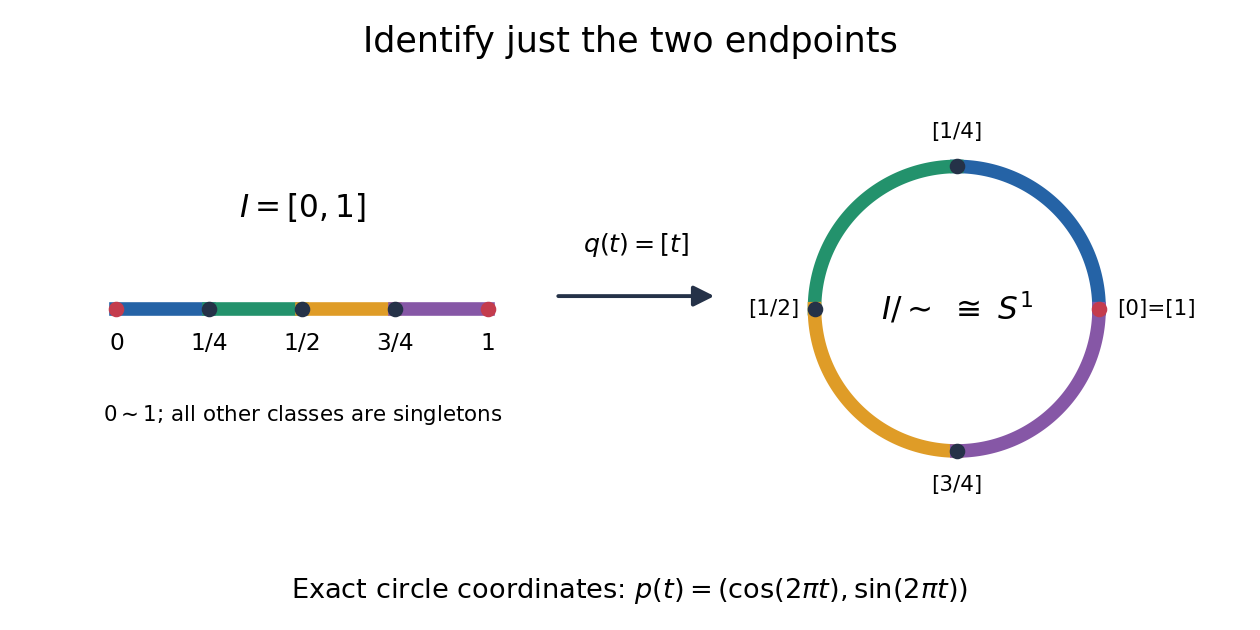

The exact continuous map to the unit circle in the plane isHere sine and cosine give , and holds exactly when or . Thus induces a bijection . [ref] The universal property of the quotient topology makes continuous. The quotient of a compact space is compact, and the unit circle is Hausdorff, so the compact-to-Hausdorff continuous bijection theorem makes a homeomorphism. This verifies the topology, not merely the point identifications.
To inspect an open neighbourhood of the seam, choose and let . Its full preimage isBoth pieces are open in the subspace topology on , so is open in the circle. In contrast, is open in , butis not open in : it contains without any neighbourhood of . Hence is not open in the circle. A quotient map can therefore fail to be an open map.
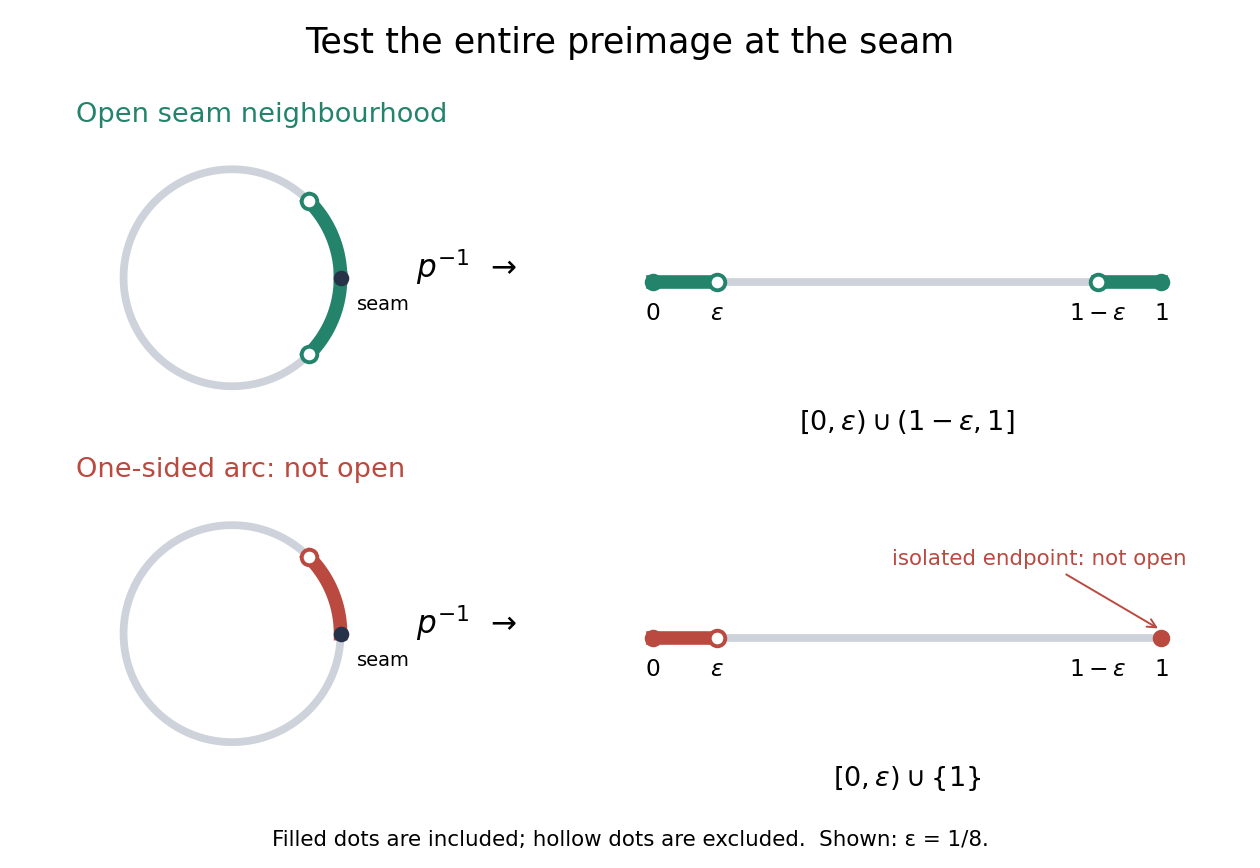
An open neighbourhood crosses both sides of the glued seam; a one-sided arc fails the full-preimage test
. Details. 
For a continuous function , the only gluing condition is . For example, defines a continuous function on the circle, whereas does not. This lets us use an interval as a coordinate for a periodic function while making the seam invisible. More general quotient spaces encode glued geometric pieces in the same way: describe continuous maps before gluing and check that their values agree on every equivalence class.
The Hausdorff property need not survive a quotient topology. In the non-Hausdorff quotient of the real line by rational translation, means . A nonempty open preimage must contain all translates by rational numbers of any open interval inside it. The density of the rational numbers then forces : for any , some rational number has in that interval. Thus this quotient space has the indiscrete topology. The irrationality of the square root of two gives distinct equivalence classes for and , so this quotient space is not Hausdorff. Unlike the endpoint-gluing circle, this gluing identifies a dense subset with each point.
Abelian quotient 2026-10-06
An abelian quotient is a quotient group that is an abelian group. It exists only for a normal subgroup , and it is abelian exactly when contains the commutator subgroup. Thus every abelian quotient factors through the abelianization .
Finite quotient of a group Created 2026-10-06 Updated 2026-10-14
A finite quotient is the image of a group under a surjective group homomorphism to a finite group. A group has no nontrivial finite quotients exactly when every homomorphism from it to a finite group is trivial. This property does not prohibit finite or finite-quotient-bearing subgroups.
Quiver with one loop 2026-10-06
Its path algebra is . Finite-dimensional representations are vector spaces with a single endomorphism. Thus oriented cycles can give an infinite-dimensional algebra even when the representations studied are finite-dimensional.
M-M-s queue 2026-10-06
Poisson arrivals of rate and independent exponential servers of rate give a birth-death chain with departure rate . The process is positive recurrent for , null recurrent at equality, and transient above capacity.
Quasireversibility Created 2026-10-06 Updated 2026-10-07
In equilibrium, a queue is quasireversible when its present state is independent of subsequent arrival times and preceding departure times, for each customer class. For an M-M-s queue, detailed balance and time reversal of a continuous-time Markov chain show that past departures become future arrivals generated independently of the present state. This backward independence is useful in tandem calculations where downstream occupancy is determined by earlier departures.
For a flux and a weak solution of , discrete integration by parts and the fundamental theorem of calculus along a line segment show that solves , with and . Coercive quadratic-form bounds and operator norm bounds for on all segments between these gradients pass to . This produces a divergence-form elliptic operator without initially assuming second partial derivatives of .
For equal-depth layers coupled by an interface,The Laplacian terms are relative vorticity; the streamfunction differences encode opposite layer-thickness changes. Each material derivative follows that layer's own velocity. The sum has a barotropic mode without interface displacement, while the difference contains a baroclinic mode.
Uniform coprime state for a semiprime 2026-10-06
For a semiprime with distinct known primes, this quantum state is uniform over the reduced residue classes. With binary digits in , its fraction among all computational labels is . An ancilla qubit whose one probability is dilutes the joint good probability to exactly . A reversible range-and-greatest common divisor predicate marks the good labels with ancilla qubit one, and a single exact amplitude amplification iteration produces . Known prime factors provide the cardinality; the membership test itself needs only . Polynomial gate complexity presumes ideal one-qubit rotations at the specified amplitudes.
There are unlisted articles, also show them or only show them.