
Geographical latitude 2026-10-06
For a spherical Earth, geographical latitude is the angle of the local vertical above the equatorial plane. It equals the altitude of the north celestial pole in the northern hemisphere. Precision astrometry distinguishes geodetic and astronomical latitude.
Tor functor Created 2026-10-06 Updated 2026-10-14
The Tor functor is the homology of a tensor product of modules with a free resolution: for a free resolution of . It measures the failure of tensoring to preserve exact sequences. For a commutative ring, one may resolve either argument; the double complex of the two resolutions proves that both computations agree.
Spectral sequence Created 2026-10-06 Updated 2026-10-14
A succession of bigraded pages with . In the cohomological convention, the differential has bidegree . A filtered complex produces such successive approximations to its cohomology.
Heterotic Calabi-Yau compactification 2026-10-06
Compactification of a heterotic string on a Calabi-Yau threefold with a consistent holomorphic vector bundle. Suitable bundle and geometry choices preserve four-dimensional N=1 supersymmetry and generate chiral matter from internal Dirac zero modes. The index controls net chirality. In the standard embedding, the net generation index is half the internal Euler characteristic, up to chirality orientation conventions.
Heteroclinic cycle 2026-10-06
A heteroclinic cycle is a closed chain of invariant states connected by heteroclinic orbits. In convection-amplitude models it can describe successive convection roll switching. Existence and attraction require the global connections and their transverse stability; a single convection roll's positive invasion growth rate alone does not establish an attracting cycle.
Helium-4 Created 2026-10-06 Updated 2026-10-07
Helium-4 is the stable helium isotope with two protons and two neutrons; its nucleus is an alpha particle. Its strong binding makes it the principal neutron-containing product of primordial Big Bang nucleosynthesis.
Hamilton-Jacobi equation 2026-10-06
A principal function obeys the Hamilton-Jacobi equation . A complete solution generates canonical momentum components and local canonical coordinates constant along motion. For a time-independent Hamiltonian, reduces the equation to . Additive separation of yields conserved separation constants, subject to local regularity and independence.
Conformal mechanics 2026-10-06
A one-dimensional particle with admits conserved time-translation, dilation and special-conformal charges. Their Poisson brackets form the sl2R Lie algebra. The homogeneity of the inverse-square potential is what allows the symmetry.
Hamiltonian system 2026-10-06
A dynamical system on a symplectic manifold whose vector field is generated by a Hamiltonian. In canonical variables it obeys Hamilton's equations.
Adiabatic invariant Created 2026-10-06 Updated 2026-10-14
A quantity conserved to leading order when a parameter varies slowly compared with the natural motion period. The action variable of a regular periodic Hamiltonian orbit is a standard example, as explained by adiabatic invariance of the action.
Known-subset Grover search Created 2026-10-06 Updated 2026-10-14
For a known finite set , prepare the uniform superposition state and implement its reflection operator . If exactly basis states in are marked, the same two-dimensional Grover rotation angle argument uses phase queries. Preparation and reflection are known operations with no calls to the unknown predicate. Their gate cost must be accounted for separately. The success guarantee requires , and choosing the optimal iteration number uses a known .
Marked density under a permutation Created 2026-10-06 Updated 2026-10-14
For a permutation of an -element set and a known marked output subset of size , exactly inputs have marked outputs. The uniform quantum superposition thus has good probability , independent of which permutation the oracle represents. This allows a known-angle amplitude amplification schedule without counting unknown preimages.
Ground-state degeneracy Created 2026-10-06 Updated 2026-10-14
When a ground state exists, its ground-state degeneracy is the dimension of the ground-state subspace:Here is the identity operator, and the kernel of a linear map is taken within the operator domain of the Hamiltonian operator . The count concerns linearly independent energy eigenstates, rather than every normalized quantum superposition or every choice of global phase. Even a single energy eigenspace contains infinitely many representing vectors; its dimension measures independent freedom. Ground-state degeneracy is the lowest-energy instance of degenerate energy levels.
For an exact finite model with energy unit , let the Hamiltonian operator be the diagonal matrixIts ground-state energy is zero and : the first two coordinate unit vectors span the ground-state subspace. Every normalized , with , is a ground state, including . Its energy measurement is certain to return zero, even though a measurement distinguishing from need not have a definite outcome. Under the unchanged Hamiltonian operator, this quantum superposition is a stationary state because both components acquire the same global phase.
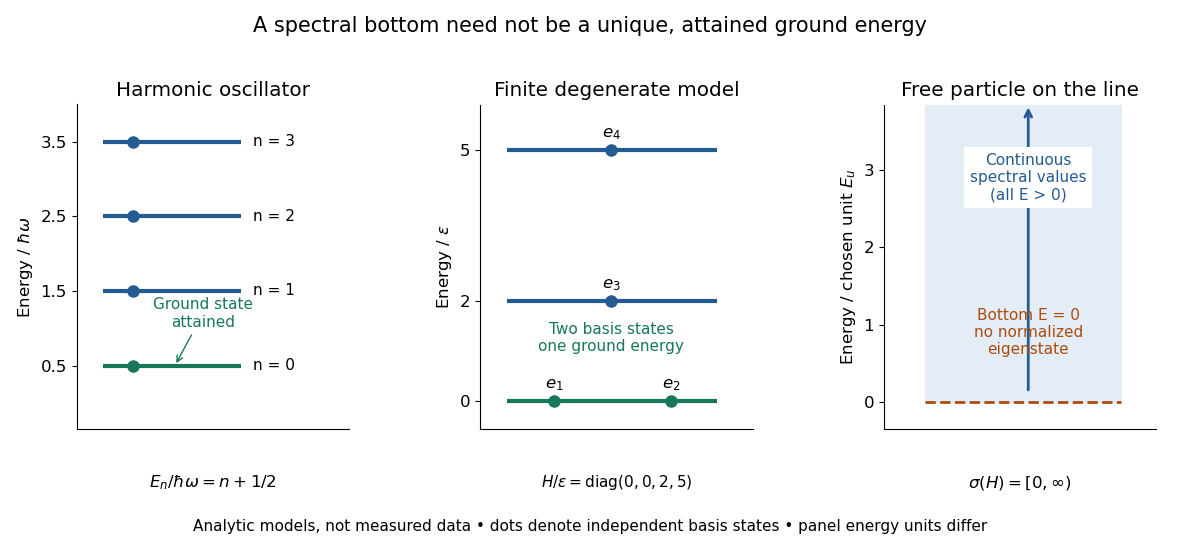
Attained ground energies, ground-state degeneracy, and an unattained spectral bottom
. Exact analytic models, not measured data. The quantum harmonic oscillator has an attained ground-state energy. The finite diagonal matrix has two independent ground states at one energy eigenvalue. The whole-line free particle has continuous spectrum beginning at zero and no normalizable zero-energy energy eigenstate; the shaded interval denotes spectral values, not a collection of normalized energy eigenstates. Each panel uses its own stated energy unit. Details.Ground-state degeneracy matters when an interaction selects or splits previously equal energy eigenvalues. In the finite model, adding with gives the formerly lowest pair the distinct energies , leaving a unique ground state. This direct calculation illustrates why degenerate perturbation theory first examines the perturbation inside the whole ground-state subspace.
A classical continuous-symmetry model can instead have a manifold of minimizing configurations, such as the sphere of orientations of a Néel state in an isotropic Heisenberg antiferromagnet. That geometric description does not by itself count the dimension of a finite quantum ground-state subspace.
Ground-state subspace Created 2026-10-06 Updated 2026-10-24
The ground-state subspace is the eigenspace of a Hamiltonian operator at its lowest eigenvalue . A computational history state construction can have many valid quantum witnesses, hence a degenerate ground space. Perturbation bounds must optimize on this entire subspace, rather than on a chosen basis of ground states.
Complex transport Green function Created 2026-10-06 Updated 2026-10-14
For , , , this kernel satisfies . A real-linear change of complex coordinate reduces its derivation to the Cauchy-Green operator; the determinant changes sign at the unit circle. For the operator becomes a real directional transport equation, whose characteristic singularity requires limiting prescriptions. The kernel has at zero and at infinity.
Axisymmetric radiation carries no axial angular momentum Created 2026-10-06 Updated 2026-10-14
An exact axial Killing vector field makes Komar angular momentum independent of the surrounding vacuum surface. Therefore gravitational waves in a configuration with exact axisymmetry carry no net angular momentum about that symmetry axis, although they can carry energy. This is specific to axial angular momentum; it is not an absence of radiation.
Free-fall time of a uniform sphere Created 2026-10-06 Updated 2026-10-14
A pressureless uniform sphere initially at rest collapses under Newtonian gravity in a time depending only on its initial mass density. Solving the radial shell equation gives . It is commonly used as a dynamical-time benchmark for cooling and star formation, with the gravitating density rather than gas density alone when other matter supplies gravity.
Walk in a graph Created 2026-10-06 Updated 2026-10-14
A walk records a journey through a graph as a finite alternating sequencewhere each edge joins the consecutive vertices and . Both vertices and edges may repeat. Its length is , counting edge traversals with repetitions, rather than counting different edges or measuring the drawing. Here a graph path means a walk with no repeated vertices; a trail instead forbids repeated edges. These conventions distinguish a journey's record from the subgraph consisting of the connections it used.[ref]
https://ptwiddle.github.io/MAS341-Graph-Theory-2017/lecturenotes/lecture3.html. Paul Johnson, MAS341, Lecture 3: walks and trails
Unless stated otherwise, the examples below use a finite simple graph that is an undirected graph, so an edge may be traversed in either direction. In a multigraph, retain each edge's individual identity as well as its endpoint vertices: two parallel edges are different choices for the same step. If self-loops are allowed, traversing one leaves the current vertex unchanged but adds one to the length. In a directed graph, each step must follow its directed edge from its initial to its terminal vertex, giving a directed walk; reversing a journey need not be possible.[ref]
https://people.math.binghamton.edu/zaslav/Oldcourses/581.S99/notes.html. Thomas Zaslavsky, Supplementary Notes for Graduate Graph Theory: edge identities and walks
We allow the zero-length walk at every vertex . It uses no edges, so it is also a trail and a graph path, and its coinciding endpoints make it a closed walk. This means staying put is a legitimate journey; a graph with no vertices has no such walk. Positive-length restrictions will be stated explicitly.[ref]
Mathematics for Computer Science by Eric Lehman and others. Lehman, Leighton and Meyer, Mathematics for Computer Science, §11.8.1: length-zero convention
Use the same constructed graph throughout these three sections:Here denotes the unordered pair , and . Two triangles in a graph, and , share , with one extra edge . These are schematic connections, not measured roads; the highlighted connections in the diagram show which edges are used, while the numbered sequence records their order.
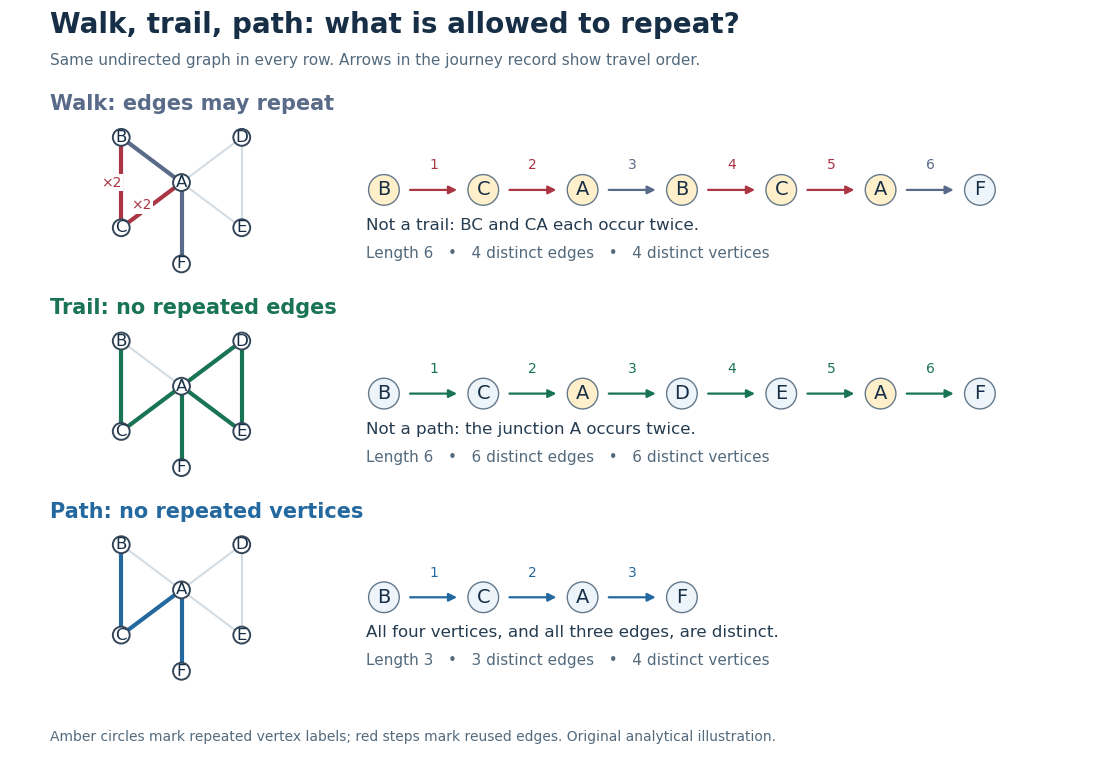


The length-six walk uses and twice, so it is not a trail. The length-six trail returns to but uses six different edges, so it is not a graph path. The length-three graph path repeats neither vertices nor edges. Thusfor this particular graph. The restrictions answer different routing questions: revisiting a junction is harmless for many journeys, whereas reusing a serviced road segment can matter for an inspection route. Travel costs require a weighted graph; a walk's cost adds the weight of each traversal, even when an edge is used again.
Every finite walk from to contains a graph path from to after deleting detours. For a proof outline, if with , delete the intervening closed walk. The retained steps still meet at the same vertex, and the length strictly decreases. Repeating terminates with no repeated vertices, or with the zero-length graph path when . This explains why reachability can be formulated using either walks or graph paths. With nonnegative edge weights, deletion also cannot increase cost, connecting the argument to the shortest path problem; with negative weights that cost conclusion fails.[ref]
https://ptwiddle.github.io/MAS341-Graph-Theory-2017/lecturenotes/lecture3.html. Paul Johnson, MAS341, Lecture 3: deleting repeated-vertex detours
Hypergraph 2026-10-06
A hypergraph consists of a vertex set and a family of subsets of , called hyperedges. Unlike a graph, a hyperedge may contain more than two vertices. A uniform hypergraph restricts all hyperedges to one fixed size.
There are unlisted articles, also show them or only show them.