
Complex Fourier series 2026-10-06
The complex form of a Fourier series for period uses coefficients and complex exponentials . For square-integrable functions it converges in the norm, and the Parseval identity is . Real functions satisfy .
For a periodic function that is piecewise continuously differentiable with finitely many pieces, its Fourier series converges at each point to the average of the two one-sided limits. At a point of continuity this is the function value. This includes the identified interval endpoints, whose two limits belong to the periodic extension. Absolute summability of the Fourier coefficients additionally gives uniform convergence.
The period-one extension of on has Fourier series . Endpoint agreement makes the periodic function continuous. Its derivative series is , which equals in the open unit interval and converges to zero at integers, the midpoint of the derivative's jump. Termwise differentiation of a Fourier series applies locally away from the corners.
Dirichlet-Jordan convergence theorem 2026-10-06
The Fourier series of a periodic function of bounded variation converges at each point to the mean of its two one-sided limits. In particular, it converges to the function at continuity points. Periodizing a compact interval introduces jumps at its integer endpoints; their half-values explain the half-weight convention in the Van der Corput sum-integral lemma. The conclusion is pointwise convergence, not a claim of absolute convergence of every such Fourier series.
Orthogonality of integer Fourier modes Created 2026-10-06 Updated 2026-10-07
For an integer , direct integration gives zero unless , in which case it gives one. Products of this identity on the unit cube turn integrals of finite exponential sums into counts of integer solutions. This is the elementary orthogonality used in the Vinogradov mean value.
Spatial frequency Created 2026-10-06 Updated 2026-10-14
Spatial frequency is the number of oscillation cycles per unit length. A ripple with spatial period has frequency ; its angular wavenumber is . In two dimensions the spatial-frequency vector specifies the orientation and period of a plane-wave pattern.
Four-divergence Created 2026-10-06 Updated 2026-10-07
The four-divergence of a four-vector field is the Lorentz scalar contraction . With , it equals . The four-current has zero four-divergence, expressing local charge conservation.
Mass shell Created 2026-10-06 Updated 2026-10-07
The mass shell is the locus of four-momenta satisfying the relativistic dispersion relation for a fixed mass . With mostly-minus Minkowski metric, ; with mostly-plus Minkowski metric, . The positive-energy sheet represents particle four-momenta. For this is the light cone. The condition of being on shell refers more generally to satisfying the field equations.
Ontological model of a quantum system Created 2026-10-06 Updated 2026-10-14
An ontological model associates each quantum state preparation with a probability distribution over underlying physical states . A measurement in quantum mechanics's response probabilities depend on its specification and , sum to one, and reproduce the Born rule when averaged over the preparation distribution. The model need not assign deterministic outcomes. Overlap or disjointness of preparation measures defines the psi-epistemic model versus psi-ontic model distinction.
Padded convolution of words 2026-10-06
The padded convolution of words reads two finite words over an alphabet in parallel, extending the shorter with a fresh padding symbol until the longer ends. Its length is . Padding may only occur as a suffix, and a column is excluded. This encodes synchronous two-tape relations as formal languages over a finite paired alphabet.
Left quotient of a formal language 2026-10-06
For a word and a formal language , the left quotient is the possible continuation language after the prefix . Two prefixes have the same left quotient exactly when they are Myhill-Nerode equivalent. For a regular language only finitely many distinct left quotients occur.
Shuffle of formal languages Created 2026-10-06 Updated 2026-10-31
The shuffle of two formal languages consists of words whose positions can be partitioned into two subsequences, each preserving its order, with the two resulting words belonging to the respective languages. For regular languages, a product-state nondeterministic finite automaton advances exactly one coordinate for each letter. Common letters allow either choice; the powerset construction proves closure.
Cavitation 2026-10-06
Cavitation is the formation of gas or vapour cavities when a liquid's pressure becomes sufficiently low. A journal bearing model with cavitation must specify how a partly filled film and its boundaries behave, so periodic pressure alone cannot determine the flow there.
Inviscid flow 2026-10-06
An inviscid flow neglects viscosity in the fluid flow. Its momentum balance is described by the Euler equations for an inviscid fluid.
Steady flow 2026-10-06
In steady flow, the velocity and other relevant flow fields are independent of time in the chosen reference frame. Streamlines then coincide with the paths of moving particles, while convective acceleration can still be nonzero.
Unidirectional flow Created 2026-10-06 Updated 2026-10-31
A unidirectional flow has velocity parallel to a single fixed direction, for example . If the speed is independent of the coordinate along that direction, the convective acceleration vanishes. The steady Navier-Stokes equation then reduces to a linear balance of the pressure gradient and viscosity, as in Couette flow and Poiseuille flow.
Fixed-energy turbulent mixed layer Created 2026-10-06 Updated 2026-10-14
In a slowly deepening mixed layer driven by a rotating boundary, a phenomenological balance between energy input, turbulent loss and acceleration of entrained fluid can keep total kinetic energy approximately fixed. For a tank of radius this gives , so velocity decreases as . The closure does not make the speed constant and is an additional physical assumption rather than a direct consequence of mass conservation.
Jacobian evolution of a smooth flow Created 2026-10-06 Updated 2026-10-14
For a smooth flow map generated by a vector field , the chain rule and give . With initial value one, its solution is the exponential of the time integral of this divergence. Thus a divergence-free generator preserves Euclidean volume and orientation. This connects the Jacobian determinant with a volume-preserving vector field.
Bound-state thresholds for a square well with one hard wall Created 2026-10-06 Updated 2026-10-14
For a zero-potential interval of width , an infinite wall at its left end, and constant exterior potential to its right, the th bound state branch exists precisely when , for . Matching the wavefunction and its derivative gives with . At equality the new threshold solution is not normalizable, so exactly one bound state corresponds to .
Field with four elements Created 2026-10-06 Updated 2026-10-14
Build this finite field by taking a quotient ring of a polynomial ring:The polynomial has in the prime field . A polynomial of polynomial degree two is an irreducible polynomial exactly when it has no polynomial root in the coefficient field. Thus the quotient by an irreducible polynomial is a field construction applies. Its elements have unique representatives , with : precisely .
The defining relation is . Since this finite field has characteristic two, every element equals its additive inverse, and the relation becomes . Addition acts separately on the two coefficients:All coefficient calculations use modular arithmetic modulo two. For example, and . Encoding as the pair of bits gives , , , and ; addition is bitwise exclusive or. These are coordinates in the basis , so the label does not make the element .
For multiplication, expand using the distributive property and replace every by :For example, , while . The following complete tables are computed from the coefficient rules. Colors identify results, rather than their numerical sizes. Every row of the addition table lists all four elements, and every nonzero row of the multiplication table does too: adding an element, or multiplying by a nonzero element, can be undone.
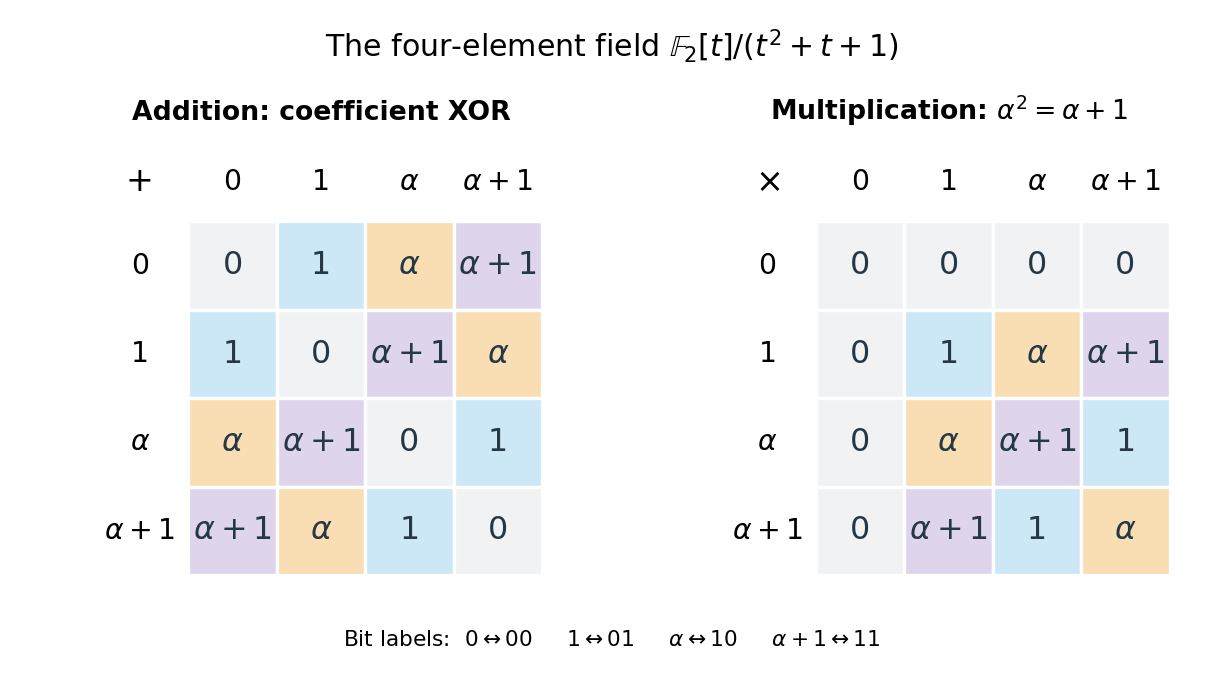
The nonzero multiplicative inverses are , , and . Consequently the equation has the unique solution . Repeated multiplication gives , , , and . They cycle through every element of the multiplicative group of a finite field.
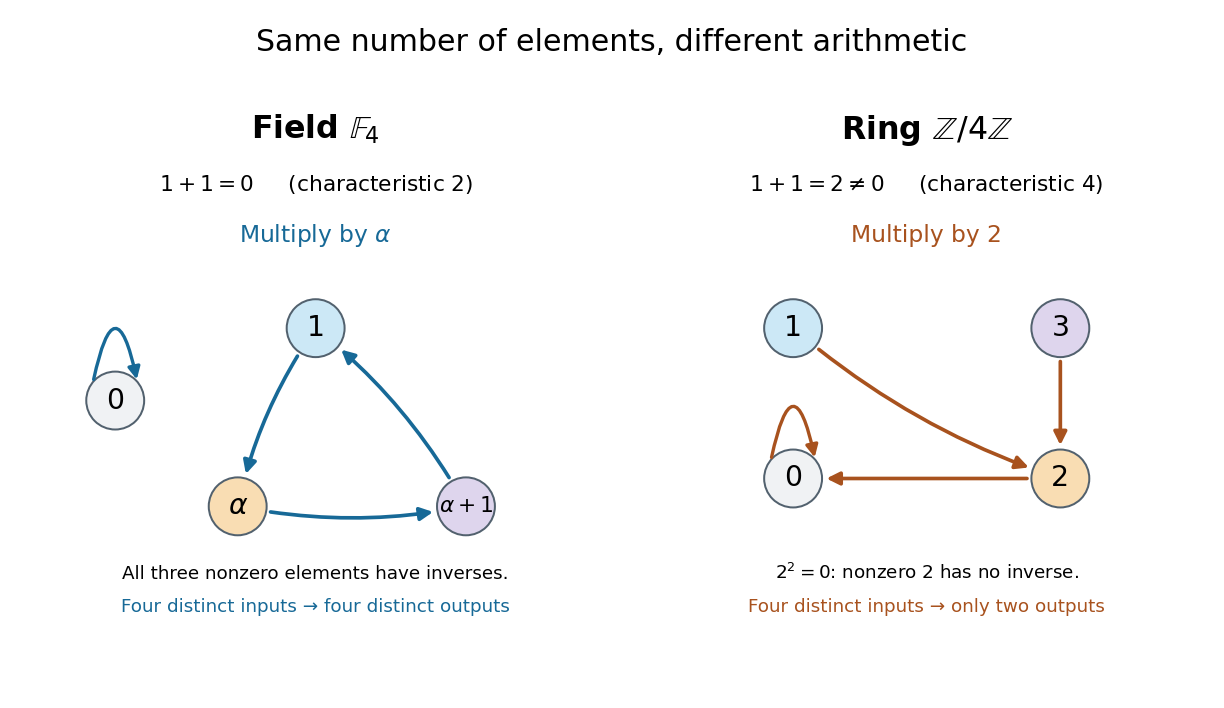
Compare the ring , also with four elements. Its addition satisfies , and its multiplication satisfies . Thus is a zero divisor, with no multiplicative inverse, and this ring is not a field. Multiplying by collapses different inputs to the same output: both and give , while both and give . In the field with four elements, multiplying by instead rotates the three nonzero elements, preserving their distinctness. The figure makes visible why counting four elements alone does not specify their arithmetic.


There are unlisted articles, also show them or only show them.