
Cut vertex Created 2026-10-06 Updated 2026-10-14
A cut vertex, also called an articulation point, is a vertex of an undirected graph whose deletion increases the number of connected components of a graph. Write for that count, including isolated vertices, and for the graph obtained by removing and every incident edge. Then the test is , even when the original graph is disconnected. By contrast, deleting a bridge in a graph removes just one edge and keeps both endpoint vertices. These are different failure models. [ref]
https://algs4.cs.princeton.edu/41graph/. Sedgewick and Wayne, Algorithms, §4.1: bridges and articulation points
First take two triangles in a graph, and , sharing only the vertex . This simple graph hasHere abbreviates the unordered pair . Removing leaves the two connected components of a graph and , so . Removing any other vertex leaves a connected graph. Thus is the only cut vertex. Every edge lies on a triangle in a graph, so deleting any single edge still leaves a graph path between its endpoints along the other two edges. There are no bridges in a graph.
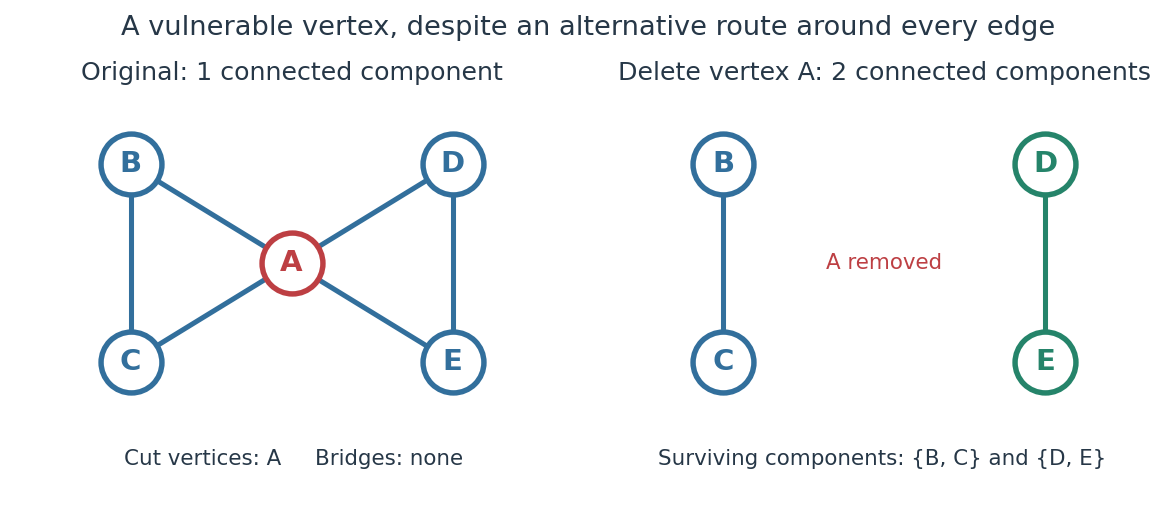
The generator computes the adjacency lists and checks every vertex deletion, giving the following complete table:
| Deleted vertex | Original graph neighbours of | |
|---|---|---|
Now take two disjoint triangles in a graph, and , joined by the edge :Deleting only preserves all six vertices and leaves connected components of a graph and : is the only bridge in a graph. Deleting also removes and , leaving connected components of a graph and . Deleting instead leaves and . Thus are exactly the cut vertices.
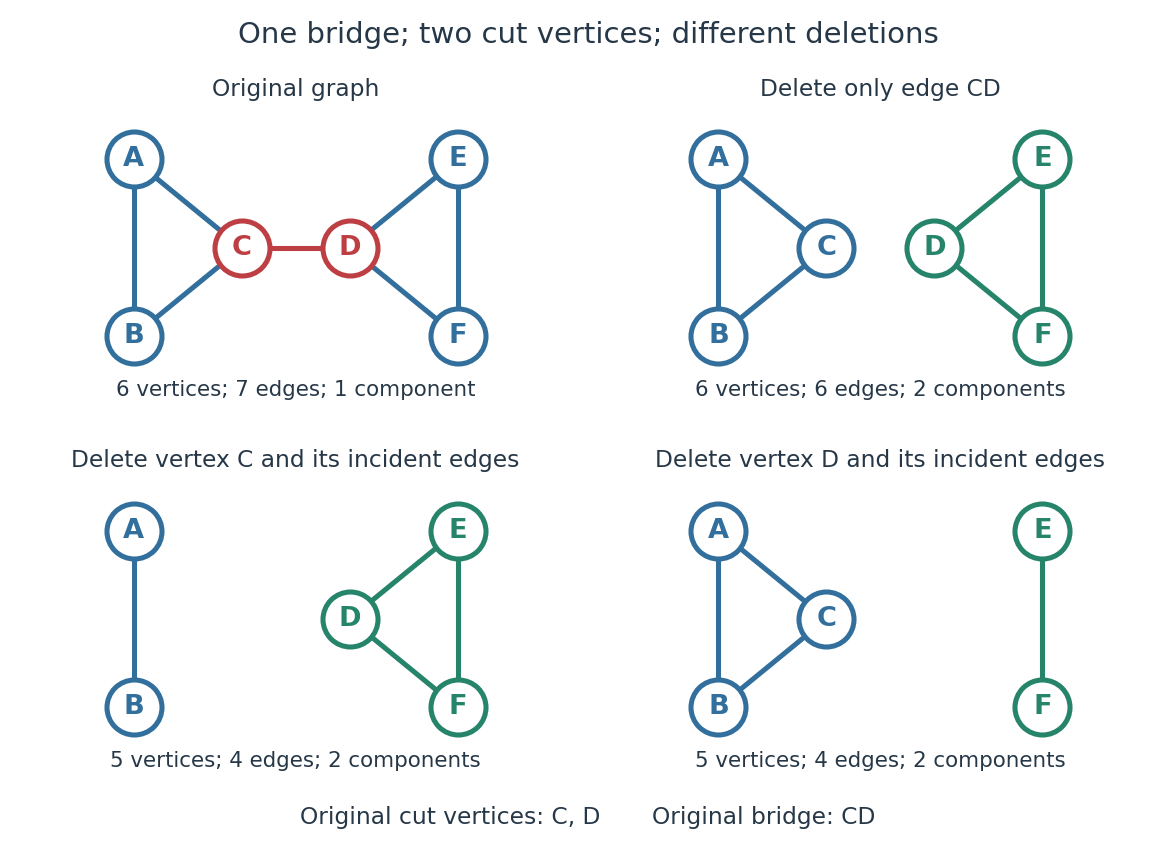


Again the adjacency lists and all vertex deletion counts are computed directly:
| Deleted vertex | Original graph neighbours of | |
|---|---|---|
For a disconnected example, adjoin an isolated vertex to the first graph. Now , deleting gives , and deleting gives . The original graph was already disconnected, but is still a cut vertex; is not. The empty graph has count zero, so deleting the only vertex of a one-vertex graph does not create a cut vertex. Nor is either endpoint of a single isolated edge a cut vertex, although that edge is a bridge in a graph.
In a communications network, a cut vertex models a router whose failure separates surviving routers. The shared- example shows why having an alternative graph path around each individual edge does not protect against failure of the common router. An additional edge from to removes this particular vulnerability: after deleting , still join the two sides. A bridge in a graph instead models a vulnerable link. This distinction tells us whether to add another cable between existing devices or a route avoiding an indispensable device; it describes connectivity, rather than traffic capacity or failure probabilities.
The beautiful structural consequence is that a graph splits into biconnected components joined at cut vertices. Within each nontrivial robust piece, a single vertex failure cannot separate the other vertices; between pieces, the shared cut vertices reveal the bottlenecks. Also, a Hamiltonian graph has no cut vertex: deleting any vertex from its Hamilton cycle leaves a Hamiltonian path through all remaining vertices.
Historically, Tarjan's June 1972 paper developed depth-first search as a tool for finding biconnected components in time linear in the numbers of vertices and edges. [ref]
https://epubs.siam.org/doi/10.1137/0201010. Robert Tarjan, Depth-First Search and Linear Graph Algorithms, SIAM Journal on Computing 1(2), 146–160 (1972)
In his 1983 recollection, Tarjan credited Hopcroft with the original linear-time biconnected component algorithm during their collaboration beginning in summer 1970, and described the published version as a refinement. The historical lesson is how a carefully organized traversal turns many separate deletion experiments into one computation. [ref]https://garfield.library.upenn.edu/classics1983/A1983QY47200001.pdf. Robert E. Tarjan, Citation Classic recollection (1983)
Kneser graph 2026-10-06
The Kneser graph has as vertices the -element subsets of , with an edge between two exactly when they are disjoint. A graph colouring of this graph partitions the -sets into intersecting families.
Graph intersection Created 2026-10-06 Updated 2026-10-07
For two graphs on the same vertex set, their graph intersection retains exactly the edges belonging to both.
Gradient-flow dissipation identity 2026-10-06
For the downward gradient flow , the chain rule gives . Integrating converts a bound on the decrease of into a bound on elapsed time wherever its Riemannian gradient is bounded away from zero.
Gradient flow with diagonal mobility Created 2026-10-06 Updated 2026-10-07
Positive mobility coefficients give . With , the substitution turns the equation into ordinary gradient ascent for the transformed potential on positive coordinates.
Glacier Created 2026-10-06 Updated 2026-10-14
A glacier is a persistent mass of land-based ice that deforms and flows under gravity. Ice accumulation, ice ablation, internal deformation and basal sliding determine its geometry and motion.
General circulation model Created 2026-10-06 Updated 2026-10-07
A general circulation model evolves rotating fluid dynamics together with heating/cooling and suitable transport parameterizations. Atmospheric applications can couple radiative transfer, clouds and chemistry to resolve longitudinal and latitudinal structure. For an exoplanet atmosphere, it can predict winds and an exoplanet thermal phase curve. Unresolved turbulence and cloud microphysics still require approximate closures.
Geometrized luminosity 2026-10-06
A geometrized luminosity is dimensionless because in geometrized units an energy and a time have the same dimension. Starting from SI luminosity, multiply by . The corresponding SI power unit is . Radiating a fraction of a mass at constant SI luminosity takes , or in seconds.
Etendue Created 2026-10-06 Updated 2026-10-14
Etendue measures how much position-and-direction space a bundle of light rays occupies. A small spot accepting a wide range of directions can have the same etendue as a large spot accepting a narrow range. This makes etendue useful for deciding whether an optical instrument can deliver an extended source's entire admitted radiant flux to a small receiver. For forward crossings of a surface, the geometrical optics definition iswhere is the occupied set of surface positions and directions, is the local refractive index, is actual surface area, is solid angle, and is the angle to the forward unit normal. The cosine supplies the projected area. Opposite crossing directions must be counted separately with positive projected area, rather than cancelling them in a signed integral. [ref]
Étendue (Photon Snacks) by R. John Koshel. Étendue, p. 1, equation (1.1): refractive-index-weighted projected-area integral
The shorthand assumes constant refractive index, a narrow nearly normal bundle, and the same admitted directions across the whole area . At larger angles, use the cosine-weighted integral; a position-dependent angular acceptance cannot generally be replaced by the product of two independent extents.
Lagrange optical invariant 2026-10-06
For paraxial rays, the Lagrange optical invariant is . Lossless paraxial ray transfer preserves this quantity: in coordinates , free propagation and a thin lens act by matrices with determinant one, which preserve the oriented area of two ray vectors. Consequently a full angular optical slit width at an optical pupil diameter satisfies for its image width and optical camera optical pupil width in the same meridional plane.
Eikonal equation for a variable-speed wave Created 2026-10-06 Updated 2026-10-07
For the wave equation with slow variables and phase , define and . The leading balance is . Its positive-frequency dispersion relation is , and the group velocity is .
Automatic group Created 2026-10-06 Updated 2026-10-14
An automatic group admits an automatic structure for a group: a regular language of representatives and synchronous group multiplier automata recognizing right multiplication by each generator and equality of representatives. Representatives need not be unique. This finite-state description yields effective algorithms for the word problem for a group.
Sharp two-sided Gaussian tail bound 2026-10-06
For with the standard normal distribution and , . The difference has derivative , starts at zero, and tends to zero, proving its nonnegativity.
Mechanism design 2026-10-06
Mechanism design chooses allocation and payment rules while accounting for how agents' information and incentives affect their reports. Social choice theory studies collective choice from preferences, while auction design also uses monetary transfers.
Bayesian game 2026-10-06
A Bayesian game gives players private information about their types, a probability model for that information, and strategies depending on the player's own type. A private-value auction with uncertain other valuations is a Bayesian game.
Contest theory 2026-10-06
Contest theory studies how prize allocation rules and effort costs influence strategic effort investment, participation, and the resulting Nash equilibria or Bayesian Nash equilibria. Unlike a sale in which only the winner pays, an all-pay auction charges every participant for its effort.
Stackelberg competition 2026-10-06
A sequential model in game theory in which a leader commits to an action before a follower observes it and chooses a best response. The leader anticipates the follower's response when optimizing. With private follower information, the leader maximizes its expected payoff over follower types. The resulting solution is a Stackelberg equilibrium.
Subgame perfect equilibrium Created 2026-10-06 Updated 2026-10-24
A strategy profile that is a Nash equilibrium in every subgame, including those outside the realized play path. In finite sequential games, backward induction constructs such profiles by solving continuation games before earlier decisions. When a stage is an all-pay contest, its solution can involve mixed strategies.
Normal-form game 2026-10-06
A normal-form game specifies each player's strategy set and their payoff for every strategy profile. In a finite two-player game these data form a bimatrix game; if the two payoffs always sum to zero, one payoff matrix describes the matrix game. The representation specifies choices and incentives, without a temporal order of observed moves.
Payoff-equivalent strategies 2026-10-06
Two strategies are payoff-equivalent for a player when they give that player the same payoff against every strategy of the opponents. If every player's payoff is also unchanged, replacing one by the other preserves the game outcomes entirely. This is distinct from weakly dominated strategies, whose definition requires a strict comparison somewhere.
There are unlisted articles, also show them or only show them.