
Past exam of the mathematics course of the University of Cambridge 2005 iii Paper 5 2 Solution Created 2026-10-03 Updated 2026-10-14
Read equality of the two positive series as equality of a finite total , so the sequences are summable. This is the majorization of summable sequences setting. If equality is instead allowed to mean , the assertion is false: the strictly decreasing sequences and satisfy every partial-sum inequality and have divergent equal extended totals. But a normalized nonnegative row of any doubly stochastic matrix averages numbers all at least , and cannot give . We prove the intended finite-total assertion constructively.
Since and , there is a finite such that . PutThe two-coordinate stochastic averaging matrix sends to . Move the first of these values to the front by a finite permutation, leaving the other values in decreasing order. The tail iswhich is decreasing and strictly positive because .
We need the residual majorization in order to repeat the construction. For , the first values of are at least , while every target-tail value is at most . ThusFor , the residual initial sum is the old initial sum with removed:The tail totals also agree, both equalling . Therefore the same step applies to and .
Iterating, let be the product of the first finite permutations and embedded averaging matrices. Each is a doubly stochastic matrix, each row is a finitely supported sequence, and the first entries of are . Later operations act only on tail rows, so row becomes permanently fixed once . Define to be that stabilized row. ThenFor every fixed column and every , its first stabilized entries sum to at most one, since they are entries of column in . Consequently . By Tonelli's theorem,All are strictly positive and every summand in the last expression is nonnegative, so for every . Thus both the row sums and the column sums are one, andThe finite-total argument is what prevents loss of column mass in the infinite construction. This completes the doubly stochastic realization of summable-sequence majorization.
Past exam of the mathematics course of the University of Cambridge 2005 iii Paper 5 1 Solution Created 2026-10-03 Updated 2026-10-14
For conjugate exponents , , Hölder's inequality states that . If in the requested product estimate, every and multiplication of essential bounds proves it directly. Suppose . Factors with can again be bounded pointwise by their essential suprema.
Here is an explicit finite-exponent proof of the remaining Generalized Holder inequality. Put , so , and normalize . If one norm is zero the product vanishes almost everywhere. Otherwise . The weighted arithmetic-geometric mean inequality, applied to with weights , givesIntegrating gives . If only one finite exponent remains, its weight is one and the same argument is an equality. Restoring the normalization and taking the th root provesIn particular the product belongs to .
For the projection estimate, use the three-dimensional functional Loomis-Whitney inequalityThis permitted three-dimensional result also follows directly by Cauchy-Schwarz inequality: integrate the square root of in , obtaining the square root of the product of their marginal integrals, and then apply Cauchy-Schwarz inequality in against .
Let be any nonnegative integrable function of the three coordinates excluding . For , define by integrating in . First Hölder's inequality with three equal exponents yieldsThe fourth factor is independent of . A further Hölder's inequality with exponents and , followed by the three-dimensional estimate, therefore givesThe marginal-integral identifications use Tonelli's theorem. Now take . The projections are compact and hence measurable with finite measure. Every has all its projected coordinates in the corresponding , so . ConsequentlyThis includes zero-measure projections and is sharp for axis-parallel rectangular boxes.
Past exam of the mathematics course of the University of Cambridge 2005 iii Paper 49 3 Solution Created 2026-10-03 Updated 2026-10-14
Split the free interaction picture field as , where the first part contains annihilation operators and the second creation operators. Time ordering places the operator at the later time on the left, while normal ordering places all creation operators on the left. For , commuting the annihilation part of the first field through the creation part of the second givesThe commutator is the c-numberFor , the same calculation interchanges . Combining the two time orders proves the two-field Wick contraction identitywhereThe equality with the four-dimensional integral follows by closing the energy contour at the positive-energy pole for and the negative-energy pole for the reverse order. This fixes the scalar Feynman propagator pole prescription; in this convention itself includes the factor .
Because these interactions have no derivatives, . Expand the Dyson seriesApply the Wick theorem to each term together with the external insertions. Every paired field contributes a propagator, and the remaining normal-ordered vacuum expectation vanishes unless no fields remain. Representing the propagators by Fourier integrals and integrating each vertex position gives the four-momentum conservation delta function. The and contractions into labelled vertex slots cancel the factorials in the interaction density. The resulting scalar-field cubic and quartic Feynman vertices areEach vertex also has , each independent internal momentum is integrated with , and repeated equivalent contractions give the usual Feynman-diagram symmetry factor. For the unamputated correlation functions, retain the propagators joining external insertions to vertices. The displayed unnormalized numerator includes disconnected vacuum bubbles; dividing by cancels them. Amputated scattering amplitudes additionally use the LSZ reduction formula.
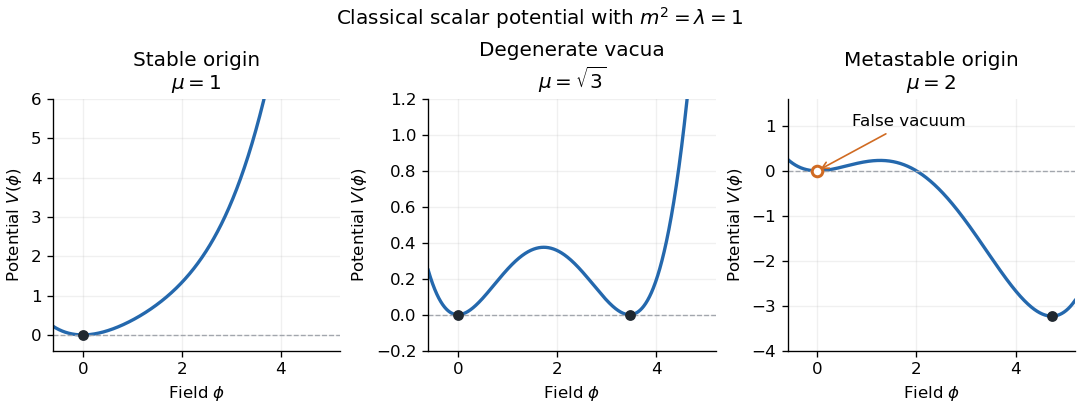
For stability, examine the classical scalar potentialThe tree-level boundedness criterion is , with arbitrary real cubic coupling. If , boundedness requires and ; if , or with , the potential is unbounded below. Thus a positive quartic coupling permits a stable ground-state vacuum, although it need not be the perturbative vacuum at .
For and , the stability of a cubic-quartic scalar potential determines when zero is a global minimum:The square bracket is nonnegative for every field value exactly whenFor a nontrivial equality case there is a second degenerate minimum at . If and , zero remains a local minimum but is a false vacuum, with a lower minimum elsewhere. If and , the origin is the quartic minimum despite its vanishing quadratic curvature. These are classical or tree-level stability statements; renormalized couplings and the quantum effective potential refine the quantum analysis.

Past exam of the mathematics course of the University of Cambridge 2005 iii Paper 49 2 Solution Created 2026-10-03 Updated 2026-10-14
Direct multiplication of the gamma matrices in the chiral representation givesFor example by the Pauli matrix multiplication law, and the block multiplications give the displayed signs. Every is off-diagonal in this representation, whereas the chirality matrix has opposite diagonal blocks. Therefore for all .
The left-handed chirality condition makes the plane-wave coefficient . With , the Dirac equation givesSince , its determinant is . A nonzero spinor therefore exists exactly whenFor nonzero momentum, put and write its direction as . Normalized eigenvectors of areThe general nonzero solution is for and for , with arbitrary nonzero complex normalization . At any constant two-component solves the equation, but the momentum direction and helicity are undefined. For the physical positive-energy branch this is the left-handed massless plane-wave spinor.
A rotation by angle about acts on the two-component spinor asThe plane-wave argument is unchanged because the rotation fixes , and . Thus the positive-energy solution has helicity , where a helicity- state has rotation phase . The negative-energy coefficient has the opposite spinor phase.
In a quantized complex left-handed Weyl field, the positive-frequency term annihilates particles and the negative-frequency term creates antiparticles. Reinterpreting negative energy also reverses its spatial momentum; for the positive physical momentum the two spinor coefficients have the same left-chiral kernel. Because one multiplies an annihilation operator and the other a creation operator, the corresponding particle and antiparticle state phases are conjugate. The helicity content of a quantized Weyl field is consequentlyThere is one particle spin state at each nonzero momentum, rather than the two helicities supplied by a full massless Dirac field. The right-handed Weyl field interchanges these signs. This is the massless relation between chirality and helicity; it does not identify them for a massive field.
Past exam of the mathematics course of the University of Cambridge 2005 iii Paper 49 1 Solution Created 2026-10-03 Updated 2026-10-14
Use the Minkowski metric and the free real scalar field Lagrangian density . Its conjugate canonical momentum is . Spatial translation symmetry and Noether's theorem give the canonical stress-energy tensorVanishing boundary flux then makes the four-momentum of a free real scalar field constant. In particular the contravariant spatial momentum isThe minus sign is from ; it is essential for the following mode calculation.
In the quantized theory, insert the mode expansions into this integral, using a Hermitian symmetric ordering or normal ordering. Write . The spatial integral is , leavingEach last term integrates to zero: replace by and commute the two annihilation operators or the two creation operators. The mixed terms reorder by the canonical commutation relation. Their vacuum contribution is proportional to the integral of the odd vector and vanishes with an inversion-symmetric regulator; normal ordering removes it directly. Thus the normal-ordered free scalar four-momentum has spatial partThese manipulations can be made first with box modes and a symmetric momentum cutoff, then used on finite-particle wave packets.
The commutator derivation identity givesFor , the commutator expansion for exponential conjugation therefore gives the translation of a scalar creation operatorThe vacuum has zero momentum, so . Hence the one-particle momentum eigenstate obeys : translation preserves its momentum and multiplies it by the associated phase.
The annihilation operator receives the opposite phase. Substituting both phases into the field expansion givesThis is the specified conjugation convention for the spatial translation operator. On states, the active translation moves a wave packet by , giving a position wavefunction . Conjugating the field by instead would give the opposite argument shift. Infinitesimally the displayed result is .
There are unlisted articles, also show them or only show them.