
Past exam of the mathematics course of the University of Cambridge 2005 iii Paper 55 2 Solution Created 2026-10-03 Updated 2026-10-14
For a chiral superfield of mass dimension one, a renormalizable quantum field theory has a quadratic Kähler potential and a superpotential of degree at most three. Before canonical normalization one may writewith real , andThe purely holomorphic terms in , their conjugates and its constant have vanishing full superspace integration; they are Kähler transformations of the global theory. Rescaling the chiral superfield sets , so the physically general kinetic choice is up to these terms. The constant superpotential in global supersymmetry also has no component effect. The dimensions of are respectively two, one and zero.
To eliminate the linear term, translate the complex chiral superfield as . The shifted linear coefficient isIf , this quadratic has a root over the complex numbers; if but , take . The resulting linear term vanishes and the new quadratic coefficient is . The canonical Kähler potential changes only by holomorphic, antiholomorphic and constant terms, which do not change the global kinetic action. This is the superpotential critical-point shift.
The claim needs an exception: if but , the superpotential is purely linear and no invertible translation can remove it. More generally an invertible regular field redefinition cannot turn a nowhere-zero derivative into a critical point. The theory with has , a constant positive scalar potential , and flat F-term breaking with a linear superpotential. Below, and denote the quadratic/cubic coefficients after the valid shift, as intended by the question.
Expand in chiral coordinates. The highest component of is , while the full-superspace kinetic term contains . Thus the auxiliary field part of the component Lagrangian isVarying and independently givesSubstitution gives , and hence the F-term scalar potentialIt is nonnegative and vanishes at , and also at when . These are supersymmetric vacua, since the auxiliary field vanishes. Thus the quadratic/cubic model does not spontaneously break supersymmetry. If but , zero is the sole critical point; if both vanish, every is a zero-energy vacuum. Nonzero give the usual two vacua, coinciding when .
For the loop argument, promote the coefficients to background chiral spurions. One convenient pair of independent formal charge assignments isBoth symmetries act nontrivially on all three of ; the second is an R-symmetry. The superspace integration measure has R-charge , so both tree monomials give invariant actions. These are spurionic selection rules, not necessarily actual symmetries after fixing numerical couplings. The R-row is an ordinary-charge redefinition of the usual Wess–Zumino spurion charge assignment.
A local Wilsonian superpotential is a holomorphic function of the chiral fields and chiral spurions. The ratio is neutral under both charge assignments and has dimension zero, whereas has exactly the charges and dimension of . The general symmetry-allowed form, on a patch with and up to a physically irrelevant global constant, is thereforewith holomorphic where that description is regular. Symmetry by itself does not determine .
For a regular perturbative local Wilsonian effective action retaining the same elementary field and an infrared cutoff, expand . Its term of order is . Negative are singular in , while are singular in ; these are excluded by perturbative holomorphic regularity at the free-coupling limits. Thus only the quadratic and cubic terms survive. Their regular holomorphic coefficients cannot acquire coupling-dependent invariant corrections. At the quadratic theory is Gaussian, fixing exactly. A contribution linear in to the cubic vertex has only one cubic interaction: three external lines exhaust that vertex, leaving no contraction to form a loop. Thus as well in the present normalization. This supplies the holomorphy argument for superpotential non-renormalization rather than concluding non-renormalization from symmetry alone.
The Kähler potential can still undergo wave-function renormalization. If its quadratic coefficient becomes , canonical normalization gives and , so physical masses and interactions can run despite superpotential non-renormalization. More generally a positive nonsingular effective Kähler metric replaces by and does not remove its zero-energy critical points. Infrared-singular nonlocal one-particle-irreducible terms and eliminating the entire massive field are outside this Wilsonian statement.
Past exam of the mathematics course of the University of Cambridge 2005 iii Paper 54 3 Solution Created 2026-10-03 Updated 2026-10-14
The Polyakov action has independent worldsheet metric and embedding fields . Varying the metric before imposing a gauge givesWorldsheet diffeomorphisms and Weyl transformations allow conformal gauge locally. The Weyl factor then cancels out of the classical action, leavingThese are free two-dimensional scalar fields, but the surviving metric equations requireEquivalently, and . Gauge fixing does not license dropping these Virasoro constraints.
For an ordinary open string, the boundary conditions relate the two chiral sectors. With , their independent Fourier generators areThe classical oscillator Poisson brackets give the classical Virasoro constraint algebraThus they are first-class constraints. In the quantum theory one applies normal ordering to the product and uses . The oscillator commutator givesFor example, for the extra vacuum term is . This exhibits the Virasoro central extension rather than concealing it in a classical constraint equation. The matter central charge is ; the worldsheet ghost fields have charge . Quantum consistency sets and the string intercept to one.
In old covariant string quantization the physical-state Virasoro conditions for an open string arePhysical string states are then identified modulo physical null string states. One does not impose both positive and negative generators as annihilation conditions: their central extension would obstruct that prescription. The resulting null-state quotient of a string agrees with the transverse light-cone spectrum at nonzero momentum.
At , the oscillator vacuum is a single spacetime scalar field with : the bosonic tachyon. At , write . The zero-mode equation gives , and gives . The null descendant identifies . This leaves 24 physical polarizations of a massless gauge vector.
At , use the level-two open-string polarization decompositionThe mass is . The oscillator commutators give all the nontrivial positive-mode conditions:Higher positive modes annihilate this level. To see the quotient explicitly, the 25 transverse-parameter null states , with , shiftThe additional level-two scalar Virasoro null state shiftsSubstitution into the two physical equations verifies the null-state conditions; the second residual is . Because is timelike, these null shifts span all components of , so choose a representative with . The physical conditions then say and . In the rest frame this is a traceless second-rank tensor in 25 spatial dimensions, with polarizations. The light-cone basis independently gives states and symmetric states . Hence
For the fermionic extension, an explicit convention prevents ambiguity in the signs. Keep worldsheet signature and useTake and the constant parameter to be real Grassmann-odd Majorana components, with . Put . Apart from the common factor , the combined Lagrangian isThe rigid transformations can be writtenor, in components,For the part, the bosonic variation is , while the fermionic variation is . Anticommuting the constant parameter past the fermion is essential in the second term. The first terms cancel. The other chiral component works in the same way, giving the chiral proof of rigid worldsheet supersymmetryThus the action is invariant off shell up to a boundary term. The transformation is a genuine supersymmetry: on its commutator for parameters is the translationOn the same translation follows using and ; the remaining cross terms are proportional to these Dirac equations. This is on-shell closure of rigid worldsheet supersymmetry. On a surface with boundary, compatible endpoint conditions must make the boundary flux vanish. On a compact worldsheet, a constant parameter must preserve the spin structure; the local identity alone does not make a constant transformation compatible with every antiperiodic sector.
The fermions contribute to the worldsheet stress-energy tensor and produce a fermionic superconformal current. In holomorphic normalization with ,The free-field contractions give and conformal weight for , where . Consequently the modes obey the N=1 super-Virasoro algebraDropping the central terms gives the classical graded constraint algebra. Integer gives the Ramond sector; half-integer gives the Neveu–Schwarz sector. In the displayed conformal-plane convention in the Ramond sector. Shifting to the Ramond vacuum-normal-ordered zero mode gives the usual Ramond supercurrent zero-mode square .
Rigid symmetry of matter already supplies these currents, but promoting their vanishing to new gauge constraints requires coupling to worldsheet supergravity and varying its worldsheet gravitino. In superconformal gauge one retains . The fermionic current constraints and their physical-state conditions extend the bosonic Virasoro conditions. The ghost charges are , so cancellation with gives the critical dimension of the RNS superstring ; the NS and Ramond intercepts are respectively and zero. This distinguishes the global supersymmetry established above from its locally gauged string completion.
Past exam of the mathematics course of the University of Cambridge 2005 iii Paper 54 2 Solution Created 2026-10-03 Updated 2026-10-14
Take and split the coordinates into along the branes and transverse to them. In conformal gauge the wave equation permits a separated mode with . For Neumann boundary conditions at both ends, selects and integer . The zero-frequency solution is independent of , with a constant position and a term linear in time. Therefore the open-string mode expansion isThe canonical momentum density integrated over this interval is .
For Dirichlet boundary conditions, subtract the static interpolation between fixed endpoint positions and . The remaining field vanishes at both ends, selecting with integer and excluding a momentum worldsheet zero mode. The expansion isHere . There is no factor in the sine series with this reality convention: changing to reverses both the sine and the denominator. These are the integer-mode expansion with parallel D-brane endpoints; they are not the half-integer modes of a coordinate with a Neumann condition at one endpoint and a Dirichlet condition at the other.
The endpoints can move on -dimensional worldvolumes but are fixed in the transverse directions. Thus these are open strings attached to D-branes, or stretched between parallel D-branes at and . The tangential momenta describe propagation on the brane; the transverse positions describe its embedding. Let . The linear spatial worldsheet zero mode contributes to . Quantization with string intercept one givesThe first term is also the square of the classical stretched-string energy , since the string tension is .
For two coincident D3-branes, label the ends of an oriented open string by . The four endpoint combinations give Chan-Paton factors , which form the full algebra of matrices. Under a change of brane basis these transform as , the adjoint action of . At , the first oscillator level is massless. Its tangential polarization supplies a four-dimensional vector , while the 22 transverse polarizations supply real adjoint scalar fields . This is the bosonic D3-brane low-energy field content.
The endpoint matrices multiply in their boundary order in disk amplitudes. The difference between the two orders in the three-vector interaction gives the matrix commutator; the kinematic factor is the one-derivative Yang-Mills theory cubic vertex. Factorization and the vector gauge redundancy then supply the quartic interaction with the same commutator. Equivalently, the leading low-energy action is the dimensional reduction of 26-dimensional Yang-Mills theory, withFor Hermitian scalar fields the last displayed term corresponds to a nonnegative potential, because their commutators are anti-Hermitian. Higher-derivative terms are suppressed at energies well below . Ignoring the tachyon, the gauge sector is four-dimensional Yang-Mills theory, accompanied by 22 adjoint scalar fields. It is not pure Yang-Mills theory, nor the supersymmetric six-scalar D3-brane theory of a ten-dimensional superstring.
Separate the two branes and use the D-brane scalar-position normalizationA Yang-Mills gauge transformation preserves this expectation value only when it is diagonal if . Thus the unbroken group is . The scalar field kinetic term supplies a mass for the off-diagonal vectors, sinceSumming over gives , exactly the mass of the stretched string. The two diagonal gauge vectors remain massless. This identifies brane separation with an adjoint Higgs mechanism, rather than an explicit deletion of the off-diagonal strings.
For the ground state of an open string joining the two different branes, , so the bosonic stretched-string tachyon threshold isAt equality it is massless, and above it the stretched ground state has positive mass squared. The same-brane ground strings still have ; this calculation removes only the stretched-string instability, not the original instability of the bosonic branes.
Past exam of the mathematics course of the University of Cambridge 2005 iii Paper 54 1 Solution Created 2026-10-03 Updated 2026-10-14
Use target signature and a closed-string spatial coordinate . Write for the compact coordinate and for the noncompact coordinates. In conformal gauge, the wave equation factorizes, so every coordinate is a sum of a function of and a function of . The closed-string boundary conditions areThus the derivatives of each chiral part are periodic and have integer Fourier modes; only their worldsheet zero modes can produce the winding displacement. Integrating these Fourier series gives the closed-string mode expansionThe oscillator reality conditions are and similarly for the tilded modes. The coefficient of follows by integrating the canonical momentum density . Single-valued wavefunctions of the center coordinate have momentum , with . Equivalently, the compact chiral worldsheet zero modes are and , whereHere tildes denote the left-moving sector. This convention will also fix the sign in compact-circle closed-string level matching.
Choose a noncompact light-cone pair and impose light-cone gauge in string theory , with . The Virasoro constraints then solve for in terms of the transverse coordinates. For example, with , one has . Thus there are two independent transverse oscillator Fock spaces, including among the transverse coordinates. Quantization gives , and the same relation for the tilded oscillators, with the two sectors commuting. Lorentz consistency gives the critical dimension of the bosonic string and string intercept one in each sector. Accordinglycount 24 transverse oscillator species. The two zero-mode constraints give the lower-dimensional bosonic string mass spectrumTaking their difference and average yieldsEvery choice of transverse string oscillators and integer charges satisfying this closed-string level matching is a physical string state in light-cone gauge. The eliminated longitudinal oscillators do not supply additional polarizations.
To classify all massless states, positivity of the two compact terms implies . When the sum is two, masslessness forces , and closed-string level matching then forces . The states have polarizations. In 25 noncompact dimensions, their decomposition gives a graviton, a Kalb–Ramond field, a dilaton, two Abelian gauge vectors from the metric and two-form with one compact index, and the radius scalar field. Their physical polarization counts areThe first two numbers are the symmetric traceless second-rank tensor and antisymmetric second-rank tensor of the massless little group .
When , closed-string level matching requires . The compact contribution obeysand equality occurs precisely at . The charges have ; the charges have . Each charge has 24 polarizations supplied by its single excited sector. At a general radius these have
Finally, requires . The exceptional massless ground states of a bosonic circle occur atEach charge is a scalar field. These special radii must be included if “general radius” is to mean a complete classification, rather than only a generic radius. At a generic radius the massless spectrum is the neutral 576-state spectrum above; at exceptional radii one adds exactly the states just listed. The neutral ground state remains tachyonic.
The mapsends to and to . Reversing all right-moving compact string oscillators, , preserves their commutators and oscillator number; the left-moving oscillators are unchanged. Both the mass formula and compact-circle closed-string level matching are therefore unchanged, with a one-to-one map of the complete oscillator basis. This proves T-duality of the full spectrum, including winding, massive and tachyonic states.
At the self-dual circle the four single-oscillator charge families give new massless states. Each family decomposes into a 25-dimensional gauge vector with 23 polarizations and one scalar field. There are also four massless ground states, with charges and . Thus the massless spectrum at the bosonic self-dual circle hasThe gauge interpretation follows directly from the chiral compact-boson operators. With , the exponential has conformal weight . At the self-dual radius,have weight one and satisfy , , and . These are the level-one current relations; the right sector supplies another copy. Multiplying these currents by a noncompact oscillator produces six gauge vectors in total. The nine scalar string vertex operators form the representation, accounting for the radius scalar field and eight new scalar fields. The remaining neutral fields are the graviton, two-form and dilaton.
A radius deformation as a Higgs mechanism is the expectation value of the Cartan–Cartan scalar string vertex operator . Its stabilizer is , soThe four compact single-oscillator scalar field polarizations become longitudinal polarizations of the four massive vectors, exactly as in the Higgs mechanism. The other four extra scalar fields have masses or and need not remain massless; one pair becomes tachyonic on either side of the self-dual point. Together with the original bosonic tachyon, this means that the gauge-symmetry interpretation is formal and does not assert a stable bosonic-string vacuum.
Past exam of the mathematics course of the University of Cambridge 2005 iii Paper 53 4 Solution Created 2026-10-03 Updated 2026-10-14
An antilinear involution need not preserve norms, so the required physical assumption is that momentum reversal maps a complete normalized basis to a normalized basis. For a spinless sector take with and relativistic normalization . Any extra degeneracy labels must likewise be mapped by a norm-preserving permutation or unitary matrix. The condition requires in the scalar basis.
For arbitrary normalizable wave packets and , where , antilinearity conjugates their coefficients. Using the normalized reversed basis givesCompleteness proves for all states, so this quantum time-reversal operator is antiunitary. The same proof with sums over extra labels uses the unitarity of their reversal matrix.
For a Hermitian interaction-picture Hamiltonian, the condition of time-reversal symmetry isExpand the scattering matrix as a Dyson series, using ordered integration rather than commuting operators:Conjugation by conjugates to but preserves the product order. Substitute ; the integration domain becomes andOn the other hand, taking the adjoint of the original series conjugates its coefficient and reverses the operator order. Relabel in each adjoint integral; it is exactly the same series. ThusEquivalently, time ordering turns into anti-time ordering after reversing the time arguments. One can first use a finite symmetric time interval and the same time-symmetric switching prescription before taking the scattering limit; the argument never assumes .
Antiunitarity relates amplitudes byUsing and taking a complex conjugate gives the time-reversal reciprocity of the scattering matrixThe reverse process starts with the reversed final state and ends with the reversed initial state. Intrinsic state phases can appear when these reversed states are rewritten in a separately chosen basis, but the corresponding squared amplitudes agree. Equal amplitudes do not mean identical numerical cross sections when the reversed process has different flux or phase-space factors.
For a spin-zero complex scalar field, choose the transformation convention . Its mode expansion of a free field isApply to the expansion. Its antiunitarity conjugates both numerical plane waves, giving coefficients multiplying and multiplying . In , replace by to obtain precisely these same plane waves. Comparing independent modes proves time reversal of a complex scalar field:Taking adjoints gives . Positive energy is preserved, and an annihilation operator remains an annihilation operator. Time reversal does not exchange particles with antiparticles.
The coefficient is an intrinsic time-reversal phase. Applying twice gives , so ; it need not be restricted to . Write and redefine . Because the phase is conjugated by ,Thus the scalar intrinsic phase can be absorbed into the annihilation-operator convention. Redefining simultaneously implements the corresponding whole-field rephasing and removes the phase from both mode transformations.
Past exam of the mathematics course of the University of Cambridge 2005 iii Paper 53 3 Solution Created 2026-10-03 Updated 2026-10-14
At momentum transfers small compared with , the two weak charged current vertices each carry when written with , and the W boson propagator reduces to a local factor proportional to . Matching their product to the Fermi interaction gives, at tree level,The Fermi constant is thus determined by the electroweak coupling and symmetry-breaking scale; the four-fermion description is a low-energy effective interaction.
Only the cross term can annihilate the pion and create the stated charged-lepton/antineutrino pair. Its leptonic matrix element is . Lorentz covariance permits a vacuum-to-spin-zero current matrix element only proportional to . At rest this has only a temporal component. The vacuum is parity-even and the pion is parity-odd, while is parity-even, so equals its own negative and vanishes. Lorentz covariance then makes the full vector matrix element vanish. The temporal axial current is parity-odd and is allowed: this is the vacuum-to-pseudoscalar current selection rule.
The minus sign in cancels the interaction's minus sign, up to an irrelevant common S-matrix phase. ThereforeThe pion decay constant convention here includes the given in its current matrix element. Momentum conservation and the external Dirac equations give , , . Since , the neutrino term vanishes andThis is helicity suppression: the amplitude vanishes in the zero charged-lepton-mass limit despite the larger available phase space.
For the spin sum, the Dirac adjoint of is , and the completeness relations giveThe chiral projectors automatically eliminate the unused neutrino helicity when the full massless completeness relation is inserted. There is no initial spin average for a spin-zero pion.
In the pion rest frame, let , . After integrating the spatial delta function and angles, the two-body Lorentz-invariant phase space becomesThe root is and . The absolute derivative of the delta-function argument is . Thus . Multiplying by the spin sum and the initial factor yields the leptonic pseudoscalar decay widthIf the decay constant were instead defined by a matrix element without , then and the width coefficient would be ; mixing these conventions would introduce a factor-of-two error.
The same derivation for a muon cancels the common hadronic and weak factors in the pion electron-to-muon decay ratio:The numerical value uses approximate masses MeV. Agreement with the corresponding Standard Model prediction tests lepton universality and the chiral, helicity-suppressing structure of the weak charged current, rather than the poorly calculable hadronic decay constant. A difference in the electron and muon weak couplings would multiply the ratio by their squared coupling ratio. Precision agreement must be assessed after radiative corrections, with matching photon-inclusive experimental definitions; the displayed tree-level ratio is not itself the radiatively corrected precision prediction.
Past exam of the mathematics course of the University of Cambridge 2005 iii Paper 53 2 Solution Created 2026-10-03 Updated 2026-10-14
The local matrix is a gauge transformation in the representation acting on the matter field. With Hermitian Lie algebra generators it can be written locally in spacetime, and pointwise for , asThe real functions can instead include a factor of by redefining the transformation parameters. The gauge covariant derivative convention in this paper is . Inserting the stated transformed shows explicitly that the term cancels, giving .
In QCD, each quark field is in the colour fundamental representation , with . Thus its colour generators are eight matrices, conventionally for the Gell-Mann matrices; their number is not their matrix dimension. The eight gluons themselves transform in the adjoint representation of SU(3).
With , the pure Yang-Mills theory has Lagrangian . Put and . Since ,The cross term has two derivative contributions. Interchange and then in the second; antisymmetry of makes it equal to the first. The cubic and quartic Yang-Mills self-interactions are thereforeThe positive cubic sign follows from the negative term in the given Yang-Mills field strength; changing the covariant-derivative convention consistently changes intermediate signs.
For the left-handed quark doublet , the hypercharge is and the weak generators are . Its electroweak term isThe Pauli matrices give diagonal entries and off-diagonal entries . Expanding the term givesIn particular the off-diagonal weak charged current coupling is .
Write , . Invert the neutral-field rotation: , . The original PDF gives , soThe photon coefficients inside the derivative are for , and for . Multiplication by the in the kinetic Lagrangian gives the requested electromagnetic coupling of a weak multiplet:Equivalently it is , making the electric charges explicit. The remaining neutral terms are . The TeX's missing prime in the mixing-angle ratio and truncated first Pauli matrix are conversion errors, not physical assumptions.
Past exam of the mathematics course of the University of Cambridge 2005 iii Paper 53 1 Solution Created 2026-10-03 Updated 2026-10-14
Write and use . The chain rule turns the renormalization-group beta function intoIntegrating gives the one-loop inverse gauge coupling evolutionThis expression applies over a range with unchanged active field content and in the perturbative regime. It uses , not .
For gauge coupling unification, define the normalized inverse couplings , , , and slopes , , . At the common scale each inverse coupling is . With ,Subtract the equations for factors 1 and 2 to solve , then insert this into the difference of factors 3 and 2:This one-loop normalized hypercharge unification relation requires . A scale above also requires the inferred to be positive. If those two slopes coincide, unification instead requires and their difference cannot fix the scale.
In the convention , one matter generation and one Higgs doublet have the following Standard Model representations. Spin is in units of ; L/R describe chirality, not the spin projection. The entry is its hypercharge eigenvalue, defining the one-dimensional representation .
There is no right-handed neutrino in the minimal field content being counted. Right-handed matter can alternatively be written as left-handed charge-conjugate Weyl fermions, in conjugate colour representations with opposite hypercharges. The quadratic indices and squared charges in the beta coefficients are unchanged.
For , one generation supplies two colour fundamentals from and one each from . With three generations there are Weyl fermions counted as fundamental copies, and no coloured scalar. ThusFor , the three colours of give three weak-doublet copies and gives one. There are doublets across three generations and complex Higgs doublet, givingThese are spectator multiplicities in gauge beta functions: the colour index multiplies the weak contribution, while the weak index multiplies the colour contribution. Each two-component fermion is counted once; it must not be counted again as a separate antiparticle.
For , sum squared hypercharges over all colour and weak components. One generation givesThe two complex Higgs components give . There is no Abelian gauge self-interaction contribution. ThereforeThe Higgs is counted only once for the whole model, whereas the fermionic generation is repeated three times. These are the Standard Model one-loop gauge coefficients in the unnormalized hypercharge convention. The grand-unified normalization instead has . The ratio of slopes in the unification relation is .
Past exam of the mathematics course of the University of Cambridge 2005 iii Paper 52 4 Solution Created 2026-10-03 Updated 2026-10-14
For a constant unitary matrix , gives . Also , so the kinetic contraction is unchanged. The mass term and the squared norm in the potential are unchanged for the same reason. The original scalar action has the stated global symmetry. For a spacetime-dependent , however, , and the extra term prevents local invariance of the ordinary-derivative kinetic term.
Choose the gauge covariant derivative , with Hermitian. Demand . Expanding both sides yieldsso the necessary Yang-Mills gauge transformation isUnitarity makes the transformed connection Hermitian. This formula includes the inhomogeneous derivative term; mere conjugation would be insufficient for a local transformation.
Define the Yang-Mills field strength by . Direct expansion givesChoose an orthonormal Hermitian generator basis with . The compact simple Lie algebra has an invariant positive trace metric, so this basis can be chosen; its structure constants are totally antisymmetric. With these conventions a locally invariant dynamical action isEach matter contraction is invariant because transforms like , and the gauge kinetic term is invariant by cyclicity of the trace. It is in components. Choosing gives the familiar convention.
Formally introduce a gauge-field source and a normalized generating functionalA gauge-field Green function is obtained by source differentiation:Here is the unnormalized integral at zero source, so the normalized functional obeys . This expression needs gauge fixing: the integral repeats every physical configuration over its whole gauge orbit, producing an irrelevant but divergent gauge-group volume, and the free gauge kinetic operator has longitudinal zero modes, so it has no inverse propagator on that unrestricted space. Ordinary gauge-field Green functions are gauge-dependent; physical gauge-invariant quantities must be obtained consistently from the gauge-fixed theory.
Use the Lorenz condition . To keep signs explicit, parametrize a small transformation by , equivalently the original parameter is . The finite transformation above gives the adjoint gauge variation for a positive-sign covariant derivative:Therefore . Define the Faddeev-Popov operator as , absorbing the field-independent minus sign of its determinant into normalization.
In a perturbative gauge patch, with residual zero modes removed by boundary conditions, the Faddeev-Popov gauge-orbit identity isIt follows by changing coordinates from the gauge parameter to the gauge condition: the functional Jacobian is precisely the determinant of its linearization. Insert the identity into the integral and change variables along the orbit. The action and measure are invariant, so the gauge-group volume factors out and is divided away. Averaging the gauge-slice value with Gaussian weight changes the delta-functional restriction to the covariant gauge-fixing termThe remaining determinant depends on through . Omitting it while adding only would weight different orbits incorrectly.
For a finite matrix , expansion of a Grassmann integral selects the product containing every and . Anticommuting the variables into a fixed order attaches the sign of each permutation, giving proportional to , with only a matrix-independent phase. The regulated functional version therefore represents the Faddeev-Popov determinant asThe independent Faddeev-Popov ghost fields and antighost fields obey , with the corresponding mixed and antighost anticommutation. A commuting complex Gaussian integral instead gives an inverse determinant, so it cannot supply this Jacobian. The required local ghost term isAfter integration by parts,This exhibits the free ghost kinetic term and the ghost-gluon vertex. Ghosts are Grassmann-valued scalar auxiliary fields in the Adjoint representation, not physical fermionic particles or external asymptotic states. Their loop signs arise from anticommutation. In an Abelian theory the adjoint derivative loses the field-dependent part, so the determinant is field-independent and the ghosts decouple; in the non-Abelian theory they must be retained.
The correctly gauge-fixed source functional thus uses and integrates over . Expanding its interaction terms gives the gauge, matter and ghost vertices, and differentiating its source functional computes the gauge-field Green functions. For example, at non-null momentum the quadratic gauge kernel iswhere and are the transverse projector of a vector field and longitudinal projector of a vector field. With the Feynman prescription this gives the gauge-boson propagatorFor the chosen ghost normalization the quadratic kernel is , so the ghost propagator is . Redefining the antighost sign changes ghost propagator and vertex signs together, without changing the determinant or physical conclusions. Gauge fixing requires the accompanying determinant, and its local representation requires anticommuting ghost and antighost fields. The gauge-orbit argument is local/perturbative: global gauge copies, the Gribov ambiguity, prevent interpreting it as a globally unique gauge slice without further treatment.
Past exam of the mathematics course of the University of Cambridge 2005 iii Paper 52 3 Solution Created 2026-10-03 Updated 2026-10-14
Set and . The kinetic term gives the scalar mass dimension , so the quartic bare coupling has mass dimension . A dimensionless renormalized coupling therefore comes with the factor .
The order- proper four-point corrections are precisely the three bubble diagrams in the diagram plate, with external partitions . Each carries a symmetry factor one half. Its two-propagator integral has logarithmic ultraviolet divergence in four dimensions, represented in dimensional regularization by a simple pole at . That pole's residue is independent of external momenta, so a local quartic counterterm cancels it. The three channels add, rather than describing three separate couplings. The two-point tadpole has no momentum dependence, so it does not supply a one-loop field-normalization correction to the four-point coupling. The first momentum-dependent field correction contributes to this relation only at higher order.
With the supplied residue , the subtraction relation consequently readsA possible scheme-dependent finite subtraction does not change the displayed four-dimensional one-loop coefficient. Keep the regulator and bare coupling fixed while varying the renormalization scale, and define . Differentiation givesTo retain all quadratic terms, put . The engineering term times the pole factor contributes , and the remaining quadratic coefficient is . It vanishes only when . ThusDropping the product of the engineering term and pole factor would give the wrong sign for the loop term.
At , separation of the one-loop renormalization-group flow givesThereforeThis is the solution of the truncated one-loop equation, not an exact all-orders running law. It applies while the coupling remains sufficiently weak; its Landau pole is at for .
A renormalization-group fixed point has . For and a small perturbation , linearization givesThus means attraction as , or ultraviolet stability; means attraction as , or infrared stability. If the derivative vanishes, higher terms decide marginal stability. These statements concern the specified coupling direction; other couplings or the mass can be relevant even when this direction is stable.
For , the quadratic renormalization-group beta function has zeros and . At the nonzero zero,ConsequentlyThis is the weak-coupling Wilson-Fisher fixed point, perturbatively controlled near four dimensions. Reaching its full critical limit also requires tuning the mass, the thermal relevant direction at the Wilson-Fisher fixed point.
At , this nonzero fixed point merges with the Gaussian fixed point. Although the derivative at zero vanishes, for a positive weak coupling, so the running solution tends to zero logarithmically toward the infrared. The four-dimensional critical long-distance limit is Gaussian: the quartic interaction is marginally irrelevant, rather than flowing to a nonzero weakly interacting infrared fixed point. This is the Gaussian infrared limit of positive four-dimensional quartic coupling. It is not ultraviolet asymptotic freedom; the positive coupling grows in the ultraviolet. Nor does it say a massive theory has no interactions at finite energy: the critical or massless scaling regime is the one described by this limiting flow. Extrapolating the one-loop law to arbitrarily high cutoff at fixed positive low-energy coupling encounters its Landau pole; avoiding that pole as the cutoff is removed forces the perturbative coupling toward zero. This motivates the usual triviality conclusion, but the one-loop calculation alone is not a nonperturbative theorem excluding all possible strongly coupled ultraviolet completions.
Past exam of the mathematics course of the University of Cambridge 2005 iii Paper 52 2 Solution Created 2026-10-03 Updated 2026-10-14
With signature , the momentum-space Feynman rules for phi-fourth theory follow by expanding the interaction exponential and using free-field Wick contractions. Every internal scalar propagator supplies , every quartic Feynman vertex supplies , and each vertex conserves four-momentum. Integrate every independent loop momentum with and divide by the Feynman-diagram symmetry factor . Equivalently, assign momenta to all lines and attach at each vertex before eliminating constrained integrations. A connected amputated graph therefore has the formwith the remaining overall momentum-conservation delta function understood. For an unamputated correlation function, retain the external propagators; scattering amplitudes instead use LSZ reduction. The factor in the interaction cancels the number of ways to attach the four identical fields at a vertex, leaving the stated vertex factor.
For a connected Feynman diagram, . The superficial degree of divergence is the power under simultaneous large rescaling of all independent loop momenta before considering cancellations or divergent subgraphs. Since each integration contributes four powers and each internal propagator removes two,Counting vertex half-edges gives . Substitution yieldsThe connectedness assumption matters: a disconnected interaction graph with components instead has the corresponding count . Tree graphs have no loop integral even when this formal power count is nonnegative.
In four dimensions the possible primitively divergent proper vertices have or , with or ; odd vertices vanish by the symmetry. The divergent local structures are a mass term, a kinetic term and a quartic coupling term. If vacuum diagrams are retained, a vacuum-energy term is also required. Thus one can renormalize using a finite family of operators already allowed by the theory's symmetries: four-dimensional phi-fourth theory is perturbatively renormalizable. The superficial count alone is not an all-orders convergence proof. After divergent subgraphs are subtracted with these counterterms, higher-point graphs have no new overall ultraviolet divergence; a negative overall does not by itself exclude subdivergences.
The requested lowest-order graphs and the three channels needed for the coupling correction are shown here:
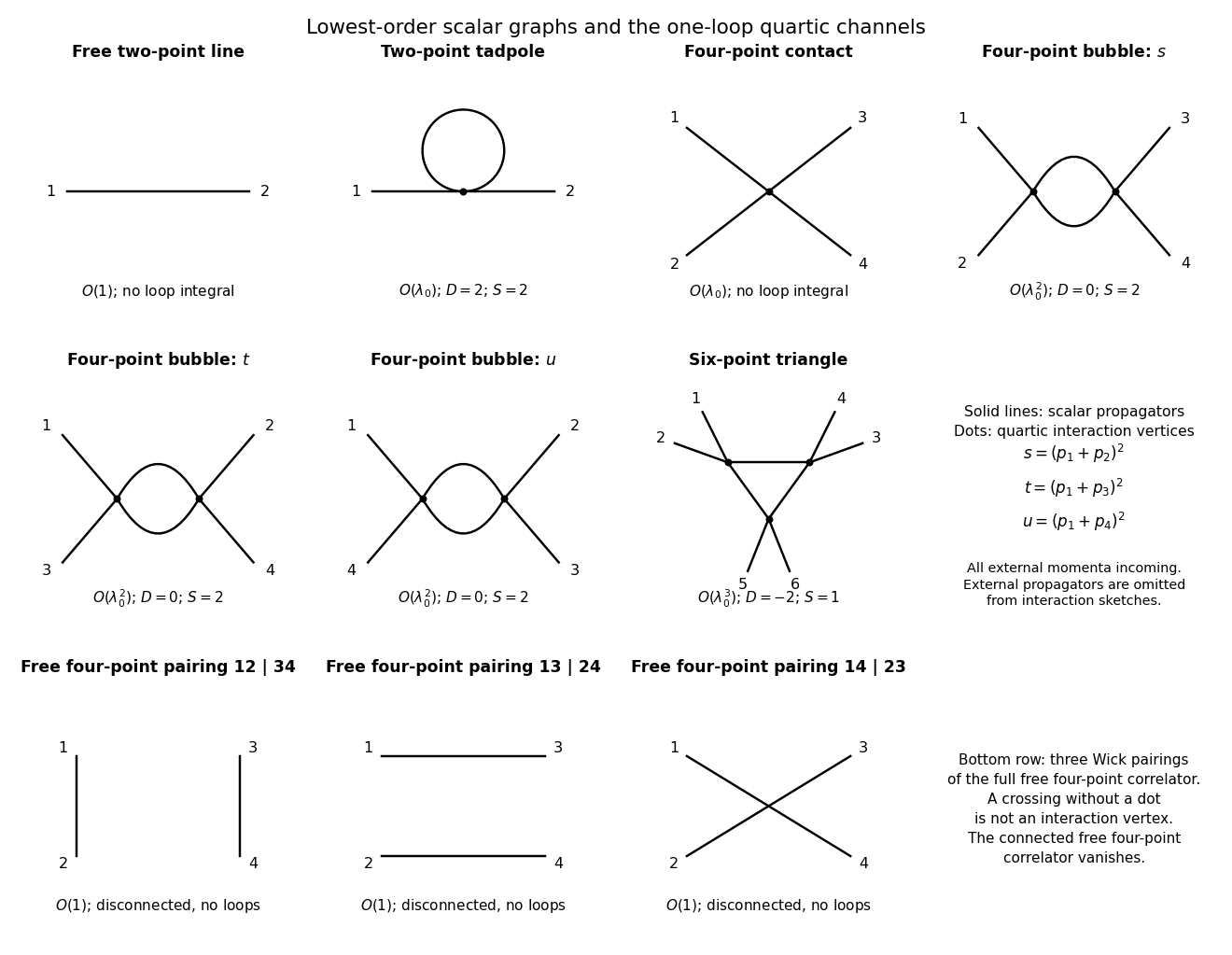
Original quartic-scalar diagrams: free line, tadpole, four-point contact and three bubble channels, ultraviolet-finite six-point triangle and all free four-point pairings
. Details. 
For the two-point function, the free propagator is order one, while its first interacting correction is the tadpole diagram, with , , and . Its loop integral behaves as and is quadratically divergent. For the connected four-point function, the lowest graph is the order- contact vertex, with and formal but no loop divergence. The first loop correction comprises the bubble diagrams. Each has , , and , matching its logarithmic integral .
If the full four-point correlation function rather than its connected part is considered, there is also an order-one contribution: the sum of the three Wick contractions into two free propagators, with pairings . Explicitly, , with the free scalar propagator between insertions . These disconnected pairings are drawn in the bottom row of the plate. They contain no loop integral and are not contributions to the proper four-point vertex.
A six-point amplitude in phi-fourth theory has a one-loop triangle Feynman diagram with two external legs at each of three vertices. It has , , and . For a fixed external-leg partition its loop integral contains three scalar denominators, for exampleAfter Wick rotation, its ultraviolet radial behavior is , which converges. The triangle has no proper loop subgraph, so no ultraviolet subdivergence is hidden in this example. It generates no new six-field counterterm. Nonzero mass avoids a separate infrared issue; with massless propagators exceptional external momenta can produce infrared singularities without changing this ultraviolet conclusion.
The bare mass is a coefficient in the regulated action, whereas the physical mass is the pole position of the full propagator. Write the amputated two-point insertion as . Summing its insertions givesAt order , only the tadpole contributes. Its factor one half follows directly from Wick pairing: of the four fields at the vertex, choices attach the two labeled external lines and the remaining pair closes the loop, so . ThusRotate through the Feynman contour. The from the measure and the in the propagator, together with the denominator sign, give a positive Euclidean integral. With spherical cutoff ,This is the Wick-rotated cutoff tadpole mass shift, and it is independent of external momentum. Hence to first order,For a positive stable quartic coupling the first-order shift is positive. Keeping the measured pole fixed while changing the cutoff requires adjusting the bare mass. At the bracket is understood by its finite limit . There is no momentum-dependent wave-function correction from this one-loop tadpole; such corrections begin at higher order.
Past exam of the mathematics course of the University of Cambridge 2005 iii Paper 52 1 Solution Created 2026-10-03 Updated 2026-10-14
Use signature and covariant one-particle state normalization . The future scattering condition uses the outgoing asymptotic scalar field:As with the incoming condition, this is understood in suitably smeared scattering matrix elements, not as unrestricted pointwise strong convergence of interacting and free local operators.
The free incoming field has expansionThe creation operator defines , with , so . On the other hand, translation invariance givesMatching the stable one-particle state component in the asymptotic condition fixes the constant overlap. Choose its state phase so that it is real and nonnegative. ThenThe same stable particle appears in the outgoing description, with compatible one-particle phases. Thus is the squared overlap measured by wave-function renormalization.
Insert a complete set of four-momentum eigenstates between the fields. For , translation invariance and Hermiticity giveFor , reversing the time-ordered product gives the same sum with . Therefore, with continuous-state integrals implicit in the completeness sum,Here is the Heaviside step function.
For the usual spectral representation, take a Lorentz-invariant vacuum, a positive-norm Hilbert space and the future-cone spectrum condition. Also take , as for the unbroken real scalar field, or subtract this constant and use the connected correlation function. Otherwise the vacuum intermediate state adds a disconnected constant not represented by the ordinary mass-shell measure below.
Let for that centered field, and use the Fourier transform convention . Define the Källén–Lehmann spectral density by the distributional equalityLorentz invariance makes the weight on each future mass shell a function or measure of ; the spectrum condition gives . Its nonnegativity follows from the displayed squared matrix elements. ThusApplying time ordering to this expression mass shell by mass shell proves the Källén–Lehmann spectral representation:The factor is outside under the convention in the question.
The stable one-particle state part of completeness is . Its overlap is , so its contribution to is times the free mass- two-point function. HenceOther isolated particles as well as multiparticle states can belong to . The full scalar propagator accordingly has isolated pole , making its pole residue.
Finally use canonical field normalization: the canonical momentum is and the equal-time canonical commutation relation is . The vacuum commutator has the same spectral decomposition. For each free mass shell,independently of . Comparing with the interacting equal-time commutator gives the canonical scalar spectral sum rule:For the particle genuinely interpolated by the stated asymptotic field, ; the general nonnegative bound allows a field with zero overlap. The total weight and the upper bound require this canonical normalization and a well-defined distributional equal-time limit. They do not follow from the asymptotic condition alone: rescaling rescales both and the entire spectral measure.
There are unlisted articles, also show them or only show them.