
Past exam of the mathematics course of the University of Cambridge 2003 iii Paper 78 1 Solution Created 2026-10-03 Updated 2026-10-14
At normal incidence the P wave and the two S wave polarizations decouple. In each uniform layer the relevant displacement satisfies , with for a longitudinal wave and for a shear wave. Its speed is and its seismic impedance is . A welded interface preserves particle velocity and traction. For displacement or velocity amplitudes, incidence from medium 0 onto medium 1 therefore givesReflection reverses the displacement sign when the receiving seismic impedance is larger. The energy-flux fractions areThe impedance factor matters: a displacement transmission coefficient larger than one does not imply energy amplification. Equal impedance eliminates reflection even when the densities and speeds differ.
For a stack, every interface creates reflected waves which can return to all earlier interfaces. A seismic layer transfer matrix incorporates those multiple reflections exactly. Use harmonic time dependence , particle velocity and compressive traction for a P-wave, or the negative relevant shear traction for an S-wave. Through layer of thickness ,This follows by solving and . Continuity means that the state passes unchanged across each welded interface. Put , with , and let the exterior impedances be . A unit incident velocity gives top state and bottom state . Eliminating these states yieldsFor real moduli and no attenuation, conservation of elastic-wave energy flux gives . Reciprocal incidence gives equal energy transmission in the reverse direction; flux-normalized amplitudes express that reciprocity without unequal exterior impedances obscuring it.
The wave phase accumulated in each layer determines constructive or destructive interference. For one layer between identical exterior media, an integral number of half-wavelengths makes and gives perfect transmission, regardless of the layer impedance. At quarter-wave phase thickness, a single matching layer with also gives zero reflection: the layer transforms the terminal impedance to . Away from these matching conditions there are transmission peaks, reflection maxima and rapid frequency-dependent phase changes. In the time domain these are a direct transmitted pulse followed by delayed internal reverberations and reflected echoes. Long residence in a resonant stack produces narrow peaks and long ringing, without creating energy.
For a periodic two-layer stack, the half-trace of one cell isThis is the periodic seismic multilayer stop band criterion. When the absolute right side exceeds one, the cell eigenvalues are a reciprocal growing/decaying pair and a long finite stack has exponentially small transmission. The missing transmitted energy is reflected, not absorbed. Large impedance contrast and repeated quarter-wave layers strengthen such stop bands. In pass bands the cell modes propagate, and a finite stack superposes transmission resonances on that propagation. An irregular stack need not have equally spaced peaks: the individual travel times and impedance contrasts set its interference pattern.
At sufficiently low frequency a finite stack has , so its leading reflection is that of the two exterior media alone. For many thin repeated layers with wavelength much longer than a cell, their effective density is the volume-weighted density and their normal modulus is the harmonic mean, . This follows by expanding each propagation matrix to first order and averaging its two coefficients. At high frequency, sharp interfaces still reflect: there is no general disappearance of reflection, only increasingly rapid interference fringes. Smooth impedance grading instead suppresses short-wavelength reflection when its variation scale is long compared with the wavelength.
These calculations provide a reproducible investigation: vary the layer travel times, impedances and number of cells; compute the matrix product; plot reflected/transmitted fluxes and check their sum. Adding attenuation makes the flux sum smaller than one and reduces reverberation peaks, while oblique incidence introduces Snell law for elastic waves and P-SV mode conversion absent from this one-dimensional setting. Impedance contrasts generate reflections, propagation phases organize their interference, and energy conservation separates reflection from genuine absorption.
Past exam of the mathematics course of the University of Cambridge 2003 iii Paper 77 3 Solution Created 2026-10-03 Updated 2026-10-14
Take an attractive nonretarded molecular potential , with molecular number densities . Its force magnitude is . For one molecule at height above a half-space, integration over cylindrical radius and depth givesIts downward force is . A sphere's horizontal cross-section a distance above its bottom has area , so its total attractive force isFor the near-bottom region dominates. Replacing its area by and extending the upper limit givesThis derives the sphere-plane dispersion force from the pairwise Van der Waals force. Hereafter denotes the magnitude of the effective repulsive interaction across water, rather than the signed attractive Hamaker constant. Its planar pressure magnitude is .
For a nearly planar freezing front, the spherical gap is . In the particle frame the incoming normal motion has speed . Axisymmetric mass conservation gives the outward gap flux per circumference . The lubrication flux law therefore givesIntegrating its axial force givesSteady particle pushing by a freezing front requires , and henceThe viscous drag is not the isolated-sphere Stokes drag: its divergence as the gap closes is essential.
For the deformed interface let and measure from the sphere's downward pole, as in the original geometry. The height below the remote melting isotherm is . Under the imposed temperature gradient, the undercooling is . With capillary depression neglected, the local phase-equilibrium pressure isHere is the absolute melting temperature; a constant reference ice density is used in the thermomolecular relation. ThusThe numerical value of will cancel from the speed relation.
In the thin spherical film, incompressibility and the incoming normal velocity giveSymmetry supplies zero pole flux. The tangential Couette contribution is smaller by and is negligible at this order. Applying the pressure-driven flux law along arclength giveswhere pressure is matched to the outer liquid at .
A cap area element is and its vertical normal component is . Put . The upward molecular and downward hydraulic forces are thereforeBalancing these forces establishes premelted-film particle pushing:The factorizations are and . They confirm positivity on the physical cap range and provide a numerically better-conditioned shallow-cap expression. Since , the shallow-cap limit within is ; it is not a limit in which the film can be identified with the flat-front gap .
The local film formula diverges right at the rim . Accordingly the thin-film calculation is an outer approximation away from a small matching fringe, not a claim of a uniformly thin film at its contact with bulk water. Both integrated stress densities vanish at that rim; in the thin-film limit the fringe contributes only a higher-order correction. Surface-tension curvature, altered thermal gradients or appreciable density-change fluxes would require a different balance.
Past exam of the mathematics course of the University of Cambridge 2003 iii Paper 77 2 Solution Created 2026-10-03 Updated 2026-10-14
Use , and , with . Equal reference densities and constant material properties are implicit in these diffusion balances. Put and . The four similarity fields areHere the same letters on the right denote their far-field values. Substitution into the heat and solute diffusion equations verifies the fields; their interface values and far-field limits verify every boundary condition. The concentration has an equilibrium jump from to , whereas temperature is continuous.
The interfacial conservation laws areFor example,Since , dividing the two jump conditions by gives, for nonzero ,where . At , use the undivided flux conditions or the continuous limit, rather than divide by zero. The liquidus relation and the segregation coefficient also give the solidus .
For the thermal expansion, write and useKeeping the constant terms in these reciprocals is essential for the full first-order answer. The result isThe remainder has this form for bounded ; a looser statement is also valid in the distinguished scaling . Dropping the temperature-difference term while claiming first-order accuracy for fixed would be incorrect.
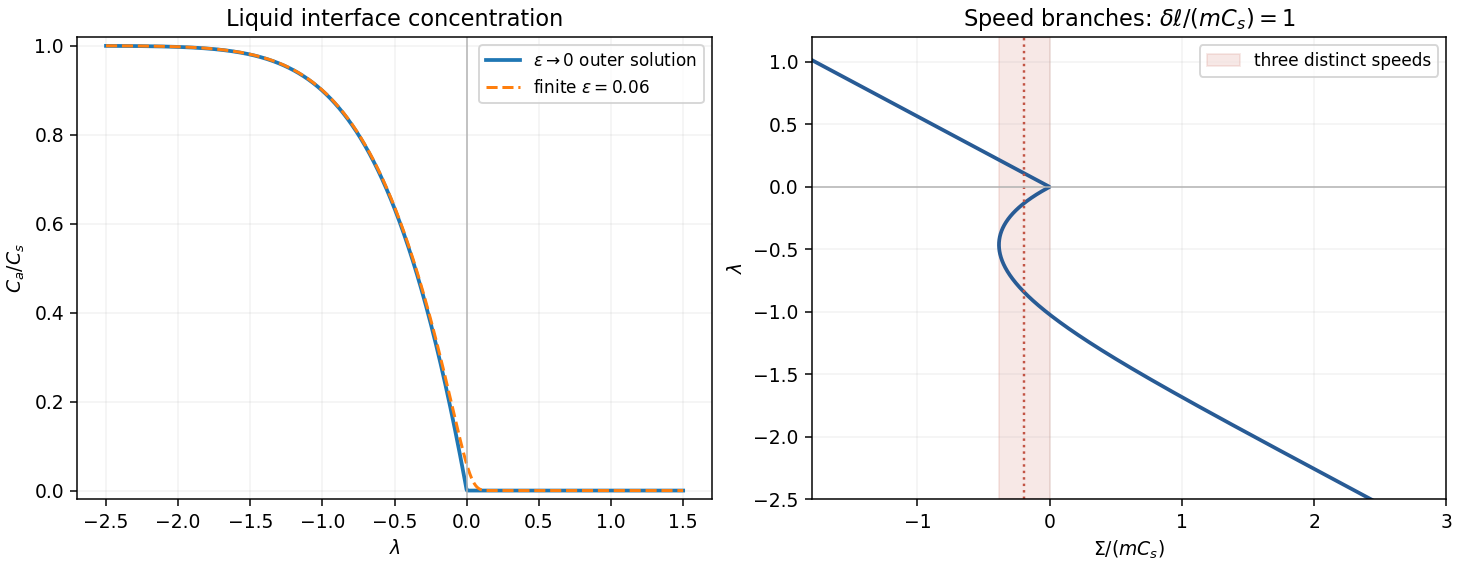
Solving the solute balance algebraically givesFor fixed positive , , and , with a positive exponentially small correction. For fixed negative , , andIt falls from as to zero as . The outer positive branch is zero. For finite the transition is rounded over ; the exact zero-speed limit is , not an actual concentration discontinuity.
To count speeds, take the leading distinguished thermal balance, set and , and combine with the thermal result:This is the intended leading approximation when and . The full first-order expression instead replaces by . Thus the printed threshold is asymptotic, not an exact criterion for finite .
For , put . The small-solid-diffusivity melting concentration is , soThe second term decreases strictly from to zero. One can check the strict decrease without guessing its shape. Set , so , , and . Direct differentiation givesThe bracket increases with on . Substituting its lower bound yields a polynomial with constant coefficient and all other coefficients positive. Hence , as claimed.
If , then and increases from zero to infinity. The freezing branch has and is also monotone. Together these give one speed for each imposed sum within the approximation. If , the melting branch initially decreases, has exactly one minimum and then increases to infinity. For sums between that minimum and zero there are two melting speeds plus one freezing speed: three solutions. At the lower fold there are two distinct speeds, one being a double solution. At zero the limiting outer branches join; finite solid diffusivity rounds the join into a nearby fold. Away from the fold values the other sums have one solution. At the threshold itself the initial slope vanishes; it is the transition between these cases.
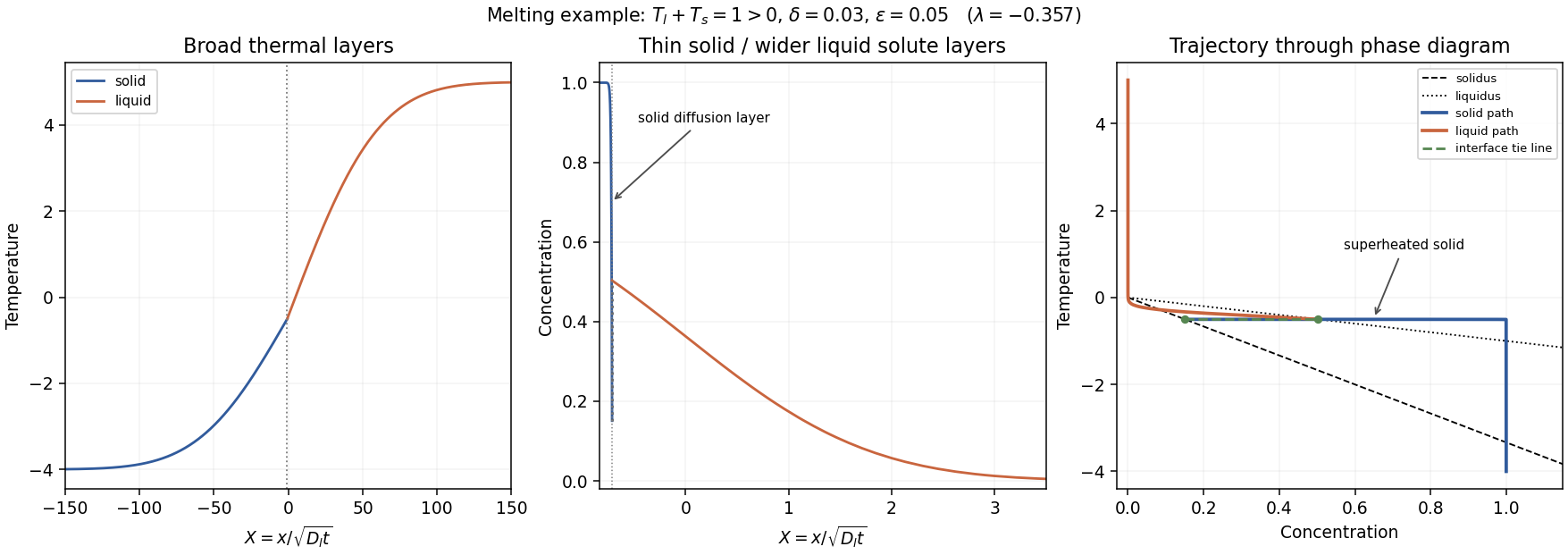
For , the solution is on the melting branch . Its thermal layers have scale , much larger than the liquid-solute scale . Because the front is retreating, the solid solute layer is thinner still:This follows by expanding the large-positive-argument complementary error function ratio on the solid side: near , its decay length is . Using simply would miss the retreating-front compression of that layer.
Across this narrow layer, solid concentration drops from almost to , while temperature stays almost . At the interface . Moving slightly into the solid increases its concentration toward , lowering its solidus to , whereas the temperature has barely changed. Since and , . Thus an adjacent region can satisfy : constitutional superheating. Its existence is especially clear when far-field solid is initially stable but heat diffuses across the narrow composition layer.
The phase-diagram path goes from through a broad thermal rise, then nearly horizontally toward across the thin solid diffusion layer. At the interface it traverses the isothermal equilibrium tie line to . On the liquid side concentration falls to zero over the liquid-solute layer, while the remaining thermal adjustment to takes place over the much wider heat layer. The path of the depleted solid approaches the solidus from its superheated side. That region should melt at additional sites or develop a two-phase mushy layer; the original single-boundary similarity construction is then a mathematical branch rather than a physically stable description of the entire sample.


Past exam of the mathematics course of the University of Cambridge 2003 iii Paper 77 1 Solution Created 2026-10-03 Updated 2026-10-14
Write , and . The first balance is depth-integrated momentum conservation. Its left side is the downstream increase of horizontal momentum flux. The wind contributes the applied stress ; the remaining term is the resultant hydrostatic force associated with the sloping base of the light layer. Because , that term opposes the wind when .
For a strip of unit alongshore width and length , let be the entrained ocean-volume flux per unit area. Ocean entering the layer carries temperature and concentration but no horizontal momentum in this model. Take the reference liquid enthalpy at to be zero and setThe latent term is negative because ice has lower enthalpy than liquid at the same temperature. The incoming entrained water has zero relative enthalpy, and the outgoing minus incoming horizontal enthalpy flux is . Atmospheric heat loss therefore gives . Similarly, solute conservation givesThese are the second and third balances. Their reference-flux form has already subtracted the heat and solute brought in by entrainment; those fluxes must not be subtracted again.
There is a dimensional normalization to make explicit. With the printed specific , the physical heat-flux balance is . Thus . The displayed exam equation uses its symbol for , or implicitly works with density-normalized heat flux. The derivation below uses to keep these two meanings distinct.
With no incoming coastal jet or ice source, the conditions at areThe regular emerging layer also has , , and . Prescribed nonzero inlet fluxes would replace these conditions and destroy the coast-origin power law. A zero-thickness coast does not justify independently prescribing an arbitrary nonzero velocity there.
Integration of the solute and enthalpy balances yields wherever , and . Local phase equilibrium now givesFor , putTo leading order, . The potential-energy closure implies , and substituting it in the momentum equation givesDividing the ice flux by this last relation gives . If , , momentum gives , while the potential-energy balance gives . Thus . Substitution fixes the coefficients:This is the dilute frazil polynya similarity solution. In particular, all three variables grow as , grows as , and the solution stops being dilute when is no longer small. Density differences have been retained in buoyancy, but not in inertia or the normalized heat capacity.
To account for upward settling, one must distinguish retained suspension from crystals that leave it. A consistent depth-averaged extension has an upward exported ice-volume flux and an entrainment flux . If all phases retain the same mean horizontal velocity within the layer, its balances becomeThe last term removes the momentum carried out by the ice; its density may be restored to outside the Boussinesq approximation. Consequentlyso one may no longer set . The local equilibrium relations are unchanged, but use the new bulk concentration. The frazil export enthalpy balance also shows why a simple replacement has the wrong sign: exported ice carries negative relative enthalpy.
A slip speed requires a vertical particle-flux closure, for example for a well-mixed top boundary. A nonuniform suspension instead requires its surface concentration and buoyancy moment. The potential-energy closure must then include the gravitational energy released by rising light crystals, with scale , and any energy and buoyancy moment carried through the boundaries. For example, a well-mixed closure that transfers a fraction of this released power to entrainment and neglects additional boundary potential-energy transport would replace the original work balance byThe allocation and exported potential-energy flux are extra closure information, not supplied constants of the original model. The original work balance cannot be retained unchanged while treating settling as an additional loss of suspended ice. Phase-dependent horizontal speeds would also replace and by their separate phase fluxes.
It is important to compare total production, not merely the retained ice flux. LetIntegrated solute conservation gives , henceIntegrating the heat balance, and neglecting products of the small concentration departure with the exported flux, givesto dilute order, provided the total processed fraction , not only the retained fraction , remains small. Thus upward settling reduces retained suspension, but does not increase the leading-order total production at fixed atmospheric heat loss. Beyond that order, efficient removal can reduce the subsequent sensible cooling of crystals and enhance mixing of ocean water; the usual expectation is a larger latent-heat fraction and hence greater production. Its amount, or an unconditional larger/smaller claim, needs the settling, mixing and surface-export closures just identified. At fixed , energy conservation bounds the production by the available heat loss; it must not be inferred simply by observing fewer suspended crystals.
There are unlisted articles, also show them or only show them.