
For every real , the mean value theorem bounds on . Hence the apparent singularity at zero cancels, and the remaining bound is Lebesgue integrable. On a bounded parameter interval , every positive-order parameter derivative of the integrand is bounded in absolute value by . Repeated dominated differentiation under the integral sign therefore proves that is a smooth function, withIn particular, , , and . Thus is strictly convex, lies above its tangent at zero, and satisfies for and for . The inequalities follow directly as well by comparing to one. The substitution removes the square-root endpoint singularity for numerical integration:
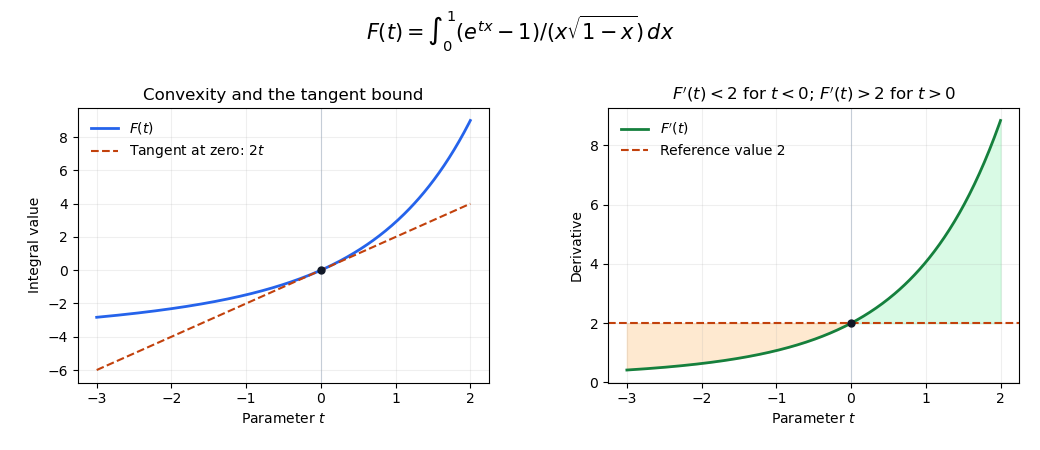
Convexity and derivative bounds for the exponential endpoint integral
. The derivative is below two for negative parameters and above two for positive parameters. The integral lies above its tangent at zero. Substitution removes the endpoint singularity before numerical quadrature. Details.Suppose and its partial derivative are jointly continuous on a compact rectangle . Then is continuously differentiable in the interior of , and the displayed formula holds, with one-sided derivatives at parameter endpoints where the corresponding partial derivative is given.
To prove it, the extreme value theorem bounds by . For each fixed , the mean value theorem bounds the difference quotient by . It converges pointwise to , and the constant is integrable over . Dominated convergence gives the derivative formula. Apply continuity of parameter integrals on compact rectangles to to obtain continuity of . The proof works locally on unbounded parameter intervals as well.
The requirement that a database query have a finite, appropriately range-restricted answer on finite input. In the usual domain-independent interpretation, extending the ambient value domain with unused values must not change the answer. The absence of a negation symbol alone does not ensure safety.
For the one-dimensional wave equation with Cauchy data on , , the solution is determined where both characteristic footpoints lie in . This is the diamond displayed in the title, or . In characteristic coordinates, it is a rectangle of known arguments for the two travelling-wave functions. A smooth invertible coordinate transformation maps it to a region bounded by the original equation's characteristic curves; it need not remain a Euclidean diamond. Both forward and backward determination can be described this way. Outside the region, changing an unspecified part of one travelling-wave function can change the solution without changing the supplied finite data segment.
For , and data on , , the transformed segment is , , . The known characteristic arguments lie in and . The corresponding original region has curved boundaries despite being a rectangle in characteristic coordinates and a diamond in coordinates.
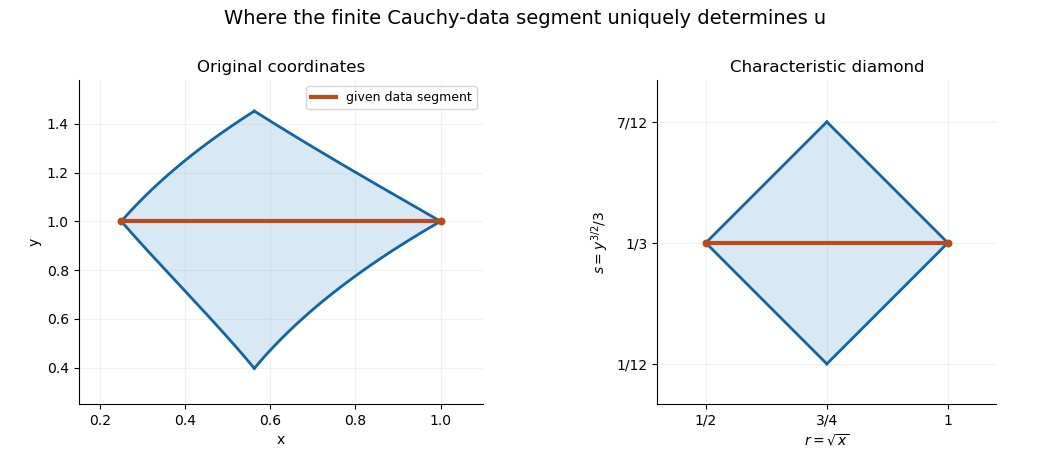


For Noncharacteristic Cauchy data parameterized by , the method of characteristics produces a surface . The part uniquely fixed as a classical graph through the data must retain both the allowed footpoint range and a nonsingular branch of the projected map. On a branch where inversion gives , require , together with the branch condition and a nonzero Jacobian determinant. The strict inequality describes its open interior; the endpoint characteristic supplies a boundary trace. A fold caustic can supply another boundary.
An algebraic formula obtained by eliminating can extend beyond this domain of dependence. Its values there need not be selected by the original data, because their characteristic footpoints can lie on the unprescribed half of the data curve. Tracking the parameter range is therefore part of the uniqueness argument, separately from selecting a real square-root branch.
For a nonnegative integer with decimal expansion , the congruence gives whenever . Thus divisibility by three or nine is equivalent to divisibility of the sum of its decimal digits by the same number. More generally a base- expansion has the analogous rule for every divisor of . This follows by repeated addition and multiplication in modular arithmetic; it does not require an empirical rule about decimal notation.
Let be piecewise twice continuously differentiable, with finite one-sided values and derivatives at , and write . Its distributional derivative is , and differentiating again givesHere is the Dirac delta at , and the subscript reg means the ordinary derivative on the two open intervals, interpreted as a regular distribution. To prove the first formula, split at and use integration by parts on each piece for a test function . The two boundary contributions add to . Applying the same argument to the regular first derivative proves the second formula. Thus a derivative jump produces a delta source, whereas a value jump produces the derivative of a delta source.
For a function smooth on either side of a joining point , integration by parts on the two intervals adds a Dirac mass whose coefficient is the right trace minus the left trace. If the one-sided derivatives are locally integrable, a first weak derivative can be represented by a locally integrable function across the join only when the jump vanishes. Derivative jumps themselves do not obstruct first-order Sobolev membership: a continuous piecewise Lipschitz function still has a bounded weak first derivative.
The dislocation core is the small region near a dislocation line where the smooth linear-elastic continuum description fails. For a screw dislocation, the far-field displacement gradient scales as the Burgers-vector magnitude divided by radial distance, so the predicted elastic stress diverges on the axis. Atomic structure, nonlinear response or local plastic deformation replaces that singular prediction in the core.
Serve requests in arrival order. This preserves queue order but can cause repeated long seeks when successive requests lie far apart.
Serve the pending request whose track is nearest to the current head position, with an explicit tie rule when necessary. This minimizes the next seek distance, rather than the total distance of every future request; a continuing stream of nearby requests can starve a distant request.
Sweep in one direction, servicing requests encountered in track order, continue to the physical endpoint, and then reverse. A calculation must state the initial direction and whether movement after the final requested service is included. LOOK disk scheduling instead turns around at the last pending request in that direction.
Sweep in one direction through pending requests, reversing at the last pending track rather than travelling to the disk's physical endpoint. It shares the directional sweep of SCAN disk scheduling but can avoid movement into an empty end region.
Total absolute track displacement along a head route . Include physical turnaround points in the route if the scheduling policy visits them, even if they do not service a request.
A hydrograph records discharge against time at a fixed location. A nonlinear kinematic wave can steepen an upstream increase into a sharp front; longitudinal diffusion or additional storage rounds the resulting rise.
absolute convergence of a Dirichlet series depends only on the real part of its variable. The set of real parts giving convergence is upward closed by the comparison test. If that set is nonempty and not all of the real line, its finite infimum is the abscissa: every larger real part gives convergence, and every smaller real part gives divergence. Boundary convergence is a separate question.
Let satisfy for . The Abel summation formula gives when , since its finite-sum boundary term tends to zero. Split this integral into blocks . For every , the estimate holds uniformly on . Each block is an entire function, by differentiation under the finite-range integral on compact sets. The Weierstrass M-test makes their sum locally uniformly convergent and therefore holomorphic; multiplication by preserves holomorphy.
This proof distinguishes uniform convergence of the block sum on a whole half-plane from local uniform convergence after multiplication by . The latter is all that holomorphy needs. In particular, a bound gives a holomorphic continuation of the reciprocal Riemann zeta function to this half-plane and excludes zeta zeros there, with the pole at one treated by cancellation.
Let be a closed linear subspace of a real Hilbert space, and let for a symmetric bounded bilinear form that is nonnegative on the ambient space and coercive on . Then has a unique minimizer on every closed affine subspace . If , the midpoint belongs to and the parallelogram law gives . Coercivity on makes the minimizing sequence Cauchy; completeness and continuity give a minimizer. The vanishing first variation is for all . Two minimizers differ by with , so coercivity gives uniqueness. This proves the symmetric existence theorem directly, without invoking the Lax-Milgram theorem.
For the point interaction in a second-order differential equation on , use homogeneous Dirichlet boundary conditions. The unperturbed Green function iswith a positive unit derivative jump at . Whenever ,To derive this rank-one operator correction, move the delta coefficient to the right-hand side and apply the unperturbed inverse: . Setting determines and gives the formula. Its denominator vanishes exactly at Dirichlet resonance for a point interaction.
The kernel is symmetric. It is continuous at and , satisfies when , and satisfies away from the source. When , the single combined condition is . These are the transmission conditions for a delta coefficient, including a source at the interaction.
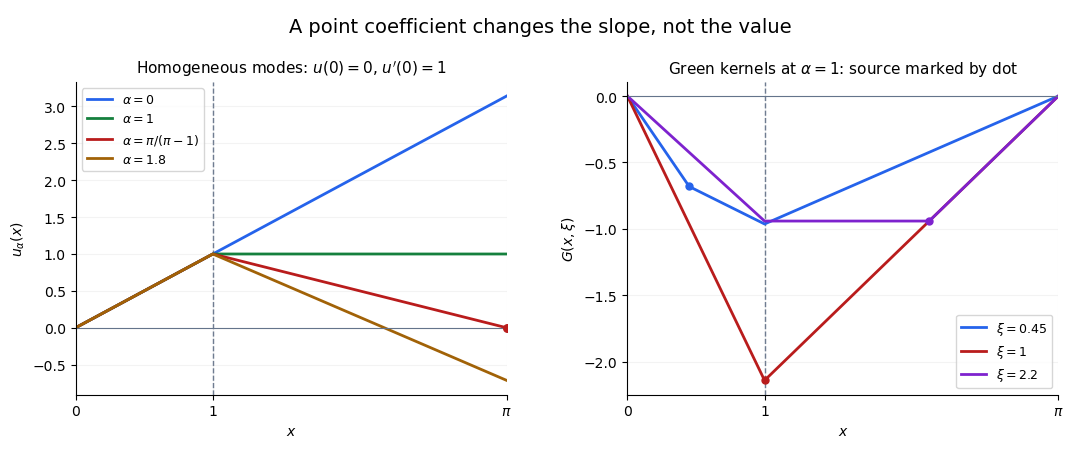

For , consider the self-adjoint differential operator with and . The homogeneous solutions and satisfy the left and right zero Dirichlet boundary conditions. Their Wronskian is , and . Thus the displayed Dirichlet Green function is continuous, zero at both endpoints, and has unit flux jump .
The right solution has a double zero, . Consequently is integrable at for fixed interior when , even though itself is not integrable there. The endpoint zero of the Wronskian causes no loss of this construction because the weighted Wronskian stays nonzero. This illustrates the need to retain the integrating factor when constructing a Green function at a singular endpoint.
There are unlisted articles, also show them or only show them.