Past exam of the laser science and quantum information processing course of the University of Oxford 2021 6 e Solution by  Codex 0 2026-10-25
An ideal zero-photon number result projects onto the first term in part (b). ConsequentlyThis is a product state, not an entangled success. The remaining ideal outcome hasand leaves . In particular, simply discarding the field outcome does not reproduce the pure heralded Bell state.
The practical requirements are strong coherent coupling of both atoms to the same optical normal mode with stable relative coupling phases, preparation of , and interaction timing on the scale before spontaneous emission or cavity loss destroys quantum coherence. The field must then be measured or extracted after halting the coherent exchange, with enough photon number resolution to distinguish one from two. Otherwise an inefficient detector can mistake a two-photon event for the desired herald. Even ideally the one-photon success probability is at most , so trials must be repeated.
“No photons detected” implies only for the ideal zero-number projection specified above. With loss or finite detector efficiency, no click also includes missed one- and two-photon events and generally leaves a conditional mixed state. Detecting a leaking photon during the interaction is also a different measurement protocol from the end-time projective measurement analyzed here.
Past exam of the laser science and quantum information processing course of the University of Oxford 2021 6 d Solution by Codex 0 2026-10-25
Codex 0 2026-10-25Suppose the conditional atomic pure state were a product stateComparing its four probability amplitudes with givesThe last two equations make all four factors nonzero, contradicting either of the first two. Equivalently, the coefficient matrix has determinant , while a product state has a rank-one coefficient matrix and zero determinant. Thus the atoms are entangled; indeed each reduced density matrix is , making the conditional state maximally entangled.
Past exam of the laser science and quantum information processing course of the University of Oxford 2021 6 c Solution by Codex 0 2026-10-25
Codex 0 2026-10-25An ideal projective measurement of the field's photon number selects the coefficient of . ThereforeWhenever this probability is nonzero, normalization of the projected joint quantum state gives the atomic Bell stateup to a common global phase. The maximum heralding probability is , attained at . At a time with , that conditioning event is impossible, so a conditional state is not defined there. The interpretation is a photon number measurement at the selected time; continuous monitoring of escaping photons would instead change the dynamics and require a different model.
Past exam of the laser science and quantum information processing course of the University of Oxford 2021 6 b Solution by Codex 0 2026-10-25
Codex 0 2026-10-25Use the resonant interaction picture and define by the one-atom Jaynes-Cummings model in part (a). Equal coupling to both atoms gives the Tavis-Cummings modelThe initial state has two excitations and is symmetric under atom exchange. Excitation conservation and this symmetry confine the evolution toThe antisymmetric atomic spin singlet state is uncoupled and unpopulated. Applying the annihilation operator and creation operator givesThe first off-diagonal entry combines two indistinguishable atomic emission paths; the second also includes the enhancement for creating the second photon. Its eigenvalues are . Put and , so . Its exponential isApplying this to yieldsAll three states have the same bare energy on resonance, so restoring the free Schrödinger-picture evolution adds only a common global phase. The expression starts at , has initial derivative , and its three squared probability amplitudes sum to one.
Past exam of the laser science and quantum information processing course of the University of Oxford 2021 6 a Solution by Codex 0 2026-10-25
Codex 0 2026-10-25Quantize a single electromagnetic normal mode of angular frequency and represent one isolated atomic transition as a two-level system with raising operator . The bare Hamiltonian operator isThe first main approximation is the electric-dipole approximation: the field varies negligibly across an atom, , and the leading coupling is . For states of definite opposite parity, the relevant dipole part is off-diagonal. After choosing operator phases, this gives , with fixed by the transition dipole and the one-photon field wave amplitude.
In the interaction picture, and oscillate at the difference , whereas and oscillate at the sum . The second main approximation is the rotating-wave approximation: near resonance and for , the latter terms average away on the interaction time scale. The resulting Jaynes-Cummings model hasThe two-level system and single-normal mode truncations are additional assumptions: other atomic transitions and optical normal modes must be sufficiently far off resonance or weakly coupled. Dissipation is neglected over the interaction time. The retained terms exchange one atomic excitation for one photon, conserving .
Past exam of the laser science and quantum information processing course of the University of Oxford 2021 5 d Solution by Codex 0 2026-10-25
Codex 0 2026-10-25After the first Bell-basis measurement and the announced correction, the shared Werner state has visibility . Ideal quantum teleportation through that resource is the depolarizing channelOne way to see this is to separate the singlet branch, which teleports perfectly with the appropriate known correction convention, from , which has no correlations and yields .
The additional Bell-basis measurement at Alice's station has its own independent reliable branch of probability . In its random-label branch the correction averages the four Pauli gates, again giving . Hence the actual teleported density matrix isOn sifted BB84 rounds, Bob measures in Alice's preparation basis. The preserved component gives the correct bit with certainty; the maximally mixed component gives an error with probability . ThereforeFor it vanishes; if either parameter is zero it is . The result presumes successful full Bell-basis measurement outcomes and independent stated imperfections, without extra loss, polarization drift or dark counts.
Past exam of the laser science and quantum information processing course of the University of Oxford 2021 5 c Solution by Codex 0 2026-10-25
Codex 0 2026-10-25Each source has density matrixAssume the two sources and the detector's random choices are independent. In the branch both resources are ideal. If either resource is , the remote pair remains after any specified Bell-basis measurement outcome. An ideal detector and the correction of part (b) therefore yieldWhen the detector instead reports an independent uniformly random label, the corresponding four Pauli gates average the conditional pair to . ThusHere is the probability of the reliable-detector branch, not its total chance of being correct: that chance is .
For the usual two-setting CHSH inequality, the spin singlet state has correlation and the white-noise part has zero correlation, so . With Alice's axes and Bob's axes , the absolute CHSH inequality combination is . These settings are optimal for an isotropic correlation tensor, givingThis is the threshold for the standard CHSH inequality with optimized projective polarization measurements. The unqualified phrase “the Bell inequality” needs this choice of test; entanglement alone is a weaker requirement, and no claim about every possible Bell inequality is needed for this calculation.
Past exam of the laser science and quantum information processing course of the University of Oxford 2021 5 b Solution by Codex 0 2026-10-25
Codex 0 2026-10-25On Bob's polarization qubit, takeSuitable conditional unitary operators areIndeed , , and . The last minus sign is a harmless global phase.
For an ideal half-wave plate whose fast axis makes angle with horizontal polarization, discard the common phase and use the Jones matrixIt implements at and at . Thus for outcome use two half-wave plates, first then in the propagation direction; for use one at ; for one at ; for use no plate. Ideal retardance is assumed at the photon wavelength, and the setting is chosen after receiving the detector's classical result.
Past exam of the laser science and quantum information processing course of the University of Oxford 2021 5 a Solution by Codex 0 2026-10-25
Codex 0 2026-10-25Use the ordered polarization basis and define the Bell statesRegrouping the four-photon quantum state by channel pairs and givesFor instance, projecting channels 2 and 3 on retains the two original terms with inner polarizations and , with opposite signs, leaving . Its squared norm is .
By the same orthonormality argument, each Bell-basis measurement outcome prepares the identically named Bell state in channels 1 and 4, withBefore communication of the outcome, Alice and Bob's density matrix is ; the usable conditional entanglement is established by the announced Bell-basis measurement result. This assumes an ideal complete Bell-basis measurement; ordinary passive linear optics alone does not deterministically distinguish all four polarization Bell states.
Past exam of the laser science and quantum information processing course of the University of Oxford 2021 4 f Solution by Codex 0 2026-10-25
Codex 0 2026-10-25An AND gate maps four possible pairs to one bit and loses information, so it is not reversible. A reversible embedding retains both inputs and uses a target bit:This is the Toffoli gate; initializing computes while preserving enough information to invert the operation.
Classical reversible gates on one or two bits alone cannot synthesize every such operation. Every permutation of two bits is an invertible affine map over the finite field : there are of them, exactly the permutations. Their extensions to a larger register and their compositions remain affine. The nonlinear term in the Toffoli gate therefore cannot be generated. Three-bit reversible gates remove this obstruction, with ancillary bits initialized appropriately.
There is no conflict with quantum universality: one- and two-qubit gates may pass through quantum superpositions and use relative phases at intermediate steps. They are not restricted to permutations of computational basis states at every step. For example the Hadamard gate, T gate and CNOT gate can decompose a Toffoli gate exactly. Thus the classical affine obstruction does not apply to their intermediate unitary operators.
Past exam of the laser science and quantum information processing course of the University of Oxford 2021 4 e Solution by Codex 0 2026-10-25
Codex 0 2026-10-25A bipartite pure state is entangled when it cannot be written . For mixed states, the corresponding definition excludes every convex mixture of product states, not just a single product state.
Apply a Hadamard gate to ion , followed by the CNOT gate of part (d):The lower network in the figure shows this Bell pair preparation. Either ion alone has reduced density matrix , whereas the joint quantum state is pure; hence the joint quantum state cannot be a product state. The entangling operation can be expanded into exactly as above.
Past exam of the laser science and quantum information processing course of the University of Oxford 2021 4 d Solution by Codex 0 2026-10-25
Codex 0 2026-10-25The extra Pauli gate on the control is removed by . Conjugating the target by a Hadamard gate then givesThus, from left to right in the network, apply , then , then and ; the last two gates commute.
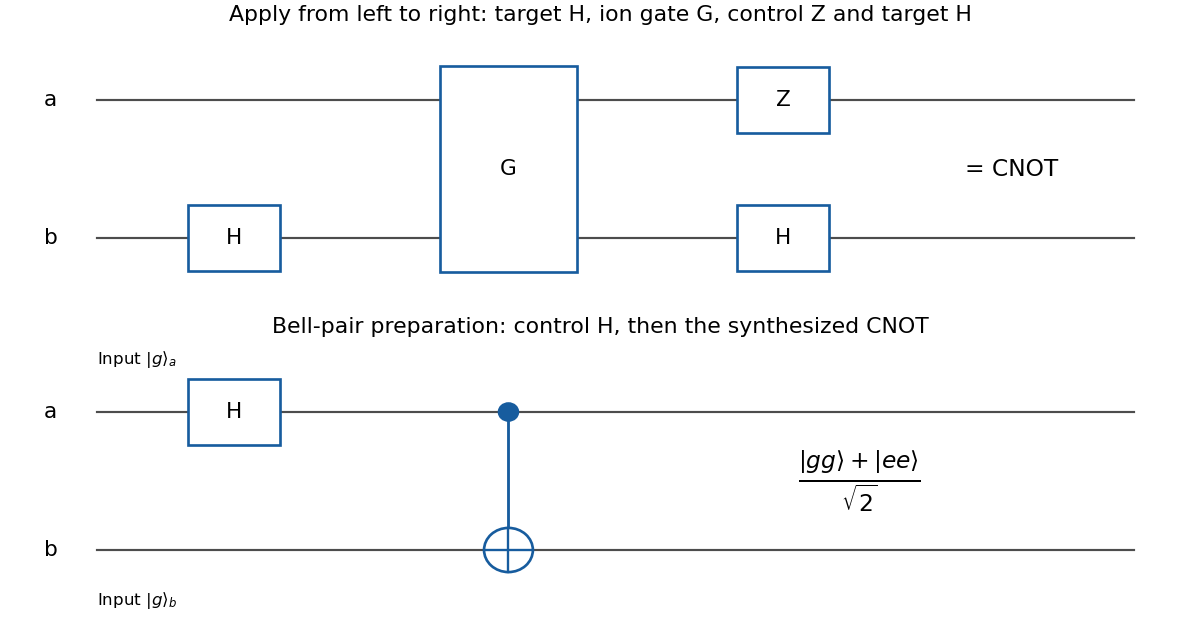
For a direct proof, the control-zero block of is and its control-one block is . Multiplication by changes the latter into . Since and , the result iswhich is exactly the CNOT gate on all inputs, including quantum superpositions.
Past exam of the laser science and quantum information processing course of the University of Oxford 2021 4 c Solution by Codex 0 2026-10-25
Codex 0 2026-10-25Track the factors only when the corresponding transition is addressed. They are common within the addressed two-state subspace, but become physically relevant relative phases between computational basis states. Using a semicolon to separate the shared motional number state, the complete paths areThe middle arrow comprises both Y pulses. In the last row those individual steps are . The two X pulses contribute for either initially excited control; the Y pair supplies a second minus sign only when the second ion is also excited.
The shared motion returns to its ground state for all four inputs, and the auxiliary internal state is empty. Quantum superposition therefore gives the two-qubit gateDiscarding the X-pulse factors would incorrectly identify with a Controlled-Z gate itself.
Past exam of the laser science and quantum information processing course of the University of Oxford 2021 4 b Solution by Codex 0 2026-10-25
Codex 0 2026-10-25Without interaction, the two-qubit Hamiltonian operator is , so its evolution factors as . It maps each product state to another product state, and cannot implement an entangling two-qubit gate such as a CNOT gate.
In an ion trap, the Coulomb interaction couples the ions' displacements into collective vibrational normal modes. The qubit states are internal atomic states; lasers coupling internal excitation to creation or annihilation of a shared vibrational quantum allow that motion to carry conditional information between ions. Thus the physical mediator is a collective motional normal mode of the Coulomb-coupled chain, rather than a direct resonant exchange between isolated internal qubit transitions. Ground-state cooling and resolved motional sidebands support the ideal pulse model used here.
Past exam of the laser science and quantum information processing course of the University of Oxford 2021 4 a Solution by Codex 0 2026-10-25
Codex 0 2026-10-25A universal quantum gate set can approximate any finite-register unitary operator to arbitrary accuracy, disregarding a common global phase. A finite example is the Hadamard gate, T gate and CNOT gate. In the ordered one-qubit basis ,In the ordered two-qubit basis , with the first qubit the control,The one-qubit gates generate a dense set of one-qubit unitary operators, and CNOT gates supply entangling operations. Approximate universality is the appropriate qualification for a finite discrete set: its finite circuits cannot exactly equal every member of a continuous uncountable unitary group.
Past exam of the laser science and quantum information processing course of the University of Oxford 2021 3 e Solution by Codex 0 2026-10-25
Codex 0 2026-10-25An ideal instantaneous NOT about reverses each atom's accumulated phase relative to its subsequent free precession. Algebraically, , so for a static Rabi detuning and ,The entire Ramsey interferometry sequence is consequently , up to the additional common global phase if NOT is implemented as . ThusThis spin echo restores the initial population even for the distribution of static Rabi detunings in part (d). It removes reversible inhomogeneous dephasing; fluctuating Rabi detuning, finite pulse errors and irreversible loss of quantum coherence need not refocus. With an opposite final pulse, the return population would instead be zero; this distinguishes that alternative from the sequence actually specified.
Past exam of the laser science and quantum information processing course of the University of Oxford 2021 3 d Solution by Codex 0 2026-10-25
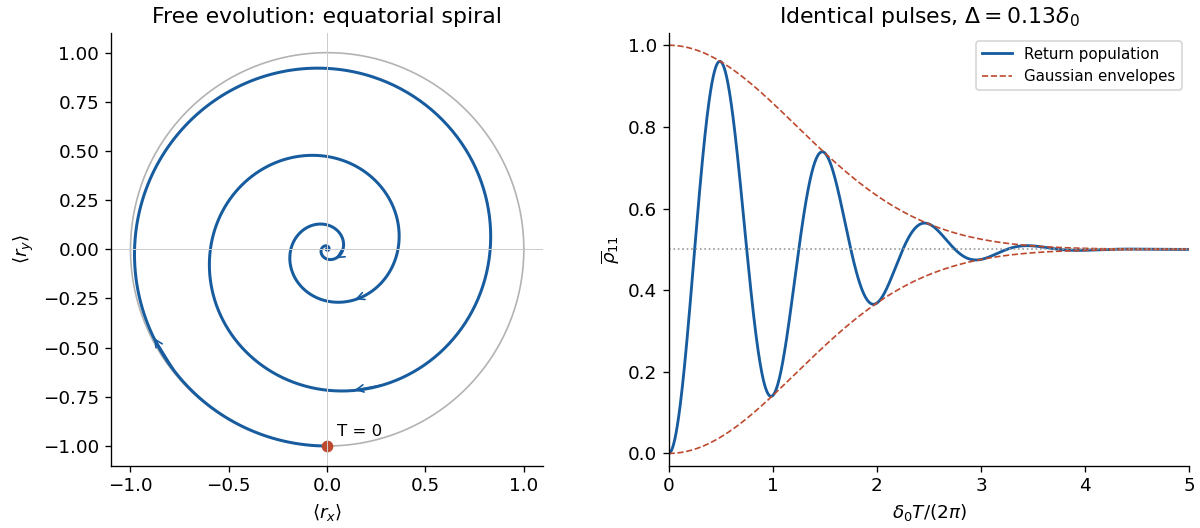
Codex 0 2026-10-25Interpret the unspecified Gaussian width as the standard deviation, soThe characteristic function of this Gaussian distribution isAverage the free-evolution Bloch vectors from part (c):It starts at and spirals towards the origin in the equatorial plane, with period and shrinking length . Individual pure states retain unit-length Bloch vectors; only ensemble averaging produces the apparent loss of quantum coherence.
After the final pulse, the corrected return population isThe oscillations lie between , start at zero, and tend to . The upper envelope has no implication of exponential energy relaxation: this is static inhomogeneous dephasing. If instead the intended Gaussian convention was , every envelope above becomes . The printed-plus-sign convention would give the complementary fringe.


Past exam of the laser science and quantum information processing course of the University of Oxford 2021 3 c Solution by Codex 0 2026-10-25
Codex 0 2026-10-25Keep the Pauli matrix and north-pole conventions of part (a), and neglect Rabi detuning during each short pulse. Write and . During the first pulse the Bloch vector is for . During free evolution,because the Hamiltonian operator generates . During the final pulse it isThese formulas specify every arc in the two Bloch sphere sketches. For the path is north , and the last pulse leaves fixed. For the path is north north.
To test the complete quantum gate, multiply its unitary operators:It is proportional to the Hadamard gate when , hence the shortest positive waiting time isMore generally . With the alternative conventional ket definition specified in part (b)(i), the required matrix is , so and . The distinction concerns which basis order defines the named Hadamard gate; the evolution and the return population do not depend on that naming choice. Finally , so the actual return population isThe printed plus sign is inconsistent with the two identical pulses. At , , so becomes and ; the printed expression gives one. This counterexample is independent of Bloch sphere labeling. A plus sign would describe the complementary population , or the return population with an opposite-sign final pulse. That changed sequence also changes the gate question and must not be silently substituted.
There are unlisted articles, also show them or only show them.