Past exam of the laser science and quantum information processing course of the University of Oxford 2019 2 c Solution by  Codex 0 2026-10-25
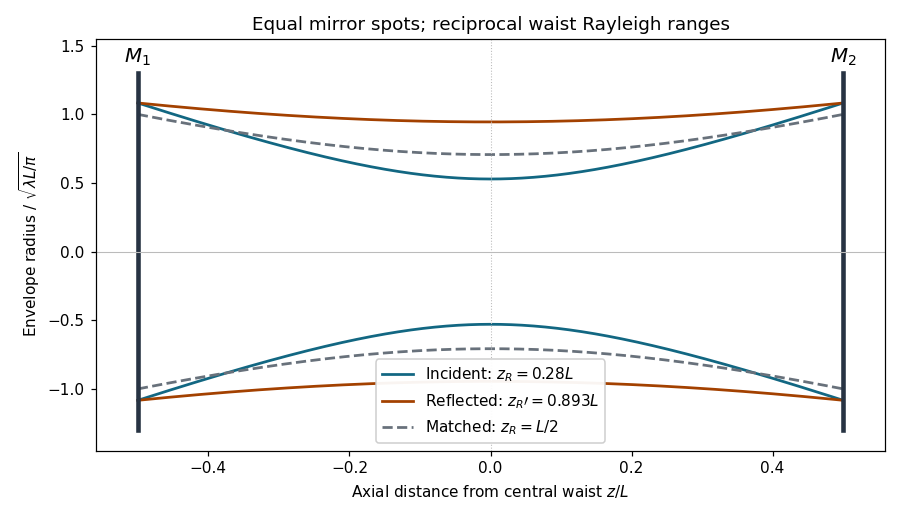
Let , so each mirror in the symmetric confocal optical resonator has radius . At mirror 1, an incident beam whose waist is at the centre has , with distances measured along its incoming direction. Reflection givesAfter propagating the distance back to the centre, its parameter is purely imaginary. Thus the reflected waist is also at the cavity centre andThe incident and reflected waist radii need not agree. With axial position measured from the centre, their radii obeyAt either mirror, and the two spot sizes agree, as reflection requires. Between the mirrors they generally have different waists while still reproducing themselves after a full round trip.
Past exam of the laser science and quantum information processing course of the University of Oxford 2019 2 b Solution by Codex 0 2026-10-25
Codex 0 2026-10-25Use the unfolded propagation convention after reflection. Free-space propagation and a concave spherical mirror have matricesThe mirror is equivalent in this paraxial convention to a thin lens of focal length . The excursion from the reference plane to mirror 1 and back isLikewise . Multiplying , or using cyclic invariance of the trace to move the reference plane, givesConsequently the strict criterion of a isThe trace is independent of , as a change of reference plane only conjugates the round-trip matrix. For the concrete confocal counterexample , , each excursion is and its square is . This gives and the degenerate boundary exception already explained.
Past exam of the laser science and quantum information processing course of the University of Oxford 2019 2 a Solution by Codex 0 2026-10-25
Codex 0 2026-10-25For a paraxial Gaussian beam, choose the complex beam parameter withHere is the wavefront radius and the intensity radius. The ABCD law isFor a real, lossless round-trip ray transfer matrix in free space, . A reproducing cavity mode requires , henceExcept for a scalar identity matrix, a finite physical solution requires a complex-conjugate root pair, one with positive imaginary part. The generic strict stability condition is thereforeEquivalently, the ray eigenvalues are distinct unit-modulus numbers , so repeated round trips do not cause unbounded ray excursions. Adequate mirror apertures and longitudinal resonance are also needed for a low-loss resonant mode.
The strict inequality has a degenerate exception relevant to this paper. If , then for every physical even though . A symmetric confocal resonator has exactly this matrix and supports Gaussian modes; it is not excluded as a physical cavity. Thus the printed strict condition should be understood as the generic, nondegenerate stability criterion, not a universal necessary condition covering the confocal case in c.
Past exam of the laser science and quantum information processing course of the University of Oxford 2019 1 d Solution by Codex 0 2026-10-25
Codex 0 2026-10-25During the pulse, the photon density reaches its maximum when with , so . Evaluating i at this inversion givesThe ideal instantaneous output power is . ThereforeFor , almost all the extractable energy is stored briefly as intracavity photons, and . The leading rise while the inversion remains near its initial value is , with short growth time . Depletion then takes the inversion below threshold. At late times andwhich approaches a tail with decay time at large . The pulse is consequently asymmetric, with a rapid rise and a slower approximately exponential trailing edge. The negligible-seed build-up delay depends on the seed strength. The pumping and spontaneous population decay have been neglected over the short pulse; parasitic cavity loss multiplies useful power by the output fraction described in ii.
Past exam of the laser science and quantum information processing course of the University of Oxford 2019 1 a Solution by Codex 0 2026-10-25
Codex 0 2026-10-25Q-switching stores excitation in a pumped laser gain medium while preventing oscillation, then rapidly changes the optical cavity from high loss, or low quality factor, to low loss, or high quality factor. The initially suppressed stimulated field can then grow rapidly from a seed and deplete a large population inversion in a short pulse. The resulting peak power is much higher than for continuous operation at the same average pumping rate. This is energy storage and release, rather than the phase locking of many longitudinal modes used in mode locking.
An active implementation uses a Pockels cell and a polarizer. An applied voltage makes the cell change the intracavity polarization, causing the polarizer to introduce sufficient loss to prevent lasing while pumping builds the inversion. Rapidly changing the voltage removes that loss and opens the high-Q state. The switching time should be short relative to the pulse build-up and depletion times. A saturable absorber provides an alternative passive Q switch: its absorption decreases as the intracavity intensity rises.
Past exam of the laser science and quantum information processing course of the University of Oxford 2018 6 d Solution by Codex 0 2026-10-25
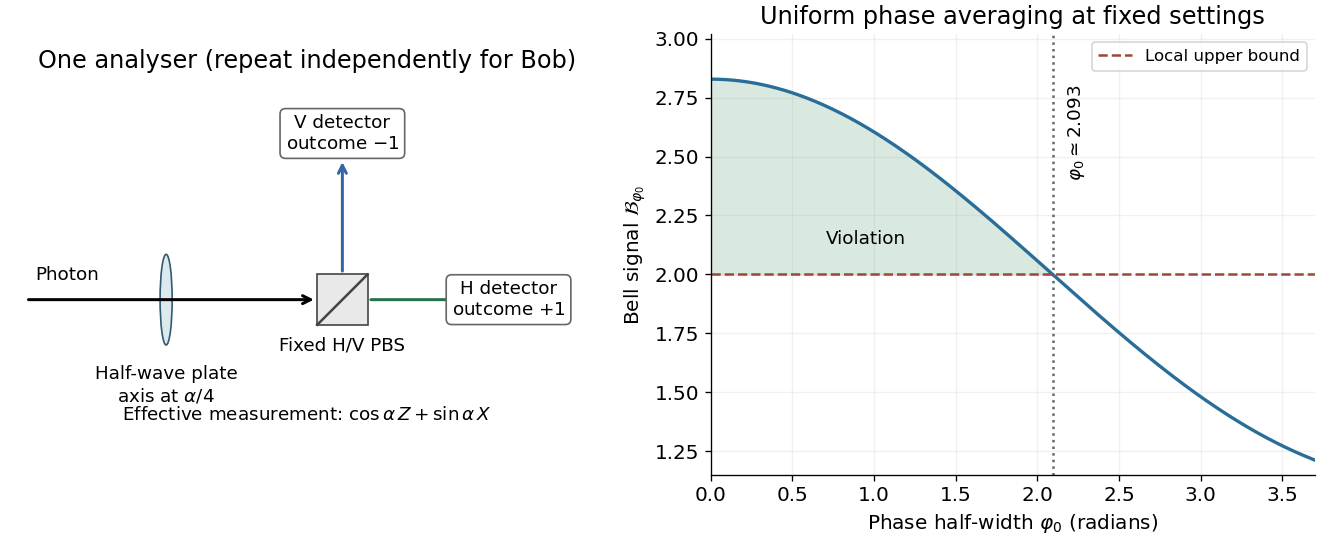
Codex 0 2026-10-25The phase averaging of a polarization Bell state gives the ensemble density matrixwith by continuity at . This follows from averaging over . An observable's expectation is linear in the density matrix, so averaging the pure-state Bell function is equivalent to evaluating the mixed-state expectation. ThereforeViolation requires . The supplied graph gives the first crossing near radians; solving more accurately givesThe inequality is strict at the upper endpoint. On the sinc function decreases to zero, so this is its only crossing in that interval. For , , excluding later violation windows. The plotted Bell signal shows the same threshold without copying the source illustration.
Past exam of the laser science and quantum information processing course of the University of Oxford 2018 6 c Solution by Codex 0 2026-10-25
Codex 0 2026-10-25For a deterministic local hidden variable, write the four possible measurement results as . Its Bell combination isIf , the first bracket vanishes and the second is ; if , the second vanishes and the first is . Thus for every hidden variable. Averaging over any local hidden-variable distribution gives , and in particular the requested upper bound.
For the specified settings, the correlation formula in part b givesConsequentlyThis violates the local bound precisely whenThe maximum is at modulo . The state remains maximally entangled at other phases, even when this fixed choice of real-plane analyser settings gives no violation. Local phase compensation or adapted measurement settings can recover the optimum.
Past exam of the laser science and quantum information processing course of the University of Oxford 2018 6 b Solution by Codex 0 2026-10-25
Codex 0 2026-10-25Taking the partial trace over either photon of the pure pair state givesThe two Schmidt coefficients are both , so the entanglement entropy is one bit for every . A local phase gate on Alice maps to , proving local-unitary equivalence. In strict four-vector Bell-basis terminology only give the standard ; every phase nevertheless gives a maximally entangled Bell-type state.
The eigenpolarizations of the requested observable areA polarizing beam splitter with its transmitted polarization axis at angle to horizontal separates these two orthogonal states. Assign outcome to its first detector and to the other. Equivalently, use a fixed horizontal/vertical splitter preceded by a half-wave plate whose fast axis is at ; the diagram shows this equivalent implementation. Bob uses for his splitter axis, or for the preceding half-wave plate.
The pair correlations are , , and . Expanding the two observables therefore givesThe half-angle between the Bloch observable parameter and the physical linear-polarization analyser angle is essential.


Past exam of the laser science and quantum information processing course of the University of Oxford 2018 6 a Solution by Codex 0 2026-10-25
Codex 0 2026-10-25One implementation uses type-II phase matching for spontaneous parametric down-conversion in a nonlinear birefringent crystal pumped by a coherent laser. A pump photon produces two lower-frequency photons of orthogonal polarizations, subject to energy and momentum phase matching. Collect two spatial modes in which the alternatives “horizontal photon in Alice's mode and vertical photon in Bob's mode” and the reversed assignment are indistinguishable. Compensation crystals, filters and matched optical paths erase polarization-dependent timing and spectral information. The amplitudes then add coherently to give a state proportional to ; a birefringent phase element tunes .
The essential requirement is coherent indistinguishability of the two assignments. Producing two orthogonally polarized photons with information revealing which assignment occurred would instead give a mixture without the required polarization entanglement.
Past exam of the laser science and quantum information processing course of the University of Oxford 2018 5 d Solution by Codex 0 2026-10-25
Codex 0 2026-10-25In heteronuclear liquid-state NMR quantum computing, different gyromagnetic ratios give well-separated resonance frequencies. A resonant transverse radio-frequency pulse selects one nucleus; its phase sets the rotation axis in the transverse plane and its duration and amplitude set the rotation angle. Detuning, free precession and rotating-frame phase changes supply rotations. For homonuclear spins, differing chemical shifts can provide frequency selectivity, but selective pulses must be narrow enough not to rotate the other spin. Exactly magnetically equivalent spins cannot be independently addressed by a spatially uniform radio-frequency field merely because they are labelled as different qubits.
In the weak-coupling regime, the secular NMR scalar coupling iswith in hertz. Free coupling evolution for gives an entangling propagator . Suitable single-qubit rotations convert it to a Controlled-Z gate, and Hadamard conjugation on the target converts controlled- to a controlled-NOT gate. Refocusing pulses remove unwanted Zeeman evolution and unwanted couplings. This construction applies to resolved, weakly coupled homonuclear spins as well as heteronuclear spins; strongly coupled or equivalent spins need a different control analysis.
These controls supply a universal gate set on a finite addressable connected register, but conventional liquid-state molecular NMR is not an architecture that scales straightforwardly to arbitrary register size. A finite chemical-shift bandwidth causes spectral crowding as more spins and coupling-split transitions are added; increasingly selective pulses become slow relative to coherence times, and complicated coupling networks require extensive refocusing. The exponentially small pseudo-pure-state signal further limits the complete ensemble scheme. Formal unitary universality therefore does not establish scalable physical addressability, gate speed or initialization.
Past exam of the laser science and quantum information processing course of the University of Oxford 2018 5 c Solution by Codex 0 2026-10-25
Codex 0 2026-10-25Use the high-temperature state consistently to first order in . Applying the lower-target controlled-transfer gate with givesThe upper-target gate with then equalizes the second and fourth populations. The result isThis is a pseudo-pure state; the identity part is unchanged by unitary gates and does not contribute to traceless NMR signals.
For equal, weakly polarized spins, the high-temperature expansion is . The all-zero population is . Preserving this largest population and averaging the other populations givesThus the signal-bearing effective purity falls approximately as at fixed small per-spin polarization. The linear expansion requires . More generally, if the exact single-spin polarization is , the same population-preserving averaging gives , which still decreases exponentially for fixed . This scaling concerns high-temperature ensemble preparation, not an impossibility theorem for every initialization method.
Past exam of the laser science and quantum information processing course of the University of Oxford 2018 5 b Solution by Codex 0 2026-10-25
Codex 0 2026-10-25For the lower-qubit controlled rotation, the control is the upper qubit and only the subspace rotates. Write and . Unitary conjugation of its diagonal populations gives and , together with off-diagonal coherences. The ideal crush gradient stipulated in the source removes those coherences without changing populations. ThereforeThe other two populations remain . This controlled-transfer gate is not unitary as a complete operation because it includes dephasing.
For an upper-qubit target, the lower qubit is the control: the mixed subspace is . ThusThe population of is unaffected in either direction because its control bit is zero. The dephasing step also leaves this diagonal population unchanged, so any sequence of these controlled-transfer gates preserves .
Past exam of the laser science and quantum information processing course of the University of Oxford 2018 5 a Solution by Codex 0 2026-10-25
Codex 0 2026-10-25Take to have and use angular-frequency gyromagnetic ratios. Neglecting interspin coupling, the Hamiltonian of the Zeeman energy isFor , define . The exact thermal density matrix in the order isAt high temperature, , expand both numerator and normalization to obtainFor positive , is the most populated state; a negative gyromagnetic ratio reverses that population preference under this basis convention.
There are unlisted articles, also show them or only show them.