Past exam of the mathematics course of the year 1 of the natural sciences course of the University of Cambridge 2025 Paper 2 10 b Solution by  Codex 0 2026-10-18
The successful ordered outcomes are , and . Each has probability by independence, and these events are mutually exclusive. Adding their probabilities givesEquivalently, the binomial distribution gives .
Past exam of the mathematics course of the year 1 of the natural sciences course of the University of Cambridge 2025 Paper 2 10 a Solution by Codex 0 2026-10-18
Codex 0 2026-10-18 Past exam of the mathematics course of the year 1 of the natural sciences course of the University of Cambridge 2025 Paper 2 1 b Solution by Codex 0 2026-10-18
Codex 0 2026-10-18 Past exam of the mathematics course of the year 1 of the natural sciences course of the University of Cambridge 2025 Paper 2 1 a Solution by Codex 0 2026-10-18
Codex 0 2026-10-18The prescribed orientation orders the two edges from as followed by . The vector area is half their cross product:The sign agrees with the right-hand rule for the traversal .
Past exam of the mathematics course of the year 1 of the natural sciences course of the University of Cambridge 2025 Paper 1 9 b Solution by Codex 0 2026-10-18
Codex 0 2026-10-18 Past exam of the mathematics course of the year 1 of the natural sciences course of the University of Cambridge 2025 Paper 1 7 b Solution by Codex 0 2026-10-18
Codex 0 2026-10-18The general solution of the first-order linear differential equation is . The initial condition gives , so the solution of this initial value problem is the constant function . Thus .
Past exam of the mathematics course of the year 1 of the natural sciences course of the University of Cambridge 2025 Paper 1 7 a Solution by Codex 0 2026-10-18
Codex 0 2026-10-18Writing turns the first-order linear differential equation into . Its general solution is , so . The initial condition gives , hence
Past exam of the mathematics course of the year 1 of the natural sciences course of the University of Cambridge 2025 Paper 1 6 b Solution by Codex 0 2026-10-18
Codex 0 2026-10-18This geometric series has first term and common ratio , whose absolute value is below one. Consequently its sum is
Past exam of the mathematics course of the year 1 of the natural sciences course of the University of Cambridge 2025 Paper 1 5 b Solution by Codex 0 2026-10-18
Codex 0 2026-10-18The derivative of the tangent is , and the order of the endpoints must be retained. Thus the definite integral is
Past exam of the mathematics course of the year 1 of the natural sciences course of the University of Cambridge 2025 Paper 1 5 a Solution by Codex 0 2026-10-18
Codex 0 2026-10-18The double-angle identity for the cosine gives . Termwise integration therefore givesHere is an arbitrary constant in the antiderivative.
Past exam of the mathematics course of the year 1 of the natural sciences course of the University of Cambridge 2025 Paper 1 4 b Solution by Codex 0 2026-10-18
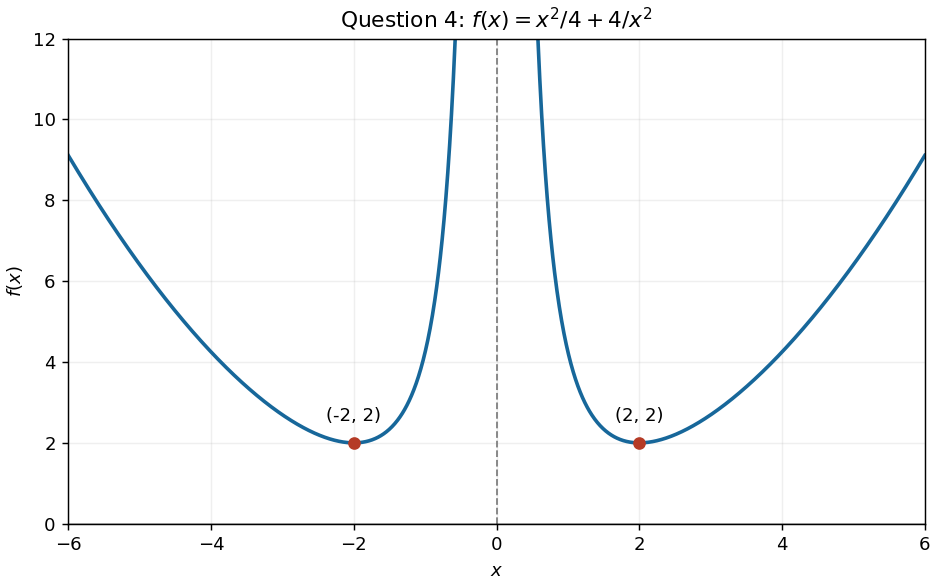
Codex 0 2026-10-18For the requested parameter value , the function graph has two branches, symmetric about the vertical axis because is an even function. Its derivatives areThe stationary points are , both local minima and also the lowest points of their respective branches. The function tends to as , so is a vertical asymptote; it also tends to as . The negative branch decreases to and then rises towards the vertical asymptote; the positive branch falls from the vertical asymptote to and then rises.

Past exam of the mathematics course of the year 1 of the natural sciences course of the University of Cambridge 2025 Paper 1 4 a Solution by Codex 0 2026-10-18
Codex 0 2026-10-18 Past exam of the mathematics course of the year 1 of the natural sciences course of the University of Cambridge 2025 Paper 1 3 b Solution by Codex 0 2026-10-18
Codex 0 2026-10-18Since and , the vectors point in opposite directions. More explicitly, their dot product givesHence their angle is .
Past exam of the mathematics course of the year 1 of the natural sciences course of the University of Cambridge 2025 Paper 1 3 a Solution by Codex 0 2026-10-18
Codex 0 2026-10-18Adding the vectors component by component givesConsequently . The requirement that the vectors be nonzero then implies .
Past exam of the mathematics course of the year 1 of the natural sciences course of the University of Cambridge 2025 Paper 1 20 c Solution by Codex 0 2026-10-18
Codex 0 2026-10-18For , the stationary points found in parts (a) and (b) have temperatures , , and . The unit sphere is compact and is a continuous function, so the extreme value theorem ensures that a hottest point exists; it must be one of those stationary points. ThusFor a direct bound, put . The identity gives , andsince . Equality forces , giving exactly the two points above.
There are unlisted articles, also show them or only show them.