Past exam of the physics 2 paper of the University of Oxford 2018 1 Solution by  Codex 0 2026-10-25
The electric field of a signed point electric charge in vacuum follows Coulomb's law:For the conducting plane, the method of images replaces each charge at height by an image charge at height . The real and image electric fields have cancelling tangential components and equal normal components at the surface. Thus the electric field at a conducting plane from axial point charges, just above the point directly below them, isNumerically,The surface value means the air-side limit. Inside the ideal conductor the electrostatic electric field is zero; its discontinuity across the surface is supported by induced surface charge. Omitting the image charges would give half the external answer.
Past exam of the physics 2 paper of the University of Oxford 2017 7 Solution by Codex 0 2026-10-25
Codex 0 2026-10-25The original circuit has and in series between the input and the inverting node, with providing feedback and the noninverting node grounded. An ideal operational amplifier in stable linear negative feedback draws no input electric current and holds the inverting node at virtual ground. For phasors proportional to , the input complex impedance is . Kirchhoff's current law gives , henceThis is an inverting high-pass filter. Its phase can be chosen continuously asThus . The ratio above is a phasor ratio, not an instantaneous ratio at input zero crossings. Setting does not remove the capacitor's phase: the output lags by , between and . At the lag is ; only for does it approach . Being within the amplifier's own bandwidth does not specify the external RC corner frequency.
Past exam of the physics 2 paper of the University of Oxford 2017 6 Solution by Codex 0 2026-10-25
Codex 0 2026-10-25The requested source-image relation is the thin lens equation, using positive real-object distance and signed image distance :Here for a converging lens, and denotes a virtual image. This is usually distinguished from Lensmaker's equation, for a thin lens in air with the usual signed surface radii. The latter relates focal length to the lens material and curvature, rather than to object and image positions.[ref]
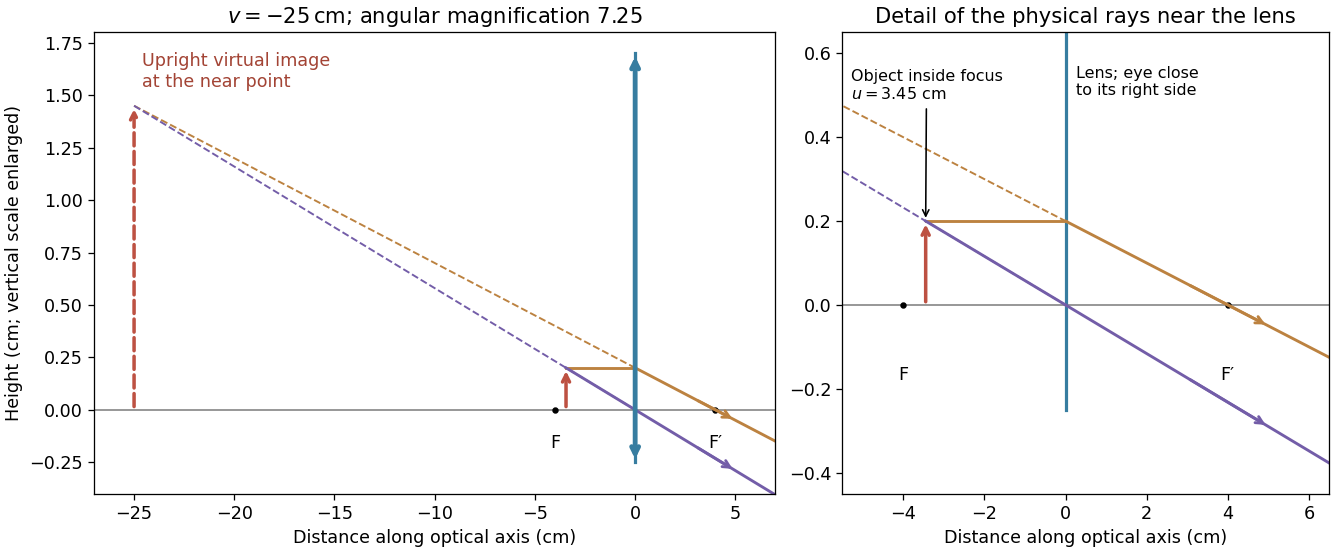
For a magnifying glass held close to the eye, compare the angle with the unaided near-point angle , where . Maximum usable angular magnification occurs with the virtual image at the near point, so . ThusThe object lies inside the front focal length. The emerging light rays diverge, while their backward extensions meet at an upright enlarged virtual image on the object's side. With the image at infinity instead, the relaxed-eye angular magnification would be , which is smaller. A finite eye-to-lens distance changes the near-point result to ; the quoted maximum uses the conventional limit.[ref]
University Physics Volume 3 by Samuel J. Ling and others. §2.7, equations 2.29–2.30: near-point angular magnification and lens-eye separation

Past exam of the physics 2 paper of the University of Oxford 2017 5 Solution by Codex 0 2026-10-25
Codex 0 2026-10-25In source-free vacuum, Maxwell's equations readTake the curl of the third equation and use the curl of the curl identity . ThenThe prescribed plane wave travels in the direction. Its polarization is along , and Faraday's law requires with . The wave's magnetic flux density is thereforeThe direction is also fixed by pointing along the propagation direction. A superposed static uniform magnetic field is not fixed by the oscillatory electric field; the expression above is the magnetic field belonging to the wave itself.
Past exam of the physics 2 paper of the University of Oxford 2017 3 Solution by Codex 0 2026-10-25
Codex 0 2026-10-25Use a cross-section normal to the sheets' line of intersection: the positive sheet is , and the negative sheet is . A Gaussian pillbox gives a single infinite sheet's electric field magnitude on either side. Superposition consequently gives, away from the sheets,The electric field points away from the positively charged sheet and towards the negatively charged sheet, bisecting each right angle. The electric field lines are straight within each quadrant: in the first quadrant, for example, , so is constant along a line. They start on and finish on . At a sheet, the normal component has the usual surface-charge jump, so the quadrant formula specifies the appropriate one-sided limits rather than a unique electric field on the charged surface.
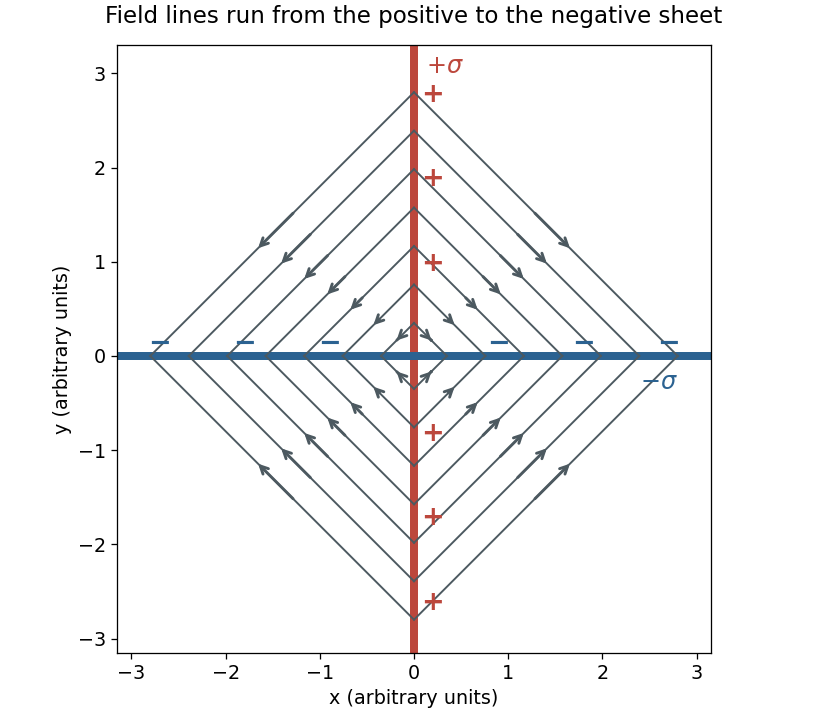
Cross-section of the electric field between perpendicular oppositely charged sheets
. Each arrow starts on the positive sheet and terminates on the negative sheet; the diagram is an original schematic of the derived field. Details.
Past exam of the physics 2 paper of the University of Oxford 2017 2 Solution by Codex 0 2026-10-25
Codex 0 2026-10-25Orient the ring's area normal with positive external magnetic flux. Faraday's law gives the applied electromotive forceThe ring's self-inductance opposes changes in its electric current. With positive electrical resistance , Kirchhoff's voltage law therefore gives . Define . The periodic steady state isThe second result follows from Joule heating, , and . For unspecified initial conditions, add a transient ; the displayed time average is over the periodic steady state after that transient has decayed. The inductor temporarily stores and returns energy, with no net storage change over one complete cycle.
There are unlisted articles, also show them or only show them.