Past exam of the physics 2 paper of the University of Oxford 2016 resit 3 Solution by  Codex 0 2026-10-25
Define to point from the negative charge to the positive charge. The electric dipole moment is . In a uniform electric field, the two forces cancel, so the net force is zero. They nevertheless form a couple with torqueFor a positive angular displacement increasing , the restoring torque component is . Thus andwith the additive constant chosen to make at . Alignment is a stable minimum and antialignment an unstable maximum. The zero-force result uses a uniform field; a field gradient can exert a net force on a dipole.
Past exam of the physics 2 paper of the University of Oxford 2016 resit 2 Solution by Codex 0 2026-10-25
Codex 0 2026-10-25Introduce cylinder length and line charge density ; only charge per length matters in the long-cylinder approximation. A coaxial cylindrical Gaussian surface gives . Choosing the outer cylinder's electric potential to be zero,The capacitance per unit length follows from :If is intended as a line charge rather than a finite total charge, replace by that . Neglecting end effects, equal opposite cylinder charges make the exterior electric field vanish; the potential difference between the conductors remains the quantity defining their capacitance.
Past exam of the physics 2 paper of the University of Oxford 2016 resit 10 Solution by Codex 0 2026-10-25
Codex 0 2026-10-25Monochromatic light has one frequency, or a bandwidth sufficiently narrow for the intended measurement. A lamp can illuminate the experiment through a narrow spectral filter or monochromator, followed by a small source aperture at the focus of a collimating lens. The aperture supplies spatial coherence across the slits; the lens supplies approximately parallel incident wavefronts. Two independently illuminated incoherent slits would not provide a stationary fringe pattern.
In the Fraunhofer approximation, the optical path difference at observation angle is . For equal single-slit intensities , adding the two wave amplitudes givesThe thin-slit idealization suppresses the individual diffraction envelope. If additionally , then and . The far-field condition does not by itself impose this small observation angle.
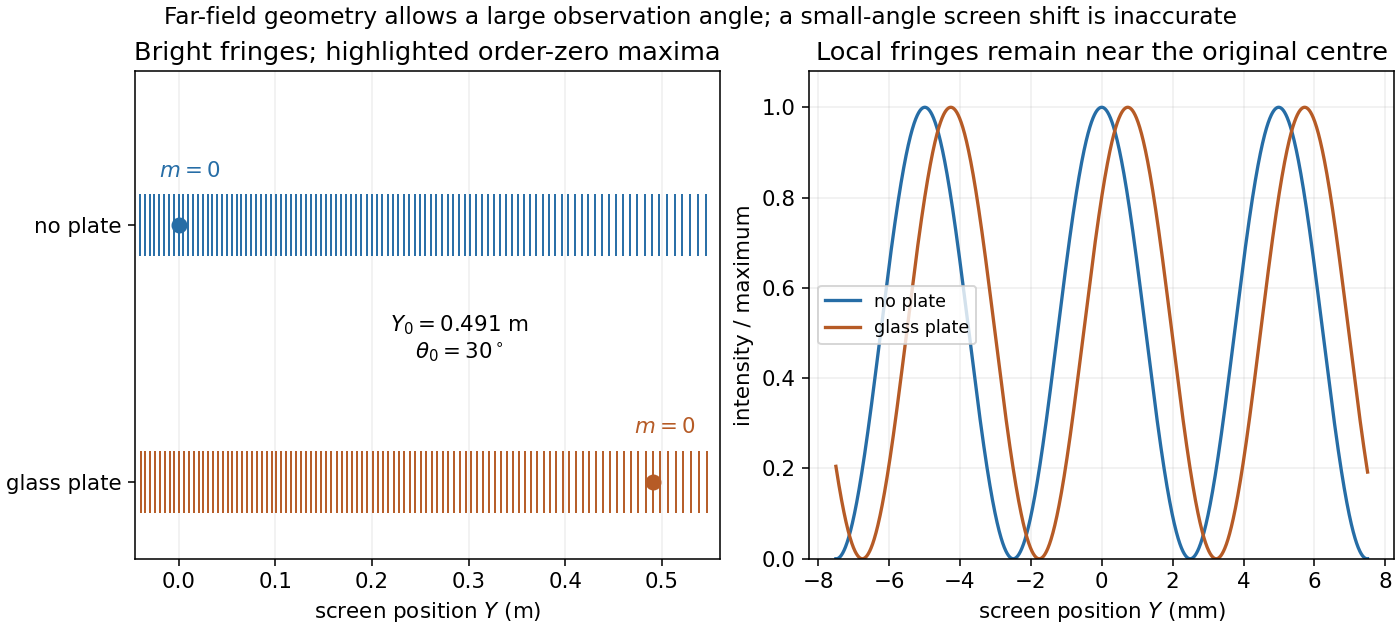
Let the upper slit contain the glass plate and take positive towards that slit. The extra optical path length is . Its total upper-minus-lower path difference is . The order-zero fringe therefore satisfiesIt moves towards the covered slit. Using here is a poor small-angle approximation: is not small. The order-zero fringe is being tracked as the optical delay is introduced; because the pattern is periodic in phase, many other bright fringes still lie near the original centre. Neglecting unequal glass transmission changes visibility but not the zero-path-difference condition.
Past exam of the physics 2 paper of the University of Oxford 2016 resit 1 Solution by Codex 0 2026-10-25
Codex 0 2026-10-25The integral Gauss law in vacuum is . A single isolated point charge has spherical symmetry, so its electric field is radial and constant in magnitude on a centred sphere. The flux is , giving Coulomb's lawIn electrostatic equilibrium, a conductor is an equipotential: a tangential electric field would move its mobile charges. The electric field inside the conducting material is zero. A thin pillbox straddling its surface therefore gives , henceHere is the charge density on the particular face and points into vacuum. For an isolated thin plate with total charge divided equally between two faces, each face instead has half that total areal density. The local boundary result must not be confused with the field of an isolated nonconducting infinite charged sheet.
Past exam of the physics 2 paper of the University of Oxford 2015 7 Solution by Codex 0 2026-10-25
Codex 0 2026-10-25Use Fraunhofer diffraction, appropriate to observation in the far field or in the focal plane of a lens, and uniform illumination across the slit. At observation angle , points separated by transverse coordinate acquire a phase difference , where is the wavenumber. The superposition principle for the coherent wave amplitudes givesThe intensity is proportional to the squared modulus of the wave amplitude, soThe limit at is one. The noncentral zeros satisfy for nonzero integers for which the angle is physically allowed. In the Rayleigh criterion, two mutually incoherent point images are just resolved when the central maximum of one diffraction pattern lies at the first minimum of the other. For single-slit diffraction this givesThe exact statement here takes one image on the slit normal; for nearby paraxial images the angular resolution is . The first propagating minimum exists only for . The numerical factor belongs to a circular aperture and does not apply to this slit.
Past exam of the physics 2 paper of the University of Oxford 2015 6 Solution by Codex 0 2026-10-25
Codex 0 2026-10-25Let denote the electric charge on the initially positive capacitor plate and define the discharge electric current by . Kirchhoff's voltage law for the series RLC circuit gives the damped harmonic oscillator equationThe initial conditions are and : the open switch initially prevents electric current, and finite inductance prevents an instantaneous jump in it. Put and . The two characteristic roots are . An oscillatory electric current requires a nonzero imaginary part, henceFor positive and nonnegative , this is the underdamped regime. The initial conditions giveAt equality there is critical damping, and above it there is an overdamped response, with no repeated changes of sign of the discharge electric current. A nonzero initial electric charge is understood; if , the stated initial conditions give no electric current at all.
Past exam of the physics 2 paper of the University of Oxford 2015 5 Solution by Codex 0 2026-10-25
Codex 0 2026-10-25Take the divergence of the proposed Ampère's law. Since the divergence of a curl vanishes identically, it implies . However, local charge conservation requires the continuity equationFor example, electric current entering a charging capacitor accumulates electric charge on its plates, so the charge density is time dependent. The proposed equation cannot describe that process.
From Gauss's law, . Thus , which supplies precisely the missing divergence. Adding the displacement current density gives the Ampère-Maxwell equation:Its divergence now yields the correct continuity equation. Through a fixed surface, the associated displacement current is , where is the electric flux. In a vacuum capacitor gap, this equals the conduction electric current charging the plates, even though no charges cross the gap. Charge conservation fixes the required divergence of the correction; by itself it does not exclude adding a further divergence-free vector field.
Past exam of the physics 2 paper of the University of Oxford 2015 4 Solution by Codex 0 2026-10-25
Codex 0 2026-10-25Choose the entry point as , the initial velocity as , and the slit as , with . A magnetic field perpendicular to the page changes the direction of the velocity, while the Lorentz force does no work. For positive , an upward initial force requires the magnetic flux density to point into the page. The resulting circular motion has centre , since its initial tangent is horizontal.
The slit must lie on the circle, giving and hence . Equating the centripetal force to the magnetic part of the Lorentz force, , givesA negative electric charge requires the opposite direction of magnetic flux density. These expressions assume nonrelativistic motion and negligible energy loss through electromagnetic radiation.
For an opaque screen, reaching the slit must be the first encounter with . The velocity there has , so passage from left to right requires , as in the drawn arrangement. At the trajectory merely touches the screen. If , the same circle first meets the screen at height , where the particle is blocked; its later passage through does not solve the opaque-screen problem. This qualification distinguishes a geometric circle through two points from an accessible slit trajectory.
Past exam of the physics 2 paper of the University of Oxford 2015 3 Solution by Codex 0 2026-10-25
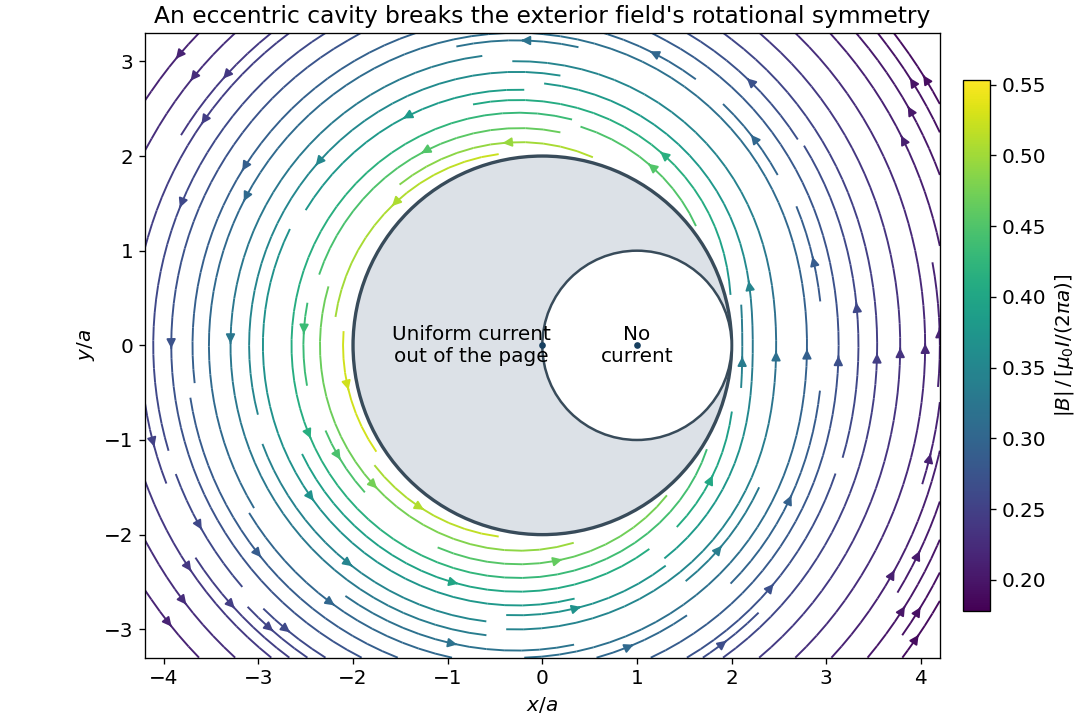
Codex 0 2026-10-25Use the geometric cross-section shown in the source: the outer cylinder has radius and centre , and the circular cavity has radius and centre . Let the electric current be in the direction. The conducting cross-sectional area is , so the uniform electric current density is .
To obtain the exterior magnetic field of a wire with an eccentric cylindrical cavity, apply the superposition principle to a full cylinder of electric current density centred at and a second cylinder of electric current density centred at . Their electric currents are and . This reproduces the actual electric current density everywhere, including zero in the cavity. Outside a long circular cylinder, Ampère's law gives . Every point outside the outer boundary is outside both component cylinders. Consequently, writing ,In Cartesian coordinates, the same magnetic flux density isThe cavity breaks rotational symmetry. Thus the magnetic flux density is generally neither constant in magnitude nor tangential on a circle centred at ; replacing its line integral by would be unjustified. Its line integral is nevertheless , as Ampère's law requires. At distances , the leading term becomes , with corrections of order .


There are unlisted articles, also show them or only show them.