Past exam of the physics 2 paper of the University of Oxford 2016 2 Solution by  Codex 0 2026-10-25
The Lorentz force isFor , the magnetic part is perpendicular to the velocity, so its instantaneous power vanishes. The speed and kinetic energy therefore remain constant. Decompose the initial velocity into along the uniform magnetic field and perpendicular to it. The parallel component is unchanged, while the perpendicular component rotates uniformly.
For a nonrelativistic particle with , the resulting helical motion hasHere is the Larmor radius, the cyclotron frequency in angular units, and the axial advance per turn. Opposite signs of electric charge give opposite senses of rotation. Pure perpendicular motion gives a circle; pure parallel motion gives a straight line. If or , there is no magnetic deflection. At relativistic speeds, replace in the radius and period by ; stays constant because the magnetic force does no work.
Past exam of the physics 2 paper of the University of Oxford 2016 resit 9 Solution by Codex 0 2026-10-25
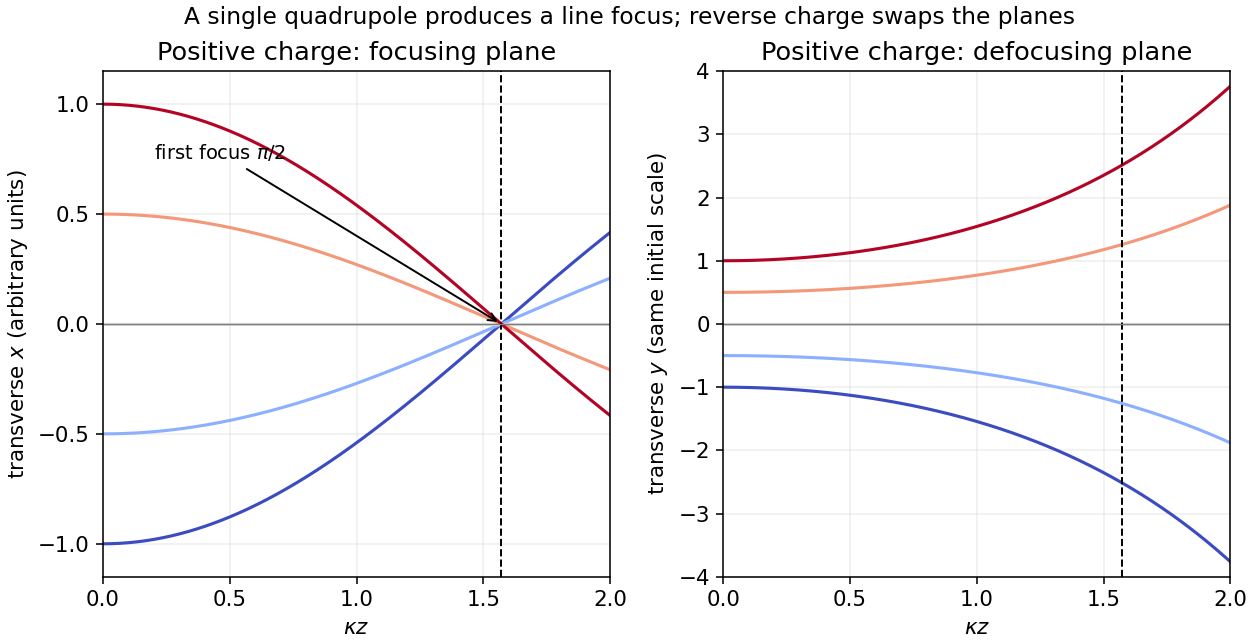
Codex 0 2026-10-25The Lorentz force is . With no electric field, the exact nonrelativistic component equations for the given quadrupole areThe magnetic force does no work, so the total speed stays constant. In the paraxial approximation, and its small change is second order in the transverse motion. For , put . Initial travel parallel to the axis means zero entrance slopes, yieldingThus is focused while is defocused. The first focus in the focusing plane occurs atFor negative , interchange the focusing and defocusing planes and use in . A single quadrupole magnet gives a line focus of a general beam, not simultaneous focusing of both transverse coordinates onto one point. The magnet must extend at least to the computed focus, and the slopes must remain small. For a relativistic beam, the corresponding paraxial factor is , with the longitudinal relativistic momentum.
Past exam of the physics 2 paper of the University of Oxford 2016 resit 8 Solution by Codex 0 2026-10-25
Codex 0 2026-10-25In vacuum, with possible sources and , Maxwell's equations areTheir integral forms, with compatible orientations and fixed surfaces, areCharge- and current-free space additionally sets , . Vacuum constitutive constants alone do not imply that no charges exist.
Take the curl of the source-free Ampere-Maxwell law, use Faraday's law of induction and :ConsequentlyFor the specified complex plane wave, the wavevector is and . Faraday's law of induction fixesThe physical fields are the real parts. They are in phase and their Poynting vector points along .
The instantaneous electric and magnetic energy densities are and . Since , they are equal for this ideal travelling plane wave, and so are their cycle averages: . For real peak amplitude , each average is . The Poynting vector and mean intensity satisfyIt represents transported energy per area per time, in .
For the numerical moonlight estimate, adopt and lunar mean radius . These additional astronomical inputs give solar irradiance at the Moon of .[ref]
Sun Fact Sheet by National Aeronautics and Space Administration. Bulk parameters: luminosity 382.8 in units of 10^24 J/s
[ref]Moon Fact Sheet by National Aeronautics and Space Administration. Bulk parameters: volumetric mean radius 1737.4 km and solar irradiance 1361 W/m^2
Under the simple isotropic point-reflector approximation, the intercepted power is , of which fraction is redistributed over steradians. ThusThese are equivalent sinusoidal peak amplitudes; the corresponding root mean square fields are smaller by . Actual moonlight is broadband and incoherent.
A total reflected fraction alone does not specify the directional brightness of a full Moon. For a Lambertian sphere at full phase, with the same total reflectance , integrating its radiance gives , instead giving and . If 0.12 is instead the geometric albedo, the full-phase formula is , giving . NASA's table itself distinguishes Bond albedo from geometric albedo.[ref]
Moon Fact Sheet by National Aeronautics and Space Administration. Bulk parameters list Bond albedo 0.11 and geometric albedo 0.12
The numerical estimate therefore needs an explicit reflection convention; the first boxed values use the stated isotropic approximation. Past exam of the physics 2 paper of the University of Oxford 2016 resit 7 Solution by Codex 0 2026-10-25
Codex 0 2026-10-25Huygens' principle treats every point of an advancing wavefront as a source of secondary wavelets; their common envelope forms the next wavefront. Consider two points of an incident plane wave reaching the interface at different times. During the same interval , the remaining incident portion travels while the first transmitted wavelet expands a distance . The two wavefront right triangles share their interface segment, soThis is Snell's law, with both angles measured from the surface normal. The speeds are phase velocities at the common frequency in stationary isotropic media. If the equation requires , there is no propagating refracted ray and total internal reflection applies instead.
Past exam of the physics 2 paper of the University of Oxford 2016 resit 6 Solution by Codex 0 2026-10-25
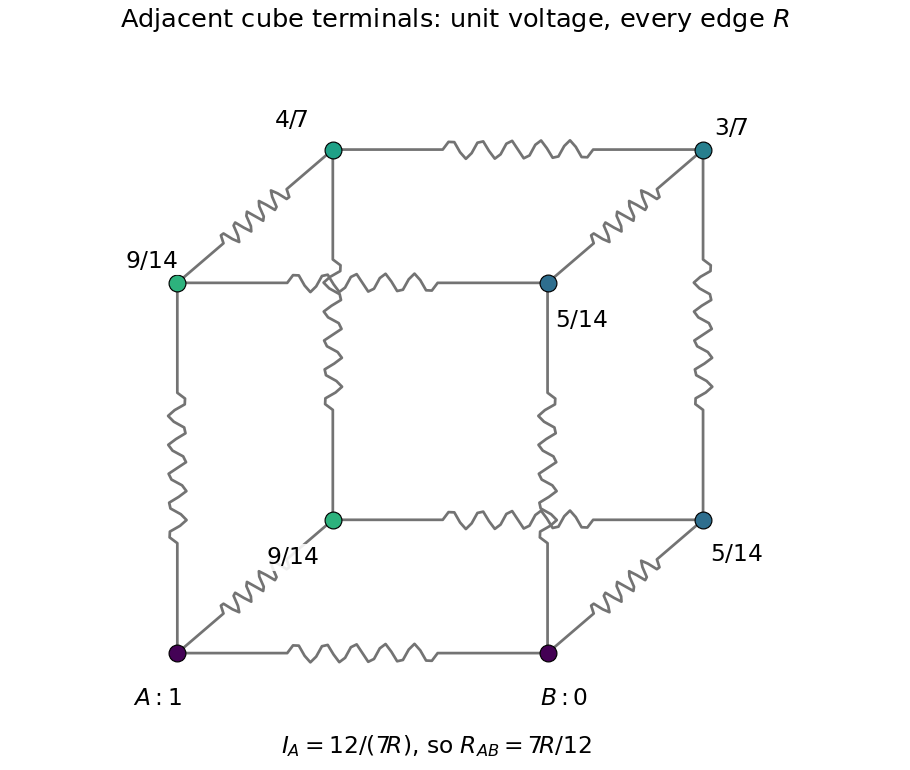
Codex 0 2026-10-25The adjacent-corner resistance of a resistor cube follows from Kirchhoff's current law and cube symmetries. Hold adjacent corners and at potentials and zero. The two corners have a common potential ; their neighbours have . Write the remaining two potentials as .


Past exam of the physics 2 paper of the University of Oxford 2016 resit 4 Solution by Codex 0 2026-10-25
Codex 0 2026-10-25Faraday's law of induction gives the electromotive force . For a fixed circuit, ; for moving material wire, include the motional term in that line integral. Lenz's law fixes the sign: the induced response opposes the change of linked flux, rather than necessarily opposing the field itself.
For the long solenoid, Ampère's law gives inside and negligible exterior field away from the ends. With turns and area , the linked flux is . Hence the self-inductance isThis assumes , closely spaced turns, negligible end fringing and an air core with relative magnetic permeability close to one. A finite core permeability or significant fringing changes the answer.
There are unlisted articles, also show them or only show them.