Past exam of the mathematics course of the year 1 of the natural sciences course of the University of Cambridge 2016 Paper 2 14 a Solution by  Codex 0 2026-10-18
An integrating factor isMultiplying the linear ordinary differential equation by it givesThe right-hand side integrates to , soThis holds on every interval where the coefficient is defined. If , intervals cannot cross ; equivalently the family is on either half-line, with an independently chosen constant.
Past exam of the mathematics course of the year 1 of the natural sciences course of the University of Cambridge 2016 Paper 2 13 c Solution by Codex 0 2026-10-18
Codex 0 2026-10-18Cubing and adding the parametrized coordinates yieldsTherefore the implicit algebraic curve isFor , every nonorigin real point on this curve has and can be recovered using ; the origin is already included. The equation is invariant under exchanging and , so its reflection line is . In the parametrization that reflection corresponds to replacing by . If , the implicit cubic degenerates to the line , whereas the given parametrization only describes the origin, so this degenerate case must be kept separate.
Past exam of the mathematics course of the year 1 of the natural sciences course of the University of Cambridge 2016 Paper 2 13 a Solution by Codex 0 2026-10-18
Codex 0 2026-10-18Take for the sketch; changing its sign rotates the picture by . The parametric curve passes through at and through at . As it returns towards the origin, since and . The positive- branch makes a loop in the first quadrant, leaving the origin tangent to the positive axis and returning tangent to the positive axis.
For a more precise sketch, differentiation givesThe loop has its largest at and largest at . Their coordinates are and its reflection in .
The parameter value is excluded. Cancelling the common factor in the sum givesThus the asymptote is . As , and ; as , and . The branch approaches the origin from the fourth quadrant as , while connects the other infinite branch to the origin through the second quadrant.
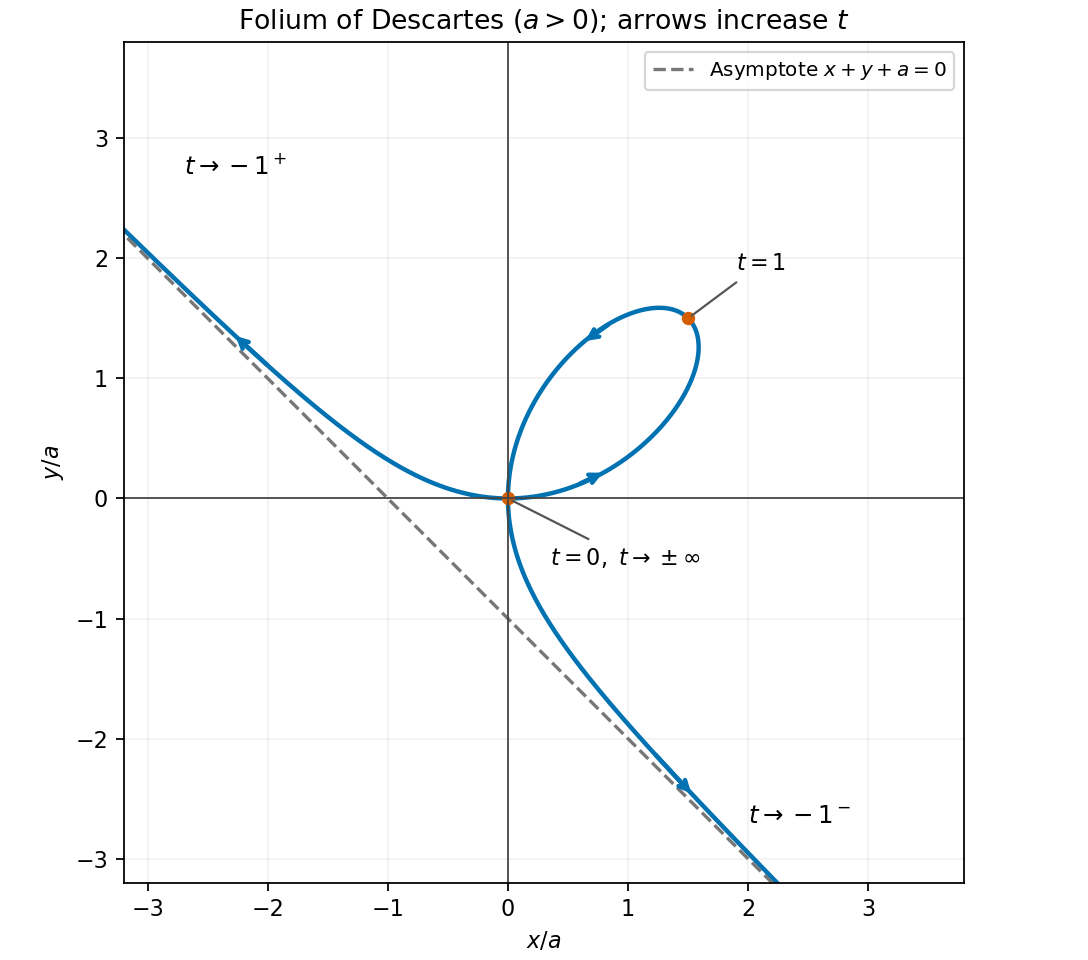

This is the folium of Descartes. If , the parametrization degenerates to the origin for every defined parameter value and there is no nontrivial loop.
Past exam of the mathematics course of the year 1 of the natural sciences course of the University of Cambridge 2016 Paper 2 12 e Solution by Codex 0 2026-10-18
Codex 0 2026-10-18The upward orientation of corresponds to traversing the boundary from the apex to the starting rim, around the rim in increasing azimuth, and back to the apex. This is the indicated orientation and is outward from the solid. Integrate that vector area element directly:The radial integrals are in the horizontal components and in the vertical component. Hence the vector area isThe absolute value is needed only because the original statement permits negative . Reversing the boundary orientation reverses the entire vector. For a full rotation the horizontal components cancel, leaving , the signed projected area of the base.
Past exam of the mathematics course of the year 1 of the natural sciences course of the University of Cambridge 2016 Paper 2 12 d Solution by Codex 0 2026-10-18
Codex 0 2026-10-18 Past exam of the mathematics course of the year 1 of the natural sciences course of the University of Cambridge 2016 Paper 2 12 c Solution by Codex 0 2026-10-18
Codex 0 2026-10-18Use the embedded surface parametrizationIts tangent vectors have cross productwhose magnitude is . Thus the surface area isWith , the radial integral becomes . Evaluating its endpoints givesThis is the scalar-area part of the paraboloid sector surface measures.
Past exam of the mathematics course of the year 1 of the natural sciences course of the University of Cambridge 2016 Paper 2 12 b Solution by Codex 0 2026-10-18
Codex 0 2026-10-18The volume element in cylindrical coordinates is . Integrating from the base to the curved surface givesHenceFor a complete rotation this is half the volume of the enclosing cylinder.
Past exam of the mathematics course of the year 1 of the natural sciences course of the University of Cambridge 2016 Paper 2 12 a Solution by Codex 0 2026-10-18
Codex 0 2026-10-18Put so that the radial range respects the stated allowance . With the azimuth measured from the starting meridian, the cylindrical coordinates of the curved surface satisfyAt all azimuths describe the same apex. The surface is a sector of an elliptic paraboloid.
Past exam of the mathematics course of the year 1 of the natural sciences course of the University of Cambridge 2016 Paper 2 11 d Solution by Codex 0 2026-10-18
Codex 0 2026-10-18The opposite face lies in the plane spanned by through the origin. Directly,The distance from a point to a plane is the absolute normal component, soHere , so the perpendicular foot is the origin, a vertex of the opposite triangular face. Thus the distance to the actual face equals the distance to its containing plane.
Past exam of the mathematics course of the year 1 of the natural sciences course of the University of Cambridge 2016 Paper 2 11 c Solution by Codex 0 2026-10-18
Codex 0 2026-10-18Set . Since these vectors form a basis, write . The reciprocal basis givesA point is in the closed tetrahedron precisely when it is a convex combination of the four vertices, with weights . Thus the necessary and sufficient conditions areThese four half-spaces are the four inward sides of its faces. This is tetrahedron membership via scalar triple products; making all inequalities strict describes the interior.
Past exam of the mathematics course of the year 1 of the natural sciences course of the University of Cambridge 2016 Paper 2 11 b Solution by Codex 0 2026-10-18
Codex 0 2026-10-18Take two edge vectors in the face, and . Their cross product is the face normal vectorThe face plane is . Every term in except vanishes, givingThe scalar triple product is nonzero, so this normal cannot vanish.
Past exam of the mathematics course of the year 1 of the natural sciences course of the University of Cambridge 2016 Paper 2 10 b Solution by Codex 0 2026-10-18
Codex 0 2026-10-18The gradient vanishes at the origin. Its Hessian matrix there iswith eigenvalues and . The quadratic term is therefore indefinite, so the origin is a saddle point of a scalar function. Equivalently, the leading term is positive along and negative along .
Past exam of the mathematics course of the year 1 of the natural sciences course of the University of Cambridge 2016 Paper 2 10 a Solution by Codex 0 2026-10-18
Codex 0 2026-10-18In a multivariable Taylor series, order means total degree. The only nonzero monomial of total degree at most three is ; there are no constant, linear, or cubic terms. Thusnear the origin.
Past exam of the mathematics course of the year 1 of the natural sciences course of the University of Cambridge 2016 Paper 1 7 b Solution by Codex 0 2026-10-18
Codex 0 2026-10-18Additivity of the definite integral combines the adjacent intervals into . For an integer , the power rule givesFor , interpret the indexed sum as an empty sum, equal to zero; the displayed expression also gives zero. This convention resolves the otherwise degenerate endpoint of the stated nonnegative-integer range.
Past exam of the mathematics course of the year 1 of the natural sciences course of the University of Cambridge 2016 Paper 1 7 a Solution by Codex 0 2026-10-18
Codex 0 2026-10-18The derivative of is . The chain rule therefore givesThe antiderivative applies on any interval containing no zero of .
There are unlisted articles, also show them or only show them.