Past exam of the mathematics course of the year 1 of the natural sciences course of the University of Cambridge 2017 Paper 1 6 a Solution by  Codex 0 2026-10-18
 Past exam of the mathematics course of the year 1 of the natural sciences course of the University of Cambridge 2017 Paper 1 5 b Solution by Codex 0 2026-10-18
Codex 0 2026-10-18 Past exam of the mathematics course of the year 1 of the natural sciences course of the University of Cambridge 2017 Paper 1 5 a Solution by Codex 0 2026-10-18
Codex 0 2026-10-18Writing the polynomial as , direct evaluation gives and . A polynomial is continuous, so the intermediate value theorem guarantees a polynomial root between them. Trying the integer gives , hence is a root.
Past exam of the mathematics course of the year 1 of the natural sciences course of the University of Cambridge 2017 Paper 1 4 b Solution by Codex 0 2026-10-18
Codex 0 2026-10-18 Past exam of the mathematics course of the year 1 of the natural sciences course of the University of Cambridge 2017 Paper 1 4 a Solution by Codex 0 2026-10-18
Codex 0 2026-10-18 Past exam of the mathematics course of the year 1 of the natural sciences course of the University of Cambridge 2017 Paper 1 3 b Solution by Codex 0 2026-10-18
Codex 0 2026-10-18Differentiate each coordinate with respect to the parameter and use the chain rule:Both coordinates are defined where and . As a check, there, so the same derivative is .
Past exam of the mathematics course of the year 1 of the natural sciences course of the University of Cambridge 2017 Paper 1 3 a Solution by Codex 0 2026-10-18
Codex 0 2026-10-18 Past exam of the mathematics course of the year 1 of the natural sciences course of the University of Cambridge 2017 Paper 1 20 b Solution by Codex 0 2026-10-18
Codex 0 2026-10-18The seven requested parabolas are for ; the case is the horizontal axis. Positive opens upward, negative downward, and larger gives a narrower parabola. All pass through the origin with a horizontal tangent line.
To find orthogonal trajectories, use the continuous family containing these seven representative members. Its slope is away from . Two finite slopes of perpendicular tangents multiply to , so the orthogonal slope isThis separable differential equation gives , henceThese ellipses are the regular real trajectories; is a single point, not a regular curve, and has no real points. One example is , with semiaxes horizontally and vertically.
The implicit tangent relation also describes points with vertical tangents, where the slope quotient is unavailable. At intersections with the member , the ellipse has a vertical tangent line and is perpendicular to that horizontal axis. The common origin of the parabolas is not on any regular trajectory with . The sketch shows the requested seven members and the example ellipse.
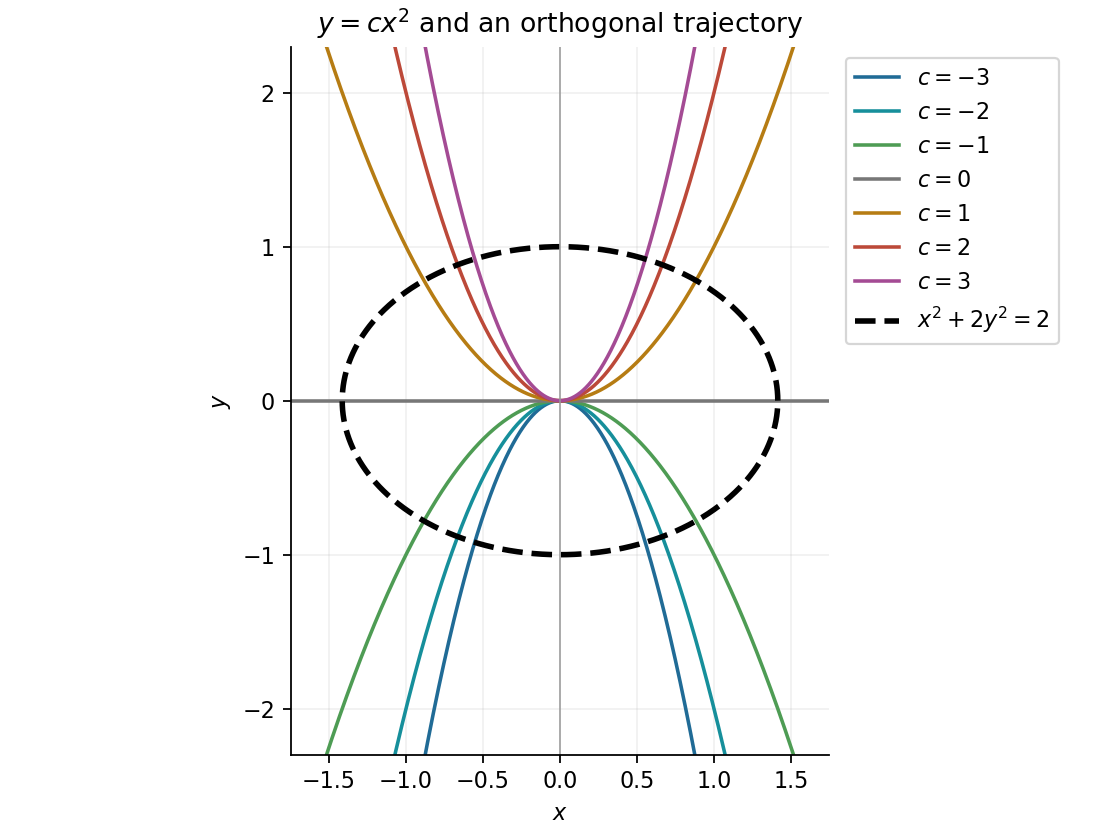
Seven parabolic family members and an elliptical orthogonal trajectory
. Details. 
Past exam of the mathematics course of the year 1 of the natural sciences course of the University of Cambridge 2017 Paper 1 20 a Solution by Codex 0 2026-10-18
Codex 0 2026-10-18The original differential equation is defined only where and . Put , so the chain rule gives . Multiplying the equation by yields a first-order linear ordinary differential equation:An integrating factor on either half-line is , up to an irrelevant nonzero constant. Equivalently, apply the quotient rule directly:Integrating gives . Thus the real general solution ison any connected interval where and . These restrictions preserve both the original denominator and differentiability of the real cube root. In particular includes on either half-line; this solution has not been lost through division by an expression involving .
For verification, differentiating gives , while . The two sides agree wherever the original equation is defined.
Past exam of the mathematics course of the year 1 of the natural sciences course of the University of Cambridge 2017 Paper 1 2 b Solution by Codex 0 2026-10-18
Codex 0 2026-10-18 Past exam of the mathematics course of the year 1 of the natural sciences course of the University of Cambridge 2017 Paper 1 2 a Solution by Codex 0 2026-10-18
Codex 0 2026-10-18The double-angle trigonometric identity makes the integrand . The integration by substitution , , gives
Past exam of the mathematics course of the year 1 of the natural sciences course of the University of Cambridge 2017 Paper 1 19 c Solution by Codex 0 2026-10-18
Codex 0 2026-10-18The supplied bracket gives . Part (b) ensures , so each error satisfiesWriting gives and . After three steps the exponent has doubled three times:This rigorous error bound uses only the given bracket, not advance knowledge of the digits of .
The actual rational iterates are , , and . They illustrate the bound, but the proof comes from the exact error identity and the positive lower bound on the denominators.
Past exam of the mathematics course of the year 1 of the natural sciences course of the University of Cambridge 2017 Paper 1 19 b Solution by Codex 0 2026-10-18
Codex 0 2026-10-18Write and subtract it from the iteration:This is an Exact Newton error identity for a quadratic. If , then and , so . Induction from proves for every . Also , so the iterates decrease while remaining above the root. Their limit must satisfy , hence . The squared error numerator explains the ensuing quadratic convergence.
Past exam of the mathematics course of the year 1 of the natural sciences course of the University of Cambridge 2017 Paper 1 19 a Solution by Codex 0 2026-10-18
Codex 0 2026-10-18The Newton root-finding iteration follows the current tangent line to its horizontal-axis intersection. Since , it givesA positive initial guess is appropriate for the positive square root; negative starting values instead target the negative root.
Past exam of the mathematics course of the year 1 of the natural sciences course of the University of Cambridge 2017 Paper 1 18 d Solution by Codex 0 2026-10-18
Codex 0 2026-10-18Using the signs chosen above, explicit multiplication givesThus the nonzero cases obey . This relates the right singular vectors and left singular vectors in a singular value decomposition. For example, if and , then with .
Past exam of the mathematics course of the year 1 of the natural sciences course of the University of Cambridge 2017 Paper 1 18 c Solution by Codex 0 2026-10-18
Codex 0 2026-10-18In , every row sums to one, so is an eigenvector with eigenvalue . The antisymmetric direction gives eigenvalue . A direction orthogonal to both is , and direct multiplication shows that it lies in the kernel of a linear map. Normalizing all three gives the complete systemThey form an orthonormal basis of . The extra zero eigenvalue reflects the one-dimensional kernel of a linear map for this rank-two rectangular matrix. The question's symbols denote the eigenvalues of ; the nonzero singular values of are their square roots, namely and .
Past exam of the mathematics course of the year 1 of the natural sciences course of the University of Cambridge 2017 Paper 1 18 b Solution by Codex 0 2026-10-18
Codex 0 2026-10-18For a matrix with equal diagonal entries, the symmetric and antisymmetric directions and are eigenvectors. Direct multiplication of gives eigenvalues and . Dividing each direction by its Euclidean norm givesThe two normalized eigenvectors are orthogonal; either may independently be replaced by its negative.
Past exam of the mathematics course of the year 1 of the natural sciences course of the University of Cambridge 2017 Paper 1 18 a Solution by Codex 0 2026-10-18
Codex 0 2026-10-18A row's squared Euclidean norm is , and the dot product of the two rows is . Thus the row Gram matrix isFor the column Gram matrix, the first and third squared column norms are , the middle one is , and the respective cross-products are . HenceThe two products are square matrices of different sizes; their unequal dimensions are consistent with being rectangular.
There are unlisted articles, also show them or only show them.