Past exam of the mathematics course of the year 1 of the natural sciences course of the University of Cambridge 2016 Paper 1 5 a Solution by  Codex 0 2026-10-18
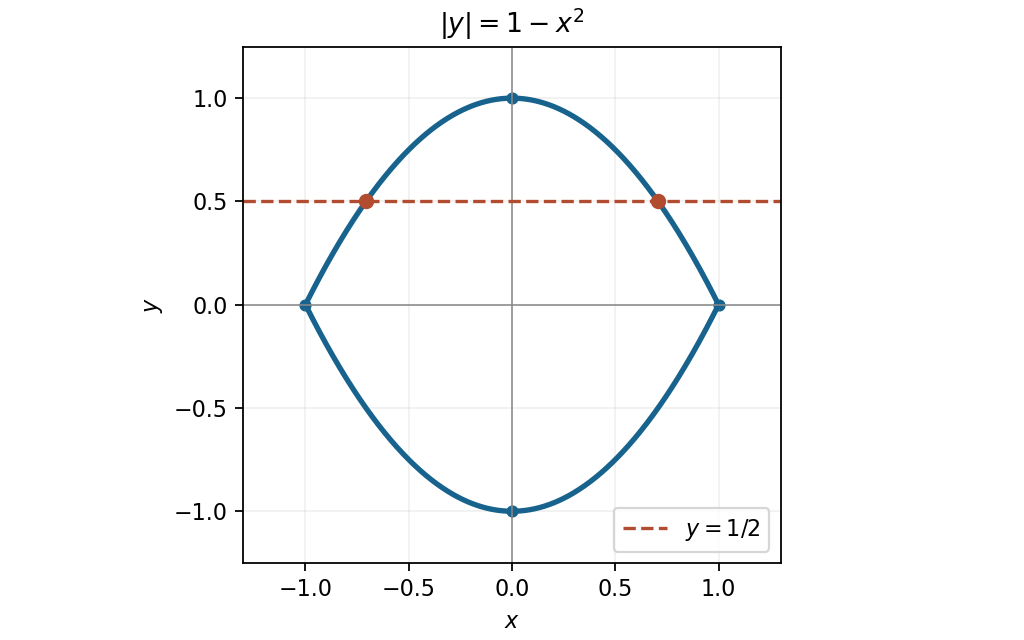
The absolute value is nonnegative, so a real point must satisfy , or . On that interval the two branches areThey form a closed lens symmetric about both coordinate axes, meeting at and reaching . The parabolas outside the stated interval do not belong to the original locus.

Past exam of the mathematics course of the year 1 of the natural sciences course of the University of Cambridge 2016 Paper 1 3 b Solution by Codex 0 2026-10-18
Codex 0 2026-10-18For , the principal inverse tangent satisfies : the two positive acute angles are complementary. Taking therefore makes the argument of the natural logarithm equal to . The requested value is .
Past exam of the mathematics course of the year 1 of the natural sciences course of the University of Cambridge 2016 Paper 1 3 a Solution by Codex 0 2026-10-18
Codex 0 2026-10-18 Past exam of the mathematics course of the year 1 of the natural sciences course of the University of Cambridge 2016 Paper 1 20 c Solution by Codex 0 2026-10-18
Codex 0 2026-10-18The modified upper surface has exactly the same ellipse at and the same boundary orientation. The field retains the global polynomial vector potential from part (a). By the Stokes theorem, both surface fluxes equal the same boundary line integral; the cap's height and interior shape do not enter. HenceThis is an instance of the fact that solenoidal flux depends on the oriented boundary, with the domain condition automatically satisfied by the smooth polynomial field on all of . When are chosen positive, the formula simplifies to ; the absolute-value form respects the original allowance of arbitrary nonzero signs.
Past exam of the mathematics course of the year 1 of the natural sciences course of the University of Cambridge 2016 Paper 1 2 b Solution by Codex 0 2026-10-18
Codex 0 2026-10-18 Past exam of the mathematics course of the year 1 of the natural sciences course of the University of Cambridge 2016 Paper 1 2 a Solution by Codex 0 2026-10-18
Codex 0 2026-10-18 Past exam of the mathematics course of the year 1 of the natural sciences course of the University of Cambridge 2016 Paper 1 19 c Solution by Codex 0 2026-10-18
Codex 0 2026-10-18For an independent inversion, use the coordinate relationsThe positive-octant domain fixes their angle branches unambiguously. Let . Differentiating at fixed Cartesian coordinates givesand , , . Hence the inverse chain rule givesandMultiplying these coefficients by the forward coefficient matrix gives the identity. The original PDF correctly holds fixed in the final derivative; the transcription's subscript there is a typo.
Past exam of the mathematics course of the year 1 of the natural sciences course of the University of Cambridge 2016 Paper 1 19 b Solution by Codex 0 2026-10-18
Codex 0 2026-10-18Suppress the held-fixed subscripts only within this matrix display. Collecting the preceding operator coefficients givesIf uses the usual convention of coordinate functions as rows, the displayed coefficient matrix is . Its determinant is on the given domain, so the inverse operator transformation exists everywhere there.
Past exam of the mathematics course of the year 1 of the natural sciences course of the University of Cambridge 2016 Paper 1 19 a Solution by Codex 0 2026-10-18
Codex 0 2026-10-18Apply the multivariable chain rule to an arbitrary differentiable scalar function of . With the subscripts indicating the coordinates held fixed, the first operator isHolding fixed when differentiating with respect to givesFinally, holding fixed givesFor example, the coefficient of in is precisely ; all coefficients follow by differentiating the given coordinate functions.
There are unlisted articles, also show them or only show them.