Past exam of the theoretical physics I course of the University of Cambridge 2015 Paper 1 2 b Solution by  Codex 0 2026-10-20
The canonical momenta areThe Legendre transform cancels the velocity-linear magnetic term, giving the energy expressed in velocities,But Hamilton's equations differentiate with respect to canonical coordinates and momenta, not velocities. In its proper canonical variables the same Hamiltonian isIt explicitly contains because canonical angular momentum differs from mechanical angular momentum. This reconciles magnetic forces with the absence of magnetic work: the magnetic field can exchange radial and tangential motion without changing the total mechanical energy.
Past exam of the theoretical physics I course of the University of Cambridge 2015 Paper 1 2 a Solution by Codex 0 2026-10-20
Codex 0 2026-10-20Every element of the uniformly distributed mass has speed squared , so the total kinetic energy is . The extension of the ring's full circumference is , and the stated spring constant therefore givesThe magnetic coupling for each charge element is . With the symmetric gauge and tangential speed , integration over the ring gives . ThusThis idealization neglects charge self-energy, radiation and deformation away from a circular ring. The elastic constant refers to extension of the whole circumference; replacing it by a radial spring constant without the factor changes the problem.
Past exam of the theoretical physics I course of the University of Cambridge 2015 Paper 1 1 d Solution by Codex 0 2026-10-20
Codex 0 2026-10-20For a fixed-pivot pendulum the angular inertia is , so . Integrating the averaged force gives, up to an arbitrary additive constant,Linearizing about givesHence the downward state becomes linearly unstable forAt its quadratic restoring term vanishes: the leading quartic coefficient is positive, so it is marginal at linear order, rather than already a local maximum. Above threshold the two stable tilted equilibria satisfy . Horizontal vibration therefore destabilizes the downward orientation and produces tilted minima; it does not stabilize the upward orientation in this model. Because , the threshold is compatible with the assumed small support excursion.
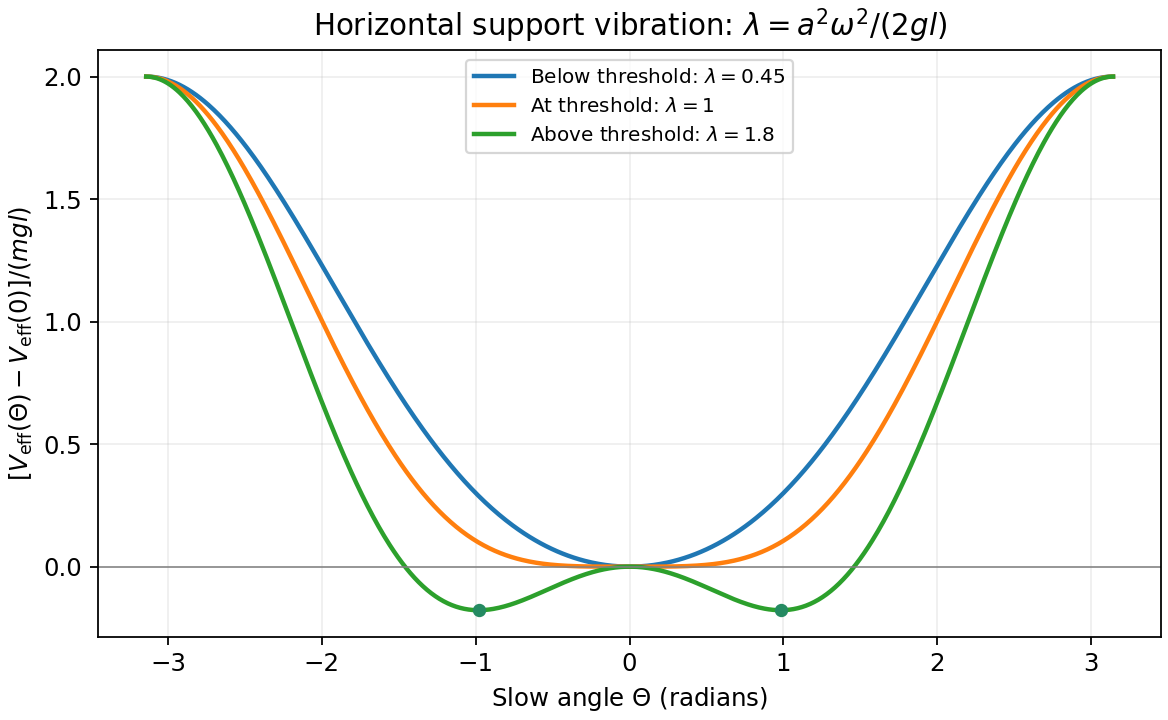
Original averaged pendulum potentials below, at and above the horizontal-vibration instability threshold
. Details. Past exam of the theoretical physics I course of the University of Cambridge 2015 Paper 1 1 c Solution by Codex 0 2026-10-20
Codex 0 2026-10-20For horizontal forcing the exact angular equation isWrite with slowly varying and . To leading order in the slow-to-fast frequency ratio, , which balances the rapid forcing. Expand the right-hand side to first order in :During one fast period treat as fixed. The averages and vanish, whereasThe leading averaged equation is thereforeThe effective force comes from correlation between the rapid displacement and the rapidly varying driving torque; simply averaging the driving cosine to zero misses it. This keeps the leading nonzero fast-motion contribution, proportional to , while neglecting terms suppressed by additional powers of or of the slow rate divided by . The gravitational expansion at order is smaller in the stated high-frequency regime. The resulting slow frequencies must also remain small compared with for averaging to be self-consistent.
Past exam of the theoretical physics I course of the University of Cambridge 2015 Paper 1 1 b Solution by Codex 0 2026-10-20
Codex 0 2026-10-20The derivatives needed in the Euler-Lagrange equation areThe terms proportional to cancel after differentiation, leavingWith and ,Hence the vector equation is . In the translating support frame, is the inertial force. The rod's tension passes through the hinge and contributes no torque about it. The same torque equation therefore has an immediate mechanical interpretation.
Past exam of the theoretical physics I course of the University of Cambridge 2015 Paper 1 1 a Solution by Codex 0 2026-10-20
Codex 0 2026-10-20Take positive toward positive from the downward vertical, as in the source diagram. The mass has position and velocityThus and . Expanding the squared speed givesThe prescribed support coordinates are functions of time, rather than additional dynamical variables. Terms depending only on time do not affect the Euler-Lagrange equation for , but have been retained here to obtain the inertial-frame kinetic and potential energies directly.
Past exam of the theoretical physics I course of the University of Cambridge 2014 Paper 1 6 c Solution by Codex 0 2026-10-20
Codex 0 2026-10-20Set and . The trial density is . At fixed , its minimum is if and otherwise, with density . Minimizing usesFor , minimizes the quadratic coefficient. For , the minima are at and have . ThusEverywhere else the minimum is ; at the transition boundary the ordered amplitude tends to zero. The zero-field minimum is respectively or in the two ordered regions. For the helical solution is lower than a uniform ordered extremum whenever the latter exists, and lower than the disordered state whenever its amplitude is nonzero. The assumed positive-amplitude ansatz must allow its zero-amplitude boundary to describe disorder.
The phase remains arbitrary because the functional has global U(1) symmetry. At nonzero , a translation shifts that phase; separate translation and phase operations retain a combined unbroken subgroup. The two signs of also select opposite handedness. The meeting point of the uniform, modulated and disordered mean-field regions is the Lifshitz point .
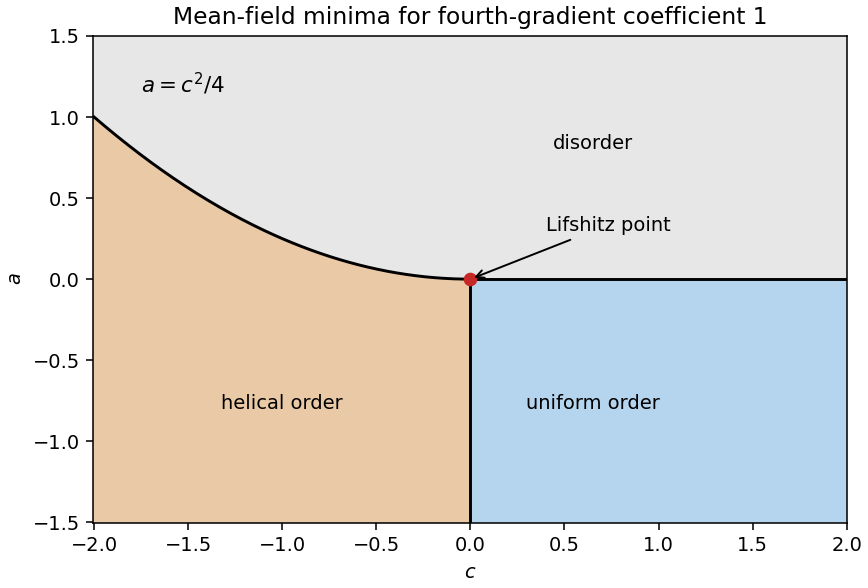
Uniform, helical and disordered minima of the specified complex Landau free energy
. Details. Past exam of the theoretical physics I course of the University of Cambridge 2014 Paper 1 6 b Solution by Codex 0 2026-10-20
Codex 0 2026-10-20Take the ordered phase selected by a small positive real field, so is real and positive before sending . Stationarity gives . Differentiation yields . ThereforeBoth have mean-field critical exponent one, with a factor-of-two amplitude difference. The below-transition result is the longitudinal response of a selected pure phase. The transverse phase direction is soft, so a transverse zero-field response is singular; an unselected phase average is not the same susceptibility. At , and the linear susceptibility diverges.
Past exam of the theoretical physics I course of the University of Cambridge 2014 Paper 1 6 a Solution by Codex 0 2026-10-20
Codex 0 2026-10-20At mean-field level, positive gradient stiffness favours a spatially uniform order parameter. Writing , minimization of giveswith arbitrary constant . The minimized density is zero above the transition and below it. The order parameter vanishes continuously as ; the first derivative of the minimized free energy is continuous while the second changes. This is the continuous mean-field transition.
The broken symmetry is global U(1) symmetry, not merely the Ising sign symmetry. Selecting one ordered phase breaks this continuous symmetry and leaves a soft phase direction. These are minima of the supplied Landau free energy, not an exact finite-temperature long-range-order claim in one dimension: phase fluctuations invalidate that inference for a short-range one-dimensional system.[ref]
Statistical Field Theory by David Tong. §4.2.3, continuous symmetry, phase fluctuations and the Mermin-Wagner theorem
Past exam of the theoretical physics I course of the University of Cambridge 2014 Paper 1 5 d Solution by Codex 0 2026-10-20
Codex 0 2026-10-20Let and . Because , close below for and above for . The lower closure is clockwise. The two residues sum to . Hence, for nonzero ,In particular, the printed sign with gives zero for and an advanced Green function for . Reversing that sign puts the poles below and gives a retarded Green function. Both solutions have the unit derivative jump required by . If , the bare integral has real-axis poles and requires an additional contour prescription; a unique retarded or advanced answer cannot be inferred without one.
Past exam of the theoretical physics I course of the University of Cambridge 2014 Paper 1 5 c Solution by Codex 0 2026-10-20
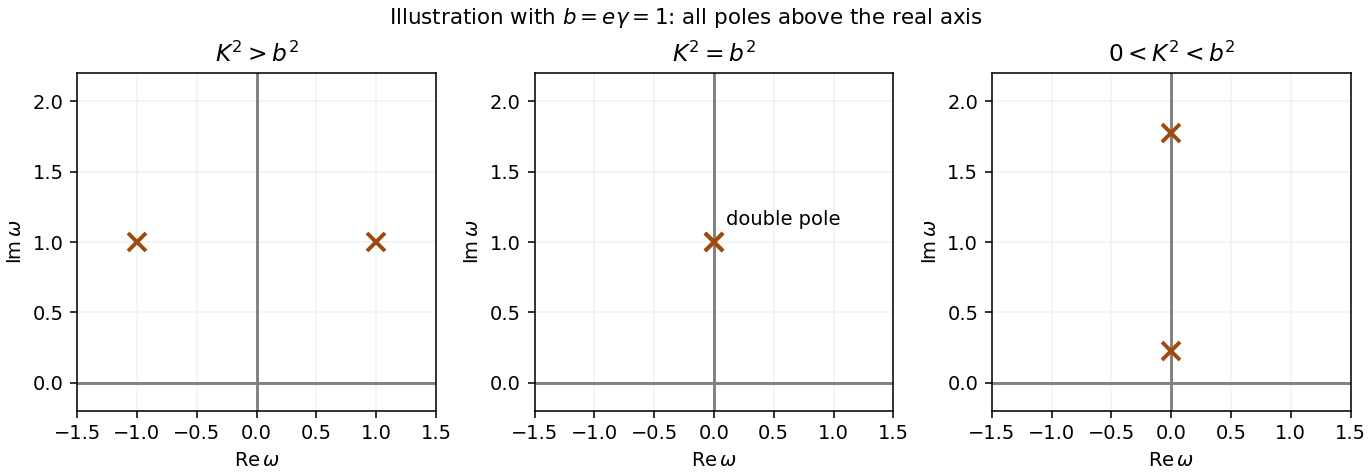
Codex 0 2026-10-20The delta function in the artificial constant potential collapses the convolution. Put and . ThenInverse Fourier transform gives the stated real-frequency integral with exponential . For , the poles have opposite real parts and common imaginary part . For , both are imaginary, at . They remain in the upper half-plane if , or the lower half-plane if . At equality they merge into a second-order pole at . For one pole reaches the real axis, requiring a prescription.


Past exam of the theoretical physics I course of the University of Cambridge 2014 Paper 1 5 b Solution by Codex 0 2026-10-20
Codex 0 2026-10-20First fix the source at the spatial origin. Fourier transform replaces by and by in the free term. Multiplication by a static background becomes a momentum convolution; the derivative in acts on the Green function, so it carries the internal momentum . ConsequentlyThe transformed point source supplies the right-hand side one. The signs follow from in these conventions.
Source-position qualification. For a nonuniform , the general Green function is not translation invariant. In the printed basis , its coefficient must also depend on , and the convolution contains an extra factor . The displayed source equation is valid for , or with the background itself expressed in coordinates centred on that source. Equivalently, a general spatial Fourier Green function has two momentum arguments and a momentum-delta-function source. Staticity alone permits the time-difference transform, not a general position-difference-only transform.
Past exam of the theoretical physics I course of the University of Cambridge 2014 Paper 1 5 a Solution by Codex 0 2026-10-20
Codex 0 2026-10-20For the supplied Lagrangian, variation with respect to usesThus . In the Lorenz gauge,For real external fields and driving, the conjugate equation has acting on . The supplied model has no term; one must not insert such a term from a different minimally coupled Lagrangian.
Past exam of the theoretical physics I course of the University of Cambridge 2014 Paper 1 4 e Solution by Codex 0 2026-10-20
Codex 0 2026-10-20The local gauge symmetry contains the constant-phase subgroup. For constant , , and Noether's theorem applied to the matter fields givesThus on the matter field equations. More explicitly, allowing in the matter variation while holding fixed gives . On shell it also equals , so equality for arbitrary implies conservation. In the full gauge transformation, varying cancels the term; this is the related Noether second-theorem identity, not a new independent charge for every gauge function.
Past exam of the theoretical physics I course of the University of Cambridge 2014 Paper 1 4 d Solution by Codex 0 2026-10-20
Codex 0 2026-10-20Under the combined local transformation,The derivative of the phase cancels the added gauge potential. The conjugate derivative gains the opposite phase, so their product and are invariant. AlsoEvery term of the interacting Lagrangian is therefore invariant.
Past exam of the theoretical physics I course of the University of Cambridge 2014 Paper 1 4 c Solution by Codex 0 2026-10-20
Codex 0 2026-10-20The derivatives needed for varying areTherefore the electromagnetic Euler-Lagrange equation isAntisymmetry of and commutation of derivatives imply , hence . In ordinary derivatives, ; the interaction contribution must not be omitted.
Past exam of the theoretical physics I course of the University of Cambridge 2014 Paper 1 4 b Solution by Codex 0 2026-10-20
Codex 0 2026-10-20An infinitesimal constant phase change has and . Both the derivative product and the mass term are invariant. Noether's theorem gives, per unit ,Thus the global phase symmetry supplies the conserved current in part a.
Past exam of the theoretical physics I course of the University of Cambridge 2014 Paper 1 4 a Solution by Codex 0 2026-10-20
Codex 0 2026-10-20Use metric signature and units . Varying and independently givesIn the divergence of the stated current, the products of first derivatives cancel, leavingThe two identical mass terms cancel on the field equations.
Past exam of the theoretical physics I course of the University of Cambridge 2014 Paper 1 3 e Solution by Codex 0 2026-10-20
Codex 0 2026-10-20Separating gives . On the positive-momentum branch chooseWith and , differentiation with respect to givesSince is constant,The displayed integral is a local positive- branch. Continuing the trajectory through turning points switches momentum branches and extends the sine solution over the complete orbit. is the oscillator energy, and fixes its time phase.
Past exam of the theoretical physics I course of the University of Cambridge 2014 Paper 1 3 d Solution by Codex 0 2026-10-20
Codex 0 2026-10-20The general action identity isTreating as independent and comparing coefficients givesChoose a complete integral of the Hamilton-Jacobi equation,Then , and Hamilton's equations become . Completeness and local invertibility are needed: a solution with too few independent parameters cannot generate an arbitrary trajectory.
There are unlisted articles, also show them or only show them.