Past exam of the theoretical physics II course of the University of Cambridge 2014 Paper 1 4 a Solution by  Codex 0 2026-10-20
With , the normalized canonical density operator isIts eigenvalues are the Boltzmann probabilities and its trace is one.
Past exam of the theoretical physics II course of the University of Cambridge 2014 Paper 1 3 d Solution by Codex 0 2026-10-20
Codex 0 2026-10-20Choose the polar axis along . ThenUsing the angular interference integral for two point scatterers, integrating the two self terms and the interference terms givesFor , the amplitudes add coherently and ; when the angle-integrated interference is suppressed. These limits hold for fixed incoming direction; no incoming-orientation average has been silently imposed.
Past exam of the theoretical physics II course of the University of Cambridge 2014 Paper 1 3 c Solution by Codex 0 2026-10-20
Codex 0 2026-10-20At large , . Retain the displacement in the phase, but replace the denominator by . ThereforeThe differential scattering cross-section is for elastic scattering with this unit incident plane-wave normalization. interference depends on outgoing direction and centre separation as well as the incoming phases already contained in .
Past exam of the theoretical physics II course of the University of Cambridge 2014 Paper 1 3 b Solution by Codex 0 2026-10-20
Codex 0 2026-10-20Put , and . In the range-to-wavelength overlap region around centre , the outgoing wave's singular and constant terms are . Matching their ratio to the Bethe-Peierls boundary condition yieldsDefine and . Solving the coupled system givesThis is the two-centre scattering-length model result, retaining the outgoing-wave term and all repeated exchange between the two centres. If terms of order are neglected in the local matching, set in these formulae; if also , set and . Away from a vanishing denominator this gives and its exchanged partner. The isolated-centre limit is . Finite-range corrections require additional effective-range data, not supplied here.
Past exam of the theoretical physics II course of the University of Cambridge 2014 Paper 1 3 a Solution by Codex 0 2026-10-20
Codex 0 2026-10-20For an interaction of finite range , higher partial waves are suppressed at by the centrifugal barrier, away from exceptional higher-wave resonances. Outside the potential, the zero-energy radial S-wave scattering equation is , where . Its solution is proportional to , so normalization of the constant term givesThe scattering length is the extrapolated zero of . At nonzero small , this form applies in the overlap region ; it is not the far-field limit at fixed . Equivalently, and .
Past exam of the theoretical physics II course of the University of Cambridge 2014 Paper 1 2 e Solution by Codex 0 2026-10-20
Codex 0 2026-10-20Take in the supplied Poisson summation identity, initially with a convergent regulator. Its left side is the winding sum. Multiplying its right side by the prefactor in part d givesConsequentlyRelabelling gives exactly the spectral answer. The square-root branch is fixed by continuation from positive imaginary-time damping; the limiting kernel has the required periodic delta-function normalization.
Past exam of the theoretical physics II course of the University of Cambridge 2014 Paper 1 2 d Solution by Codex 0 2026-10-20
Codex 0 2026-10-20The angular action is . In each winding sector, write with zero at both endpoints. The cross term vanishes and the Gaussian fluctuation integral is the free-particle prefactor with mass replaced by . ThusEquivalently, multiply the line kernel for displacement by to change its measure from arc length to angle. The quadratic action makes the classical-path sum exact, rather than merely a stationary phase approximation. Real-time sums are understood with the usual negative imaginary part of and its boundary limit.
Past exam of the theoretical physics II course of the University of Cambridge 2014 Paper 1 2 c Solution by Codex 0 2026-10-20
Codex 0 2026-10-20Lift the circle to its real-valued angular covering coordinate. The free classical equation is . For each winding number , the endpoint lift is , andPositive and negative windings are distinct classical paths with the same physical endpoints. Reducing the angle modulo returns their trajectories on the ring.
Past exam of the theoretical physics II course of the University of Cambridge 2014 Paper 1 2 b Solution by Codex 0 2026-10-20
Codex 0 2026-10-20Let , , and . Periodic angular wave functions have modes with integer and energies . Normalizing the kernel with respect to givesIf the integration measure is arc length , the corresponding kernel is . This measure choice accounts for the otherwise ambiguous radius prefactor.
Past exam of the theoretical physics II course of the University of Cambridge 2014 Paper 1 2 a Solution by Codex 0 2026-10-20
Codex 0 2026-10-20The quantum propagator is the position-space kernel of the time-evolution operator: . For a time-independent Quantum Hamiltonian, . Inserting a complete orthonormal energy eigenbasis givesA continuous spectrum requires the corresponding integral. At equal times, completeness makes this kernel a Dirac delta function.
Past exam of the theoretical physics II course of the University of Cambridge 2014 Paper 1 1 d Solution by Codex 0 2026-10-20
Codex 0 2026-10-20For first-order excitation in a linearly expanding infinite well, retain only the ground-state amplitude on the right. For the second level, the coupling coefficient is . With ,The relative dynamical phase is plus a constant. Up to an irrelevant phase,The lower endpoint is an oscillatory improper limit: substituting gives . A physical initial state cannot occupy a zero-width well. Prepare the ground state at , integrate from , and then take the formal limit of the probability. For , endpoint asymptotics give ; the first-order expression is reliable only while total excitation remains small.
Past exam of the theoretical physics II course of the University of Cambridge 2014 Paper 1 1 c Solution by Codex 0 2026-10-20
Codex 0 2026-10-20Use normalized instantaneous modes and expand . Differentiating at fixed givesFor , integration usesso the moving-wall derivative coupling isFor the normalization derivative and the remaining integral cancel exactly, giving zero. The moving integration endpoint contributes no boundary term because every mode vanishes there. ThereforeThe real coupling matrix is antisymmetric, as required by conservation of total probability.
Past exam of the theoretical physics II course of the University of Cambridge 2014 Paper 1 1 b Solution by Codex 0 2026-10-20
Codex 0 2026-10-20Set . Differentiating the expansion produces for each term. The energy term cancels in the Schrödinger equation. Projecting the remainder with and using orthonormality yieldsThe diagonal term is purely imaginary and supplies the geometric phase. Off-diagonal instantaneous eigenstate couplings transfer population; differentiating the eigenvalue equation gives when the levels are distinct.
Past exam of the theoretical physics II course of the University of Cambridge 2014 Paper 1 1 a Solution by Codex 0 2026-10-20
Codex 0 2026-10-20An initially occupied, isolated instantaneous energy eigenstate follows its changing eigenspace, acquiring a dynamical phase and generally a Berry phase. For smooth nondegenerate evolution, a useful local smallness condition isA nonvanishing spectral gap and suitably smooth, slow driving throughout the evolution are needed; the local inequality alone is not a universal long-time error bound. Gap closure invalidates the simple nondegenerate approximation. A separated degenerate eigenspace may mix internally even when transitions out of it are suppressed.
Past exam of the theoretical physics II course of the University of Cambridge 2013 Paper 1 6 d Solution by Codex 0 2026-10-20
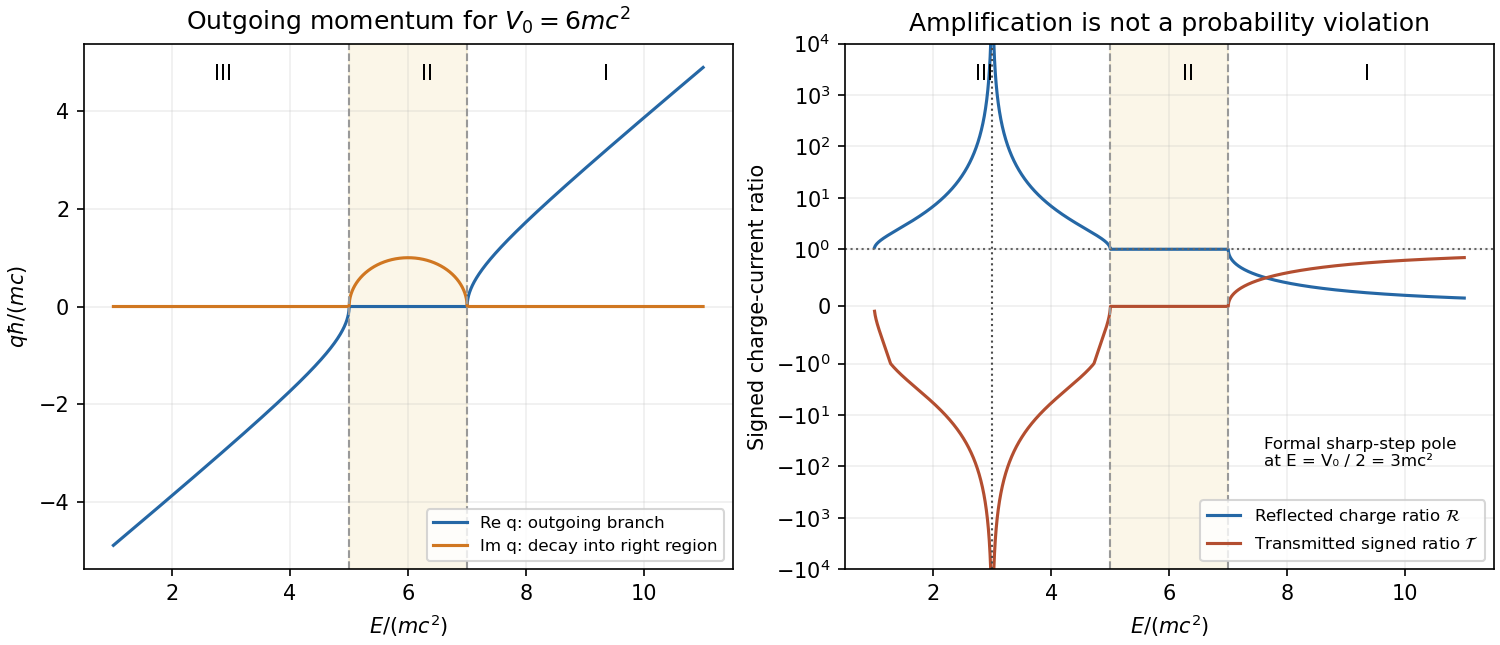
Codex 0 2026-10-20The negative-kinetic-energy branch is interpreted as an antiparticle channel. In the overlap , particles can escape to the left and oppositely charged antiparticles to the right. This interval exists only when . The external electrostatic source supplies the energy for pair creation; the reflected particle flux can exceed the incident one because the outgoing state need not contain only the incident particle.
The conserved quantity is signed charge current, not a positive one-particle probability in both regions. Negative denotes rightward transport of opposite charge, so it is consistent with and . A quantized charged field with particle and antiparticle creation operators gives the appropriate interpretation of this Klein paradox. This bosonic result must not be replaced by a fermionic reflection law or interpreted as a failure of charge conservation.[ref]
Klein Paradox for Spin-0 Particles by Douglas M. Gingrich. Discussion after equation 4.155: pair creation and the oppositely signed transmitted current
Past exam of the theoretical physics II course of the University of Cambridge 2013 Paper 1 6 c Solution by Codex 0 2026-10-20
Codex 0 2026-10-20Let . The outgoing analytic branch of Klein-Gordon step momentum iswhere each square root is continued from the upper half-plane. It behaves as at large positive or negative real . The branch points are ; replacing this product by a principal square root of can choose the wrong sign below the lower threshold.
I. For , and both transmitted kinetic energy and group velocity are positive. Thus and ; the transmission decreases to zero on approaching the upper threshold from above.
II. For , write with . The right wave decays, has modulus one, and . There is an evanescent tail but no flux transmitted to infinity. Its reflection quantum phase changes continuously between the two thresholds.
III. For , the analytic continuation gives , where . The group velocity is again rightward, while the charge density and transmitted charge current are negative. ThereforeChoosing would describe a wavepacket arriving from the right, inconsistent with the chosen incoming channel. As the lower threshold is approached, and from above. This Klein-Gordon step amplification has a real denominator zero at when : there , and no finite stationary solution with unit incoming amplitude satisfies both matching equations. The resulting formal pole must not be described as an infinite single-particle probability. Finite switching, wavepackets and the treatment of the external source require a multiparticle analysis.[ref]
Klein Paradox for Spin-0 Particles by Douglas M. Gingrich. Equations 4.142–4.155: outgoing negative-momentum branch, boundary matching and charge currents

Past exam of the theoretical physics II course of the University of Cambridge 2013 Paper 1 6 b Solution by Codex 0 2026-10-20
Codex 0 2026-10-20Assume a positive-energy incoming particle, , and a nonzero upward step . Set and . With the common time factor removed, take and . The right-hand wavenumber satisfies ; its physical branch is specified in part (c). Integrating the stationary equation across the finite step requires continuity of and , giving and . ThusThese are wave amplitudes, not flux probabilities. The Noether current of scalar electrodynamics, in a convenient common normalization for a stationary mode, is and . For a real , its charge-current ratios are and , with . The same statement uses for a decaying solution. The electrostatic potential couples through the time derivative; it is not a Lorentz-scalar mass shift. A zero step is recovered separately with , and .
Past exam of the theoretical physics II course of the University of Cambridge 2013 Paper 1 6 a Solution by Codex 0 2026-10-20
Codex 0 2026-10-20A constant electrostatic energy offset is removed locally by the quantum phase substitution , since . Therefore the two frequency branches becomeThe normalization uses the kinetic frequency , while the canonical energy eigenvalues are . The opposite-frequency branch is not obtained by replacing by the same shifted positive frequency in both terms. A globally constant offset produces no electric field, whereas different offsets on opposite sides of a step cannot be removed by a single smooth global phase.
Past exam of the theoretical physics II course of the University of Cambridge 2013 Paper 1 5 e Solution by Codex 0 2026-10-20
Codex 0 2026-10-20The literal printed difference is zero, because the same spin-index product appears twice, and zero is invariant under every transformation. The intended SU(2)-invariant antisymmetric spinor contraction uses opposite indices in the second term. With , define . For any two-by-two matrix,Thus for ,Expanding the determinant identity proves the result without complex conjugating either spinor. This is the invariant alternating tensor behind the spin singlet state. If the two spinors are identical, the contraction vanishes. An antisymmetric internal two-boson state also needs an antisymmetric additional degree of freedom for overall bosonic symmetry; it does not lie in the fully symmetric fixed-two-mode sector discussed above.
Past exam of the theoretical physics II course of the University of Cambridge 2013 Paper 1 5 d Solution by Codex 0 2026-10-20
Codex 0 2026-10-20The defining matrix conditions areThe group operation is matrix multiplication. Equivalently with real and , so it has three real parameters and is a compact connected simply connected Lie group. Its Hermitian spin generators obey the commutator from part (a); the corresponding Lie-algebra matrices themselves are traceless and anti-Hermitian.
There are unlisted articles, also show them or only show them.