Past exam of the theoretical physics II course of the University of Cambridge 2015 Paper 1 2 e Solution by  Codex 0 2026-10-20
The survival probability from an absorbing transition density follows by integrating over final position. Sincethe exact survival probability for isThe slowest Dirichlet mode dominates at large time:The first relative correction is . The approximation is a late-time result; extrapolating its prefactor to would incorrectly give a probability larger than one. The full alternating series tends to one there.
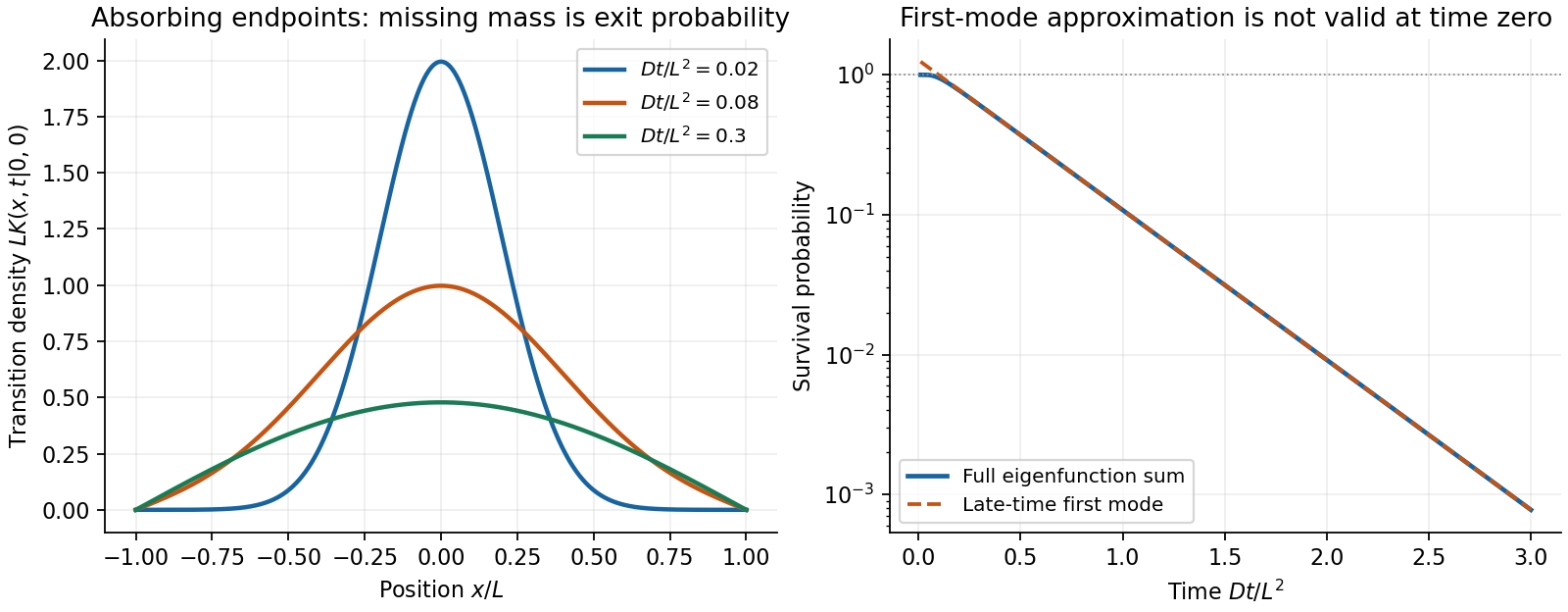
Original absorbing-interval transition densities and the approach of the survival probability to its slowest-mode asymptote
. Details. 
Past exam of the theoretical physics II course of the University of Cambridge 2015 Paper 1 2 d Solution by Codex 0 2026-10-20
Codex 0 2026-10-20The normalized Dirichlet eigenfunctions on and their decay rates areTheir norms are one because the sine-squared integral is . At the initial position zero, , so all even disappear. For , the two signs from and cancel, yieldingThis holds for and is zero outside. The kernel is even in , vanishes at both boundaries and tends weakly to the initial delta. The eigenvalues are decay rates rather than quantum energies unless one makes an additional unit convention.
Past exam of the theoretical physics II course of the University of Cambridge 2015 Paper 1 2 c Solution by Codex 0 2026-10-20
Codex 0 2026-10-20Multiply each time-sliced path weight by . A nonnegative finite is a local killing rate: the Feynman-Kac weight attenuates paths in proportion to the time spent in regions where . Let that rate tend to infinity outside the allowed interval. Paths that exit are removed, leaving Brownian motion killed at its first boundary hit.
Consequently the required kernel is the Gaussian path measure restricted to surviving paths, equivalentlywith the infinite-barrier interpretation stated above. It solves in the interior with absorbing Dirichlet boundary conditions at . A reflecting boundary condition for a diffusion would describe a different process.
Strictly, this is a transition probability density in the final position, jointly with survival; a probability for an interval of final positions includes an integral over . Its integral over the whole allowed interval is at most one. It is not the normalized endpoint density conditional on survival, which would require division by the survival probability. In these diffusion units and the eigenvalues of have units of inverse time.
Past exam of the theoretical physics II course of the University of Cambridge 2015 Paper 1 2 b Solution by Codex 0 2026-10-20
Codex 0 2026-10-20Take and split it into intervals of width . The markov property and Gaussian convolution giveThis finite-dimensional identity is exact for every positive . Define the path-integral measure by these normalized time slices:In the time-sliced diffusion path integral, the discrete exponent is . Its conventional continuum notation is thereforeThe time-slice normalization is essential, not an arbitrary multiplicative constant. Brownian paths are almost surely nondifferentiable, so the displayed action is shorthand for the Gaussian limiting measure rather than an ordinary integral of the derivative of each typical path.
Past exam of the theoretical physics II course of the University of Cambridge 2015 Paper 1 2 a Solution by Codex 0 2026-10-20
Codex 0 2026-10-20Write , and for , with . Direct differentiation givesAlso and, for a smooth bounded test function ,Thus tends to a Dirac delta distribution as . Defining the retarded kernel supplies the initial impulse:The source term arises from the jump at in the distributional sense; differentiating only the smooth positive-time Gaussian would miss it.
Past exam of the theoretical physics II course of the University of Cambridge 2015 Paper 1 1 d Solution by Codex 0 2026-10-20
Codex 0 2026-10-20For general spin , use dimensionless generators obeying . The two exponentials represent the same group elements as for spin , now in the -dimensional representation of . A representation preserves products, sowith exactly the same axis and angle found in (c); after periods the angle is . One must not substitute higher-spin matrices into the two-term Pauli exponential in (b), which used a property special to spin .
The dimension and action on spin states change, but the spin-independent axis-angle composition does not. In particular,Integer-spin states return with positive sign and half-integer-spin states with negative sign. spin expectation vectors transform as spatial vectors in either case, while a general higher-spin state also carries higher multipole information.
Past exam of the theoretical physics II course of the University of Cambridge 2015 Paper 1 1 c Solution by Codex 0 2026-10-20
Codex 0 2026-10-20For the axis-angle composition of orthogonal spin rotations, set and . Multiplication, including , givesOne checks that . For , chooseThis choice retains the full spinor sign and gives . Repeated periods have the same axis:Thus the spin expectation vector rotates through , interpreted modulo as a spatial rotation. The positive component comes from the stated ordering; reversing the two rotations changes that component's sign.
Past exam of the theoretical physics II course of the University of Cambridge 2015 Paper 1 1 b Solution by Codex 0 2026-10-20
Codex 0 2026-10-20The Pauli matrix multiplication law givesFor a unit vector , it follows that . In the exponential series the even powers therefore multiply and the odd powers multiply . Summing them separately,Equivalently, the eigenvalues of are , so its two spectral projectors acquire phases . The half-angle belongs to a spinor rotation, while the associated physical spin vector rotates through .
Past exam of the theoretical physics II course of the University of Cambridge 2015 Paper 1 1 a Solution by Codex 0 2026-10-20
Codex 0 2026-10-20The spin operators here are dimensionless: , so has units of inverse time and is a dimensionless pulse area. Integrating the Schrödinger evolution across an infinitesimally short pulse gives . The finite free Hamiltonian contributes a vanishing integrated phase within that pulse. Between pulses the free evolution is .
In the eigenbasis, and . ConsequentlyStarting just before a pulse, the kick acts first and the free interval second. Operators act on states right to left, henceThere are exactly kicks, at times ; the pulse at is excluded. Sampling just after kicks would change the displayed product order. This endpoint convention specifies the delta-kicked spin Floquet operator.
Past exam of the theoretical physics II course of the University of Cambridge 2014 Paper 1 6 d Solution by Codex 0 2026-10-20
Codex 0 2026-10-20The pair products are and . Hencewhereas . Subtraction givesThe number difference commutes with pair creation, pair annihilation and , since each pair operation changes both occupations equally. Its boson-pair Casimir operator therefore commutes with every generator. In a fixed-difference sector , the Casimir eigenvalue is , including for equal occupations.
Past exam of the theoretical physics II course of the University of Cambridge 2014 Paper 1 6 c Solution by Codex 0 2026-10-20
Codex 0 2026-10-20Set and . Independent bosonic canonical commutation relations give , while and . Substituting and yieldsThereforewhich matches the matrix Lie algebra. This boson-pair realization of SU(1,1) differs from the number-conserving Schwinger boson representation of .
Past exam of the theoretical physics II course of the University of Cambridge 2014 Paper 1 6 b Solution by Codex 0 2026-10-20
Codex 0 2026-10-20 Past exam of the theoretical physics II course of the University of Cambridge 2014 Paper 1 6 a Solution by Codex 0 2026-10-20
Codex 0 2026-10-20With these matrices obey and , identifying the group as SU(1,1). Products preserve the displayed conjugate-entry pattern and determinant; the identity belongs, andalso belongs. Multiplication and inversion are smooth. The real constraint has nonzero gradient on its level set, so the matrices form a smooth real three-dimensional manifold. Associativity is inherited from matrix multiplication. These facts establish a Lie group, which is noncompact because is unbounded.
Past exam of the theoretical physics II course of the University of Cambridge 2014 Paper 1 5 d Solution by Codex 0 2026-10-20
Codex 0 2026-10-20Binomial factorial moments give , its mode-zero counterpart , and . Consequently the exact projected expectation isSince and ,The finite- correction is simply the replacement in the interaction term. Number correlations must be retained to obtain that correction.
Past exam of the theoretical physics II course of the University of Cambridge 2014 Paper 1 5 c Solution by Codex 0 2026-10-20
Codex 0 2026-10-20Put and . Commutativity of the two creation operators and the binomial theorem giveThusThe state is a fixed-number two-mode condensate with binomial mode occupations; it is not a product of two independent Poisson-distributed Glauber coherent states.
Past exam of the theoretical physics II course of the University of Cambridge 2014 Paper 1 5 b Solution by Codex 0 2026-10-20
Codex 0 2026-10-20The occupation state is an eigenstate of the projected Quantum Hamiltonian. Since ,Equivalently, the bracket is , where ; there is no self-interaction for a single particle.
Past exam of the theoretical physics II course of the University of Cambridge 2014 Paper 1 5 a Solution by Codex 0 2026-10-20
Codex 0 2026-10-20orthogonality of angular modes makes the one-body term , whereThe contact-interaction integral supplies , expressing angular momentum conservation. Within modes zero and one, the four mixed permutations each reduce to . The two remaining terms have all four indices equal. ThusThis is the projected two-mode Quantum Hamiltonian; the full interaction could scatter into excluded modes, so the truncation is an assumed approximation rather than an exact invariant subspace of the complete ring problem.
Past exam of the theoretical physics II course of the University of Cambridge 2014 Paper 1 4 d Solution by Codex 0 2026-10-20
Codex 0 2026-10-20Write and . Dropping commutators of order permits . With , the momentum Gaussian givesIntegrating the diagonal yields , so the leading high-temperature density kernel isThis unsymmetrized product has an apparent off-diagonal asymmetry at the omitted order; reversing the product puts in the potential factor. A manifestly Hermitian approximation uses , replacing by with the same leading normalization. The condition is ; the Gaussian off-diagonal width is of order .
Past exam of the theoretical physics II course of the University of Cambridge 2014 Paper 1 4 c Solution by Codex 0 2026-10-20
Codex 0 2026-10-20Set . The oscillator populations are , and differentiating the geometric series gives . The canonical oscillator coordinate variance follows from , andIt approaches at zero temperature and at high temperature, agreeing respectively with ground-state fluctuations and classical equipartition.
Past exam of the theoretical physics II course of the University of Cambridge 2014 Paper 1 4 b Solution by Codex 0 2026-10-20
Codex 0 2026-10-20The density operator is diagonal in the oscillator number basis, so . With and ,HenceEquality holds even at zero temperature, when each contribution is . Classical equipartition alone would miss this zero-point energy.
There are unlisted articles, also show them or only show them.