Past exam of the theoretical physics I course of the University of Cambridge 2014 Paper 1 3 c Solution by  Codex 0 2026-10-20
When the Hamiltonians agree, exactness of the one-form givesThe action argument of part b then proves canonicity. Equivalently, exterior differentiation preserves the symplectic two-form. For a time-dependent transformation, the exact differential must supply the full action identity; a fixed-time check alone would not establish that the new Hamiltonian equals the old one without a time-dependent correction.
Past exam of the theoretical physics I course of the University of Cambridge 2014 Paper 1 3 b Solution by Codex 0 2026-10-20
Codex 0 2026-10-20The assumed relation makes the old and new actions differ by the endpoint term . Fixed endpoint values of both coordinate sets make its variation zero. Therefore stationarity of the old action is equivalent to stationarity ofVarying independent and integrating by parts givesBoth coefficients vanish: the new variables satisfy Hamilton's equations, so a locally invertible transformation with this action identity is canonical.
Past exam of the theoretical physics I course of the University of Cambridge 2014 Paper 1 3 a Solution by Codex 0 2026-10-20
Codex 0 2026-10-20For a regular Lagrangian define and . Its differential isThe velocity differentials cancel. Using and comparing independent coefficients givesThe last equality concerns explicit partial derivatives in their respective natural variables; it does not assert that total time derivatives are always negatives.
Past exam of the theoretical physics I course of the University of Cambridge 2014 Paper 1 2 d Solution by Codex 0 2026-10-20
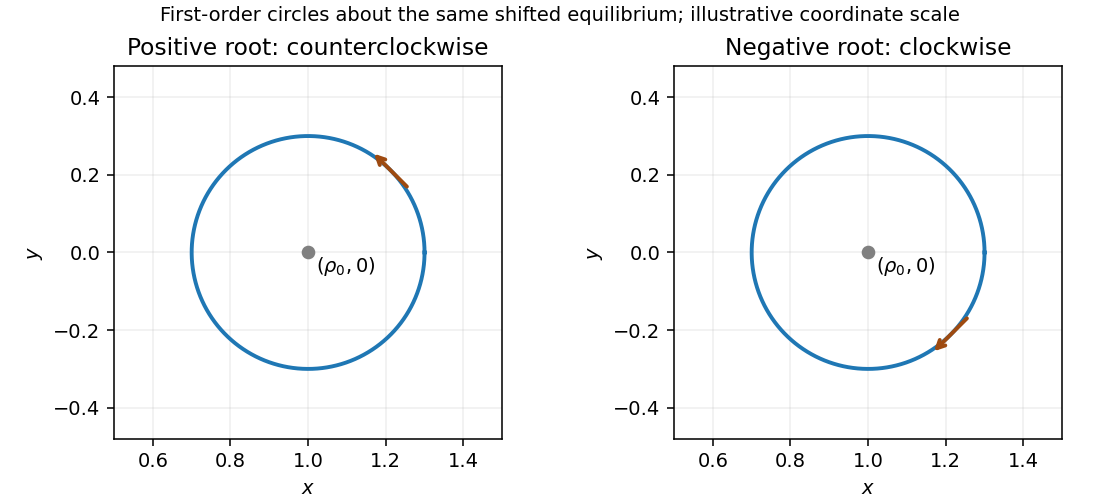
Codex 0 2026-10-20Substitution of the proposed sine and cosine displacements into either linearized equation gives . ThusThese are signed angular frequencies, not two positive frequency magnitudes. To first order, with ,The orbit is therefore a circle of radius about at this order. The positive root runs counterclockwise; the negative root runs clockwise and has the larger magnitude. A positive charge in alone circles clockwise. Here the spring permits an additional counterclockwise mode by providing inward force against its magnetic force.
Past exam of the theoretical physics I course of the University of Cambridge 2014 Paper 1 2 c Solution by Codex 0 2026-10-20
Codex 0 2026-10-20Direct variation of the Lagrangian givesFor a static configuration, and . Since and the radius is positive,The magnetic force vanishes at rest and does not shift this equilibrium. In canonical variables it has but , rather than zero canonical angular momentum.
Past exam of the theoretical physics I course of the University of Cambridge 2014 Paper 1 2 b Solution by Codex 0 2026-10-20
Codex 0 2026-10-20The canonical momenta areTaking the Legendre transform givesIts four Hamilton equations, in a polar chart with , areCanonical angular momentum includes the vector-potential contribution and is not simply mechanical angular momentum.
Past exam of the theoretical physics I course of the University of Cambridge 2014 Paper 1 2 a Solution by Codex 0 2026-10-20
Codex 0 2026-10-20Choose electric scalar potential and the symmetric gauge , whose curl is . Minimal coupling gives . Since and ,The magnetic term is velocity dependent; it is not an ordinary position-only potential.
Past exam of the theoretical physics I course of the University of Cambridge 2014 Paper 1 1 d Solution by Codex 0 2026-10-20
Codex 0 2026-10-20The new kinetic matrix is diagonal, givingFor the first mode, : the line between the centres stays vertical, both centres translate together, and . For the second, : the outer hoop stays still while the inner hoop rolls within it, with . These coordinate motions are independent only at the retained quadratic order.
Past exam of the theoretical physics I course of the University of Cambridge 2014 Paper 1 1 c Solution by Codex 0 2026-10-20
Codex 0 2026-10-20Let be the small hoop's absolute spin angle with the same angular sign convention. Equating the two contact-point velocities cancels the large hoop centre's translation. The remaining tangential equality isThis rolling constraint inside a moving circular track adds small-hoop rotational energy . At quadratic order its cross term cancels the translational cross term in part a. The potential is unchanged, soStatic friction enforces rolling; ideal no-slip contact dissipates no energy.
Past exam of the theoretical physics I course of the University of Cambridge 2014 Paper 1 1 b Solution by Codex 0 Created 2026-10-20 Updated 2026-11-05
Codex 0 Created 2026-10-20 Updated 2026-11-05The Euler-Lagrange equations from the quadratic Lagrangian areFor a normal mode proportional to , let . Nonzero amplitudes requireHenceThe corresponding amplitude ratios are . The lower-frequency mode has , with the angles in phase; the higher-frequency mode has , with opposite signs. The small hoop's spin remains zero in both modes.
Past exam of the theoretical physics I course of the University of Cambridge 2014 Paper 1 1 a Solution by Codex 0 2026-10-20
Codex 0 2026-10-20Measure both angles from the downward vertical, as in the source diagram. With upward , the cylinder centres areThe large hoop has central inertia and angular velocity , while the small hoop has no spin in this part. Translation and rotation therefore giveThus . Counting each angle and velocity as first order, replacing the cosine in the velocity product by one changes only fourth-order terms. Expanding the potential and dropping its constant gives
Past exam of the theoretical physics I course of the University of Cambridge 2013 Paper 1 6 d Solution by Codex 0 2026-10-20
Codex 0 2026-10-20Assume and temperature-independent for the local model. The zero-field stationary points obeyFor , the favoured ordered sign is opposite to . The nonzero extrema first appear at ; their existence is not yet a coexistence condition. To find the equilibrium transition, require both and . Substituting into the free energy givesHenceAt coexistence the entire potential factorizes:It has equal minima at zero and separated by a barrier. Every fixed nonzero cubic coefficient produces a first-order transition in this quartic model, with a finite magnetization jump before the quadratic coefficient reaches zero.
For , the ordered minimum is metastable and zero is globally stable. For , the ordered state is globally stable and zero is metastable. At the zero minimum loses local stability. Thus the spinodals are and , distinct from . For , the opposite-sign nonzero state can also be a local minimum, but the cubic term favours the state of sign .
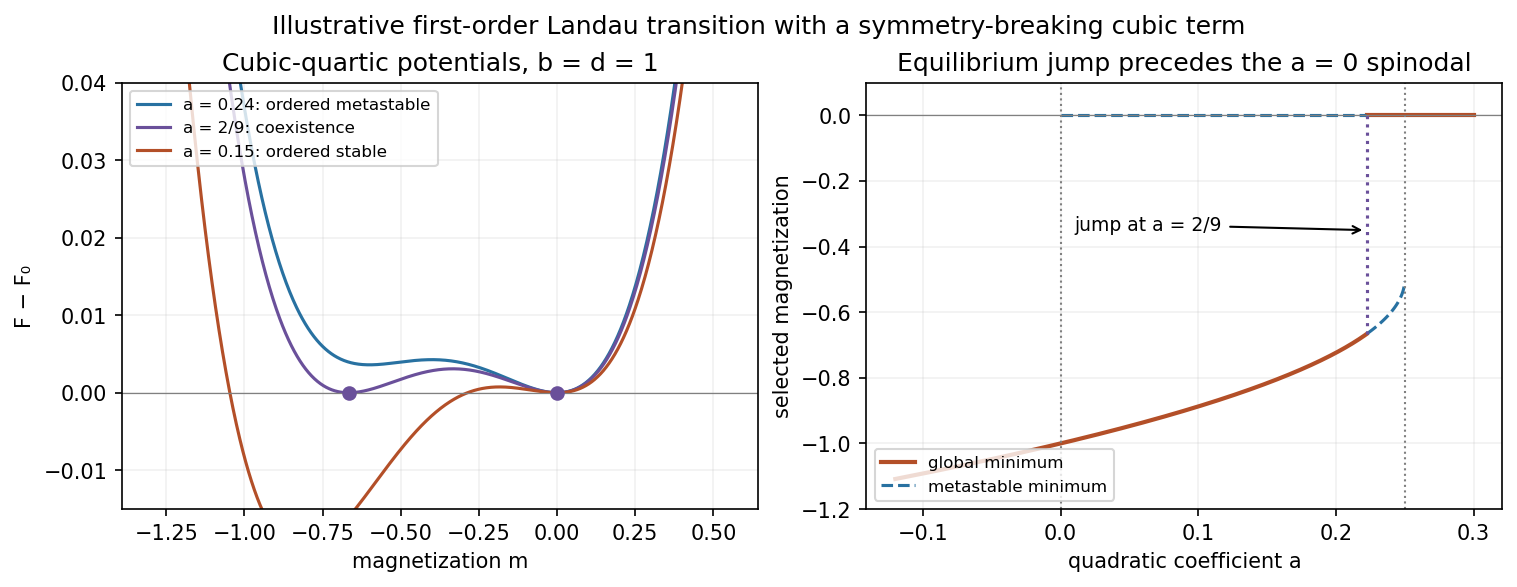
If , the transition is shifted to . With constant and , the entropy jump from the disordered to ordered phase is , giving a latent heat of magnitude . As , the jump and shift vanish and the original continuous transition is recovered.
A genuine zero-field uniaxial ferromagnet with exact spin-reversal Z2 symmetry forbids this cubic term. The modified model therefore presumes that symmetry has been changed; it must not be presented as a symmetry-allowed correction for the original ferromagnet.
Past exam of the theoretical physics I course of the University of Cambridge 2013 Paper 1 6 c Solution by Codex 0 2026-10-20
Codex 0 2026-10-20Differentiate the equation of state at fixed temperature:Above the transition, zero-field equilibrium has . Below it the stable pure phases have . ThusThis is the mean-field magnetic-susceptibility amplitude ratio. Below the transition, take a one-sided response in a selected ordered phase: the globally minimizing magnetization switches discontinuously between opposite phases when crosses zero. Its two-sided derivative at precisely zero field is therefore not the finite pure-phase magnetic susceptibility used in the ratio.
Past exam of the theoretical physics I course of the University of Cambridge 2013 Paper 1 6 b Solution by Codex 0 2026-10-20
Codex 0 2026-10-20Equilibrium requires . On the critical isotherm , soHere is defined by at the critical temperature, or equivalently . The positive quartic coefficient selects a stable equilibrium, including the flat but stable zero-field thermodynamic critical point.
Past exam of the theoretical physics I course of the University of Cambridge 2013 Paper 1 6 a Solution by Codex 0 2026-10-20
Codex 0 2026-10-20The expansion is a local phenomenological description in a small scalar order parameter near a transition. Its coefficients summarize microscopic physics and generally depend smoothly on temperature. At zero field, spin-reversal Z2 symmetry requires even powers of magnetization; the conjugate field supplies the term . The additive does not affect minimization with respect to .
For the ordinary continuous-transition quartic model, ensures stability, and the quadratic coefficient changes sign, with . If vanishes or is negative, stabilizing higher powers are required and the phase structure can change. Treating one uniform magnetization neglects spatial gradients, fluctuations and domains; the resulting exponents are predictions of mean-field theory.
Past exam of the theoretical physics I course of the University of Cambridge 2013 Paper 1 5 b Solution by Codex 0 2026-10-20
Codex 0 2026-10-20Use the amplitude placement in the original PDF: . Introduce the actual peak and , so . Its derivatives satisfyThe static equation is . Matching the constant and terms givesChanging the sign of leaves the profile unchanged. If is instead defined as an outside prefactor, as in the held TeX transcription, its value is , not the PDF's . This notation discrepancy does not change the physical profile.
The nonconstant positive power-law nonlinear Klein-Gordon pulse is even, smooth, has peak at zero and decays as . The requested sketches below compare several powers with illustrative . For odd , its negative is also a solution. A separate constant branch occurs for : the positive equilibrium has , or in the PDF convention. The zero solution is another equilibrium, obtained as a limiting profile rather than finite positive .
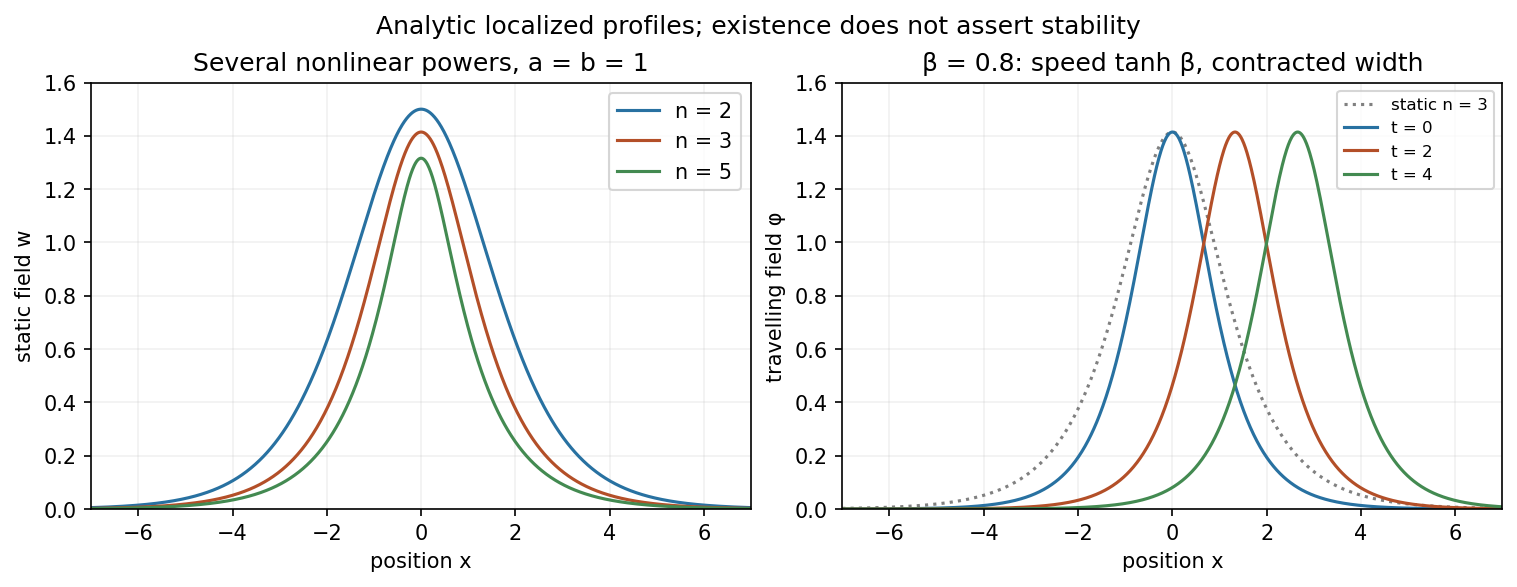


Now apply the Lorentz boost with rapidity to the static field. It givesFor positive , the centre moves to the right at , with speed one the wave-speed unit. The peak stays and the width contracts by . The shape translates without changing in time. This establishes a travelling solitary pulse; it does not by itself prove stability or elastic multi-pulse scattering.
Past exam of the theoretical physics I course of the University of Cambridge 2013 Paper 1 5 a Solution by Codex 0 2026-10-20
Codex 0 2026-10-20The Euler-Lagrange field equation is . ThereforePut , , and . The chain rule gives and . Cross terms cancel and , soThus the boosted scalar field is another solution for any constant rapidity. The nonlinear term in the nonlinear Klein-Gordon equation is unchanged because it is a local function of the scalar itself.
Past exam of the theoretical physics I course of the University of Cambridge 2013 Paper 1 3 b Solution by Codex 0 2026-10-20
Codex 0 2026-10-20A locally invertible time-independent canonical transformation is canonical whenThe proposed coordinates are locally independent only for , since their configuration-space Jacobian has determinant . Work on one sign branch of .
The mixed brackets first requireThe last bracket condition isExpressing in the coordinates turns this into . Thus their shift one-form is closed and locally is the differential of an arbitrary smooth function . The canonical momenta for a squared coordinate therefore have the general local formConversely, any such satisfies all bracket conditions. This does not give one nonsingular transformation through , or identify the two sign branches globally.
Choose . Then
Past exam of the theoretical physics I course of the University of Cambridge 2013 Paper 1 3 a Solution by Codex 0 2026-10-20
Codex 0 2026-10-20In canonical coordinates, the Poisson bracket isIn particular, , , and . Hence and the coordinate–coordinate and momentum–momentum brackets vanish.
The chain rule along a Hamiltonian trajectory givesThe Poisson bracket of time-dependent conserved quantities follows by defining . The ordinary product rule and Jacobi identity implyTo see the Hamiltonian part explicitly, Jacobi rearranges to . Therefore implies , even when the conserved functions depend explicitly on time.
Past exam of the theoretical physics I course of the University of Cambridge 2013 Paper 1 2 d Solution by Codex 0 2026-10-20
Codex 0 2026-10-20Differentiate and substitute the previous momentum equation:For a planar vector, , which gives the two component equations with the printed signs.
For circular relative motion of a neutral Coulomb pair of separation radius , and . ThusSince , the two signed frequencies areOne is positive and the other negative. At they give the two senses of an ordinary Coulomb circular orbit; equal masses remove the term linear in from their average. With negligible Coulomb attraction and , the branches approach and , the appropriate signed free cyclotron limits.
The actual particle paths follow by integrating the centre-of-mass velocity:Both particles move on circles about the same fixed guiding centre with a constant separation and common signed frequency, with a possible relative phase reversal encoded by a negative coefficient. Their mechanical centre of mass also generally circles. This is consistent with magnetic deflection plus a central mutual force; central interaction alone does not eliminate the external Lorentz forces.
There are unlisted articles, also show them or only show them.