Past exam of the physics course of the year 4 of the natural sciences course of the University of Cambridge 2015 Paper 1 Section A A7 Solution by  Codex 0 2026-10-20
Let be the cylinder centre's small displacement away from the wall. Rolling without slipping gives rotation angle of magnitude . The material point initially at the top moves horizontally by another relative to the centre to first order, so the spring extension is , not . Its small vertical displacement affects the extension only at higher order.
The kinetic and potential energies areThe linearized equation is , givingStatic friction enforces the rolling constraint and does no work at the instantaneous contact point. Omitting rotational kinetic energy, or attaching the spring to the centre instead of the top material point, would change the result.
Past exam of the physics course of the year 4 of the natural sciences course of the University of Cambridge 2015 Paper 1 Section A A6 Solution by Codex 0 2026-10-20
Codex 0 2026-10-20For total relativistic energy , the speed is . Both beam energies are enormously greater than the rest energy, so expanding the square root avoids obscuring the small difference:With all energies in GeV, , and , givingThe deficits below the speed of light are about and . The large energy increase therefore produces only a small speed increase; the energy mainly changes the Lorentz factor. These numbers use the quoted beam energies as total energies. Interpreting them as kinetic energies requires adding the rest energy, with only a tiny correction at these scales.
Past exam of the physics course of the year 4 of the natural sciences course of the University of Cambridge 2015 Paper 1 Section A A5 Solution by Codex 0 2026-10-20
Codex 0 2026-10-20A spin-half gas has two spin states. Filling the Fermi sphere at zero temperature gives , soWith , the number density is and . ThusThe associated Fermi temperature isFermionic degeneracy matters on cooling to a few kelvin or below in this model, and is pronounced for . Liquid helium-3 is interacting; its quasiparticle effective mass and thermodynamics need not equal the bare-mass free-gas predictions. The requested calculation is the ideal Fermi-gas scale.
Past exam of the physics course of the year 4 of the natural sciences course of the University of Cambridge 2015 Paper 1 Section A A4 Solution by Codex 0 2026-10-20
Codex 0 2026-10-20For a homogeneous ideal gas in a two-dimensional box of area , with dispersion and one internal state, the density of states is . The excited-particle density at temperature isAs , this diverges. Hence at every fixed positive temperature the excited states can accommodate any finite areal density with ; they never saturate at a finite critical density. There is no finite-temperature Bose-Einstein condensation in the homogeneous two-dimensional ideal gas thermodynamic limit.
The low-energy logarithmic divergence is the reason, not merely the small number of spatial dimensions. A finite box has a low-energy cutoff and a crossover; a trap changes the density of states and can change the conclusion. Condensation at zero temperature and an interacting gas's Berezinskii–Kosterlitz–Thouless transition are separate issues. The proof assumes the uniform quadratic-dispersion model, rather than every conceivable two-dimensional trapping potential.
Past exam of the physics course of the year 4 of the natural sciences course of the University of Cambridge 2015 Paper 1 Section A A3 Solution by Codex 0 2026-10-20
Codex 0 2026-10-20In the sudden approximation, the nuclear charge changes before the electronic wavefunction has time to evolve. Immediately afterward the state is still the original hydrogenic 1s wavefunction, now expanded in the eigenstates of the new Coulomb Hamiltonian. The final-ground-state probability is the squared overlap, rather than one minus an energy change.
For initial and final charges , the normalized 1s overlap isUsing givesThe remaining probability includes higher bound states and the -wave ionization continuum. In this central, instantaneous model the initial orbital has , and angular orthogonality excludes states with . The electronic spin is unchanged. Nuclear recoil and interactions with the emitted decay particles are outside this leading sudden-charge-change approximation.
Past exam of the physics course of the year 4 of the natural sciences course of the University of Cambridge 2015 Paper 1 Section A A2 Solution by Codex 0 2026-10-20
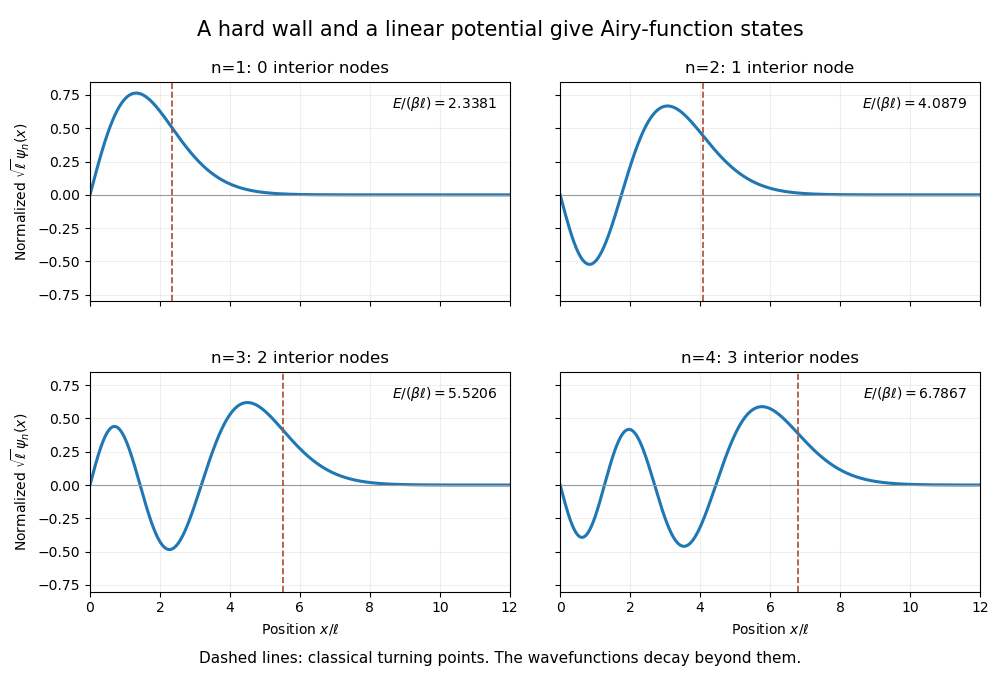
Codex 0 2026-10-20The hard wall imposes , while the increasing linear potential requires decay as . SetThe stationary Schrödinger equation becomes . The growing Airy function solution is excluded, leavingThis is the quantum bouncer. For the first four states, . Their interior node counts are respectively zero, one, two and three. Each wavefunction starts at zero at the wall, oscillates in the classically allowed interval, and crosses smoothly into an exponentially decaying tail beyond the turning point . The turning point is not an extra hard wall: the wavefunction generally remains nonzero there and beyond it.
Past exam of the physics course of the year 4 of the natural sciences course of the University of Cambridge 2015 Paper 1 Section A A10 Solution by Codex 0 2026-10-20
Codex 0 2026-10-20Normalize the central slit amplitude to one. The two outer amplitudes are each, not , because the specified attenuation concerns amplitude. For centre spacing , adjacent slits have phase difference . The far-field amplitude and intensity are thereforewhere is the central slit's intensity alone in the same narrow-slit approximation. Principal maxima have and height ; between them, zeros occur at . Only values in are physical. The endpoints are grazing-direction limits of this ideal angular model.
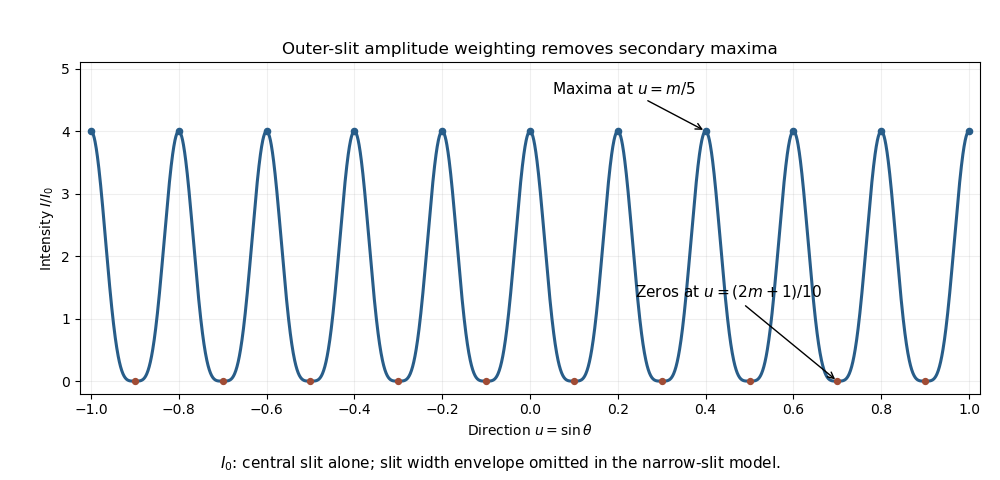
The amplitude weights form a binomial pattern. They remove the secondary maxima that an equal-amplitude three-slit array would have between its principal peaks. No phase shift is needed: changing the coherent weights already changes the interference structure.
Past exam of the physics course of the year 4 of the natural sciences course of the University of Cambridge 2015 Paper 1 Section A A1 Solution by Codex 0 2026-10-20
Codex 0 2026-10-20For an infinite cubic potential well of side , the one-particle energy eigenvalues are , where and each quantum number is a positive integer. The lowest spatial orbital is , with energy and orbital degeneracy one. The next energy is , with three orbitals given by permutations of .
Spin-zero identical particles are bosons. Both can occupy the lowest orbital, so the two-boson ground state is nondegenerate. The first excited total energy is : one particle occupies the lowest orbital and one an excited orbital. Symmetrizing the two-particle wavefunction gives one state for each of the three excited orbitals, so the first-excited degeneracy is three.
Spin-half identical particles are fermions, so the total state must be antisymmetric. Two particles in the same lowest orbital have a symmetric spatial wavefunction and must form the unique spin singlet state. Thus the fermion ground state is also nondegenerate. At the first excited energy, each choice of excited spatial orbital permits a symmetric spatial state with a singlet state, or an antisymmetric spatial state with a three-dimensional triplet state. ThereforeThe spin multiplicity is essential: counting only the three orbital choices would omit allowed triplet states. The result assumes ordinary spin-statistics, an unsplit spin degeneracy and the hard-wall cube model.
Past exam of the physics course of the year 4 of the natural sciences course of the University of Cambridge 2014 Paper 1 B7 d Solution by Codex 0 2026-10-20
Codex 0 2026-10-20Treat the transparent plate as a phase plate at normal incidence. Its extra optical path is . An unchanged interference pattern requires an integer number of full phase cycles:For full-cycle phase-plate invisibility in an ordinary nontrivial material with , the two smallest are and . If the optically null case is admitted, the first two nondecreasing- values are and . A different allowed range of refractive indices would need to be specified before calling these the absolute smallest possibilities.
Past exam of the physics course of the year 4 of the natural sciences course of the University of Cambridge 2014 Paper 1 B7 c Solution by Codex 0 2026-10-20
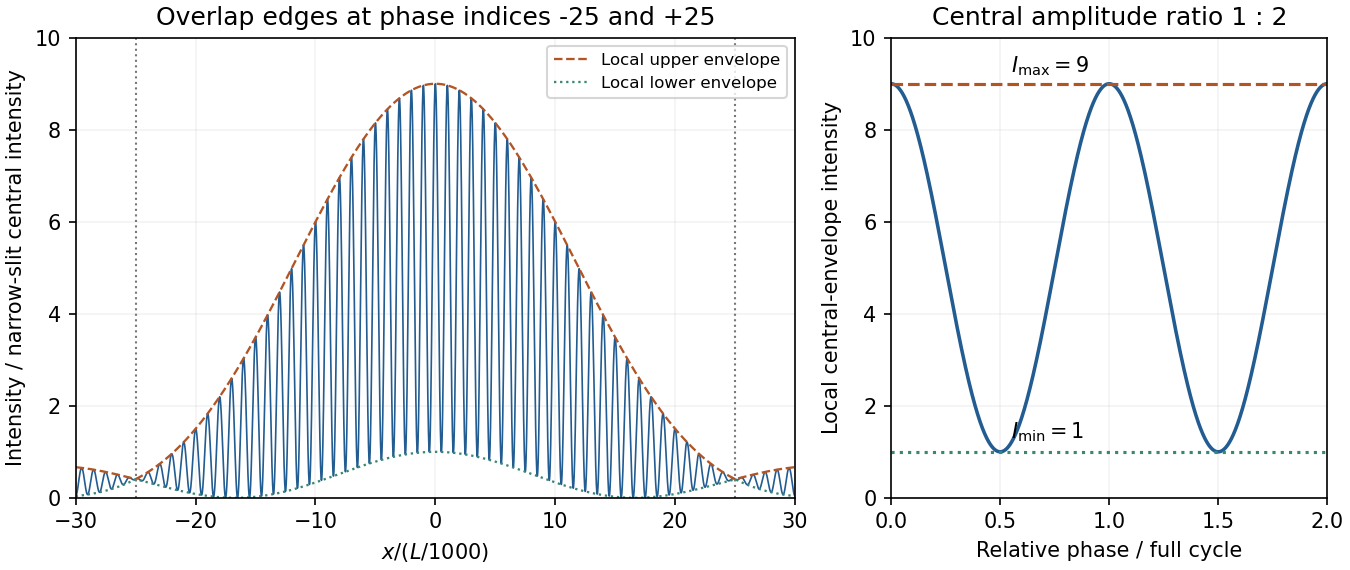
Codex 0 2026-10-20At the centre, equal illumination gives slit amplitudes proportional to widths, so . The local interference extrema are and , givingThese are the central-envelope extrema as relative phase varies, or equivalently the near-centre fringe limits where the envelope is nearly constant.


Past exam of the physics course of the year 4 of the natural sciences course of the University of Cambridge 2014 Paper 1 B7 b Solution by Codex 0 2026-10-20
Codex 0 2026-10-20A slit of width has its first zeros at . Thus the full central-envelope widths areThe narrower envelope determines the overlap, so it spansThis is the usual approximate “50 fringes” count. If counting nominal bright fringe centres strictly inside both first zeros, they have indices , giving 49 centres. The endpoints lie at the wider slit's first zeros, where two-slit visibility vanishes; they should not be counted as fully interfering bright centres.
Past exam of the physics course of the year 4 of the natural sciences course of the University of Cambridge 2014 Paper 1 B7 a Solution by Codex 0 2026-10-20
Codex 0 2026-10-20The relative slit-centre phase is . Near the optical axis, , so adjacent interference maxima have spacingSlow diffraction-envelope variation can slightly shift the exact local maxima.
Past exam of the physics course of the year 4 of the natural sciences course of the University of Cambridge 2014 Paper 1 B4 c Solution by Codex 0 2026-10-20
Codex 0 2026-10-20For proper-time acceleration by reflected laser light, the spacecraft receives momentum per incident photon. Combining with the impact rate givesBecause and ,Integrating from rest gives , henceThe mirror's rest mass is assumed constant and the laser illuminates it continuously; diffraction losses, incomplete interception and microscopic recoil are neglected.
Past exam of the physics course of the year 4 of the natural sciences course of the University of Cambridge 2014 Paper 1 A10 b Solution by Codex 0 2026-10-20
Codex 0 2026-10-20The first dipole remains perpendicular to the separation and is now also perpendicular to the second dipole. Both terms in the point-dipole interaction vanish, giving . This is the electrostatic point-dipole contribution, not a claim that real finite water molecules have no other intermolecular interaction.
Past exam of the physics course of the year 4 of the natural sciences course of the University of Cambridge 2014 Paper 1 A10 a Solution by Codex 0 2026-10-20
Codex 0 2026-10-20 Past exam of the physics course of the year 4 of the natural sciences course of the University of Cambridge 2013 Paper 1 Section B B8 Solution by Codex 0 2026-10-20
Codex 0 2026-10-20Substitution of a plane wave in the Schrödinger equation gives . For a stationary step-scattering state, remove the common phase and write , . If , the right-side outgoing wave is , . A finite step with no delta-function potential in the Schrödinger operator requires continuous and : a discontinuous wavefunction would generate a delta derivative, and integrating the equation over a vanishing interval gives derivative continuity. Matching yieldsFor , take and the bounded right-side state . It carries no transmitted flux and . The threshold limit also has reflection probability one. Thus at ,For the two-step profile, set , and . With all regions propagating, the net reflection amplitude isThe given quarter-wave condition makes . Zero reflection then requires , equivalent to . ConsequentlyFor an increasing intermediate step this needs and , together with the stipulated thickness condition. In this quarter-wave matching layer for a quantum potential step, two reflected amplitudes cancel while the transmitted flux equals the incident flux.
Past exam of the physics course of the year 4 of the natural sciences course of the University of Cambridge 2013 Paper 1 Section B B7 Solution by Codex 0 2026-10-20
Codex 0 2026-10-20The proper time satisfies . The collinear transformation from the Earth frame into the instantaneous rest frame gives proper acceleration , soStarting from rest, integration gives . HenceSince , a further integration givesUsing Julian years and gives , so the star is about light years away in the Earth frame. The Earth-frame travel time is about years and the final speed is about . The model accelerates toward the star throughout; adding a braking leg would be a different itinerary.
Past exam of the physics course of the year 4 of the natural sciences course of the University of Cambridge 2013 Paper 1 Section B B6 Solution by Codex 0 2026-10-20
Codex 0 2026-10-20For charge per length , Gauss's law gives between the conductors. Integration gives . Similarly Ampère's law gives ; integrating the magnetic energy per length and setting it equal to givesHere are per unit length. The displayed is the external TEM inductance, appropriate to the ideal surface-current/high-frequency model. Internal magnetic energy in conductors with appreciable current penetration adds internal inductance; it cannot be determined fully from an outer conductor with unspecified wall geometry.
The distributed series resistance and inductance, with shunt capacitance and negligible leakage, give the telegrapher's equationsDifferentiate the first with respect to and substitute the second to obtainFor the forward attenuating branch has . When ,The positive imaginary part gives amplitude . Power decays twice as fast in its exponent, so its attenuation length is . Finite conductivity changes the speed only at higher order in this constant-parameter weak-loss expansion, apart from any separately retained internal inductance or dielectric response.
There are unlisted articles, also show them or only show them.