Past exam of the physics course of the year 1 of the natural sciences course of the University of Cambridge 2024 Paper 1 Section A 5 Solution by  Codex 0 2026-10-20
At closest approach the velocity is tangential. The conserved specific orbital energy and specific angular momentum areThe negative energy gives an elliptic orbit. Its semi-major axis isSince ,This treats the star as fixed, appropriate to . Equivalently, equate the energy at the two turning points using . The planet mass cancels; a circular-orbit relation would be inappropriate here.
Past exam of the physics course of the year 1 of the natural sciences course of the University of Cambridge 2024 Paper 1 Section A 4 Solution by Codex 0 2026-10-20
Codex 0 2026-10-20The slit spacing is . At normal incidence, the diffraction grating maxima satisfy . ThereforeThe third order would require , so it cannot propagate. At fixed order and spacing, a longer wavelength requires larger . Green light has a larger first-order diffraction angle than blue light.
Past exam of the physics course of the year 1 of the natural sciences course of the University of Cambridge 2024 Paper 1 Section A 3 Solution by Codex 0 2026-10-20
Codex 0 2026-10-20The string's no-slip condition gives . Conservation of mechanical energy from release to the stated height drop yieldsSolving for the spool's moment of inertia,The axle does no work because its point of application is fixed, and the ideal string and axle introduce no losses. The spool mass is not needed to infer from this energy measurement.
Past exam of the physics course of the year 1 of the natural sciences course of the University of Cambridge 2024 Paper 1 Section A 2 Solution by Codex 0 2026-10-20
Codex 0 2026-10-20Using the convention , the series RLC circuit has complex impedanceAt the stated frequency, and . ThusThe vector is in the resistance–reactance plane. Positive reactance means that the net circuit is inductive and current lags voltage. With the alternative convention the imaginary signs reverse, while the magnitude and physical phase relationship agree.
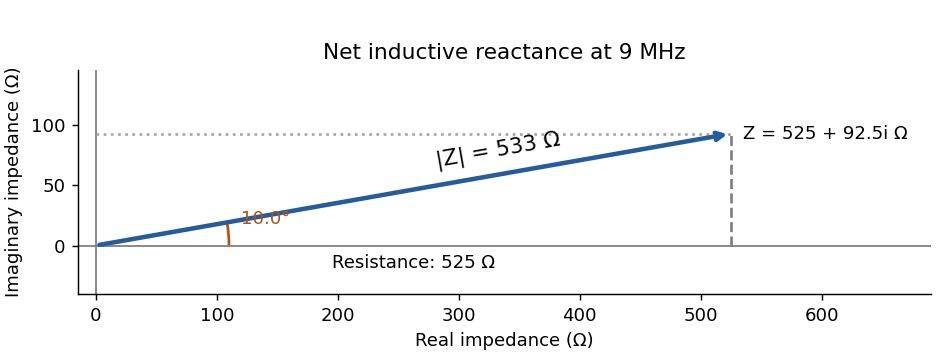
Series-circuit impedance in the resistance–reactance plane
. Details. Past exam of the physics course of the year 1 of the natural sciences course of the University of Cambridge 2024 Paper 1 Section A 1 Solution by Codex 0 2026-10-20
Codex 0 2026-10-20The surface tension has dimensions , while and . ConsequentlyMatching the dimension of height gives , so . Dimensional analysis fixes this exponent but cannot determine a dimensionless prefactor or a contact-angle dependence.
Past exam of the physics course of the year 1 of the natural sciences course of the University of Cambridge 2016 Paper 1 Section E E14 Solution by Codex 0 2026-10-20
Codex 0 2026-10-20For a steady thin-wire electric current, the Biot-Savart law iswhere points from the source element to the field point and follows positive electric current. On a circular loop's axis the transverse contributions cancel by symmetry. The axial numerator is and the distance is , givingIts graph is positive and even, with maximum at the centre and a far-field decay. Reversing the electric current reverses its sign.
For two equally oriented -turn coils centred at , superposition givesConsequentlyThis is an even differentiable function, so every odd derivative at zero vanishes, including the first and third. To check the second derivative explicitly, let . ThenThus makes the quadratic variation vanish, which is the Helmholtz coil condition. The central value and leading axial variation are
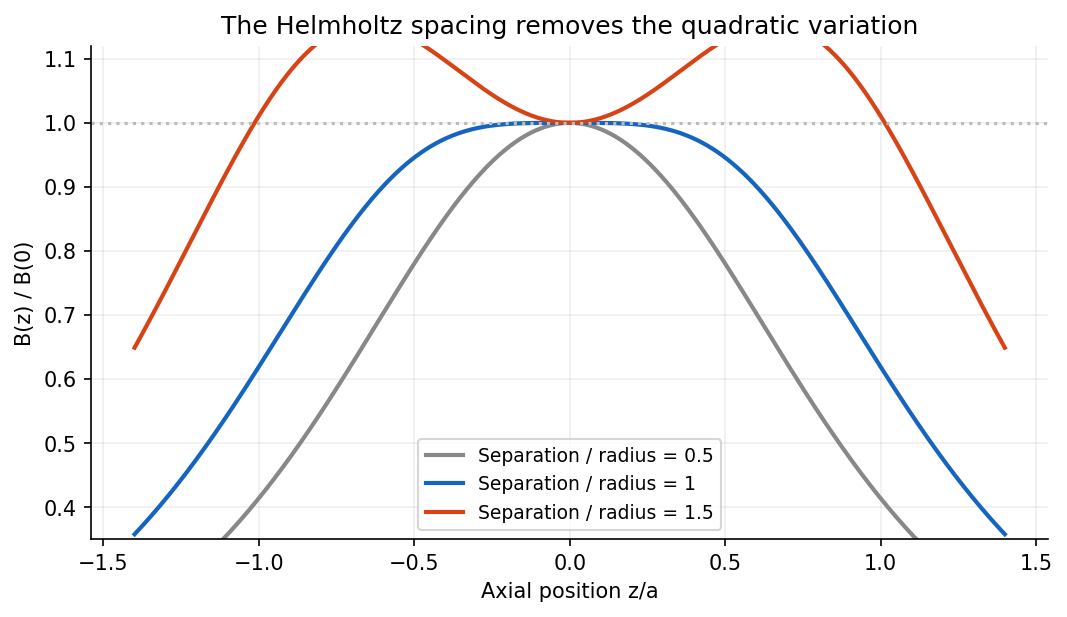
Near the centre, the coils' magnetic field lines are nearly straight and parallel to the axis. On the axis rotational symmetry makes exactly; in the central plane the radial components from the two coils cancel. More quantitatively, in the current-free central volume, axisymmetry and implyThe suppressed axial derivatives therefore also suppress transverse magnetic fields near the centre. The smallness applies locally compared with the coil radius; it is not a claim of an exactly uniform field throughout the apparatus.
Past exam of the physics course of the year 1 of the natural sciences course of the University of Cambridge 2016 Paper 1 Section D D13 Solution by Codex 0 2026-10-20
Codex 0 2026-10-20Snell's law is , with angles measured from the interface normal. The Huygens-Fresnel principle explains it by constructing the transmitted wavefront from secondary wavelets: during the same time interval, distances travelled in the two media are proportional to and . The geometry of the advancing plane wavefront then gives .
For incidence from index into vacuum, the transmitted angle is . The ray bends away from the normal, so its positive deviation isFor ,Thus the graph rises monotonically from zero to a finite endpoint with a vertical tangent:At the endpoint the transmitted ray grazes the interface. Beyond the critical angle for total internal reflection, no propagating transmitted ray exists and total internal reflection occurs.
Inside a prism, the two ray angles with the face normals sum to its apex angle. For the equilateral cross-section, they are and . The entry deviation equals the corresponding exit deviation under ray reversal. Adding the two changes of direction therefore givesThis is symmetric about . Symmetry alone gives a stationary point; to establish that it is a minimum, differentiate once more:within the transmitted-ray interval. The sum is therefore strictly convex, andThese expressions require for a non-grazing path through both faces; is a grazing limit, and admits no such two-face transmitted path. More explicitly, both internal angles must be at most , which is possible only if .
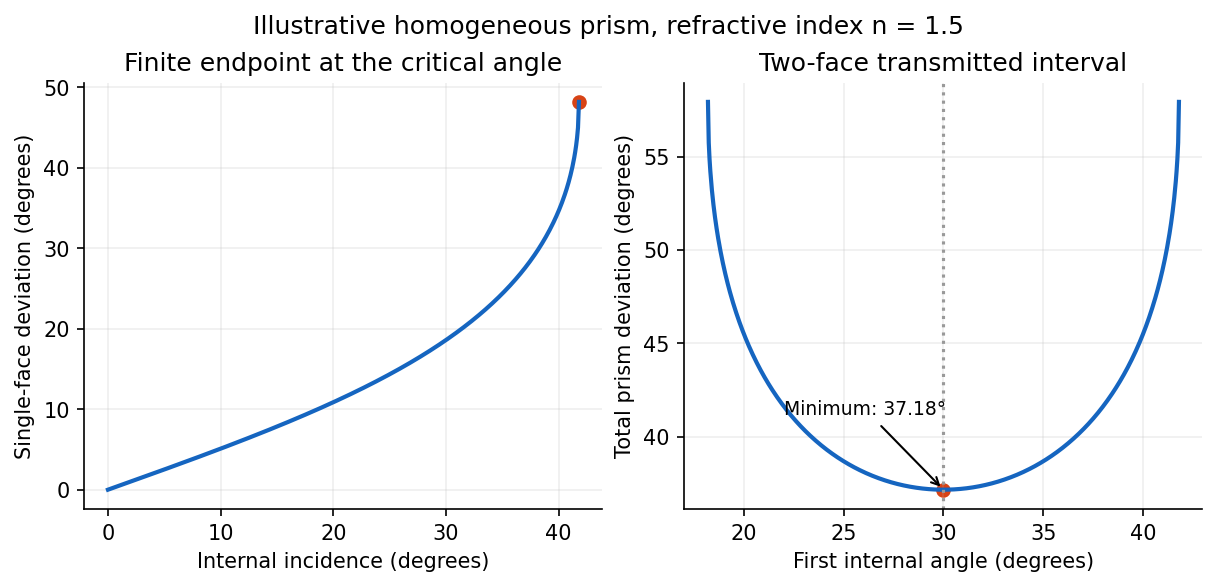
Single-interface deviation and the symmetric minimum of an equilateral prism, illustrated for index 1.5
. Details. Atmospheric hexagonal ice crystals can present pairs of faces with a angle, acting as small prisms. Their orientations turn the minimum-deviation cone around the Moon into an optical halo. No transmitted ray of this family is deflected less than the minimum deviation of a prism. Moreover, near the minimum, is quadratic in the departure from the symmetric ray, so a range of incident directions is compressed into a small outgoing angular range. This caustic makes the inner rim sharp and bright, with the ray density decreasing farther outside. The common 22-degree halo has an angular radius near about either the Sun or Moon, hence a diameter near .[ref]
Past exam of the physics course of the year 1 of the natural sciences course of the University of Cambridge 2016 Paper 1 Section D D12 Solution by Codex 0 2026-10-20
Codex 0 2026-10-20Comparing with the standard wave equation gives the shallow-water wave speedTwice differentiating the proposed standing wave multiplies its spatial factors by and , and its temporal factor by . It solves the wave equation precisely whenTo obtain the local gravitational potential energy, integrate through a water column of height and unit horizontal area:The time averages are and . ThusThe constant is retained because the specified zero of gravitational potential is the tank bottom. This is local time-averaged potential energy, not the sum of potential energy and kinetic energy.
The no-normal-flow wall conditions are Neumann boundary conditions. Differentiating the cosine factors at the opposite walls givesNegative integers give the same cosine modes. The formal case has : it is a uniform change of the mean level, not a finite-frequency oscillation. In a closed tank with fixed water volume even that mean-level change is excluded from the oscillatory disturbance.
Since , the lowest finite frequency is the mode :It is uniform across the shorter direction, has opposite-sign displacement antinodes at the two ends of the longer direction, and a displacement node midway along it.
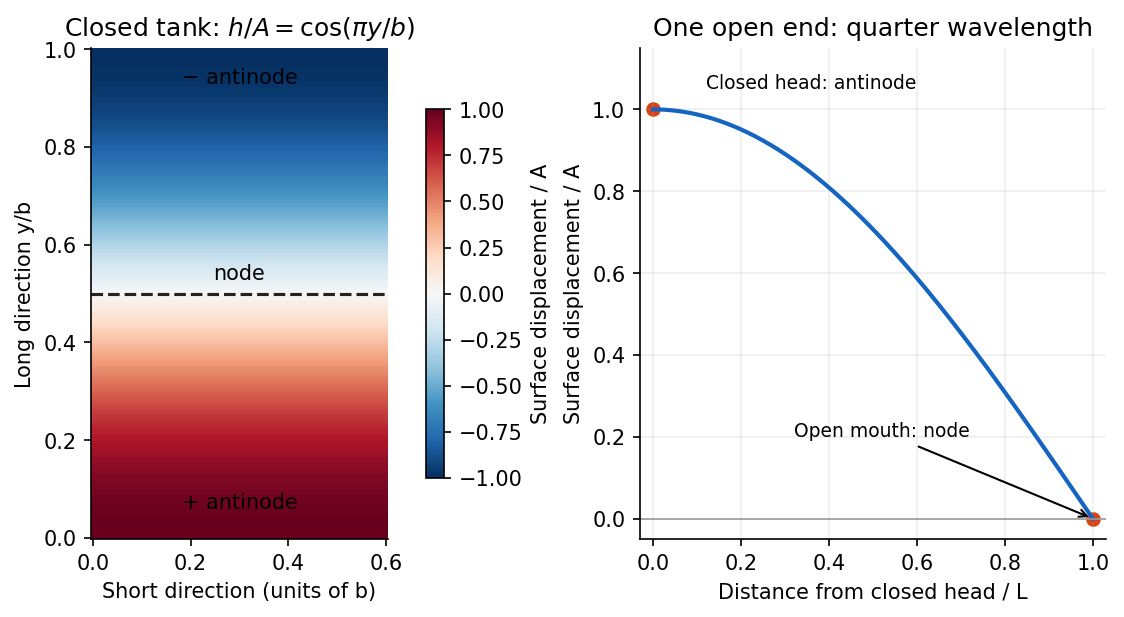


For the open-ended Bay of Fundy model, approximate the ocean mouth as a displacement node and the closed head as an antinode. The fundamental is a quarter-wave basin resonance, so its wavelength is andTaking a roughly -hour semidiurnal tide gives . Using the principal lunar period of approximately gives . The idealized estimate is therefore about . The lunar period is half of a roughly -hour -minute lunar day.[ref]
About Harmonic Constituents by National Oceanic and Atmospheric Administration. Examples M2 and S2: two lunar peaks per 24 hours 50 minutes, compared with two solar peaks per 24 hours
Past exam of the physics course of the year 1 of the natural sciences course of the University of Cambridge 2016 Paper 1 Section C C11 Solution by Codex 0 2026-10-20
Codex 0 2026-10-20Measure the mass's displacement from its static equilibrium height. This removes the constant spring extension supporting its weight. If the spring's top moves with the box, its incremental extension is , so its incremental upward force is . The specified damping force is against the mass's velocity in the static frame. Newton's second law therefore givesIn absolute height coordinates an additional constant on the right expresses the spring's rest length, its fixed attachment height and gravity; translating to static equilibrium removes it. Replacing the given damping by would describe a different base-excited oscillator.
After the decaying transient, write the steady-state response as . Using a complex sinusoid givessoFor positive frequency, the phase lag lies between zero and , passing through at . For small , the frequency response begins at , develops a narrow resonance near , and falls asThe precise amplitude-peak frequency is when that expression is positive.
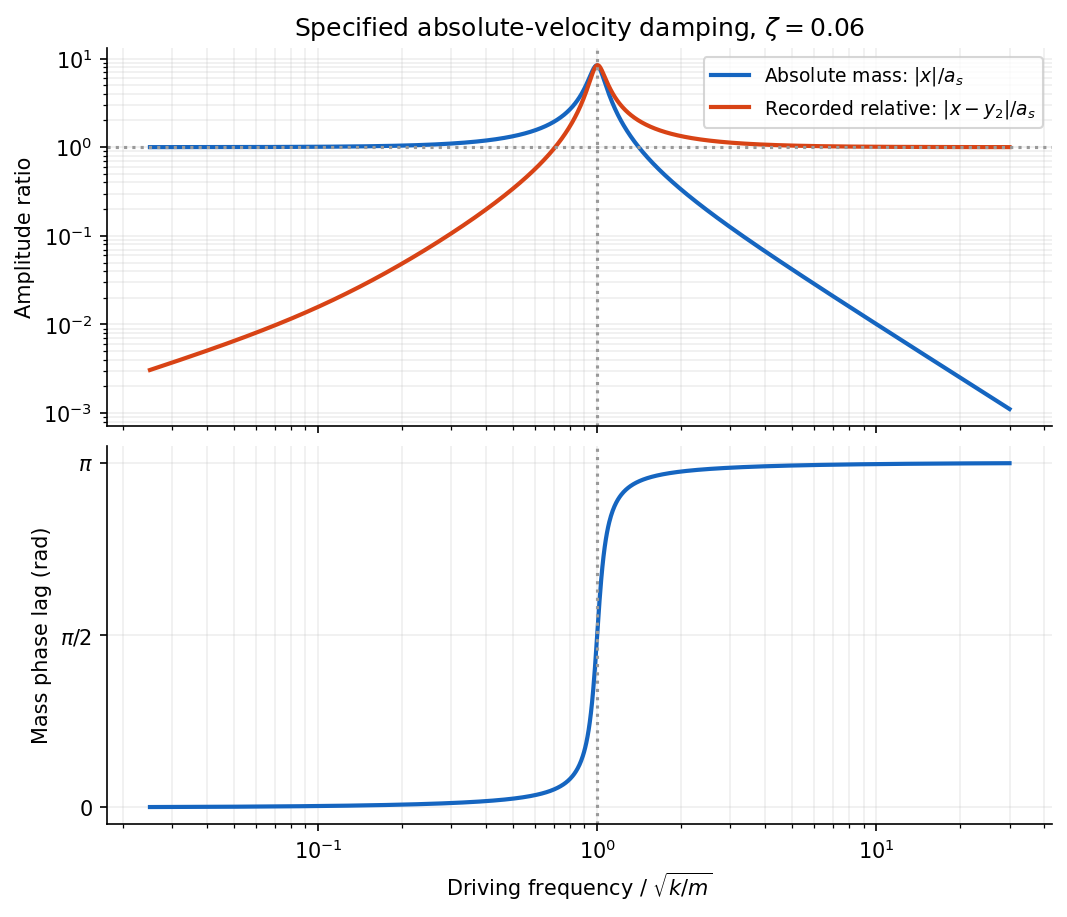
Absolute and relative motion of the stated seismograph model, and the phase lag of its inertial mass
. Details. 
The pen records the relative displacement . Its complex transfer function isAt high frequency, is small while . The inertial mass then stays nearly stationary and the recorded relative motion reproduces the ground displacement, with reversed sign. At low frequency the mass follows the box and their relative motion is small; near resonance the response is strongly frequency-dependent. Here “high” means compared with the suspension's natural frequency, rather than an absolute seismic-frequency threshold.
There are unlisted articles, also show them or only show them.