Past exam of the mathematics course of the year 2 of the natural sciences course of the University of Cambridge 2014 Paper 1 7 iii Solution by  Codex 0 2026-10-18
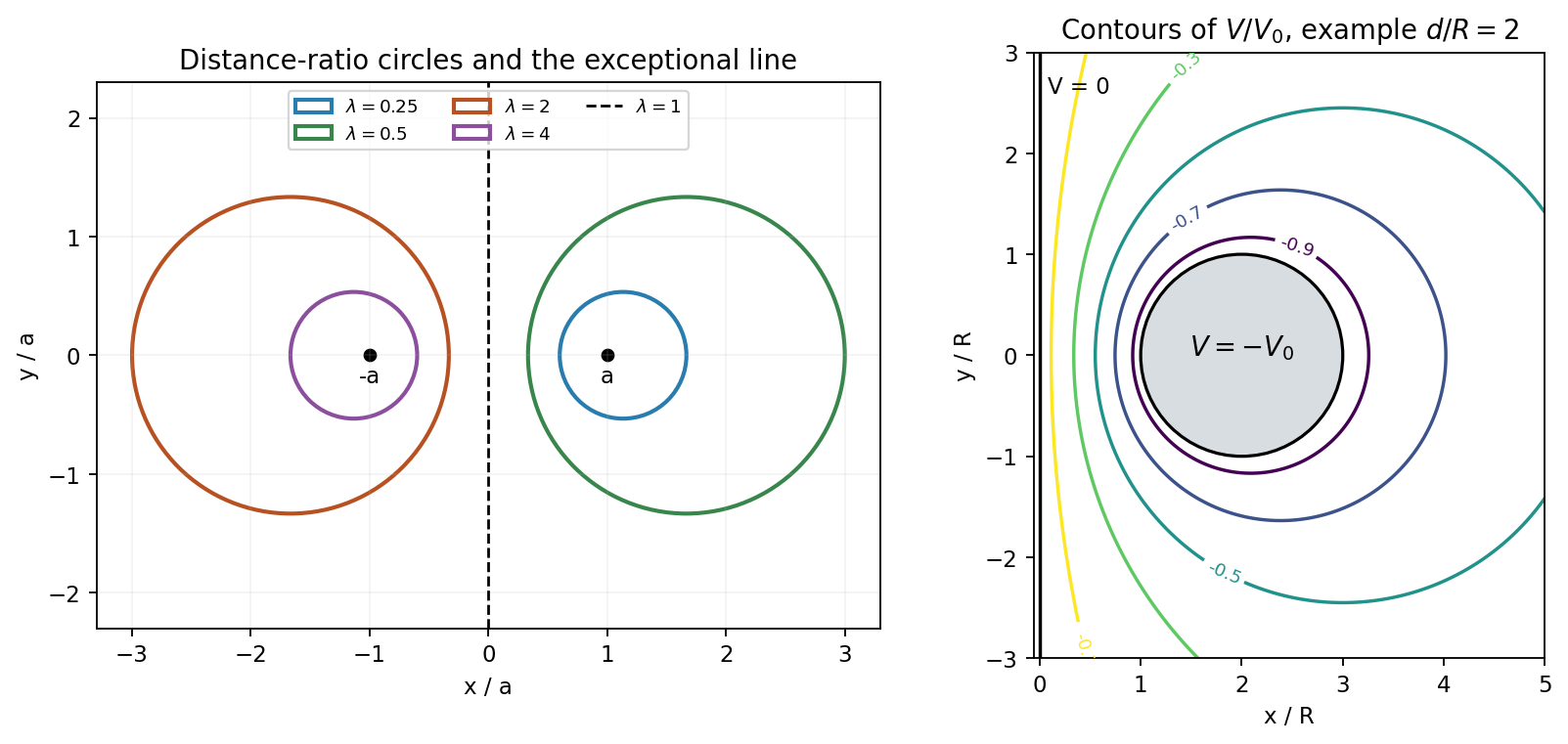
For a circle in the right half-plane use . Its centre and radius from part (ii) satisfy . Hence choosePut . Then andIndeed the Apollonius circle has centre and radius . Its logarithmic modulus is therefore , while on the modulus is one. The logarithmic Dirichlet potential between a circle and a line isThe logarithmic singularity at lies inside the excluded disk, since . The other singularity, at , lies outside the right half-plane. Thus the real logarithmic modulus is harmonic throughout the required region and has exactly the two specified boundary values.
Local branches of the complex logarithm justify harmonicity; its real part is globally single-valued even though the complex logarithm need not be single-valued around the excluded disk. The displayed solution is bounded and tends to zero at infinity. A boundedness or corresponding far-field condition supplies uniqueness in this unbounded domain; finite boundary values alone do not rule out unbounded additional harmonic solutions. The same geometry appears in cylinder-plane image charges.

Past exam of the mathematics course of the year 2 of the natural sciences course of the University of Cambridge 2014 Paper 1 7 ii Solution by Codex 0 2026-10-18
Codex 0 2026-10-18Squaring the ratio of moduli givesFor , complete the square to obtain the Apollonius circleIts centre is and its radius is . The centres are positive for and negative for .
At the allowed exceptional value , the locus is the line , the perpendicular bisector of the two fixed points. It is a generalized circle, but not an ordinary finite-radius circle. The point is excluded from the original ratio.
Past exam of the mathematics course of the year 2 of the natural sciences course of the University of Cambridge 2014 Paper 1 7 i Solution by Codex 0 2026-10-18
Codex 0 2026-10-18For real-direction increments, complex differentiability gives . For imaginary-direction increments it gives . Equating these expressions gives the Cauchy-Riemann equationsA holomorphic function is smooth, so mixed partial derivatives commute. Differentiating these equations givesThus both real and imaginary parts are harmonic functions:
Past exam of the mathematics course of the year 2 of the natural sciences course of the University of Cambridge 2014 Paper 1 6 iii Solution by Codex 0 2026-10-18
Codex 0 2026-10-18The matrix is , where . Along , its eigenvalue is . Every vector perpendicular to has eigenvalue two. For example, use the orthonormal basisThe principal-coordinate equation isIt depends only on distance from the axis and position along it, so every rotation about that axis preserves the surface. ThereforeThis is a one-sheet hyperboloid with waist radius . The repeated positive eigenvalue makes the two transverse principal axes nonunique.
Past exam of the mathematics course of the year 2 of the natural sciences course of the University of Cambridge 2014 Paper 1 6 ii Solution by Codex 0 2026-10-18
Codex 0 2026-10-18Use the orthogonal change of coordinatesIt preserves distances and angles and gives . Thus the quadric surface is expressed along its principal axes asThe following three cases are the subparts of (ii) in the original PDF.
Past exam of the mathematics course of the year 2 of the natural sciences course of the University of Cambridge 2014 Paper 1 6 i Solution by Codex 0 2026-10-18
Codex 0 2026-10-18The spectral theorem for real symmetric matrices supplies real eigenvalues and an orthonormal eigenbasis. Compute eigenvectors, normalize them, and within each repeated-eigenvalue eigenspace choose an orthonormal basis. Distinct eigenspaces are already orthogonal because symmetry gives for eigenvectors with eigenvalues .
Use the resulting basis vectors as columns of . ThenThe order and signs of the columns can be chosen freely; rotations within a repeated-eigenvalue eigenspace are also allowed.
Past exam of the mathematics course of the year 2 of the natural sciences course of the University of Cambridge 2014 Paper 1 5 iii Solution by Codex 0 2026-10-18
Codex 0 2026-10-18Taking the adjoint of gives . In particular, the Hermitian parts of a unitary matrix are uniquely determined:Expanding both unitary identities givesSubtracting shows , and adding gives . If , commutation implies . The assumed simple spectrum makes the eigenspace one-dimensional, so . Thus have a common orthonormal eigenbasis.
On such a vector, . If the corresponding unitary eigenvalue is , thenThe formulas for also show the same eigenvalue correspondence directly from and . Degeneracies do not prevent existence of a common basis, although the simple-spectrum assumption makes the elementary proof immediate.
Past exam of the mathematics course of the year 2 of the natural sciences course of the University of Cambridge 2014 Paper 1 5 ii Solution by Codex 0 2026-10-18
Codex 0 2026-10-18The absolutely convergent matrix exponential series givesfor Hermitian . The exponents and commute, so their exponentials multiply to the exponential of their sum:Hence is unitary. Alternatively, an orthonormal eigenbasis of turns the exponential eigenvalues into , all on the unit circle.
Past exam of the mathematics course of the year 2 of the natural sciences course of the University of Cambridge 2014 Paper 1 5 i Solution by Codex 0 2026-10-18
Codex 0 2026-10-18A Hermitian matrix satisfies , where denotes the conjugate transpose. For a nonzero eigenvector with , the scalar equals its own complex conjugate, andThus every Hermitian eigenvalue is real.
A unitary matrix satisfies . If , preservation of the squared norm givesSince , . These statements concern complex eigenvectors, even when the matrix entries happen to be real.
Past exam of the mathematics course of the year 2 of the natural sciences course of the University of Cambridge 2014 Paper 1 4 v Solution by Codex 0 2026-10-18
Codex 0 2026-10-18 Past exam of the mathematics course of the year 2 of the natural sciences course of the University of Cambridge 2014 Paper 1 4 iv Solution by Codex 0 2026-10-18
Codex 0 2026-10-18For sufficiently rapidly decaying functions, substitute the inverse Fourier transform of and interchange the integrals:The bracketed integral is the complex conjugate of . This is Parseval's identity for the chosen normalization. One may first prove it for Schwartz functions, where the interchanges are justified, and then extend it to by the Plancherel theorem.
Past exam of the mathematics course of the year 2 of the natural sciences course of the University of Cambridge 2014 Paper 1 4 iii Solution by Codex 0 2026-10-18
Codex 0 2026-10-18Let be the Fourier transform of . Since , integration by parts gives . Differentiation under the integral then yields . The Gaussian integral supplies , soApplying part (ii) with givesIt is imaginary and odd, as expected for the transform of a real odd function.
Past exam of the mathematics course of the year 2 of the natural sciences course of the University of Cambridge 2014 Paper 1 4 ii Solution by Codex 0 2026-10-18
Codex 0 2026-10-18Differentiate under the Fourier transform integral:Hence the Fourier transform of a polynomial multiple isAbsolute integrability of the required moments justifies differentiation under the integral. The identity also extends to tempered distributions.
Past exam of the mathematics course of the year 2 of the natural sciences course of the University of Cambridge 2014 Paper 1 4 i Solution by Codex 0 2026-10-18
Codex 0 2026-10-18With the stated negative sign in the forward exponential, the inverse Fourier transform isFor example, this holds pointwise for Schwartz functions; more general square-integrable functions use the corresponding mean-square interpretation.
Past exam of the mathematics course of the year 2 of the natural sciences course of the University of Cambridge 2014 Paper 1 2 ii Solution by Codex 0 2026-10-18
Codex 0 2026-10-18Separate variables as . The zero values at both plates give the Fourier sine basisExpand the initial profile using orthogonality. With , its coefficients areConsequentlyOnly odd modes occur because the initial profile is symmetric about the midpoint. The coefficients are absolutely summable, so dominated convergence gives uniformly as . The slowest decay rate is , associated with .
Past exam of the mathematics course of the year 2 of the natural sciences course of the University of Cambridge 2014 Paper 1 2 i Solution by Codex 0 2026-10-18
Codex 0 2026-10-18For the established time-periodic response, take a complex separated solution and set . The diffusion equation gives . For , define the penetration depth ; the spatial roots are . Decay at infinity selectsIts real part is the solution of Stokes' second problem:The velocity amplitude decays exponentially, while the phase lags by . Direct substitution verifies the diffusion equation, and the two boundary conditions follow immediately.
These data select a unique periodic response, but do not specify an arbitrary initial transient. With no initial velocity supplied, one may add any suitable solution of the homogeneous-boundary diffusion problem. The displayed solution is the usual established oscillatory flow after transients have decayed.
Past exam of the mathematics course of the year 2 of the natural sciences course of the University of Cambridge 2014 Paper 1 10 ii Solution by Codex 0 2026-10-18
Codex 0 2026-10-18The boundary conditions on the positive half-line, absent from the transcription, select the half-harmonic oscillator. The trial state with satisfies both endpoints and has finite norm and energy. Integration by parts, with vanishing endpoint term, givesUsing , the three required integrals areThus the exponential trial state for a half-harmonic oscillator gives . Its derivative vanishes at , and the arithmetic-geometric mean inequality confirms the global minimum:For comparison, the exact lowest half-line state is proportional to and has eigenvalue three. The exponential trial family gives a valid upper bound rather than an exact eigenvalue.
There are unlisted articles, also show them or only show them.