Past exam of the mathematics course of the year 2 of the natural sciences course of the University of Cambridge 2013 Paper 2 6 ii Solution by  Codex 0 2026-10-18
Define the outer product . Transforming each vector givesThus is a rank-two tensor, since it obeys the two-index tensor component transformation law. This is the component form of the tensor product of two vectors; its two indices are independent, not contracted.
Past exam of the mathematics course of the year 2 of the natural sciences course of the University of Cambridge 2013 Paper 2 6 i Solution by Codex 0 2026-10-18
Codex 0 2026-10-18For a constant orthogonal Cartesian coordinate change , the tensor component transformation law givesRepeated indices are summed. Each index of an ordinary Cartesian tensor contributes one factor of . A pseudotensor would have an additional determinant factor under an orientation-reversing transformation; the rules here concern ordinary tensors.
Past exam of the mathematics course of the year 2 of the natural sciences course of the University of Cambridge 2013 Paper 2 5 iv Solution by Codex 0 2026-10-18
Codex 0 2026-10-18Zero initial velocity selects the cosine solution of the transformed equation:with the removable value one at . Since , the Fourier shift theorem giveswhere . This is triangular pulse splitting under the wave equation, a special case of the D'Alembert formula.
The two half-height triangles move in opposite directions at speed . Their sum initially reproduces the full triangle; once their supports are disjoint. The field vanishes outside , consistent with finite propagation speed. For it simply remains .
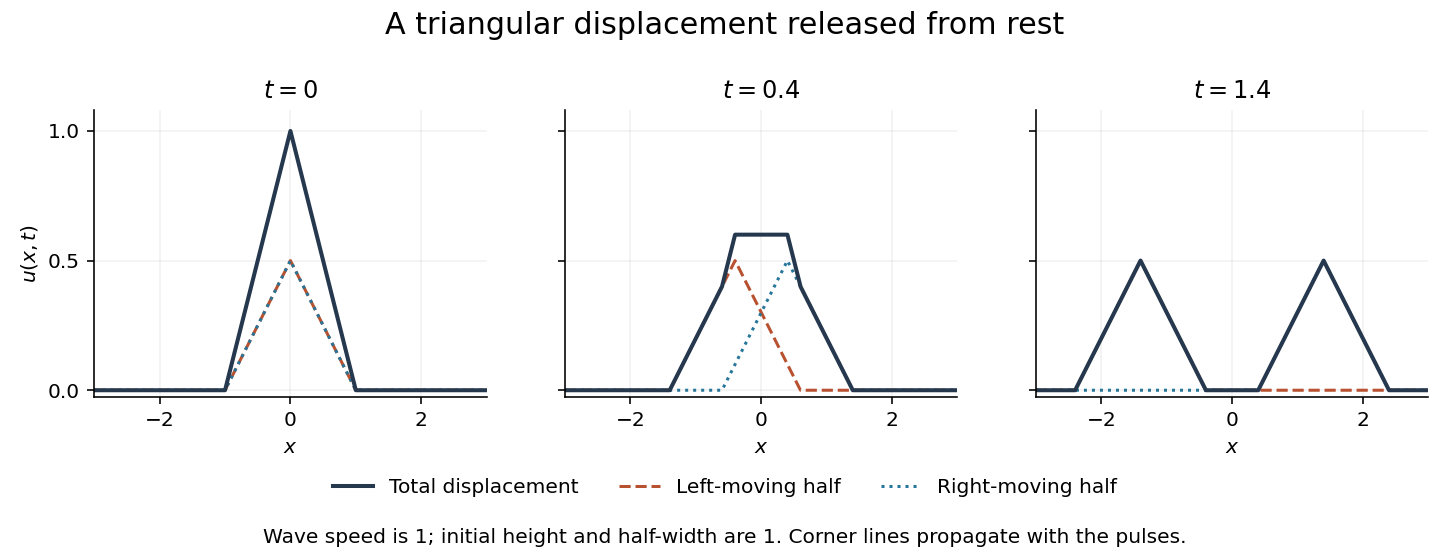
A triangular displacement released from rest splits into two translating half-amplitude pulses; their overlap adds
. Details. 
Because the triangular profile has slope discontinuities, this is a weak solution rather than a globally twice differentiable solution. The initial velocity is zero in the distributional or square-integrable sense, and pointwise away from the initial corners. A classical pointwise time derivative need not exist at those corners; for example near . The initial conditions must be interpreted consistently with this nonsmooth displacement.
Past exam of the mathematics course of the year 2 of the natural sciences course of the University of Cambridge 2013 Paper 2 5 iii Solution by Codex 0 2026-10-18
Codex 0 2026-10-18Apply the identities from part (ii) twice. The second time derivative becomes and the second spatial derivative becomes . The Fourier transform method for the wave equation therefore givesFor each fixed wavenumber , this is a harmonic oscillator equation with angular frequency . At its solutions are affine in time rather than two independent oscillatory exponentials.
Past exam of the mathematics course of the year 2 of the natural sciences course of the University of Cambridge 2013 Paper 2 5 ii Solution by Codex 0 2026-10-18
Codex 0 2026-10-18Under regularity and integrability conditions permitting the limits to pass through the integral, apply the difference quotient directly in time:For the spatial derivative, translate the integration variable in the first term:ConsequentlyThe second calculation is the Translation property of the Fourier transform applied to a difference quotient. These are the Fourier transform of a derivative identities. The stated decay removes boundary terms in the alternative integration-by-parts derivation; rigorous interchange of limits also requires suitable control, for example integrable derivatives. The formulas extend to tempered distributions.
Past exam of the mathematics course of the year 2 of the natural sciences course of the University of Cambridge 2013 Paper 2 5 i Solution by Codex 0 2026-10-18
Codex 0 2026-10-18The triangular function is real and even, so its Fourier transform reduces to a cosine integral:For , one integration by parts gives . Therefore the Fourier transform of a triangular function isThe zero-frequency value is the removable limit and also the area of the triangle. The transform is a squared sinc function, which explains its nonnegativity despite the oscillating Fourier exponential.
Past exam of the mathematics course of the year 2 of the natural sciences course of the University of Cambridge 2013 Paper 2 4 iii Solution by Codex 0 2026-10-18
Codex 0 2026-10-18For , use . The interval traverses once counterclockwise, , and . ThusPut . The two simple poles areTheir moduli are and , so exactly is enclosed, for either sign of . Its residue isThe residue theorem yieldsThis also follows from the reciprocal affine sine integral after an angular shift. At , the original integral is directly , agreeing with the boxed formula. The displayed two-pole formulas require : at zero the contour integrand reduces to with a single pole. Thus the source's claim of two simple poles has this removable special-case exception.
Past exam of the mathematics course of the year 2 of the natural sciences course of the University of Cambridge 2013 Paper 2 4 ii Solution by Codex 0 2026-10-18
Codex 0 2026-10-18The integrand has simple poles at and . Only the first is inside the upper contour, and its residue isThe residue theorem therefore gives, for every ,On the upper semicircle, and . The estimation lemma bounds the arc contribution by . Hence the real-axis integral has the same limit, and taking its real part givesThe imaginary part vanishes independently because is odd. The real integral converges absolutely, since the denominator grows quadratically.
Past exam of the mathematics course of the year 2 of the natural sciences course of the University of Cambridge 2013 Paper 2 4 i Solution by Codex 0 2026-10-18
Codex 0 2026-10-18The only possible singularity of inside the contour is at , with residue . It is at most a simple pole; when , it is removable. Thus the residue theorem gives the Cauchy integral formula,for a counterclockwise simple contour containing once, with analytic on a neighbourhood of the contour and its interior. More generally the answer is , where the winding number accounts for multiple turns or reversed orientation. A clockwise simple contour has the opposite sign.
Past exam of the mathematics course of the year 2 of the natural sciences course of the University of Cambridge 2013 Paper 2 3 ii Solution by Codex 0 2026-10-18
Codex 0 2026-10-18Choose the polar axis in the source integration along the evaluation vector . The Euclidean distance then satisfies , givingFor the uniform ball, integrate its Newtonian gravitational potential in these spherical coordinates. With ,For , the inner integral isobtained from the antiderivative . ThereforeFor , split the radial integral at . Its two pieces are and . The Newtonian gravitational potential of a uniform solid sphere is consequentlyThe centre value follows by continuity, removing the intermediate . For , the same integral gives , so both the potential and first derivative match at the surface. Finally inside, while is directed inward and vanishes at the centre, checking the sign and normalization.
Past exam of the mathematics course of the year 2 of the natural sciences course of the University of Cambridge 2013 Paper 2 3 i Solution by Codex 0 2026-10-18
Codex 0 2026-10-18Write . Away from the source, the radial Laplacian gives . Through a small source-centred sphere, the outward flux of its gradient isThis identifies a unit Dirac delta at the source. More explicitly, for a smooth compactly supported test function , apply Green's second identity outside the radius- ball. The inner outward normal of that punctured domain is . The term has integral , while tends to . Thus , proving the distributional identityWhenever the integral converges, convolution with this Green function of the Laplacian solves the Poisson equation for Newtonian gravity:The harmonic term represents the homogeneous freedom and is fixed by boundary conditions. For an isolated finite mass distribution, regularity away from the prescribed sources and the normalization at infinity select .
Past exam of the mathematics course of the year 2 of the natural sciences course of the University of Cambridge 2013 Paper 2 2 iv Solution by Codex 0 2026-10-18
Codex 0 2026-10-18A positive matching root gives . Substituting the root value requested by the question gives the intended expressionAfter the index correction in part (iii), this is indeed the lowest mode in the sector, because its condition is and its first positive root is . It is also the minimum over .
However, the literal scalar problem includes , for which matching gives . Its first positive root is , so the actual minimum for the written scalar equations and stated boundary conditions isAn explicit counterexample to the larger proposed minimum is , , with no angular dependence. At , both values are and both radial derivatives are .
To verify minimality, put . The radial problem is , , . Its Rayleigh quotient isFor this is the Dirichlet-Neumann interval problem, whose lowest eigenvalue is . The additional nonnegative terms increase with , proving the scalar minimum and the minimum-at- statement for the restricted family. A monopole-free magnetic multipole interpretation would exclude and yield the intended value, but that extra restriction is not supplied by the stated scalar model. The claim about the first zero is not valid for every as printed.
Past exam of the mathematics course of the year 2 of the natural sciences course of the University of Cambridge 2013 Paper 2 2 iii Solution by Codex 0 2026-10-18
Codex 0 2026-10-18Put . Orthogonality of the Legendre polynomials lets us match each degree separately. Continuity of the field and its radial derivative givesEliminate by multiplying the first equation by and adding it to the second. A nonzero mode therefore requiresThis argument avoids dividing by a potentially zero boundary value. Apply the supplied recurrence with :Consequently spherical Helmholtz matching to a decaying harmonic exterior giveswhere for the sector.
The original PDF has an index error here: it prints rather than in the resulting eigenvalue condition. This cannot be repaired by silently choosing another normalization. If itself were zero at a positive matching root, the boundary equation would also give , contradicting uniqueness for this nonzero solution of a regular differential equation at that point.
Past exam of the mathematics course of the year 2 of the natural sciences course of the University of Cambridge 2013 Paper 2 2 ii Solution by Codex 0 2026-10-18
Codex 0 2026-10-18Separate the interior Helmholtz equation in the same angular basis. Each radial coefficient satisfiesFor , set . The equation becomes . Its regular solution is a Spherical Bessel function , up to a multiplicative constant. The second independent solution is singular as at the origin and is excluded. HenceOne may denote by as in the source. Its leading behaviour ensures regularity. Primes on below refer to its dimensionless argument; differentiating with respect to introduces the factor .
Past exam of the mathematics course of the year 2 of the natural sciences course of the University of Cambridge 2013 Paper 2 2 i Solution by Codex 0 2026-10-18
Codex 0 2026-10-18For separation of variables, write . The exterior Laplace equation separates intoWith , angular regularity at the poles selects and the Legendre polynomial . The radial equation is , an Euler-Cauchy equation with solutions . Decay at infinity excludes the first branch for every , including its constant case. ThereforeThe expansion uses axisymmetric spherical harmonics. The written scalar boundary-value problem permits the term; any additional physical exclusion of that sector must be stated separately.
Past exam of the mathematics course of the year 2 of the natural sciences course of the University of Cambridge 2013 Paper 2 10 iii Solution by Codex 0 2026-10-18
Codex 0 2026-10-18Write the finite cyclic group as , the source's . It is Abelian, so and every conjugacy class is a singleton: there are such classes.
Over the complex numbers, all its irreducible representations are one-dimensional. One direct proof is that the matrix representing has an eigenvector over ; its line is preserved by every power of that matrix and hence by the whole group. Irreducibility forces the line to be the whole representation space. Its eigenvalue must be an th root of unity.
The complex irreducible representations of a finite cyclic group are thereforeTheir generator values are distinct, so no two are equivalent. There are of them, and squared dimensions equal one, exhausting the sum of squares of irreducible representation dimensions: . Thus the list is complete.
For , let , so and . The character table isThe complex-field convention is essential. The preceding part used real matrices, but that does not make the one-dimensional classification valid over : conjugate nonreal characters combine into the two-dimensional irreducible real representations of a finite cyclic group. The character table and dimension-sum result used here have their usual complex meaning.
Past exam of the mathematics course of the year 2 of the natural sciences course of the University of Cambridge 2013 Paper 2 10 ii Solution by Codex 0 2026-10-18
Codex 0 2026-10-18Denote the four listed matrices, in order, by . As permutation matrices, act on the four basis vectors by , and , respectively. Direct multiplication givesThese relations prove closure and show that each element is its own inverse. The identity is included and matrix multiplication is associative, so the matrices form a group.
The relations coincide with those of the Klein four-group : take its half-turn generator to , a reflection generator to , and their product to . All four matrices are distinct, so this assignment is a faithful representation of . It is the four-point regular representation of the Klein four-group.
Every matrix fixes , since it permutes its coordinates. Thereforeis a one-dimensional invariant subspace, nonzero and strictly smaller than the four-dimensional space. This proves the representation is reducible. In fact the four mutually orthogonal sign vectors , , and give invariant lines and completely diagonalize the representation, as in the normalized Hadamard matrix construction.
Past exam of the mathematics course of the year 2 of the natural sciences course of the University of Cambridge 2013 Paper 2 10 i Solution by Codex 0 2026-10-18
Codex 0 2026-10-18For a group representation , a faithful representation is injective, equivalently only for . Thus no distinct group elements are represented by the same linear map.
Two equivalent representations are related by one fixed invertible change of basis: for every . The same must work simultaneously for all group elements.
An irreducible representation acts on a nonzero vector space and has no invariant subspace other than and the whole space. An invariant subspace is one carried into itself by every representing matrix.
The character of a representation isThe cyclic property of the trace makes it invariant under equivalence and constant on conjugacy classes. Its value at the identity is the dimension of the representation.
Past exam of the mathematics course of the year 2 of the natural sciences course of the University of Cambridge 2013 Paper 2 1 iii Solution by Codex 0 2026-10-18
Codex 0 2026-10-18For nonnegative integer , De Moivre's theorem makes its polynomial nature explicit:Every term is a polynomial of degree at most . For , the coefficient of is , so its polynomial degree is exactly . These are the Chebyshev polynomials . Their polynomial form also proves the required boundedness of the function and derivative at both endpoints. Negative labels reproduce and have degree .
The first three areUnder , their cross inner products become integrals of , and on . The constant-cosine integrals vanish, and also integrates to zero. Thus all three pairs are orthogonal. Their squared weighted norms are , respectively; more generally
Past exam of the mathematics course of the year 2 of the natural sciences course of the University of Cambridge 2013 Paper 2 1 ii Solution by Codex 0 2026-10-18
Codex 0 2026-10-18Use the real eigenfunctions, or insert a complex conjugate on the first factor for complex functions. Multiply by , do the same with interchanged, and subtract. Integration by parts givesThe boundary term vanishes because both functions and derivatives are bounded while . For distinct squared indices, orthogonality of Sturm-Liouville eigenfunctions therefore yieldsA second integration by parts, using the equation for , givesThus derivative orthogonality when the Sturm-Liouville potential vanishes givesThe index qualification matters. The source initially allows integer indices, so alone does not imply distinct eigenvalues: gives the same . Taking the conventional nonnegative labels makes the stated conclusion valid. For the polynomial solutions below, , so opposite indices are an explicit counterexample to an unqualified orthogonality claim.
There are unlisted articles, also show them or only show them.