
Beta decay is a weak interaction process changing the proton-to-neutron composition of an atomic nucleus while preserving its mass number. In beta-minus decay, a neutron converts to a proton with an emitted electron and electron antineutrino; in beta-plus decay, a proton converts to a neutron with an emitted Positron and electron neutrino, when the complete energy balance permits it.[ref]
DOE Explains Beta Decay by United States Department of Energy. Beta-minus and beta-plus transformations and emitted particles
The emitted beta particle is created in the transition rather than being an ordinary orbital electron expelled from the atom. Its kinetic energy varies because the available Q value is shared with the neutrino and daughter recoil. A magnetic electron spectrometer can separate different emitted momenta; a detector then records a continuous distribution rather than one universal electron energy.
Conservation of electric charge, energy and angular momentum constrains the final state. Nuclear binding matters: a free proton cannot undergo ordinary beta-plus decay, although an energetically allowed proton-to-neutron transition can occur within an appropriate atomic nucleus.
Alpha decay is radioactive decay emitting an alpha particle, a bound group of two protons and two neutrons. The daughter atomic nucleus therefore has atomic number reduced by two and mass number reduced by four.
A released alpha particle must escape the Coulomb barrier outside the short-range nuclear attraction. Quantum tunnelling explains how emission can occur even when the alpha particle's measured kinetic energy is below the barrier's classical height. The strong sensitivity of tunnelling to energy helps explain widely differing decay lifetimes.
For a specified transition from a parent initially at rest, the alpha particle and daughter share the available Q value through two-body recoil. Different daughter nuclear energy levels can produce distinct alpha lines. Their line energies and populations provide information beyond simply counting the sample's total radioactive activity.
Radiometric dating estimates elapsed time from changes in radionuclide populations, using a known nuclear decay constant and assumptions about the initial composition and subsequent closure to matter exchange.
A radionuclide is a species of atomic nucleus with an unstable nuclear state that undergoes radioactive decay. A sample's expected surviving population decreases with its nuclear decay constant. Carbon-14 is the radioisotope used in radiocarbon dating.
Wireless telegraphy conveys discrete symbols without a connecting message wire. Here the mechanism is radio communication: keyed excitation produces radio waves, a receiving antenna drives a selective electrical circuit, and a detector produces a readable event. This makes a beautiful bridge between resonance and information: accumulating many appropriately timed small electrical disturbances can distinguish one transmission from another. Selectivity is finite, however; resonance alone cannot guarantee immunity to strong unwanted signals or noise.
The 1909 Nobel Prize in Physics recognized Guglielmo Marconi and Karl Ferdinand Braun for contributions to wireless telegraphy.[ref]
The Nobel Prize in Physics 1909 by Nobel Prize Outreach. 1909 award motivation and joint laureates
Their apparatus should be understood as a developing collection of systems. An early coherer receiver, a later tuned receiver and a modern envelope detector are different instruments.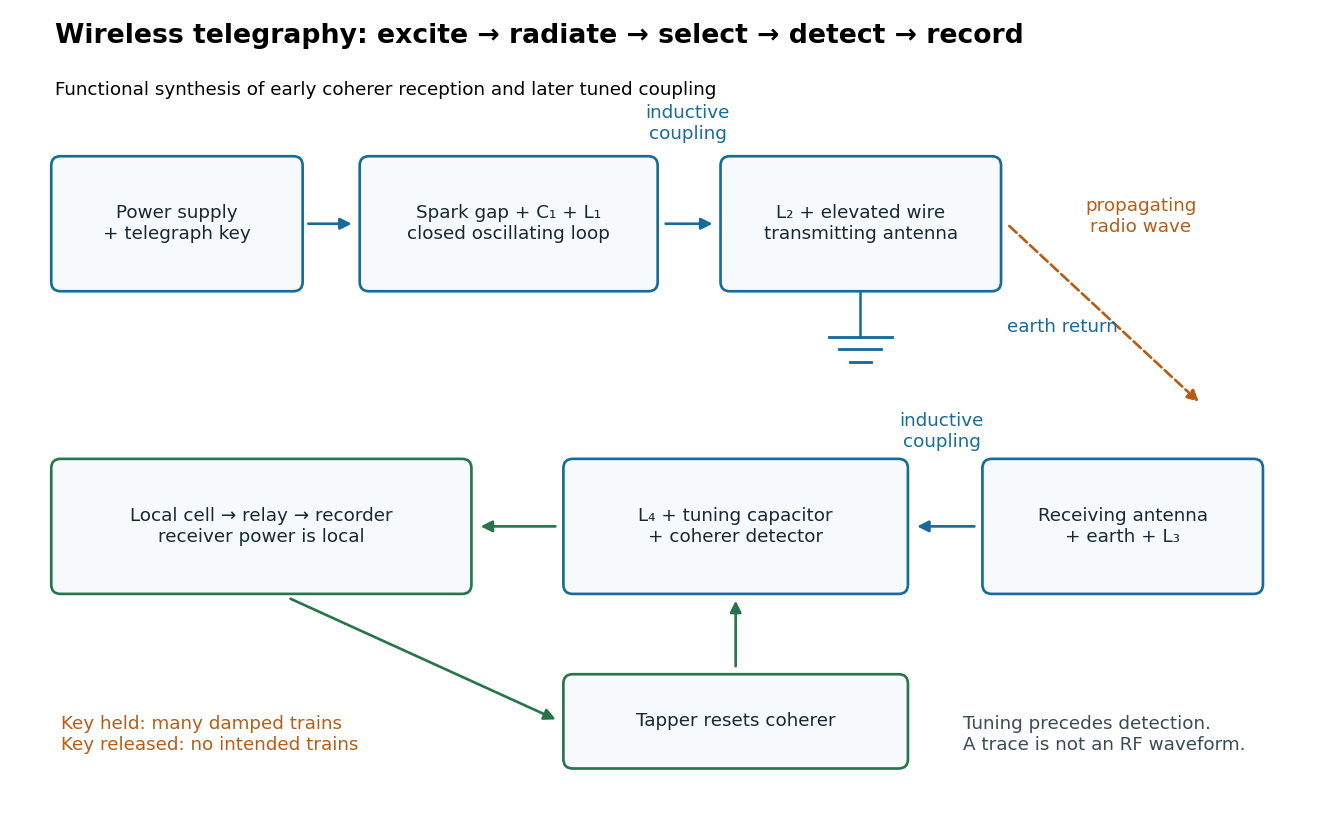
Functional transmit and receive chain for tuned spark wireless telegraphy
. Original functional synthesis of tuned spark wireless apparatus and early coherer reception. Arrows show functional transfer; local battery energy powers recording. Details.
A radio receiver selects and detects an incoming radio wave; its frequency selection affects which signals reach its output.
There are unlisted articles, also show them or only show them.