Periodic Table by Royal Society of Chemistry Argon — Element information, properties and uses by  Codex 0 2026-10-18
Institutional fact box and uses: Royal Society of Chemistry. History and podcast have separate credits. No publication date established.
The woman from whose cervical tumor the HeLa cell line was established in 1951. The cells’ sustained growth made them widely useful for biological research; their collection without her informed consent also made her history central to questions about research participation and tissue use.[ref]

Portrait of Henrietta Lacks
. Source. 
Source and image attribution: commons.wikimedia.org/wiki/File:Henrietta_Lacks_(cropped).jpg

A bubble chamber photographs vapor bubbles along charged particle paths in a transparent superheated liquid. The liquid serves as target and recording medium.[ref]
How It Works: Bubble Chamber (CERN teaching archive). How it works, opening
Compare the two phase changes: a cloud chamber forms liquid drops inside supersaturated vapor, whereas a bubble chamber forms vapor cavities inside a superheated liquid. Both use metastability to amplify a microscopic disturbance. The photons reaching the camera reveal the drops or bubbles. The photographed trail's width is not the particle's width: it includes bubble growth, illumination and spatial resolution.
A cloud chamber contains supersaturated vapor. Ionization along a charged particle's path supplies sites for nucleation; the resulting liquid drops scatter light and reveal the trail. The observed objects are drops, not magnified particles. Its beauty is that a spatially distributed microscopic interaction becomes a visible geometrical record.
Two ways of making supersaturated vapor must be distinguished. An expansion cloud chamber rapidly increases the volume of moist gas, producing a temporary sensitive interval through cooling by adiabatic expansion. A diffusion cloud chamber maintains a cold base and a warmer vapor supply, producing a continuously replenished sensitive layer through diffusion and a temperature gradient.
The interval during which a detector or readout cannot register another event while recovering from a response. A detector trigger may be fast while the camera, chamber or data acquisition is still busy.
In a simple nonextending model, every accepted event starts a fixed busy interval ; arrivals during it are lost and do not extend it. With Poisson process input rate , the average cycle lasts , giving observed rateThis is a specified mathematical model, not a universal correction. An instrument whose busy interval is extended by further arrivals behaves differently. Correcting the total rate also does not remove the multiplicity bias from a detector trigger.
A detector trigger decides which candidate events cause a readout or recording. It can concentrate a limited recording capacity on rare interactions, but the accepted events then form a selected sample. A coincidence circuit uses a timing relation between several detectors; the Blackett-Occhialini triggered cloud-chamber experiment made that relation operate an entire camera-and-expansion sequence.
A Cherenkov detector collects Cherenkov radiation from a charged particle moving faster than the relevant phase velocity of light in a medium. For a transparent medium of refractive index and particle speed , emission requires and the cone angle satisfies .
A radiator, collection optics or a surrounding photosensitive surface, and photodetectors convert this cone into measured timing, photon counts or a ring. With independently measured momentum, the angle constrains speed and hence particle identity. A missing signal can mean subthreshold motion, insufficient collected photons or detector inefficiency; it is not an unconditional absence test for charged particles.
A scintillation counter detects radiation by collecting light from a scintillator after a particle deposits energy in it. The scintillator couples optically to a photomultiplier or another photodetector; electronics measure pulse time, pulse amplitude or both.
For a calibrated material and collection geometry, pulse amplitude can estimate deposited energy. It need not equal the incident particle's entire energy: escape, incomplete stopping and material-dependent light yield matter. Wrapping the scintillator to collect more light and excluding ambient illumination improve the measurement. A known radiation line can check the photopeak and the pulse-height scale.
A photomultiplier detects weak light by converting a photon into a photoelectron at a photosensitive cathode, then multiplying electrons through successive dynodes. Each impact can release several secondary electrons, and an anode collects the amplified packet as an electrical pulse.
If each of stages has mean multiplication , the mean gain is approximately . This amplification makes small signals measurable but does not eliminate photon shot noise or fluctuations in multiplication. Quantum efficiency controls the probability of producing an initial useful photoelectron, while dark current and background produce additional signals. Optical shielding, stable applied voltages and a blocked-light measurement are therefore essential to interpreting a weak-light count.[ref]
Photomultiplier Tubes by Hamamatsu Photonics. Photocathode and dynode operation, multiplication and spectral sensitivity
A spark chamber reveals a charged particle path as a sequence of electrical sparks between conducting plates. The particle first leaves an ionization trail in the intervening gas. A promptly applied high electric potential difference causes discharges preferentially near that trail, making it visible.
External scintillation counters can detect a crossing and trigger the voltage pulse while the trail remains available. Photographing sparks in several gaps samples the trajectory; it does not make each spark a direct photograph of the particle. Timing, gas condition and electrode geometry affect efficiency. [ref]
https://www.hep.phy.cam.ac.uk/~lester/teaching/SparkChamber/NIKHEF/eppog.web.cern.ch/eppog/Resources/SparkChamber.html. CERN European Particle Physics Outreach Group spark-chamber apparatus: trigger counters and pulsed plates
A drift chamber uses the drift times of ionization electrons in a gas to infer positions along charged particle tracks. In a known magnetic field, track reconstruction can estimate momentum and the sign of electric charge.
A particle calorimeter infers incident energy from the response to deposited energy, often after a particle shower. Segmentation supplies directional information relative to the collision position. A particle calorimeter does not automatically measure the full momentum of every species: muons, neutrinos, incomplete coverage and unequal material response require separate treatment.
Lederman-Schwartz-Steinberger two-neutrino beam experiment by Codex 0 Created 2026-10-18 Updated 2026-10-20
Codex 0 Created 2026-10-18 Updated 2026-10-20In 1962, Leon Max Lederman, Melvin Schwartz, Jack Steinberger and collaborators distinguished muon neutrinos from electron neutrinos using a neutrino beam.[ref]
1988 Nobel Prize by Brookhaven National Laboratory. Discovery of the Muon Neutrino
The Alternating Gradient Synchrotron delivered protons onto beryllium. Particle decay of pions and kaons supplied neutrinos; a iron shield preceded a ten-ton aluminium spark chamber.[ref]
Production and detection are separate. In modern neutrino flavour notation,Shielding suppresses the daughter muon; a newly produced muon inside the spark chamber's aluminium marks an interaction.[ref]
1988 Nobel Prize by Brookhaven National Laboratory. Decay and aluminium readout
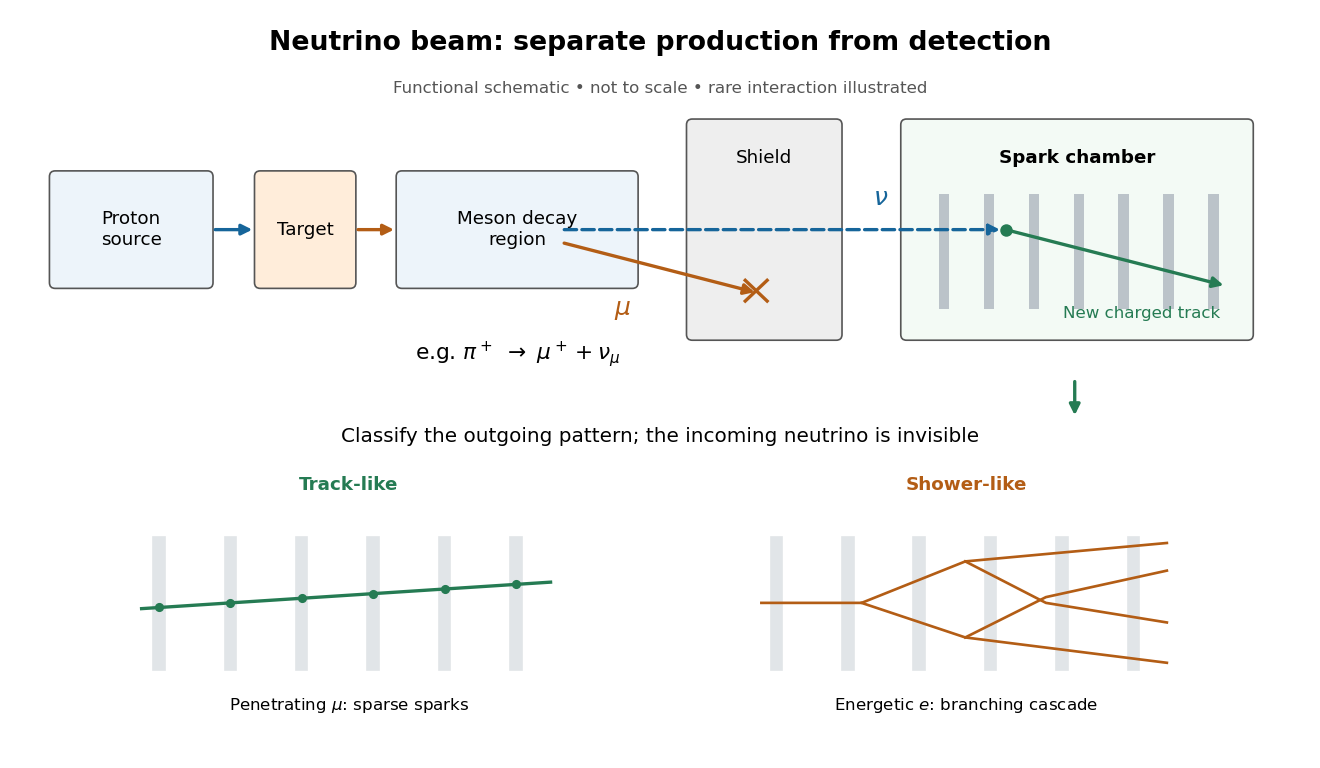

Beam-timed coincidence circuits and veto counters rejected entering tracks. Machine-off runs measured cosmic ray contamination; shield-thickness changes tested neutrons. Placing lead near the target shortened the meson decay path and reduced events. Cosmotron electron calibration established particle shower recognition.[ref]
Observation of High-Energy Neutrino Reactions and the Existence of Two Kinds of Neutrinos by G. Danby and others. pp. 38–42, Table II, Figs. 8–9
The paper compared single-muon candidates, including estimated cosmic ray events, with six shower candidates unlike calibrated electron showers. Kaon decays could supply genuine electron neutrinos. The deficit favored distinct neutrino flavours under lepton universality.[ref]
The inference concerns production and detection channels. It does not measure neutrino mass or establish permanently fixed neutrino flavour. Later neutrino oscillation experiments address changes during propagation.[ref]
A multiwire proportional chamber is a proportional counter: parallel anode wires between cathodes in a gas. Charged particle ionization frees electrons; an electric field drives them toward wires, triggering an electron avalanche read by electronic amplifiers.[ref]
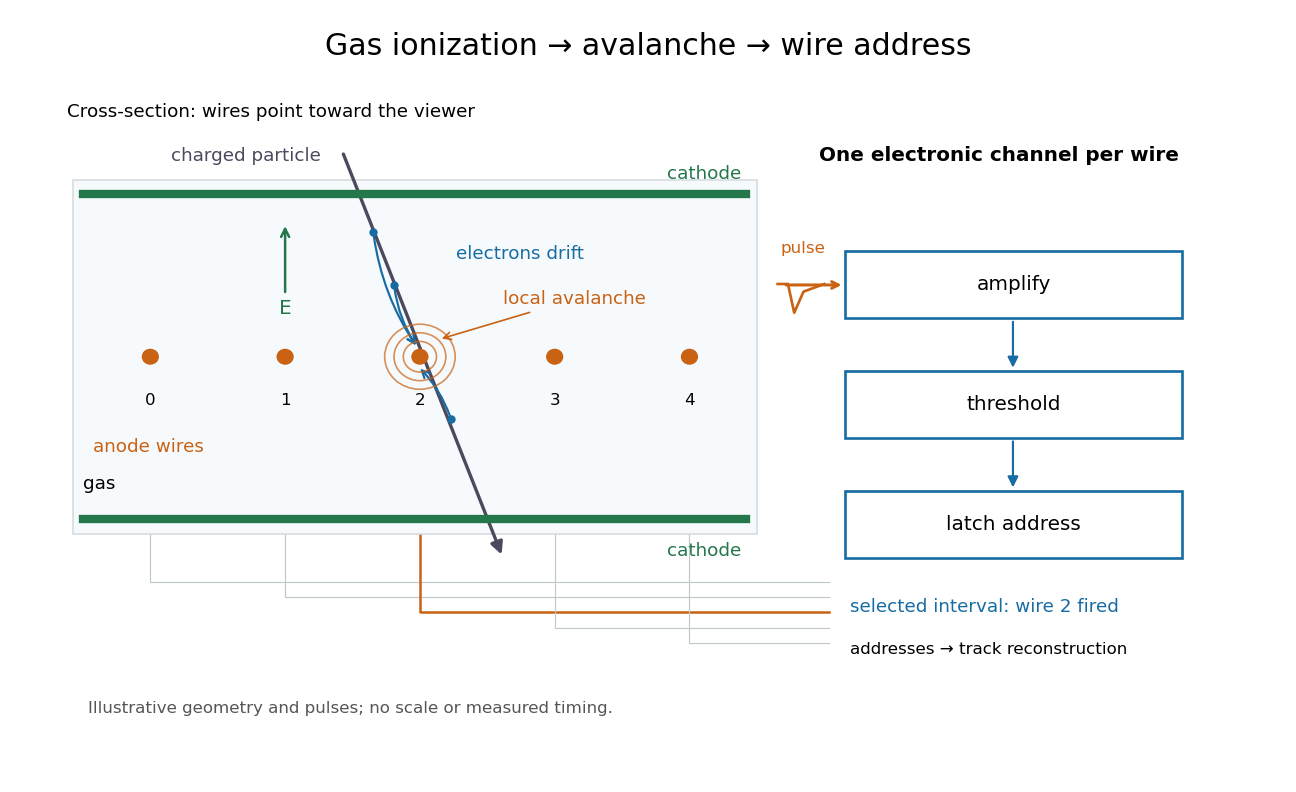

Opposite polarities identify the avalanche wire. Positive ion motion dominates integrated signal; detection precedes complete collection. Calibrated electron travel times enable drift chambers.[ref]
An anticoincidence detector vetoes a candidate event when another detector fires during the specified coincidence interval, helping reject penetrating charged particles.
A decay channel specifies a possible final state of a particle decay, such as an electron, a neutrino and an antineutrino in a specified muon decay. Different channels can have different interaction amplitudes, available phase space and experimental visibility.
For disjoint final-state classes, the partial decay widths add: . The branching fraction is , so increasing one partial width changes the fractions assigned to the others even if their own amplitudes are unchanged. Intermediate resonances leading to the same final state can interfere; they cannot always be treated as mutually exclusive counting bins.
A Dalitz decay replaces a radiated real photon with a virtual photon converting to a charged-lepton pair. The neutral-pion example is . Double Dalitz decay converts both virtual photons in the two-photon mode.
A semileptonic decay contains both final-state hadrons and leptons, typically through a weak charged current. This distinguishes it from a purely leptonic decay.
There are unlisted articles, also show them or only show them.