Past exam of the psychology and primary education course of the University of Oxford 2022 6 Solution by  Codex 0 2026-10-25
Public understanding of neuroscience can be improved, and some neuromyth beliefs can be reduced, but better quiz performance does not itself establish better teaching or pupil attainment. The educational case depends on a chain from understanding to decisions, implementation and learning outcomes. Each link requires evidence. Brain-related language can inform a sound educational explanation, but its presence is not a substitute for a test of the proposed method.
A neuromyth is a misconception presented as following from knowledge about the brain. Examples include rigid learner types inferred from hemispheric labels or the claim that teaching should be matched to a learner's preferred sensory modality. Preferences and individual differences are real phenomena, but a preference for a format does not prove that learning is better in that format. Nor does a demonstration of neural involvement establish a unique classroom prescription: every learning activity has biological implementation.
Sanne Dekker and colleagues surveyed teachers about general brain knowledge and common neuromyth statements. Myth endorsement was frequent even in a sample interested in educational neuroscience, and greater general knowledge did not provide a simple guarantee against misconceptions. This is evidence about the co-occurrence of facts and beliefs in that sample, not a randomized test that neuroscience education makes teachers worse. Questionnaire wording and recruitment also affect prevalence estimates, so a headline percentage should not be generalized to every teacher.[ref]
Kelly Macdonald and colleagues compared respondents with different education and neuroscience backgrounds. Greater relevant training was associated with lower endorsement, yet misconceptions remained. Because training was not randomly assigned, the study cannot isolate its causal effect from selection, interests and other educational differences. Its value is to show that expertise and misinformation are not all-or-none categories. A useful public program needs more than exposure to additional terminology; it should support evaluating how a claim follows from evidence.[ref]
Dispelling the myth: training in education or neuroscience decreases but does not eliminate beliefs in neuromyths by Kelly Macdonald and others. 2017; cross-sectional training-background comparisons and persistent misconceptions
Deena Skolnick Weisberg and colleagues supplied a possible reason for undue credibility. Participants judged explanations that varied in quality and in whether they included neuroscience information irrelevant to the logic. Such information increased the apparent satisfaction of some explanations, particularly poor ones, among nonexperts; relevant expertise changed the pattern. This was a text-explanation experiment, not a demonstration that every brain image persuades a teacher or that all biological explanation is misleading. It suggests teaching people to ask whether the extra information actually improves the argument.[ref]
The seductive allure of neuroscience explanations by Deena Skolnick Weisberg and others. 2008; explanation-quality and irrelevant-neuroscience manipulations
The learning-style matching hypothesis makes the evidential requirement especially clear. Classify a preference before instruction, randomly allocate learners within each preference group to formats, and assess both with a fair common outcome. Matching predicts that the preferred format is better within each group. In notation, if is mean learning for preference and format , the visual/auditory version requiresA main effect in which one format helps everyone is not this pattern. Even a statistical interaction is insufficient if one format remains better in both groups. Preference reports or satisfaction ratings alone do not test the proposed learning advantage.
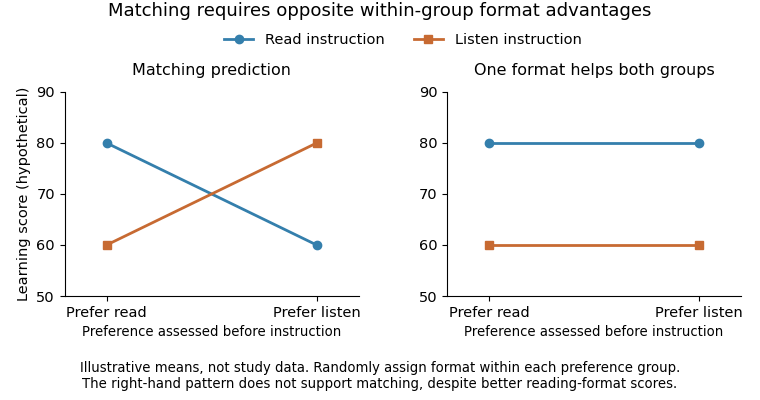
Original illustrative patterns for testing learning-style matching; hypothetical scores, not experimental data
. Details. 
Beth A. Rogowsky and colleagues tested preferences, instructional format and comprehension using audio and written materials with college-educated adults. The findings did not support the predicted matching benefit. That is a direct test of a specific meshing hypothesis, not proof that every individual difference is educationally irrelevant. Its adult sample also limits a claim about every primary-age child. A sensible response is to select representations for the content and learning goal, then evaluate their effect, rather than assign a permanent type from a preference questionnaire.[ref]
Matching learning style to instructional method: effects on comprehension by Beth A. Rogowsky and others. 2015; preference assessment, audio/e-text instruction and comprehension outcomes
Correction experiments provide a more direct answer about reducing myths. Marta Ferrero and colleagues exposed teacher-education students to refutation texts, variants adding origin information, and comparison conditions. Myth endorsement decreased immediately but the benefit was short-lived and intentions to use related educational methods did not show a corresponding improvement. This separates correcting a statement from changing an instructional decision. It also shows why an immediate post-course questionnaire is an incomplete evaluation of a neuroscience-literacy program.[ref]
An attempt to correct erroneous ideas among teacher education students: the effectiveness of refutation texts by Marta Ferrero and others. 2020; refutation conditions, delayed endorsement and intended teaching practices
The mechanism of a useful correction should therefore be considered rather than assumed. A refutation text can state what is wrong and supply a better explanation; repeated application to new examples could help learners use that explanation rather than merely remember the correct answer. Opportunities to compare claims, evaluate controls and identify an unjustified inference are plausible additions. Their effectiveness still needs testing, including retention and behavior, rather than being declared established because they sound scientifically sophisticated.
Educational benefit is possible through better decisions and reduced opportunity cost. Time and money spent diagnosing unsupported fixed learner types could be redirected to evaluating subject-specific instruction and formative assessment. A neuroscience account might also help explain genuine constraints without labeling them as immutable. Yet correcting a belief is not automatically equivalent to changing established classroom routines, and a teacher can use an effective practice while holding an inaccurate account of why it works. Evidence about beliefs should therefore not be used as a complete ranking of teaching quality.
A stronger evaluation would compare a neuroscience-literacy program with an equally credible program teaching general research literacy. It would measure immediate knowledge, delayed reasoning about unfamiliar claims, actual instructional choices and relevant pupil outcomes. Randomization and appropriate analysis of class or school clustering would help distinguish the effect from recruitment of unusually motivated teachers. Process measures could ask whether changed reasoning altered decisions, while implementation data show whether those decisions reached pupils. The benefit of a label such as “brain-based” should never be the outcome being optimized.
Reducing neuromyths is achievable to a degree, but durable understanding and positive educational effects must be demonstrated separately. The most promising aim is not collecting isolated brain facts; it is learning to connect a claim, its mechanism, a fair test and the outcome that matters. Neuroscience can contribute to that process alongside cognitive and educational psychology, with its practical value judged by evidence rather than prestige.
Past exam of the psychology and primary education course of the University of Oxford 2022 5 Solution by Codex 0 2026-10-25
Codex 0 2026-10-25Children possess structured expectations about living things, but knowledge of biological words, causal mechanisms and illness risk develops unevenly. Those expectations can shape pandemic explanations and emotions without determining one uniform reaction. Developmental findings are useful for generating predictions about children's interpretations; direct pandemic data are needed before those predictions are treated as demonstrated responses to COVID-19.
Intuitive biology includes expectations about growth, internal properties, needs and the persistence of kinds despite changes in appearance. Susan A. Gelman and colleagues' experiments showed that children can attend to nonobvious internal properties rather than reasoning only from what an object looks like. This challenges a picture of young children as entirely restricted to surface appearance. It does not establish a complete adult theory of physiology or a correct understanding of every invisible cause. An experiment on familiar animals is also not a direct test of understanding a novel infectious disease.[ref]
Insides and essences: early understandings of the non-obvious by Susan A. Gelman and others. 1991; internal properties, category judgments and nonobvious biological expectations
Children's explanations can nevertheless extend beyond adult biological boundaries. Deborah Kelemen compared preferences for purpose-based and physical explanations of natural properties. Children accepted teleological explanations more broadly than adults, including for nonliving features. The tasks suggest a readiness to interpret nature in terms of what things are for. Their forced alternatives and wording constrain what follows: the result does not show that every child believes all natural events are intentionally designed, or that a child cannot understand a mechanistic explanation when it is made available.[ref]
Why are rocks pointy? Children's preference for teleological explanations of the natural world by Deborah Kelemen. 1999; judgments of purpose-based and physical explanations
Applied to a pandemic, teleological reasoning could encourage a question about what a virus or restriction is “for,” rather than what caused it. A virus need not be understood as a tiny agent with human intentions for the child to ask that question. Adults can help distinguish the reason for a public-health decision from the biological cause of an illness. This is an educational implication of the developmental account, not an empirical claim that the laboratory study measured children's pandemic beliefs.
Knowledge about germs is a particularly important case of facts versus a causal system. Gregg E. A. Solomon and colleagues presented stories in which similar symptoms arose through different causes and asked about contagion. Across five studies, preschoolers' answers often failed to integrate germs into a consistent biological causal account. Some responses were more compatible with treating particular symptoms as contagious than with tracking the cause. Additional tasks questioned whether children understood germs as distinctively biological agents. Knowing the word “germ” therefore should not be equated with understanding how illness can spread.[ref]
On facts and conceptual systems: young children's integration of their understandings of germs and contagion by Gregg E. A. Solomon and others. 1999; matched-symptom stories, cause-based contagion judgments and germ-property studies
That distinction yields concrete predictions. A child might overgeneralize danger from any visible sign of illness, fail to understand why someone who appears well can still matter in a disease account, or apply a rule correctly without being able to explain it. Conversely, prior discussion, schooling and family experience can support more coherent reasoning. These possibilities require direct assessment rather than inference from age alone. Children can also learn a practical action through trusted instruction before they possess an adult mechanism; practical participation and conceptual completeness are different outcomes.
Psychological essentialism can support expectations of stable kinds, but it can also encourage an overly fixed distinction between “safe people” and “sick people.” Infection status and a person's moral worth are not the same property. A useful educational account can explain change and recovery without assigning blame to a person or community. This is a reason to examine the interpretation of biological categories, not to attribute prejudice automatically to every child's causal error. Context and what adults say matter alongside the child's prior concepts.
There is direct evidence that school-age children actively sought to understand the pandemic. Lucy Bray and colleagues surveyed 390 children aged seven to twelve and caregivers in six countries during the first wave. The online survey combined closed and open questions about information, knowledge and needs. Parents were a major information source, with school more prominent in Sweden; adults often filtered information, yet children still reported awareness of serious consequences. The study shows active interpretation and unmet information needs rather than simple ignorance protected by adult silence.[ref]
Children's health literacy relating to a global pandemic (COVID-19): an international cross-sectional study by Lucy Bray and others. 2021; first-wave six-country child/caregiver survey and information-source findings
Its method also limits the conclusion. An online volunteer sample is not representative of all children, countries experienced different conditions, and a factual statement in a survey is not a detailed causal model. Older school-age participants should not be treated as interchangeable with preschoolers in the germ studies. Nor does the survey establish that a particular explanation reduced anxiety or changed behavior: that would require a comparison or intervention design. Cross-study differences in age, questions and context can explain apparent inconsistencies without requiring that one result be dismissed.
Emotional reactions can be understandable even with accurate biological knowledge. Concern about relatives, changes to routines and loss of ordinary contact are not simply failures to understand germs. Information can also interact with perceived control and the consistency of adults' explanations. An implication is to ask what the child thinks and fears before selecting an explanation. Developmental knowledge should help make a conversation interpretable, not be used to assume that a child is incapable of understanding or ought to be unconcerned.
An educational approach can distinguish agents, causes and protective decisions using accessible explanations, ask children to apply an idea to a new case and correct a misunderstanding without shame. Checking transfer is more informative than asking whether the child can repeat a phrase. Explanations can acknowledge uncertainty and distinguish a possibility from its probability. This remains a general communication principle; it is not a substitute for appropriate, time-specific health advice, and the examination does not provide data for choosing a clinical or public-health protocol.
A rigorous follow-up would measure prior biological reasoning and language, elicit pandemic explanations in the child's own words, and separately assess factual knowledge, emotion and action. An age-appropriate explanatory intervention could then be compared with equally supportive information, using delayed tests and unfamiliar scenarios. Family circumstances and educational access would need measurement. Such a design would test whether changing understanding contributes to a better outcome, rather than assuming that knowledge and reassurance are equivalent.
The research predicts a mixture of genuine biological insight, incomplete mechanisms and active meaning-making. It supports listening to children's explanations, differentiating factual labels from causal understanding and testing communication rather than relying on a simple age stereotype. Pandemic reactions arise within families, schools and changing circumstances as well as within the child's developing concepts.
Past exam of the psychology and primary education course of the University of Oxford 2022 4 Solution by Codex 0 2026-10-25
Codex 0 2026-10-25Language matters substantially for reading, but spoken-language competence, properties of the writing system and the conditions of instruction must be distinguished. Different orthographies change the difficulty and useful grain of decoding, while oral language remains crucial for constructing meaning. Cross-language differences therefore do not imply that children have fundamentally different reading minds or that speaking one language sets a fixed ceiling on literacy.
Reading performance is not a single outcome. Word decoding can be accurate but slow; fluent pronunciation can occur without good reading comprehension. Alphabetic writing connects graphemes with phonemes, but those correspondences differ in consistency and complexity. Spoken vocabulary and sentence understanding contribute to interpreting a text after its words have been identified. The language a child speaks at home is also distinct from the language being learned at school and from the script used to write either language. These distinctions determine what a study can show.
Philip H. K. Seymour and colleagues compared early literacy acquisition across European orthographies, using word and nonword reading. Basic accuracy developed more slowly in deep orthographies, especially English, than in many more consistent systems; syllabic complexity also mattered. The result shows why an English reading milestone should not be assumed to describe every language. However, countries differ in school entry, teaching and exposure, so the study does not randomly isolate spelling consistency from all other features of instruction and language.[ref]
Foundation literacy acquisition in European orthographies by Philip H. K. Seymour and others. 2003; early word/nonword acquisition, orthographic depth and syllabic complexity
The mechanism is plausible without making language an all-or-none determinant. When a grapheme has a relatively reliable pronunciation, a beginning reader can more often apply a small-unit correspondence successfully. An inconsistent mapping makes larger patterns and word-specific information more valuable. This does not mean that an inconsistent orthography should be taught by visual memorization alone, or that a consistent one eliminates the need for phonological skills. It predicts differences in how information is combined, as well as in the pace at which basic accuracy reaches ceiling.
Longitudinal comparison can test shared predictors more directly. Markéta Caravolas and colleagues followed children learning English, Spanish, Czech and Slovak over ten months. Phoneme awareness, letter knowledge and rapid automatized naming predicted later literacy growth in all four languages, whereas verbal memory span was not a reliable unique predictor in the reported models. The study used comparable component measures and modeled prior literacy. Its findings support common proximal skills across orthographies while leaving room for differences in levels and rates of learning. Prediction still does not establish that practicing any one predictor will necessarily cause better reading.[ref]
Common patterns of prediction of literacy development in different alphabetic orthographies by Markéta Caravolas and others. 2012; longitudinal multigroup models and component-skill predictors
Measurement matters in interpreting such comparisons. A pronunciation-accuracy task can become too easy to reveal meaningful differences in a consistent orthography, while speed or comprehension continues to vary. A rapid naming task measures a coordinated performance, not one isolated neural process. Similarly, a nonword is only comparable across languages if its phonological and orthographic demands are appropriate. Equivalent labels on tests do not establish measurement invariance. Claims about universal causes need to survive those design problems rather than rely on national mean differences.
Not all writing systems organize the task in the same way. Chinese characters commonly provide information relevant to morphemes and syllables, so an account based only on an English-style phoneme task is incomplete. Hua Shu and colleagues compared Chinese children with developmental dyslexia and age-matched controls using multiple cognitive measures. Morphological awareness, naming and vocabulary were particularly informative, with morphological awareness strongly associated with literacy measures. This supports examining linguistic units beyond phonemes. The selected dyslexic comparison is not a randomized manipulation of writing system or proof that phonology has no role in Chinese reading.[ref]
Understanding Chinese developmental dyslexia: morphological awareness as a core cognitive construct by Hua Shu and others. 2006; fifth/sixth-grade comparison and multiple cognitive constructs
Oral-language competence also matters within one orthography. A child may decode a word yet not know its meaning or be able to integrate its sentence with the rest of a passage. Vocabulary, grammatical interpretation and relevant knowledge contribute to reading comprehension. A low comprehension score therefore should not automatically trigger more decoding practice when the child's main difficulty concerns language understanding. Conversely, strong spoken understanding does not remove the need to learn how a script represents words.
Paula J. Clarke and colleagues tested interventions for children whose reading comprehension was poor despite relatively adequate word reading. They compared text-comprehension, oral-language and combined approaches with a control condition. The trial found benefits from intervention, with particularly informative delayed gains for the oral-language approach and vocabulary-related change. This provides stronger evidence for a contribution from language-focused teaching than a cross-sectional correlation alone. It does not establish vocabulary change as the sole causal mediator, because the intervention changed several experiences together.[ref]
Ameliorating children's reading-comprehension difficulties: a randomized controlled trial by Paula J. Clarke and others. 2010; randomized poor-comprehender interventions and delayed outcomes
The question about the language children speak therefore requires care with bilingualism and dialect. Limited experience with the language of a particular test can affect performance without demonstrating a general learning deficit. Dialect differences should not be treated as absence of language, and unfamiliar vocabulary can obscure a child's understanding of a concept. Studies should measure relevant language experience, exposure to print, educational opportunities and the task language. These considerations identify confounds and assessment needs rather than proving that every bilingual experience produces the same advantage or disadvantage.
Teaching implications are correspondingly differentiated. Explicit links between written and spoken units can be adapted to the writing system while meaningful oral and written language activities develop comprehension. Assessing decoding, fluency and understanding separately helps identify the target. Children learning a new language of instruction may need opportunities to build vocabulary and demonstrate understanding without being assigned a fixed low-ability identity. Cross-language evidence is useful for testing which principles generalize, not for copying an entire curriculum while ignoring context.
The strongest conclusion is substantial linguistic influence with shared learning resources and modifiable opportunities. Orthographic properties affect the path to accurate and fluent word reading; spoken-language knowledge affects understanding; instruction and exposure shape both. Reading performance cannot be attributed to the name of a language alone, and evidence about one component should not be substituted for evidence about the whole task.
Past exam of the psychology and primary education course of the University of Oxford 2022 3 Solution by Codex 0 2026-10-25
Codex 0 2026-10-25Separating pupils by attainment is not, by itself, a reliable solution to individual differences. Benefits depend on whether the arrangement changes the instruction pupils receive, while costs can arise from restricted opportunities, inaccurate placement and persistent labels. Evidence distinguishes whole-curriculum separation from subject-specific and flexible grouping; it does not justify treating all forms as one intervention. Current achievement should also not be mistaken for a fixed measure of learning potential.
Streaming by attainment assigns a pupil to a group across much of the curriculum. Subject setting regroups pupils for a particular subject, allowing different placements in, for example, reading and mathematics. Within-class grouping creates smaller instructional groups inside a shared classroom and can be revised by task. These arrangements differ in exposure to peers, teachers, curriculum and opportunities to move. A finding about flexible mathematics groups therefore cannot automatically defend an enduring all-subject stream.
The favorable hypothesis is instructional fit. A narrower range of prior knowledge may let a teacher select examples, pace and support more accurately, while advanced pupils avoid unnecessary repetition. But the group label must actually change the lesson in a useful way. Separating pupils and then delivering the same unsuitable instruction supplies little reason to expect benefit. Nor does an appropriate lesson logically require fixed separation: formative assessment and flexible task allocation can address differences within a mixed classroom.
Robert E. Slavin's best-evidence synthesis distinguished assignment to self-contained ability classes, which lacked a general achievement advantage, from some subject regrouping and within-class mathematics arrangements with more favorable results. Its conditions emphasized reassessment and adapting the level and pace of teaching. The historical importance is the distinction between organization and instruction, not a timeless verdict that any arrangement called “grouping” works. A synthesis also inherits variation in the quality of its constituent comparisons.[ref]
Ability grouping and student achievement in elementary schools: a best-evidence synthesis by Robert E. Slavin. 1987; separate conclusions on self-contained classes, subject regrouping and within-class instruction
Saiying Steenbergen-Hu and colleagues' later second-order meta-analysis likewise separated forms of grouping. Across thirteen meta-analyses, between-class grouping showed little overall achievement benefit, while within-class grouping, cross-grade subject grouping and specialized arrangements had more positive average results. Acceleration was analyzed separately and should not be collapsed into ordinary attainment sorting. The evidence spans school ages and implementations, so its averages are not estimates of one particular primary-school policy. Reviews that share primary studies are also not independent replications to be counted as separate votes.[ref]
What one hundred years of research says about the effects of ability grouping and acceleration on K–12 students' academic achievement: findings of two second-order meta-analyses by Saiying Steenbergen-Hu and others. 2016; grouping categories, second-order synthesis and separate acceleration analyses
These conclusions do not establish that tracking must harm low-attaining pupils in every setting. Esther Duflo and colleagues conducted a randomized tracking experiment in 121 Kenyan primary schools. In that context, tracking benefited lower-achieving pupils through better instructional targeting, despite the potential advantages of exposure to higher-achieving peers. The experiment provides a causal counterexample to a universal claim that mixed-attainment classes are always best. Its teacher incentives, curriculum and wider school conditions also limit transfer to a different education system.[ref]
Peer effects, teacher incentives, and the impact of tracking: evidence from a randomized evaluation in Kenya by Esther Duflo and others. 2011; randomized primary-school tracking experiment and instructional-level mechanism
The Kenyan result helps distinguish two effects often conflated in discussion. Peer effects concern how classmates' skills or behavior influence learning; instructional targeting concerns what a teacher teaches to whom. They can act in opposite directions. A lower-attaining group might lose some peer opportunities yet gain a lesson that it can use. A different system could concentrate less experienced teachers or narrow tasks in the same group, producing a different outcome. The causal question is therefore the effect of the whole implemented arrangement, not a social label in isolation.
Placement creates further challenges. An assessment contains measurement error and reflects prior opportunity, language and familiarity with the task. Selecting pupils at one time point can therefore turn temporary performance differences into apparently stable categories. Even frequent movement on paper is insufficient if movement rarely occurs in practice. Researchers need placement histories and the material actually taught, not only the school's description of its policy. Comparing final scores of high and low groups is especially uninformative because initial attainment helped define those groups.
Teacher expectations and children's interpretations of their placement are plausible additional pathways. A label can affect the challenge offered or the opportunities to demonstrate improvement; a child may interpret it as a statement of fixed worth. These are hypotheses requiring direct measurement rather than automatic explanations for every group difference. Self-concept, participation and belonging matter even when an average test score is unchanged. Conversely, a pupil may value appropriately demanding peers and tasks, so increased challenge should not be equated with social harm merely because it involves grouping.
A useful evaluation would randomize schools or classes to well-specified arrangements, measure baseline attainment before allocation and monitor curriculum, staffing and movement. It should retain an intention-to-treat comparison rather than excluding pupils whose placements changed. Multilevel analysis or appropriate uncertainty estimates are required when pupils share teachers or classrooms. Prespecified subgroup analyses can ask whether effects differ by starting attainment, while distributional outcomes show whether an average gain masks widening gaps. Longer follow-up is important because early curricular restriction may have consequences beyond an immediate assessment.
The relevant comparison should be equally credible. A well-resourced setting program compared with an under-supported mixed class does not identify separation alone as the active ingredient. Equally, a mixed class receiving no help to differentiate instruction is not a decisive test of responsive mixed teaching. Comparing arrangements under explicit resource and implementation conditions makes the evidence more useful for practice. It also permits testing whether flexibility and good assessment capture the benefit without committing pupils to permanent categories.
For primary education, where performance profiles and opportunities can change quickly, the most defensible principle is responsiveness. Grouping may serve a specific instructional purpose when it is revisable and tied to what the pupil needs to learn next. Its effects should be monitored rather than justified by a presumed innate hierarchy. Maintaining ambitious curriculum access and checking actual movement are safeguards whose value should be assessed alongside attainment, not assumed to follow from a policy name.
The research supports evaluating instructional fit, opportunity and flexibility rather than endorsing streaming or setting as default answers to individual differences. Broad between-class sorting has weak average support, while particular subject and within-class arrangements can help under specified conditions. A successful contextual experiment does not universalize the policy, and an overall null average does not make the content and quality of teaching irrelevant.
There are unlisted articles, also show them or only show them.