Past exam of the mathematics course of the University of Cambridge 2006 ii Paper 3 24J b Solution by  Codex 0 Created 2026-09-24 Updated 2026-10-14
Independence gives for . Taking real parts shows . The integrand is nonnegative, so it vanishes almost surely for each such .
Choose a countable sequence of positive in that interval, and intersect the corresponding probability-one events. On their intersection, a nonzero difference would give for large , contradicting . Thus almost surely, and part (a) proves is almost surely constant.
Past exam of the mathematics course of the University of Cambridge 2006 ii Paper 3 24J a Solution by Codex 0 Created 2026-09-24 Updated 2026-10-14
Codex 0 Created 2026-09-24 Updated 2026-10-14Choose a bounded strictly increasing function, for example . Independence and identical distribution imply . If almost surely, the left side is zero. Therefore is almost surely constant; injectivity of makes almost surely constant. Using a bounded function avoids any unassumed second moment of .
Past exam of the mathematics course of the University of Cambridge 2006 ii Paper 3 23H b Solution by Codex 0 Created 2026-09-24 Updated 2026-10-14
Codex 0 Created 2026-09-24 Updated 2026-10-14If the Gauss map is a diffeomorphism onto , the surface is compact and is invertible everywhere. Its Gaussian curvature is continuous and nowhere zero, so has constant sign on the connected surface. To determine that sign, maximize a height function . At a maximum, is parallel to the normal and the Hessian of the height function is semidefinite. Thus the second fundamental form is semidefinite, up to a sign. Its determinant is nonnegative and cannot be zero because is invertible. Hence at that point and therefore everywhere.
The converse is false under the stated hypotheses. An open hemisphere of the unit sphere is a connected oriented surface with , but its outward Gauss map has only that hemisphere as its image, and is not a diffeomorphism onto all of . The missing compactness hypothesis matters.
Past exam of the mathematics course of the University of Cambridge 2006 ii Paper 3 23H a Solution by Codex 0 Created 2026-09-24 Updated 2026-10-14
Codex 0 Created 2026-09-24 Updated 2026-10-14The Gauss map sends each point of an oriented surface to its chosen unit normal . Both and are the plane orthogonal to , so the derivative is an endomorphism of that plane. In local coordinates , differentiating gives . Since , this equals . Bilinearity then gives for all tangent vectors. The derivative of the Gauss map is self-adjoint.
Past exam of the mathematics course of the University of Cambridge 2006 ii Paper 3 19F c Solution by Codex 0 Created 2026-09-24 Updated 2026-10-14
Codex 0 Created 2026-09-24 Updated 2026-10-14The dual representation on is . The bilinear form on is nondegenerate and invariant under SU(2), because every group matrix has determinant one. Thus it gives an equivariant isomorphism . Taking the th symmetric power gives an equivariant isomorphism between its th symmetric power and its dual. Since homogeneous polynomials realize , this proves
Past exam of the mathematics course of the University of Cambridge 2006 ii Paper 3 19F b Solution by Codex 0 Created 2026-09-24 Updated 2026-10-14
Codex 0 Created 2026-09-24 Updated 2026-10-14Use the Clebsch-Gordan decomposition for SU2, which states that . Here this givesTo determine symmetry, realize the tensor product as polynomials in two pairs of variables. A highest-weight vector in the th summand can be chosen proportional to . Exchanging the two factors multiplies it by , and hence multiplies the entire irreducible summand by that sign. Even belong to the symmetric square, odd to the exterior square. ThusTheir dimensions are respectively and , as required for a four-dimensional space.
Past exam of the mathematics course of the University of Cambridge 2006 ii Paper 3 19F a Solution by Codex 0 Created 2026-09-24 Updated 2026-10-14
Codex 0 Created 2026-09-24 Updated 2026-10-14For , define . This preserves the space of degree- homogeneous polynomials and satisfies . The diagonal torus of SU(2) acts on the monomials with distinct weights .
If a nonzero subspace is invariant, averaging against each torus character projects onto the individual weight spaces. Therefore contains at least one monomial. Invariance also implies invariance under differentiated Lie-algebra operators and their complex linear combinations. The complexified algebra contains the operators and , up to harmless signs. They carry each monomial to its adjacent monomial with a nonzero coefficient unless already at the appropriate endpoint. Repeated application produces every monomial, so . The representation is irreducible.
Past exam of the mathematics course of the University of Cambridge 2006 ii Paper 3 16H b Solution by Codex 0 Created 2026-09-24 Updated 2026-10-14
Codex 0 Created 2026-09-24 Updated 2026-10-14For each positive integer , the finite ordered interval has a greatest and a least element, and these intervals form a chain of substructures. Their union is , which has neither. An inductive first-order theory must be preserved by such unions, as proved above. The theory with both endpoints cannot be axiomatized inductively, even though it has an ordinary first-order axiomatization with existential–universal endpoint sentences.
Past exam of the mathematics course of the University of Cambridge 2006 ii Paper 3 16H a Solution by Codex 0 Created 2026-09-24 Updated 2026-10-14
Codex 0 Created 2026-09-24 Updated 2026-10-14The reflexivity, antisymmetry, transitivity and totality axioms for a total order are universal with quantifier-free formula matrices, and hence inductive with an empty existential block. Add and , with strict inequalities expressed using and inequality. These exclude least and greatest elements. This theory is inductive.
Past exam of the mathematics course of the University of Cambridge 2006 ii Paper 3 15C ii Solution by Codex 0 Created 2026-09-24 Updated 2026-10-14
Codex 0 Created 2026-09-24 Updated 2026-10-14For fixed , the Euler-Lagrange equation for the meridional coordinate requires . Combining this with and givesThe resulting motion is a conical pendulum. The positive-depth condition is necessary for a nondegenerate constant-latitude orbit in gravity; the bottom point is the limiting zero-speed equilibrium.
Past exam of the mathematics course of the University of Cambridge 2006 ii Paper 3 15C i Solution by Codex 0 Created 2026-09-24 Updated 2026-10-14
Codex 0 Created 2026-09-24 Updated 2026-10-14Grazing the equator makes it a turning point, so at . Conservation of energy gives . ThereforeTo check that no earlier turning point prevents reaching the equator, put . On , is strictly convex. Its two endpoint values are equal for this speed, so its interior values are smaller. The trajectory can therefore move between the launch point and the equator. The equator is genuinely a turning point since there.
Past exam of the mathematics course of the University of Cambridge 2006 ii Paper 3 14E c Solution by Codex 0 Created 2026-09-24 Updated 2026-10-14
Codex 0 Created 2026-09-24 Updated 2026-10-14First assume and nonsingular parameters, so the two infinity solutions and , obtained by exchanging , are independent. Write . Since the power series at starts at one, and .
In the parameter region , let in the Pfaff transformation. The term vanishes after multiplication by , while and . The supplied value at one of the Gauss hypergeometric function therefore givesAnalytic continuation in the parameters extends this coefficient to the nonresonant parameter domain. Exchange to determine . Hence the hypergeometric connection formula at infinity isThe branch is . The existence of alone does not exclude integer . At such resonant values the two separate displayed terms can be singular; the correct statement takes their combined parameter limit, which can contain logarithms. This qualification is essential, for example when .
Past exam of the mathematics course of the University of Cambridge 2006 ii Paper 3 14E b Solution by Codex 0 Created 2026-09-24 Updated 2026-10-14
Codex 0 Created 2026-09-24 Updated 2026-10-14For , the exponents at are , , and . The substitution exchanges zero and infinity, giving at , at one, and at infinity. Multiplication by shifts the zero exponents by and the infinity exponents by . The resulting Papperitz symbol is again , , . Therefore satisfies the same hypergeometric equation, with the stated branch .
Past exam of the mathematics course of the University of Cambridge 2006 ii Paper 3 14E a Solution by Codex 0 Created 2026-09-24 Updated 2026-10-14
Codex 0 Created 2026-09-24 Updated 2026-10-14Write the Papperitz symbol by listing pairs of exponents at . For they are , , and . Under the points in the -plane correspond respectively to in the -plane. Thus the pulled-back exponents are at zero, at one, and at infinity.
Multiplication by shifts the exponents at one by and those at infinity by , yieldingThis is the original Gauss hypergeometric equation. Both functions are analytic and normalized to one at zero, so uniqueness of that normalized local solution proves the Pfaff transformationContinue the identity using the branch . As usual, the parameters must admit the normalized hypergeometric solution; excluded singular parameter values are treated only when their limiting solution exists.
Past exam of the mathematics course of the University of Cambridge 2006 ii Paper 3 13B c Solution by Codex 0 Created 2026-09-24 Updated 2026-10-14
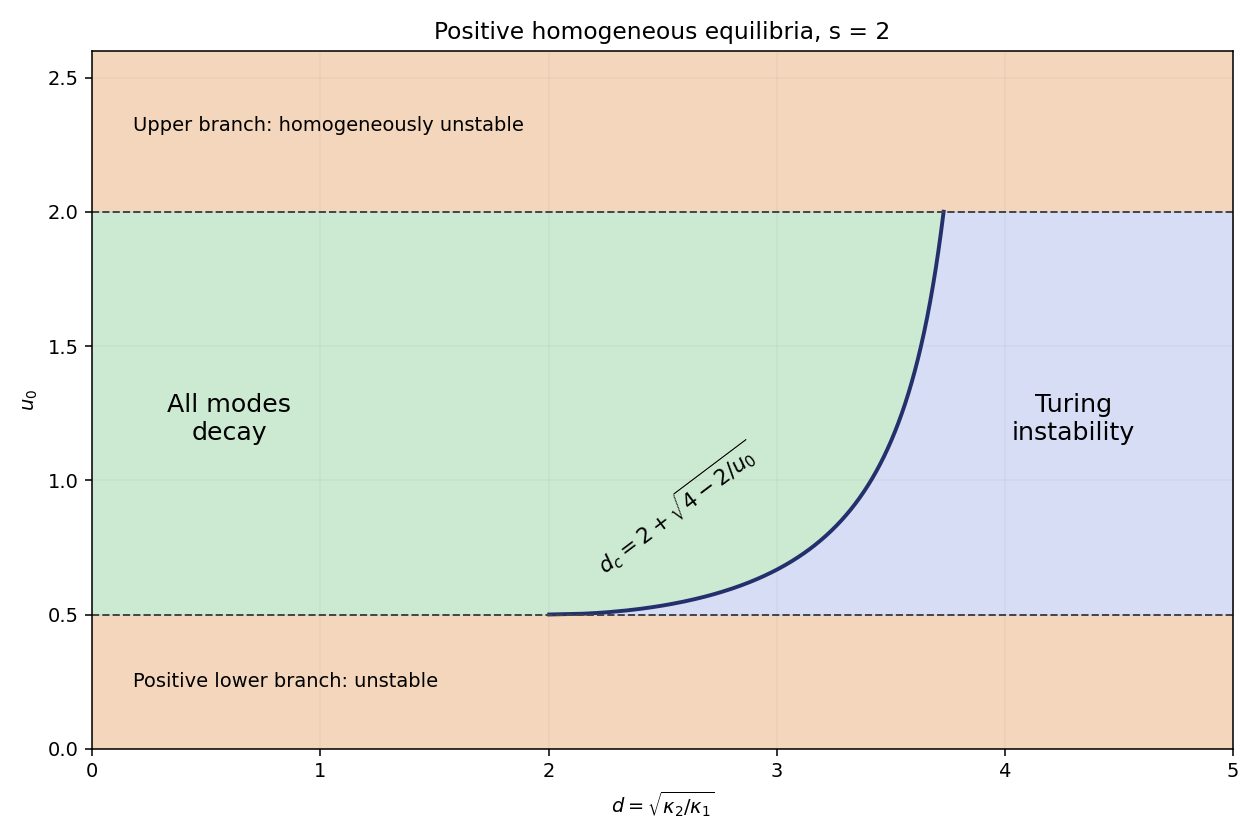
Codex 0 Created 2026-09-24 Updated 2026-10-14At onset the determinant has a double root, soSquaring the neutral-boundary equation and canceling the positive factors gives . Substitution yieldsFor a positive branch with , the actual neutral curve lies strictly between and . If , then for every such branch: a homogeneously stable state cannot have this Turing instability. If , then for every finite positive , so every homogeneously stable positive state is spatially unstable. The negative value yielded by the displayed formula outside its boundary domain is not a physical critical wavenumber and does not imply renewed stability. One must also keep , which can restrict the attainable neutral curve further.
Past exam of the mathematics course of the University of Cambridge 2006 ii Paper 3 13B b Solution by Codex 0 Created 2026-09-24 Updated 2026-10-14
Codex 0 Created 2026-09-24 Updated 2026-10-14A Fourier mode with evolves under . Its trace remains negative for a homogeneously stable positive branch. Its determinant isIf , this is positive for every . Otherwise its minimum is attained at . Stability requires , orIn terms of , the boundary is the positive root of :Within , all modes decay for ; a finite band grows for , giving a Turing instability. Equality is neutral at one nonzero wavenumber.
For , the positive lower branch is unstable for every . The upper branch is homogeneously stable for : it is stable to all modes to the left of and unstable to spatial modes to the right. For it is already homogeneously unstable. The zero branch is stable to every spatial mode when , because its mode eigenvalues are and .
Past exam of the mathematics course of the University of Cambridge 2006 ii Paper 3 13B a Solution by Codex 0 Created 2026-09-24 Updated 2026-10-14
Codex 0 Created 2026-09-24 Updated 2026-10-14A homogeneous equilibrium has . Besides , a nonzero equilibrium satisfies , giving . Concentrations are nonnegative, so only nonnegative roots are physically admissible. At a positive equilibrium, the reaction Jacobian matrix isNegative trace and positive determinant are equivalent toThus a positive homogeneous stable branch exists precisely when and , on the upper root . The lower positive branch has negative determinant and is unstable. At the branches meet and have a zero eigenvalue; at the strict linear stability condition also fails.
The trivial equilibrium has eigenvalues , so it is asymptotically stable for . It exists for all , independently of the nonzero branches. If negative were allowed mathematically, the negative branch for would also be homogeneously stable, but it does not represent a chemical concentration.
Past exam of the mathematics course of the University of Cambridge 2006 ii Paper 3 10D b Solution by Codex 0 Created 2026-09-24 Updated 2026-10-14
Codex 0 Created 2026-09-24 Updated 2026-10-14After its giant phases, the Sun ejects much of its envelope and leaves a carbon–oxygen white dwarf. The remnant mass lies below the Chandrasekhar limit. Its support is chiefly electron degeneracy pressure: the Pauli exclusion principle forces electrons into distinct momentum states even at low temperature, giving when they are nonrelativistic. Consequently pressure support need not cease when nuclear burning ends. The white dwarf subsequently cools and fades.
The process called inverse beta decay here is electron capture, , becomes possible for free particles when the electron's total energy exceeds approximately , corresponding to a kinetic energy about . Electron capture on nuclei has thresholds modified by nuclear binding energies. In a solar-mass progenitor's ordinary white dwarf remnant, the Fermi energy is below the relevant capture thresholds, so the electron population providing support is stable. At much higher density, electron capture can reduce the electron density and pressure and promote collapse; this is why stability against electron capture matters in assessing degeneracy support. The Sun ends as a cooling white dwarf, rather than a neutron star.
Past exam of the mathematics course of the University of Cambridge 2006 ii Paper 3 10D a Solution by Codex 0 Created 2026-09-24 Updated 2026-10-14
Codex 0 Created 2026-09-24 Updated 2026-10-14A thin spherical shell has mass and inward gravitational force . The net outward pressure force is . Their balance gives the hydrostatic equilibrium equationSince , multiplying by and differentiating yields .
At the centre, require and finite and . Spherical symmetry gives ; indeed makes the pressure gradient for regular density. At the surface require , usually approximated by zero, because pressure matches the surrounding medium. If the stellar mass is prescribed, also impose . An equation of state is needed to close the system. A vanishing surface density is appropriate for some stellar models but is not a universal boundary condition.
Past exam of the mathematics course of the University of Cambridge 2006 ii Paper 2 35A ii Solution by Codex 0 Created 2026-09-24 Updated 2026-10-14
Codex 0 Created 2026-09-24 Updated 2026-10-14Write . The proposed function is . Differentiating using and verifies . Its physical branches have , namely , andOn the positive branch it comes from infinity at and spirals toward from outside as . The negative branch gives the reversed orbit after reflection. The interval where does not describe positive physical radius.
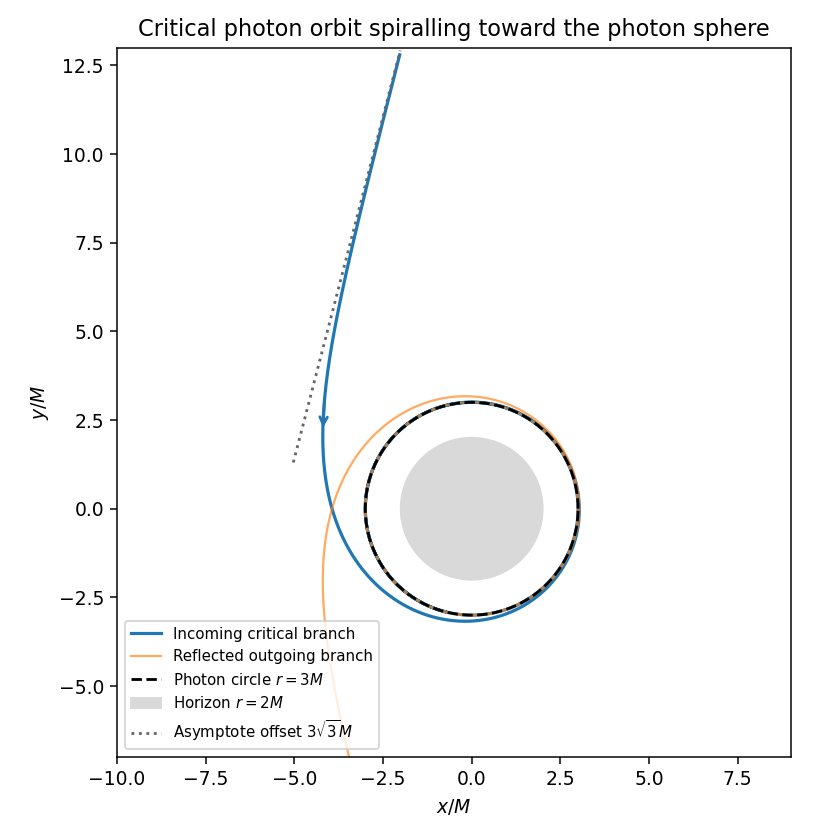


Near , . Thus , while . HenceThis is the perpendicular offset of the incoming asymptote and agrees with from the circular orbit. The orbit is the critical separatrix between scattering and capture.
There are unlisted articles, also show them or only show them.