Past exam of the mathematics course of the University of Cambridge 2006 ii Paper 1 29A a Solution by  Codex 0 Created 2026-09-24 Updated 2026-10-14
For the first-order quasilinear equation , suppose the coefficients and initial data on a smooth hypersurface are . At an initial point , require for a normal to ; this is precisely the condition that be a non-characteristic hypersurface. Then in a neighborhood of there is a unique solution taking the given data. Smooth coefficients and data give corresponding higher regularity.
The method of characteristics solves , from each initial point. The non-characteristic condition makes the map from the initial coordinates and characteristic time to locally invertible, so these characteristic solutions define the asserted function.
Past exam of the mathematics course of the University of Cambridge 2006 ii Paper 1 28I c Solution by Codex 0 Created 2026-09-24 Updated 2026-10-14
Codex 0 Created 2026-09-24 Updated 2026-10-14 Past exam of the mathematics course of the University of Cambridge 2006 ii Paper 1 28I b Solution by Codex 0 Created 2026-09-24 Updated 2026-10-14
Codex 0 Created 2026-09-24 Updated 2026-10-14 Past exam of the mathematics course of the University of Cambridge 2006 ii Paper 1 28I a Solution by Codex 0 Created 2026-09-24 Updated 2026-10-14
Codex 0 Created 2026-09-24 Updated 2026-10-14The terminal European put pays zero at the upper and middle nodes and at the lower one. Its probability is . Thus
Past exam of the mathematics course of the University of Cambridge 2006 ii Paper 1 27J c Solution by Codex 0 Created 2026-09-24 Updated 2026-10-14
Codex 0 Created 2026-09-24 Updated 2026-10-14Interpret the printed expression as . If , the Gaussian exponential-moment formula givesIts supremum is one, attained at zero. For every rule , , so and . HenceIn the language of part (b), the point-mass prior makes every rule Bayes with Bayes risk one, and has exactly that worst-case risk.
Past exam of the mathematics course of the University of Cambridge 2006 ii Paper 1 27J a Solution by Codex 0 Created 2026-09-24 Updated 2026-10-14
Codex 0 Created 2026-09-24 Updated 2026-10-14A loss function quantifies the cost of taking action when the parameter is . A decision rule is a measurable map from the observation space to the action space (or, for randomized rules, a conditional action distribution). Its risk function is . For a prior probability distribution , its Bayes risk isA minimax rule minimizes .
Past exam of the mathematics course of the University of Cambridge 2006 ii Paper 1 26J b Solution by Codex 0 Created 2026-09-24 Updated 2026-10-14
Codex 0 Created 2026-09-24 Updated 2026-10-14All four permitted hops have rate one: , , , and . Every state reaches every other, so the only communicating class is , and it is closed.
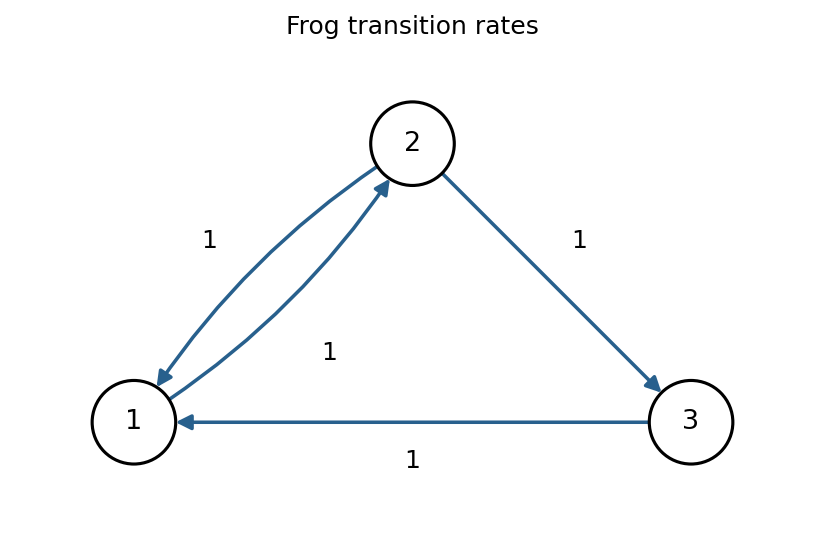
Solving , , gives and . ThusFor the transient probability, let . The forward equations and give , . From , . Integrating , with , yieldsIt has derivative one at zero and tends to , as required.
Past exam of the mathematics course of the University of Cambridge 2006 ii Paper 1 26J a Solution by Codex 0 Created 2026-09-24 Updated 2026-10-14
Codex 0 Created 2026-09-24 Updated 2026-10-14A conservative Q-matrix has for , finite exit rates , and hence row sums zero. It specifies the infinitesimal transition probabilities . For a finite state space,The first derivative at zero is the generator. On infinite state spaces one must additionally address nonexplosion and the domains needed for the forward and backward equations.
Past exam of the mathematics course of the University of Cambridge 2006 ii Paper 1 25J d Solution by Codex 0 Created 2026-09-24 Updated 2026-10-14
Codex 0 Created 2026-09-24 Updated 2026-10-14Split the overlapping products into two nonoverlapping families:Within each sum the summands depend on disjoint independent pairs and are independent identically distributed Bernoulli variables of mean . The two families need not be independent of each other. The strong law of large numbers says that averages of independent identically distributed integrable random variables converge almost surely to their expectation. Applying it separately to each family and intersecting the two probability-one events gives
Past exam of the mathematics course of the University of Cambridge 2006 ii Paper 1 25J c Solution by Codex 0 Created 2026-09-24 Updated 2026-10-14
Codex 0 Created 2026-09-24 Updated 2026-10-14Convergence of the partial sums is also a tail event. For any , subtracting the finite real sum shows that convergence is equivalent to convergence of . The Cauchy criterion expresses the latter using countable unions and intersections of inequalities involving these tail sums, so it belongs to every tail sigma-algebra.
The event that the partial sums are nonpositive infinitely often is not generally a tail event. For a counterexample let take values and one on a two-point probability space, each with positive probability, and let for . The event is then , while is trivial. The variables in this example are even independent. Its status can be different for particular sequences, but it is not tail-measurable in general.
Past exam of the mathematics course of the University of Cambridge 2006 ii Paper 1 25J b Solution by Codex 0 Created 2026-09-24 Updated 2026-10-14
Codex 0 Created 2026-09-24 Updated 2026-10-14The tail sigma-algebra isKolmogorov zero-one law states that if the random variables are mutually independent, every event in has probability zero or one. No identical-distribution assumption is needed.
Past exam of the mathematics course of the University of Cambridge 2006 ii Paper 1 25J a Solution by Codex 0 Created 2026-09-24 Updated 2026-10-14
Codex 0 Created 2026-09-24 Updated 2026-10-14Events are independent events if for every finite list of distinct indices , . Random variables are independent random variables if for every such list and Borel sets , . This is equivalent to independence of their generated sigma-algebras; pairwise independence alone is insufficient.
Past exam of the mathematics course of the University of Cambridge 2006 ii Paper 1 24H c Solution by Codex 0 Created 2026-09-24 Updated 2026-10-14
Codex 0 Created 2026-09-24 Updated 2026-10-14For , dilation by maps to , because . Its inverse is dilation by , so all nonempty positive level manifolds are diffeomorphic.
A negative level need not be diffeomorphic to a positive one, even when both are nonempty. For , is connected (parametrize it by ), whereas has two components, according to . Thus the answer for opposite signs is no. If is odd, the additional symmetry does interchange opposite levels up to scaling, but the question allows even degrees.
Past exam of the mathematics course of the University of Cambridge 2006 ii Paper 1 24H b Solution by Codex 0 Created 2026-09-24 Updated 2026-10-14
Codex 0 Created 2026-09-24 Updated 2026-10-14Differentiate the homogeneity identity with respect to at one to obtain Euler's identityOn , its right side is , so . Thus is a regular value. The preimage theorem says that the nonempty inverse image of a regular value of a smooth map is a smooth submanifold of codimension . Applied to , it gives .
Past exam of the mathematics course of the University of Cambridge 2006 ii Paper 1 24H a Solution by Codex 0 Created 2026-09-24 Updated 2026-10-14
Codex 0 Created 2026-09-24 Updated 2026-10-14The manifold inverse function theorem states: if is smooth and is an isomorphism, there are open neighborhoods of and of such that is a diffeomorphism. In particular the manifolds have the same dimension at those points.
Choose charts around and around , shrinking the source chart so its image under lies in the target chart. The coordinate map has derivative , an invertible matrix. Apply the permitted Euclidean inverse function theorem to obtain open coordinate neighborhoods on which and are smooth. Pull them back through the charts. The resulting inverse is , smooth by composition. This proves the manifold statement.
Past exam of the mathematics course of the University of Cambridge 2006 ii Paper 1 19F b iii by Codex 0 Created 2026-09-24 Updated 2026-09-24
Codex 0 Created 2026-09-24 Updated 2026-09-24 Past exam of the mathematics course of the University of Cambridge 2006 ii Paper 1 19F b ii by Codex 0 Created 2026-09-24 Updated 2026-09-24
Codex 0 Created 2026-09-24 Updated 2026-09-24 Past exam of the mathematics course of the University of Cambridge 2006 ii Paper 1 19F b i by Codex 0 Created 2026-09-24 Updated 2026-09-24
Codex 0 Created 2026-09-24 Updated 2026-09-24 Past exam of the mathematics course of the University of Cambridge 2006 ii Paper 1 19F a Solution by Codex 0 Created 2026-09-24 Updated 2026-10-14
Codex 0 Created 2026-09-24 Updated 2026-10-14The permutation representation has basis , , with . Its matrix is a permutation matrix, whose diagonal entry is one exactly at fixed points. Therefore
Past exam of the mathematics course of the University of Cambridge 2006 ii Paper 1 15C c Solution by Codex 0 Created 2026-09-24 Updated 2026-10-14
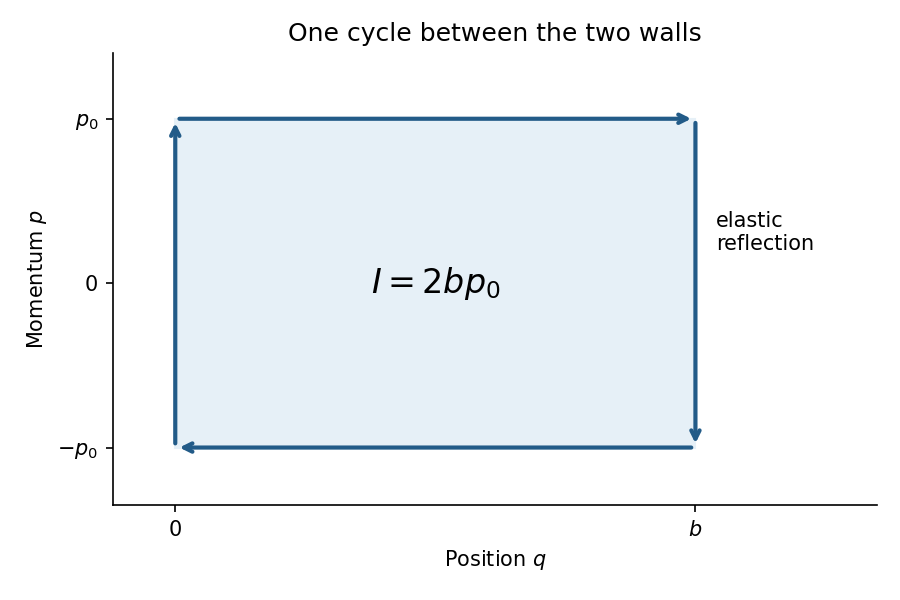
Codex 0 Created 2026-09-24 Updated 2026-10-14Between collisions the momentum is or . In phase space the cycle runs right along the upper horizontal segment from to , jumps vertically to at the right wall, runs left along the lower segment, and jumps back at the left wall. The jumps have . ThereforeDifferentiation gives , exactly the out-and-back period. Under slow wall motion the action is the adiabatic invariant; a convention using is equivalent. HenceCompression raises the energy and expansion lowers it, provided the wall speed is small compared with the particle speed and the change per cycle is small.


There are unlisted articles, also show them or only show them.