The de Hoffmann-Teller frame is a tangentially boosted shock frame in which the electric field vanishes. Ideal MHD then makes the fluid velocity parallel to the magnetic field on both sides.
For constant ,
Coordinate acceleration of a relativistic charged particle by  Codex 0 Created 2026-09-24 Updated 2026-09-24
Codex 0 Created 2026-09-24 Updated 2026-09-24For , the temporal component of the covariant Lorentz-force equation givesThe magnetic field does no work because .
In uniform perpendicular electric and magnetic fields, a charged particle's cyclotron orbit has guiding-centre velocityindependent of its charge and mass.
For a positive semidefinite trace ball , the quadratic-form hypothesis class isIts empirical logistic risk is convex as a function of .
For positive-definite Hermitian operators,The same statement on supports follows by regularizing with a positive multiple of the identity and taking a limit.
The natural logarithm is the logarithm with base Euler's number, and the inverse function of the real exponential function. A particularly geometric definition isFor , it is the area under the hyperbola from to . For , the reversed integration limits give a negative value. The fundamental theorem of calculus gives , so the natural logarithm is increasing, while gives concavity.
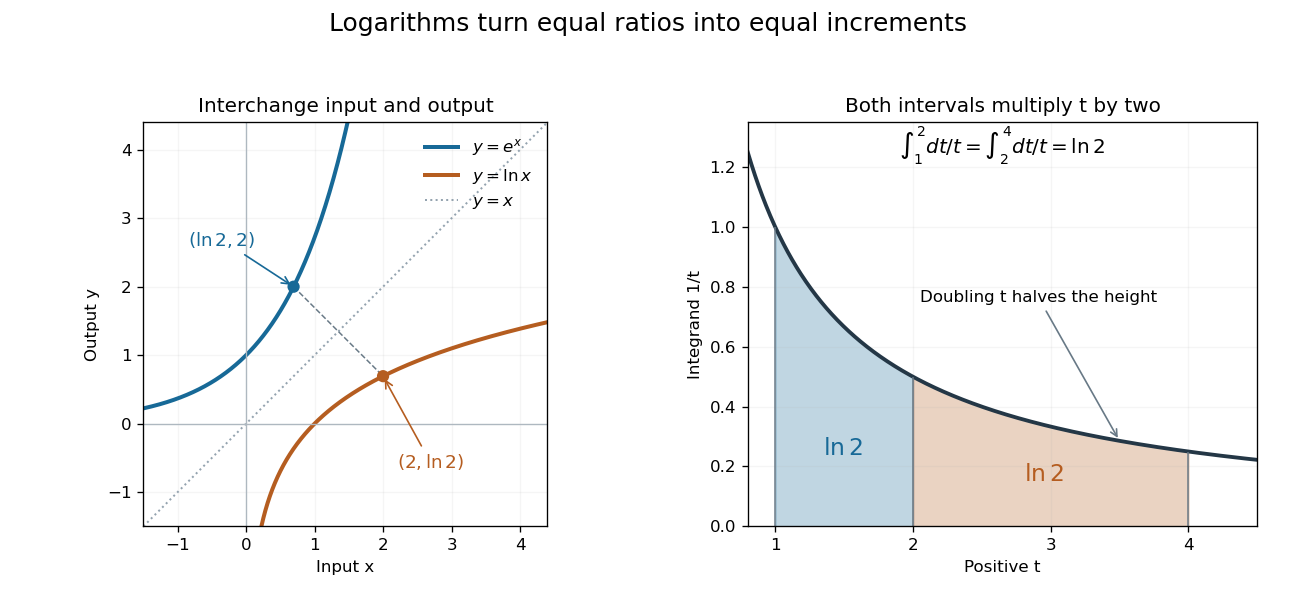
Exponential function and natural logarithm graphs reflect across ; equal multiplicative intervals have equal logarithmic areas
. Details. 
The change of variables shows for . Thus the intervals from to and from to each contribute area , explaining . Equal ratios give equal increments on a logarithmic scale, even though the ordinary differences grow. This makes the natural logarithm useful for comparing multiplicative changes and solving for time in exponential growth or exponential decay. The integral construction and inverse function properties are discussed in OpenStax, the natural logarithm as an integral.
A locally uniform limit of continuous real-valued functions is continuous. Moreover, local uniform convergence is uniform on every compact subset: choose finitely many neighbourhoods from the local uniformity cover and take the largest of their convergence indices.
A line bundle on a scheme is a locally free sheaf of rank one. Its global sections can define a morphism to projective space when they have no common zero.
Polynomial reproduction property of local polynomial regression by Codex 0 Created 2026-09-24 Updated 2026-10-07
Codex 0 Created 2026-09-24 Updated 2026-10-07Local polynomial weights of degree reproduce every multivariate polynomial of total degree at most : applying the estimator to its design values returns its value at the target point.
Effective kernel weights are the coefficients for which a local polynomial estimate can be written .
The local polynomial Gram matrix is the weighted matrix of inner products of the local monomial basis. Its invertibility makes the local fit unique.
For a finite conformal group action, choose a disc around each point that meets only its stabilizer translates. The local cyclic quotient chart , where is the stabilizer order, gives the orbit space a Riemann-surface structure and makes the quotient map holomorphic.
Local Artin reciprocity gives a continuous homomorphism with dense image. For every finite abelian extension , it induces an isomorphism
Let be a holomorphic function on , and suppose is an isolated essential singularity. There is a set with at most one element such that, for every and every , the equation has infinitely many distinct solutions with . Thus each nonexceptional value has preimages accumulating at in every punctured neighbourhood. The same possible exception works for all these neighbourhoods; it need not be a completely omitted value, since it could be attained only finitely often near . [ref]
https://terrytao.wordpress.com/2016/10/11/math-246a-notes-4-singularities-of-holomorphic-functions/. Terence Tao, Math 246A Notes 4 (2016), Theorem 57 and the following discussion
The basic example is at . It is a holomorphic function for , and its Laurent serieshas infinitely many nonzero negative-power terms, making zero an essential singularity. Its sole omitted value is zero. For the value one, its preimages are exactlyThey satisfy and . For any , every integer with therefore supplies a distinct solution inside .
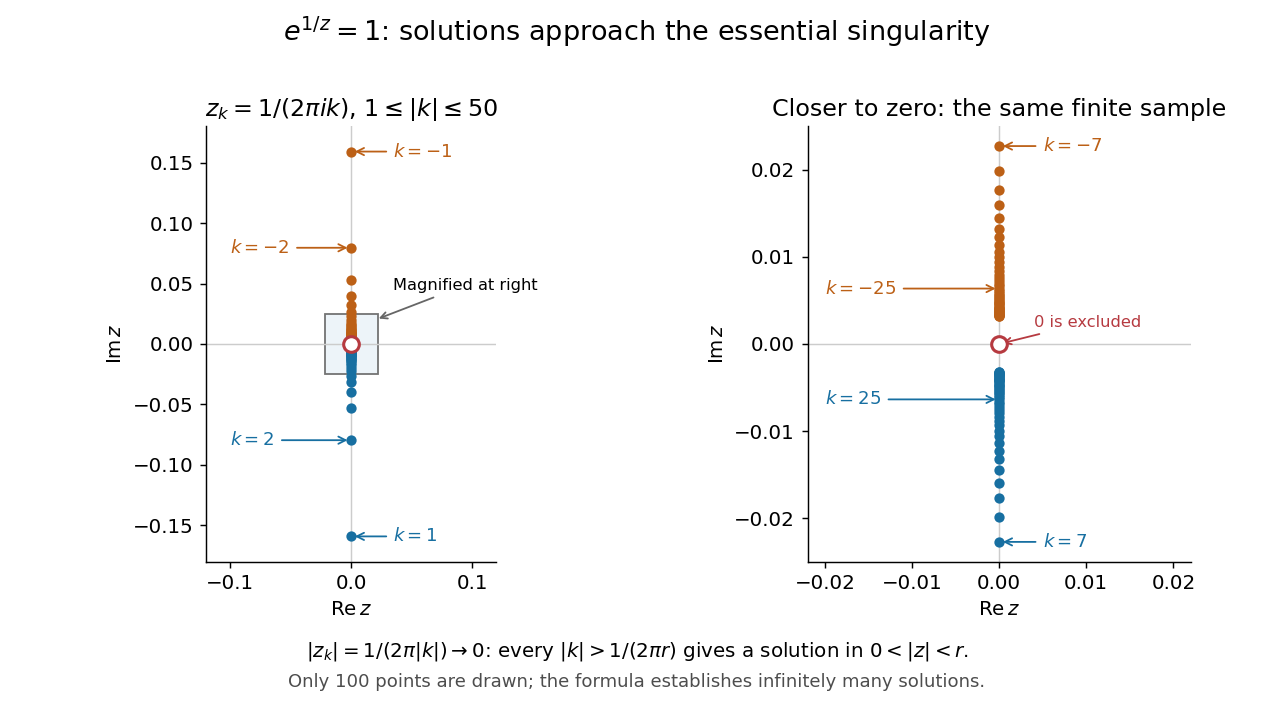
A finite sample of the preimages of 1 under exp(1/z), with a magnified view of their accumulation toward the excluded origin
. Details. 
The diagram displays only finitely many preimages; the formula and its limit, rather than the finite picture, establish that infinitely many occur in every punctured neighbourhood. More generally, for any , choose an argument of . All its preimages arewith any zero denominator excluded. Such an exclusion occurs only for , with exactly one excluded integer for the chosen argument. The remaining preimages are distinct and tend to zero as .
The isolated essential singularity hypothesis is crucial. The function has a pole at zero; on its image is only . It omits every value in the closed disc , and each attained value has just one preimage. A pole therefore has entirely different local behaviour from an essential singularity.
The Casorati-Weierstrass theorem says that the image near an essential singularity is a dense subset of the complex plane. The Great Picard theorem replaces arbitrary approximation by exact attainment, and then repeats that attainment infinitely often. This is useful when a local restriction on the image can rule out an essential singularity and reduce the possibilities to a pole or a removable singularity. For a meromorphic function viewed as a holomorphic map into the Riemann sphere, the corresponding statement has at most two exceptional sphere values, including infinity in the count; it applies when the map has an isolated essential singularity, even if poles accumulate there. Picard's 1880 memoir proves the local result in section 15, treating the cases with and without accumulating poles separately. [ref]
https://numdam.org/articles/10.24033/asens.187/. Picard, Mémoire sur les fonctions entières (1880), pp. 164-166
The Great Picard theorem also explains the Little Picard theorem. For a nonconstant polynomial, every value is attained by the fundamental theorem of algebra. For an entire function which is not a polynomial, the function has an essential singularity at zero: a removable singularity would force to be constant by the Liouville theorem, and a pole would force to be a polynomial. Applying the Great Picard theorem to leaves at most one finite omitted value for .
Energy dissipation identity for a linearly damped string by Codex 0 Created 2026-09-24 Updated 2026-09-24
Codex 0 Created 2026-09-24 Updated 2026-09-24 There are unlisted articles, also show them or only show them.