Critical damping is the repeated-root case of the viscous damping model: its two characteristic roots coincide at . The solution with arbitrary initial conditions isThe extra factor is essential: one exponential function alone cannot fit arbitrary initial displacement and velocity when the characteristic equation has a double polynomial root. Substitution, or taking the limit of the underdamped formula as its angular frequency tends to zero, gives the displayed expression.
The precise fastest-return statement is this: hold , , and fixed, and compare all . Every response decreases positively toward equilibrium; the critically damped responseis smaller than every overdamped response at each . It therefore reaches and stays within any specified band , , sooner than those responses. Exact arrival at rest takes infinite time. This is a comparison among nonoscillatory regimes for these particular initial conditions, not a universal minimum of every possible settling-time criterion.
One short comparison argument uses . Its initial conditions are zero and . For release from rest, at ; the causal Green function of a damped oscillator is positive at positive time for . Its convolution with gives : increasing damping beyond the critical value increases the remaining displacement.
There is no repeated oscillation at critical damping, but there can be overshoot once. For , the factor in square brackets crosses zero precisely when , atFor example, gives , crossing equilibrium at as shown above. An overdamped response can also cross once for suitable initial conditions. Conversely, specially chosen initial conditions can remove its slow exponential decay entirely. Thus the generic slow-root argument must not be applied to a response whose slow-root coefficient is zero.
In a rectangular box with Neumann side walls, a horizontal modehas horizontal wavenumber , depth dependence in infinitely deep fluid, and natural frequency .
For a constant coefficient system, eigenvectors split the homogeneous equation into scalar exponential or power-law modes.
Linear operators and on the same finite-dimensional vector space are conjugate when for some linear isomorphism . Their matrices in any fixed basis are similar.
A unitary operator on a complex vector space with an inner product satisfies and therefore preserves inner products.
Mapping matter and halos from their initial positions adds the matter displacement contribution, giving . Mass conservation requires the mass-weighted consistency relation .
A connected noncompact manifold is disconnected at infinity when the complement of some compact subset has at least two unbounded connected components. Equivalently, it has at least two ends.
The Jacobi identity is the compatibility condition on a Lie bracketTogether with an Alternating Lie bracket, it defines a Lie algebra. Unlike associativity, it relates three cyclic bracketings rather than equating two bracketings. Equivalently, using antisymmetry of a Lie bracket,Thus the linear map is a derivation of a Lie algebra: acting on a bracket is the sum of acting on each argument. This makes infinitesimal symmetries act consistently on each other's products. It also gives , the identity that makes the Adjoint representation of a Lie algebra a Lie algebra representation.
For the commutator in an associative algebra, the cancellation is directly visible:Each word occurs once with each sign. This proves the Jacobi identity without a restriction on the characteristic of a field.
For a computed check in the sl2 matrix commutator example,Here the last two terms are individually nonzero over characteristic zero; the identity records their cancellation. In the cross-product Lie algebra, the same cyclic cancellation is the vector triple product identity.
The historical connection is unusually concrete: Lie and Engel's volume I expands nested commutators of differential operators into twelve terms and cancels them cyclically, in Chapter 5, §26, equation (7). See Lie and Engel, §26, in Merker's translation, pp. 105–106.
The commutator of two elements of an associative algebra over a field isIt measures how much the order of multiplication matters: exactly when . It is a bilinear map, it is alternating since , and associativity makes it satisfy the Jacobi identity. Hence every associative algebra becomes a Lie algebra on the same vector space when equipped with this product. This holds in every characteristic of a field.
For square matrices, this is the matrix commutator, and it is defined even for singular matrices. The group commutator of invertible matrices is instead : it equals the identity element when the matrices commute, whereas equals the zero matrix. The Lie bracket from local group commutators explains how differentiation connects the two constructions.
Differentiation of an indefinite Lebesgue integral by  Codex 0 Created 2026-09-24 Updated 2026-09-24
Codex 0 Created 2026-09-24 Updated 2026-09-24A point is a Lebesgue point of a locally Lebesgue integrable function whenThe Lebesgue differentiation theorem says that almost every point is a Lebesgue point.
Let nonzero ordinals have leading exponents . If is finite, then has leading exponent . If is infinite, so that , then has leading exponent . This follows by multiplying the leading terms in Cantor normal form and using continuity of ordinal multiplication at limit ordinals.
A distributive lattice is a lattice in which meet distributes over join and, equivalently, join distributes over meet.
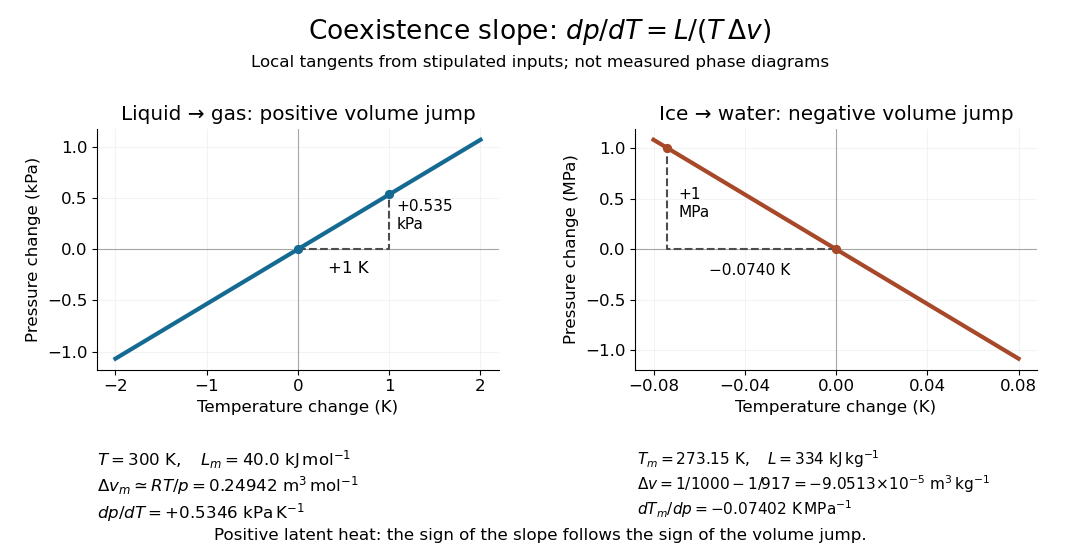
The Clapeyron equation connects the slope of a phase coexistence curve to the latent heat and the change in volume during a first-order phase transition. A steep boundary can indicate a large latent heat, a small change in volume, or both. This lets a measured boundary constrain caloric properties and predicts how changing pressure shifts a melting temperature.
For a pure substance in bulk phase coexistence, label the initial and final thermodynamic phases and . Both have the same absolute temperature , pressure , and chemical potential. With , , and denoting entropy, enthalpy, and volume on one common basis, define , , and . ThenThe derivative follows the phase coexistence curve; it is not a partial derivative within one thermodynamic phase. Use molar volume with molar latent heat in , or specific volume with latent heat in . Both give in . For molar mass , and , so the predicted slope is independent of the chosen basis. This formulation assumes a simple compressible system, fixed composition, and negligible interface contributions; a curved interface can instead require the Young–Laplace equation.
For positive latent heat in the stated conversion direction, the sign of the slope is the sign of . Converting liquid to gas normally increases volume and gives a positive slope. The negative melting-point slope of water illustrates the opposite sign. At a thermodynamic critical point, the coexisting gas and liquid merge: both and vanish, so their ratio needs a limiting analysis rather than substitution of zero into the Clapeyron equation.[ref]
Statistical Physics by David Tong. §5.1.2, equation (5.185) and the discussion of the critical endpoint

A short derivation uses the molar Gibbs free energy , equal to the chemical potential for a pure substance. Equality persists along the boundary, so with . Therefore . Equality of also gives . Eliminating yields the Clapeyron equation.
There are unlisted articles, also show them or only show them.